Category Archives: Archives

Newspapers & Other Periodicals

Kay Francis Lives Here

KAY FRANCIS LIVES HERE

Originally appeared in the October 1939 issue of House & Garden.

Kay Francis is a connoisseur. Long noted as Hollywood’s best dressed actress, she find further expression for her superb good taste in her new home in the Santa Monica foothills, near Beverly Hills.

It is a low, rambling house, of white brick, gray roofed, commanding from its mountain-top site an incredible spread of surrounding hills and sea. A bricked terrace caters both to this wide view and to the well-known Californian penchant for outdoor living.

Inside the house, one color—gray—is used throughout, creating a brilliantly sophisticated scheme highly complementary to Miss Francis’ own distinguished tastes. This soft shade carries through every room—even on the terrace, where the chairs wear gray outdoor linen. In the living room the basic tone is enlivened by rose, mauve and emerald green; in the dining room it is accented with pink and in Miss Francis’ bedroom with yellow. Levine & Frederick, architects; Tom Douglas, decorator.

houseoutside


housediningroom


houselivingroom


housebedroom


housepowderroom


houseterrace


Archives Main Page

A Bad Girl Makes Good

A BAD GIRL MAKES GOOD: Hitherto Unrevealed Facts About the Devastating Kay Francis Who Started as a Siren and Is Becoming Better and Better

By Radie Harris
SILVER SCREEN, February 1931.

SHE looks as volcanic as Mt. Etna during an eruption. And is as calm as a lake on a clear day.

She looks like a brunette Peggy Joyce. And doesn’t even own a diamond bracelet.

She looks like the daughter of a thousand earls. And was born in Oklahoma City.

Her name is Kay Francis.

It was during the first talkie boom that Kay took the trek west to find gold in them thar microphones [webmaster’s note: ‘thar’ is appeared as in original text]. She’s been Hollywood’s ultimate gasp ever since. Men swoon when she enters a room and women sidle close to learn the recipe. To Kay, it is no novelty. Life has always been like that!

Long before she ever dreamed of becoming a “moom pitcher” star, Kay, without lifting a single eyebrow or exposing a bare knee, vamped more men than Theda Bara in her “kiss-me-my-fool” hey-day.

Kay, herself, has never been too susceptible. But when she does “fall”, it isn’t a plunge—it’s a nose-dive!

Her first “heart” was the young man whose last name she now emblazons in electric lights—Dwight Francis. She me him shortly after she had graduated from Miss Fuller’s School as Ossining. It was the case of love at first sight that culminated in a large wedding at the very swanky St. Thomas’ Church in New York.

Although he was heir to the Francis millions, all his rich relatives were very much alive, so Dwight took his bride to Pittsfield, Massachusetts, where realtors told him that two could live as cheaply as one Kay went domestic in a Big Way and so help my Aunt Sophrosia, loved it! She did all her own housework—including the cooking and laundry—and the residents of Pittsfield will vouch for the fact that she looked as beautiful in her ginghams and denims as she does in her silks and satins now.

After almost two years of happiness, there was a rift in the marital lute. Kay sailed for Europe and a divorce. She spent the next few months exploring England, France, Holland, and Belgium. Few of Kay’s friends know that she was entertained by crowned heads everywhere. No interviewer has ever heard the story. It is part of Kay’s modesty that she doesn’t like to publicize anything that might be associated with “putting on the dog.” It was just by mere chance that I happened to hear about the time she dined with Queen Wilhemina in the Royal Palace at The Hague and when she found herself confronted with the problem of deciding which knives and forks to use out of the vast array at her place, she solved it by asking the Queen herself!

Returning home to America, Kay encountered a very bad crossing. One night during a particularly heave storm she remained up on deck. Leaning against the rail, looking out at the fathomless sea below, she suddenly felt free—indomitable, self-confident. Then and there she decided to become an actress. Ten days later she was playing on Broadway in the modern clothes version of “Hamlet.”

True, she had often thought about going on the stage before, but her mother, Katherine Clinton, a former vaudeville and repertory player, had been so strenuous in her objections that she had turned to other vocations instead—secretarial and modeling being included among the list.

Kay loved to tell the story of her first day as a model. She regaled me with it when I lunched with her not very long ago.

“I had been spending the weekend visiting friends at Southampton and arrived in town early Monday morning just in time to check in on my new job. Everything went very smoothly all day and I was just congratulating myself on my quick adaptability when six dressed were reported missing from the racks. Of course, no one accused me BUT…I was a new girl…I had arrived that morning with a valise…the evidence was all against me. If I had stolen the entire store I couldn’t have felt—nor looked—more guilty. I was so embarrassed I never went back. I’m sure to this day they suspect me of ‘taking ways.’”

Right about this time Kay fell in love again. This time with Allen Ryan, Jr., of the Social Register Ryans. They became engaged and Kay flashed a solitaire large enough to illuminate Madison Square Garden. But Allan and his family objected to Kay’s continuing career. And Kay was just beginning to become really interested in it. Besides, she knew that she could never stand the boredom of a Park Avenue matron’s life. So she returned the ring (which, is not according to Lorelie Le a’ tall a’ tall!) and took up bachelor girl quarters with her two friends, Louis Long, the present Mrs. Peter Arno and Katherine Swan, now on the scenario staff at Paramount Pictures.

They didn’t live in Greenwich Village, but they were poor and struggling “artists” just the same—their combined earnings just managing to meet the monthly rent. Lois and “Swannie” were always trying to marry Kay off a dozen or more of the millionaires who wrote off the welcome on her doormat every night. Neither of them had much confidence in her acting ability and felt that with her beauty, a brilliant marriage was her métier.

All this happened B.T. (before talkies) so pictures never occurred to any of them. Long before, Kay had taken a silent test for the vamp role in “Sorrows of Satan”. She wore a blonde wig. The result was enough to make Kay vow that she would appear on the screen again. Instead, she went to Cincinnati and joined Stuart Walker’s stock company, the kindergarten of all first-grade players.

After serving a rigid apprenticeship of two seasons, Kay returned to Broadway and appeared in “Crime” with Kay Johnson, Chester Morris and James Rennie and in “Elmer the Great”, with Walter Huston.

It was during the run of this play that Paramount was combing the town for someone to play the female menace in “Gentlemen of the Press”. Kay was approached for a test. She turned it down in polite, albeit no uncertain terms. Her unfailing memory recalled all too vividly the nightmare of her first test! Paramount pleaded and cajoled and Kay hedged with all sorts of excuses—broken ankles, sprained ribs and even housemaid’s knee. It was Walter Huston’s persuasive powers that finally won her over. She appeared in “Gentlemen of the Press”, vamping with sound.

When Kay first went to Hollywood, she was determined to save her money. She rented a small bungalow in Beverly Hills. A colored maid, Ida, was her only accessory.

Other actresses returned to Broadway flat broke Not Kay! In less than a year she had saved a tidy sum. She still lives in the same bungalow and still has the same made, although her living expenses have since increased by one yellow Ford coupe, called “Rabbit” because it goes into leaps and bounds; two Persian cats, “Mitzi” and “Tibs”; a canary named “Napolean”; a Boston Bull christened “Caesar”; a wire-haired terrier whose godfather is William Powell and whose name is “Sniffer”; and seven fish—known as the Seven Vestal Virgins.

Although she has the reputation of being one of the best-dressed women in Hollywood, Kay doesn’t spend half her salary on her wardrobe. She never makes an “entrance” and yet, when she enters a room, she is immediately the cynosure of all eyes. Everything she does is effortless—with no striving for effort.

Shoes are her greatest hobby. At the last census there were more than 75 pair. She doesn’t own any diamonds and never wears anything in silver and platinum. Despite her brunette beauty, she claims she is a “golden” girl.

Although she is on every host and hostess list in Hollywood, she doesn’t go in for a continual round of parties. She has a small group of friends, the John Cromwells (Kay Johnson), the Arthur Hornblows, the Louis Bromfields, the Edmund Lowes, with whom she likes to dine informally.

She adores music. When she was a child it was her mother’s fondest hope that she would be a genius of the piano. Kay wanted to be a trapeze artist and wear pink tights. Both have since recuperated from their respective disappointments. Kay now occupies a box at the Hollywood Bowl during the summer months and at the opera during the season. Her escort on the musical evenings is usually Mrs. Mackenna’s little boy, Kenneth.

Kay’s cup would be overbrimming now if she could only see New York again. She hasn’t been back for almost two years and no anodyne but a return trip will cure her nostalgia. She is hoping that in a very important future she will be allowed to make a picture at the Paramount New York Studios…and then excuse her dust!

Many of Kay’s friends, however, crossed the desert sands to help assuage her homesickness. They report that she is still the same Kay—sweet, unspoiled, unaffected, evidencing no traces of “going Hollywood.” This, in the nature of things, is not surprising. Popularity and adulation have always been hers and her grand sense of humor would never allow her to take herself too seriously. In other words, she doesn’t think she is important.

Which, really, is the most unimportant thing about her.

Archives Main Page

Kay Francis Fights for Her Glamour

KAY FRANCIS FIGHTS FOR HER GLAMOUR
By Norman Payne.

Originally appeared in Pictuegoer Weekly
June 25, 1938.

fightsforglam1


CAN a Hollywood glamour queen play “mother”? Without losing her glamour I mean. We all know she may play fathers as she likes—play them for all they’ve got as you may say—without losing an inch in moral stature out of Hollywood way. But the moment she becomes, one the screen, an ordinary common or garden mother, she drops in Hollywood’s estimation from the realm of sex and beauty to the basement level of shop-spoiled goods.

You may feel like picking a quarrel about all this, but if you do, pick it with Hollywood and not me. I know how I feel about mothers who feed their families, work cheerfully in their own homes and mind their own business. I can’t think if it Hollywood considers them rather too ordinary to be glamorous, or even interesting. I wouldn’t have brought up the matter at all, but for the fact that it places, right up on the table, a nice little Hollywood problem story. You out to know about it. Especially if you like Kay Francis.

For Kay Francis is fighting a silent bloodless battle against the political tyranny of Hollywood. She is striving bravely to retain her glamour and play a screen “mother” at one and the same time. Oh, I know quite well that she has been a film mother before. Several times in fact.

But she hasn’t been a kind of middle-aged grass-widow with four huge children. Especially in what Hollywood calls a “B” picture. When the Hollywood producers label a picture “a ‘B’ effort” they aren’t being even in the mildest bit blasphemous, although it often seems to amount to the same thing. They merely admit that it is not a film of the tip-top class in the sense of cost.

fightsforglam4Sometimes—frequently, in fact—they happen to discover after the picture has been made that it is much better than one which cost them four times as much. At such times they cough uneasily, reach out for the cuspidor and the telephone. The phone is to tell their publicity departments to spend more money putting over the expensive film, and “pipe down” on the “B” picture in case the wrong one succeeds most at the box offices!

However, that is getting into Hollywood politics; deeply I mean. Actually we have to uncover a few political irons to get to our story which is interesting enough as an example of what can happen in the mad scramble for film fame and fortune.

It has never been settled which came first, the chicken or the egg. Neither has anyone ever proved whether film stars came as a result of good screen plays or good screen plays as a logical result of film stars.

On this reckoning, who can say whether Kay Francis first flashed to fame on the strength of a good screen yarn, or whether the actress which is undoubtedly in her, made the public fall for her until she passed from a $100 a week actress to a $850 a week star [webmaster’s note: this was a 1938 British magazine; those figures are in pounds, not American dollars].

Kay thinks it is a safe bet that whether or not a star is made famous by any particularly lucky performance in any specifically suitable story, if she is to remain famous she has to get a fair sprinkling of good roles in reasonably credible stories. That was the jagged rock of contention upon which she came to grips with the Warner Brothers. She began to struggle so hard that she toppled off that same rock into rather dangerous waters. How she will come out—or whether she will—remains to be seen.

Over a year ago Kay told me over tea one day that she would feel happier if Jack Warner would permit her occasionally to go to some other studio to make a film. “I have been here at this Warner studio so long I must have gotten into people’s hair. It works this way, you know. After a while a kind of personal machine builds itself around a star limited to working in only one studio. Largely the same writers work on her scripts; the same handful of director are assigned to her films; the same “front office” conditions bear on each film she makes and even the same designers do her gowns. She is apt to become a ‘stock’ property. There is less opportunity for her to break new ground occasionally and that I what any star has to do if she is to keep on year after year.

“I got a spell of suffering mother roles until I was driven almost mad. But the studio people said ‘this is the kind of stuff the public wants from you, Kay; look at the returns from the box offices.’ Well, I argued that a change would send those figures still higher. Even if it was me the public so kindly went to see, there was a limit to the number of times a certain type of story or motif could be repeated.”

That was the way Kay felt about things.

Warners, on the other hand, said: “We are not going to loan Kay Francis to any other studios. We have made her what she is and we pay her one of the top most salaries any Hollywood star ever got. Why should we ‘cut in’ any other producer on our profits? Kay Francis is our A1 star and she will appear in only our own productions.”

Just when the Warners came to the conclusion that Miss Francis could no longer be fairly described as their “A1” star, no one in Hollywood seems quite sure, but it is not secret history that just over a year ago she began to rail furiously against the stories the studio was giving her.

fightsforglam2Such pictures such as I Found Stella Parish hadn’t kept up the merry tinkle at the box office, said the Warner executive [webmaster’s note: Stella Parish did poorly abroad, but was a massive success in the US, which prompted Jack Warner to give her a raise before her old contract even expired]. To which Kay was apt to reply, “Do you wonder?” Perhaps you agree with her. But then no sustained improvement followed. The Kay Francis picture began gradually to lack the startling dramatic quality it had always had when she first emblazoned her name among the leading glamour stars of Hollywood. Another Dawn was just another story; Confession, a poor imitation of something once acclaimed as the great screen-play Mazurka.

By the time First Lady arrived and Kay was shown as only Americans can be, statuesque and chipper in high social circles, just like a Park Lane mannequin who suddenly had become wife of the President of the U.S.A., we began to feel certain something had gone seriously wrong somewhere. Though it was a change to see Kay Francis as a chatty, wisecracking society dressmodel—that’s really all she was although her husband was supposed to really be in the running for Presidency—we began to feel in sympathy with Kay herself when she had said, “this is a devilish lot worse than playing sob stuff.”

Kay grew daily more and more bitterly opposed to starring in expensive disappointments.

The Warner Brothers argued it was not their fault if her films were not as good as they used to be.

Kay replied that it certainly wasn’t her fault, either.

Somewhere a doubt crept in.

Suddenly the Warner Brothers announced that Kay Francis would star in a couple or three “B” class films.

Hollywood was stunned. What at 4,000 dollars a week? Doing the kind of story usually gave to a young actress waiting to be stars and drawing perhaps less than 400 dollars a week? What the dickens? Would Kay Francis stand for that? Wouldn’t she most likely walk out on the Warner Brothers? Hollywood held its breath.

Then the miracle happened. Flame scorched dynamite but there was no explosion!

Kay Francis who through the years of her fattest Hollywood success has not earned the reputation of being one of the easiest stars to get along with, was as docile as a child.

She had never been especially temperamental but she hadn’t been too ready to see the Press; she had a trace of that Garbo habit about her. Now she was changed. She received the Press with open arms. And when she talked to the film writers she said not one single word against this new Warner idea that she should star in cheap films. When the news went round Hollywood that her first “B” class role would introduce her as a mother with a daughter almost old enough to be married, and several other children besides, people wise to the wonderful ways of filmtown gasped and said, “de-glamourising her, eh?” Kay didn’t turn a hair.

She announced that as and when her present contract is through—in September of this year—she will marry Count Erik Barnekow.

“After that,” she added, “I shall place career second to personal peace and happiness…where it belongs.”

Kay definitely has declared she will sign no new contract with Warners. It is a forgone conclusion that if she were to negotiate such a contract, she would not be offered her present salary over a long period unless Warners had plans once again to take her out of “B” class films and put her back among their avowed glamour stars.

fightsforglam3But the fact that Kay will not again sign a long-term contract with Warners—nor probably with any other company—doesn’t mean she will carry out her threat to become “nothing but a good housewife.” She will sign up picture by picture, as when she can do so with a certain conviction that the story she is going to make will be as good for her career, as her cooking may well be for the Count. Hollywood may have its own peculiar standards by which to judge the virtues of womanhood. But Kay Francis, woman of the world, traveler, ex-political-secretary and glamour star, knows that the outside world—particularly the women of the outside world—often refuses to be bamboozled by publicity into accepting Hollywood standards.

Kay intends to show, not only that she can stand her ground and do her bit of acting just as well in a $30,000 picture as in one which costs $200,000, but that she can play a real woman—a family woman—and still keep her glamour.

One of the cheap films Warners have cause Kay to make is titled, tawdrily, The Secrets of an Actress. Hollywood said, “That’s a nasty title.” Kay said, “If I am an actress my secret will be revealed about next October.”

What is that secret? That she will, after all, retire every from the screen?

Or that she has designed a plan whereby to regain her place among the most highly paid and highly popular “glamour” women of Hollywood?

Is she going to prove to the world once and for all, that feminine beauty, grace and charm, said to be inherent in the glamour women, can survive motherhood and even the drudgery of the kitchen? As a bride for the fourth time, will Kay Francis prove that glamour is not made of the stuff women pack away with scented orange blossoms and brides dream about as part of a past and faded glory?

Archives Main Page

Vamping with Sound

VAMPING WITH SOUND:
Regarding Kay Francis, the First Menace of the Talkies

By Leonard Hall
Originally appeared in the October 1929 issue of Photoplay.

NOT so long ago a long-legged, short-haired, frank-eyed girl stepped boldly upon a big sound stage at the Long Island studio of Paramount Pictures.

Her name was Kay Francis (Katherine for short), and for three brief years she had strutted upon the speaking stage. Never in her life had she stood unarmed before a snarling motion picture camera.

Director Millard Webb said, “One, two, three, go!” She went! The next day, two things had happened.

First, Kay Francis, as the snaky secretary in “Gentlemen of the Press,” had given one of the most astonishing performances in the history of motion pictures.

Second, she had appeared, in a blaze of glory, as the first great vamp of the audible pictures, using a type of male-killing technique that is perfection itself for the new form of entertainment.

Movies go and talkies come, but screen sirens must and will go on forever. Sound or silent, there is always a menace in skirts that must stand between the fine young hero and the sweet young heroine before the last reel.

The styles in screen vamping have changed with the times, hats and skirt lengths.

The old school of cinema siren, incarnate in Theda Bara, is no more. It’s rough and tumble, catch-as-can style of attack will never do for talking pictures, for its physical and vocal acrobatics would sound like a fox in a hen yard in the ears of the demon microphone.

The modern, up-to-date man-killer of the screen must be a far smoother and more seductive article. A come-hither look and a provocative rolling of the eyes and hips must do the work that the half-nelson and strangle hold performed in the dear old days.

AS the first great practitioner of this new school, as shown by her work in “Gentlemen of the Press,” Kay Francis stands alone.

Others will come, do their dirty deeds, and pass, but as the pioneer of the clan, Miss Francis will occupy a sizable place in this yet unwritten history of the talkies.

If you have already seen her first picture, you are acquainted with Kay’s methods. If you aren’t, here’s a brief explosion of vamping technique, 1929 model.

Instead of circling her male prey looking for punishing hold, she stands still, fixing the victim with a steady gaze that half repels, half commands. As she takes her stance close to the unhappy male, there is an air about her that said, “Well, you fool, take it or leave it,–but if you leave it you’re an idiot!”

Fascinated by the attitude of the siren and utterly undone by her compelling charm, the poor fellow has no more chance than a rabbit transfixed by the eye of a cobra. Unless he falls dead of heart failure, or the house is struck up by lightening, he is a gone coon.

KAY FRANCIS’ work in “Gentlemen of the Press” was great, not so much for what she did as for what she left undone. She made no passes at the unlucky Walter Huston—she merely exerted every cubic ounce of her fascination and let nature take its course. And so she stands forth as the forerunner of the perfect vamping technique for the talkies.

It didn’t take the smart talent at Paramount long to see what they had in Kay Francis when they looked at the rushes of her scenes.

The projection machine had hardly stopped whirring before they had her Jane Hancock on the dotted line of a long term contract. Before she caught her breath she was aboard a fast train bound for the Hollywood foundry of Paramount. Still gray with desert dust, she was hurtled into the latest Clara Bow Production, “Dangerous Curves,” and what she did to the unsuspecting Dick Arlen, in that picture, will be everybody’s business when the world sees it.

Even while the cameras were grinding on the Bow film, Paramount was planning to shoot its newest find into another picture called “Youth Has Its Fling.” The “Youth” referred to is a handsome young newcomer named Phillip Holmes, twenty and new to the world. And he will fling into those scenes in which he runs head on into the terrific, demanding fascination of the tall, handsome Francis Girl.

And then Heaven help young Mr. Holmes, for only Heaven can!

WHEN I talked to Kay Francis, she was sitting in the living room of her little Hollywood bungalow—and I kept my distance, too.

I remembered only too well what had happened to Walter Huston when he came within that fatal radius of her charm.

She had just finished the long, horrible grind of the Bow picture. Night shooting, to avoid off-stage noises—until three or four in the morning.

She hadn’t seen Hollywood, she hadn’t had any fun.

But she was in her second big film, her third was planned, and she was happily hotfooting it for fame and fortune.

TIMID as I was, I thought I could manage a question or two.

“Do the camera and ‘mike’ scare you?” I asked.

“No,” said Miss Francis, “what is there in a ‘mike’ to scare you after you are used to 1,500 people? And once you get used to observing the camera lines by instinct, there isn’t anything to worry about.”

At that, I couldn’t imagine a sill old camera scaring this big, self-possessed gal. She is the type that frightens the old guard of silent picture actors into fits.

No wonder, when, after they have made a Great Mystery of the Art of Acting before the Camera, they see this untried girl step before one and give a motion picture performance of the very first rate!

“Do you miss the theater?”

“Yes, I miss it some, but this is a great chance for me, and everyone at Paramount is swell to me, and I’m happy. Will you have a dash more of that ginger ale?”

“I Will. And do you enjoy knowing over helpless members of my poor sex?”

“I’ve placed menaces right along, and I suppose I’ll have to, for a while. But I’d like to do sophisticated heroines.”

Sure—and she probably will, too. But the world reeks with heroines, while there are only a few superb demons like Kay Francis. What could Eddie Foy have gotten by playing Hamlet?

But this had gone far enough. Again I thought of Walter Huston and Dick Arlen and young Holmes, and shivered.

“Well, thank you, Miss Francis,” I stuttered. “I guess I’ll have to be going now.”

“Do have just a touch more of this ginger ale,” she said, leaning forward.

“No thanks!” I really must be moving,” I said, and rushed out the door, falling the last two steps and pursued by a gust of merry laughter, but no applause.

That was the finale of my interview with Kay Francis, the first great vamp of the talking pictures, and standard bearer of the new come-hither school.

If you come within gunshot of her tremendous fascination, take my advice and follow my example—get on your bicycle and pedal away with no back looks.

Run, do not walk to the nearest exit.

Remember what happened to Walter Huston!

Archives Main Page.

The Chicago Tribune

The Chicago Tribune

One of the very few of the major newspapers to have their archives available online for free public viewing!

Official Website.
Wikipedia info.
Digital, online, free archives.


1932, August 11. “DASH OF VIDOR NOW APPEARS AT ALL STUDIOS: A New Director of That Name Signs Up.” George Shaffer.

Kay Francis owes her start in pictures to the fact that Lilyan Tashman has been so busy for four years. Kay came west from New York; was used in one role that Lilyan had been compelled to reject because of working in a second, and pretty soon Miss Francis was working in several films that had been cast with Miss Tashman in mind.

[Article covers different studio news.]


1934, December 20. “Kay Francis, Dietrich Visit Chevalier Set” By George Shaffer.

HOLLYWOOD, CAL., Dec 19. The afternoons on the set where Maurice Chevalier, with a new and spiky little mustache, is humming and smiling his way through the hearts of various ladies in “Follies Bergeres de Paris” have been enlivened all week because two of the girl friends from other studios dropping in to watch how Maurice does it professionally.

On Monday afternoon it was Kay Francis who dropped in on the French light comedian and flashed the full force of the dazzling Francis smile on the Frenchman. On Tuesday it was Marlene Dietrich who drove from her studio to pay Maurice a visit. Loretta Young dropped onto the set another day.

[Article does on about Dietrich and Merle Oberon.]


1935, July 3. THROUGH THE LOOKING GLASS by Eleanor Nangle.

archive5HOLLYWOOD, Cal.,–You can take it from Perc Westmore, who should know, seeing as how he’s make-up director of Warner Brothers, that picking up your usual lipstick, slathering it on both upper and lower lips, then tilting your bonnet and going about your business isn’t making the most of your makeup.

Mr. Westmore has a theory about lip adornment. For those beauteous creatures he makes up for the screen as well as for those of us who are concerned only with street makeup he advocates lip rouge one shade darker for the upper lip than for the lower one. This, he says, creates composition and does away with the unfortunate effect of a pointless blob of red. You’ll notice that the Warner Brothers stars are all made up in this fashion—and if you try the effect on yourself you’ll realize that there’s sense to it.

Mr. Westmore is all for the natural effect in makeup. When he declared that the one thing he hates more than his worst enemy is a plucked eyebrow we could have embraced him. He wishes all women would keep the brows they are born with. He asks us to keep them well groomed, to be sure, but not to get the notion that we’re smart little improvers on nature just because we know how to wield a tweezer.

He thinks Kay Francis is just about perfect, although to his sorrow she’s lately tinkered with the tweezers. She’s the makeup man’s pet because there is no need, with Kay, to do more than accentuate the good looks the Lord gave her. There is no necessity for tricky camouflage.

And Westmore has loads of sound theories about the inner spirit that invariably reflects itself in faces. What distresses him perhaps more than anything else is the sight of a face made vapid or coarse by an unintelligent makeup. This is the sort of mistake women make, he thinks, when they start out on the wrong foot of trying to look like someone else—perhaps the siren they like best in movies. Westmore belongs to the “Be Yourself” school of makeup thought.


1938, January 5. “LOOKING AT HOLLYWOOD” by Ed Sullivan.

Hollywood, Cal. Jan. 4—The Jim Cagney-Warner reconciliation, which came true as predicted in this space weeks back, is interesting from a clinical view-point because the walkout, as differentiated from the sitdown, always has been considered a logical weapon on the part of a movie performer.

The rows are always about two things, money or roles. The later reason motivated Kay Francis’ lawsuit, Kay’s ire being aroused when the “Tovarich” role was given to Claudette Colbert. Miss Francis recently withdrew her suit, undoubtedly because of representations that fatter parts were in the immediate offering.

[Article covers further Hollywood news.]


1939, August 17. “LOOKING AT HOLLYWOOD” by Ed Sullivan.

It’s a big year for the veterans, too. The town has been tremendously interested in the comeback campaign of Kay Francis. The Francis eyeful in an attempt to win her way back to the pinnacle she once occupied, deliberately accepted one of the heaviest parts of the year in “In Name Only.”

I saw her one night at the Trocadero with Louis Bromfield and she was telling him about the role. “The part of the wife who keeps Cary Grant and Carole Lombard apart is a mean assignment, but I’m risking everything on it clicking.”

Judging from the critical raves throughout the country, Kay’s gamble worked out. Marlene Dietrich, another glamour girl whose stock was on the downgrade, makes her try in “Destry Rides Again.”

[Article covers further Hollywood news.]


1939, September 17. KAY FRANCIS—THE GIRL WHO MADE A SCOLDING PAY by Ed Sullivan
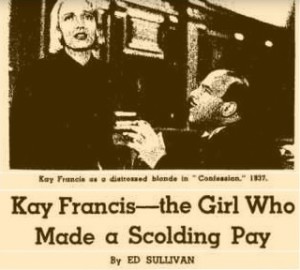
scalding1JUDGING from the press comment of the nation, the comeback of Kay Francis has met with more than considerable success. Miss Francis, you will recall, closed out a long career at Warners’ in the dog-house of studio disapproval. In her last months at the studio she was reduced from “A” pictures to a diet of B’s.” The idea was that the haughty brunette star would become so piqued at this professional insult that she would tear up her contract and walk out of Burbank in high dudgeon. Instead Miss Francis, showing admirable self-control in the face of demotion, worked out her contract, collected all of the emoluments included in its fulfillment, and then started looking for another job.

scalding3RKO offered her a role in the Carole Lombard-Cary Grant flicked, “In Name Only.” They tendered it rather apologetically, because it called for a characterization so unsympathetic that few actresses wooing the public in favor would dare to play it. “I’ll play it,” said Kay. She played it, played it to the hilt, and it is as a result of her role and her handling of it that she has won a new lease on Hollywood stardom.

scalding2It has been offered in evidence that Kay Francis has always been an unusual personality in Hollywood, that she has retarded her on success by arbitrary attitudes and alienated the help of important people. There is a lot of truth in it. But I think she probably inherited it from her dad. He was a man of strong convictions and original ideas.

Her dad, a promoter with magnificent visions, had long regarded the growth of American polo with speculative eyes. He was fascinated by the thought that if anyone could secure a monopoly on the source and supply of polo ponies that man would be independently wealthy. Communing on this and related matters, Kay’s father learned that the chiefs of a certain tribe of Indians in Oklahoma were in a mood to dispose of all their ponies. Instantly he conceived the idea of buying all these Indian ponies and introducing that strain in polo.

scalding4You can imagine what the mother, in a delicate condition, thought of this zany scheme. But the father was resolute and an eloquent talker. The Indian chiefs, it developed upon arrival at Oklahoma City, did not want to sell their ponies. So Kay’s father, broke by the expenses of the trip west and compelled to make immediate arrangements for the arrival of Sir Stork, talked himself into the management of an Oklahoma hotel. It was there that Daughter Kay arrived.

With such a background of impracticability surrounding her arrival it is not strange that we find Kay, her first stab at the professional stage, glibly assuring Veteran Producer Al H. Wood that she had years of professional stage experience. She didn’t fool Wood, but she finally landed a job in a Walter Huston show.

Talkies had just arrived, and studios in New York were signing players who were photogenic. On the day that Huston secured Miss Francis a job at Paramount she had a heavy cold. A physician relaxed it so that she could talk, but the tones had the huskiness of Ethel Barrymore’s delivery. The sound engineers, when they heard the deep-throated, husky tones, were delighted, as that type of voice always records well. Two days later, however, the cold had disappeared and the sound engineers were pretty mad at her. They had to match the deep tones with the lighter ones.

From that point on Kay’s movie career was checkered. She played in the first Marx Bros. pictures.

“One Way Passage” established her as a romantic heroine, and from then on the tall brunette with the lisp was in the big money. She continued to be a big name right up to the last year, when bad pictures placed the kiss of death on her.

“In Name Only” returns her to the charmed circle. From now on producers will cast her in feminine “menace” roles, and it is entirely possible and probable that in type of characterization she will outlast the current femme stars.


1939, November 2. TRICKS WITH MAKEUP HELP SMALL EYES by Antoinette Donnelly.

Kay Francis manages a clever makeup for her lovely oval face. Because her forehead is not too high and her hairline tapers it toward a very becoming “widow’s peak,” Kay does not arch her brows. She lets them follow along the natural bone structure, so that they can make virtually a straight line across her forehead with a slight elongation with the pencil. Her eyes are large, which adds to the effect.


1940, May 19. KAY FRANCIS, COMEBACK QUEEN. Ed Sullivan.

archive4THE MOVIES have had the unusual proportion of comebacks this year, but I guess the case of Kay Francis is the most pronounced example of a woman who refused to believe that the movies had nothing for her. That was the pretty general Hollywood opinion after Miss Francis, refusing to permit the Warner studio to breach her contract, was given a series of bad flickers by that studio for general annoyance value. It was believed that her pride would refuse to sanction her appearance in “B” flickers and that instead she’d tear up her contract and walk off the Burbank lot in high dudgeon.

To her everlasting credit, Kay did no such thing. She proved that she could “take it,” and in the final analysis she won a lot of friends for herself in Hollywood, and the Warners appeared quite picayune and cheap by contrast.

Not that the Warners’ patience hadn’t been tried severely by Miss Francis in the years of their association. She had never been particularly tactful, and her gusts of temper undoubtedly cost her a lot of friendships she could have cultivated very easily.

I doubt that her temperament is the fault of Miss Francis. Probably it traces back to a somewhat impractical and impulsive father and an actress mother. The father, Kay tells me, was as sudden in his decisions as and April shower. The reason she is listed in the record books as being from Oklahoma City, Okla., is that her dad, a polo enthusiast, conceived the bizarre idea of buying thousands of Indian ponies from the Sioux Indians in Oklahoma. So he trundled off the mother with him to Oklahoma Coty to promote the deal, and Kay was born there.

She arrived at a moment when the family finances were at their lowest. The deal for the Indian ponies, which were to be sold for polo, fizzled and the family was stranded and broke. They wouldn’t even have been able to eat had it not been for the father’s enterprise in talking himself into the management of an Oklahoma Coty beanery. So Kay’s whole life was lived against just a helter-skelter background. She had looks, breeding, and the air and mannerisms that go with these assets, but she never had the money to complete the picture.

archive1Straitened circumstances made Miss Francis an actress. She and Margaret Case had toured Europe, acquiring nothing but memories of wonderful times and, in Kay’s case, a stunning wardrobe. Coming back, again broke, on the S.S. Lapland, the two girls summed up the Francis situation, and Margaret Case came up with the brilliant idea: “You ought to be an actress.”

Her approach of the problem becoming an actress was typically juvenile and brash. She told Al Woods, one of the top Broadway producers, that she had played stock in Kansas City and in amateur Shakespearean productions. Woods was amazed and amused at the brass of the 19-year-old, but the one part which the tall eyeful might have filled in “The Shanghai Gesture” was denied to her by veteran Mrs. Leslie Carter on the grounds that Kay was too tall for the strangling scene. “The audience would start snickering if little me strangled you,” pointed out Mrs. Carter.

archive2But the Francis girl finally got into a Broadway show, a production of “Hamlet” in modern dress. It was one of the outstanding flops of the season. But by that time she was learning her way around the Broadway casting offices, and she finally got a good part in “Elmer the Great,” an association with Walter Huston that was to get her into the movies. Huston was signed by Paramount Pictures during the running of the play, and he landed Kay a job at $300 a week for five weeks. “For $1,500 I would have walked up the side of the Woolworth building,” she said.

Her dark, interesting type registered beautifully in the movies, and despite a slight lisp she was for some years the top glamour girl of the Warner lot, a natural for sophisticated roles. Then she started to lose ground; her publicity stared sliding, her fan mail dropped, bringing about the crisis at Warners’ studio which ended in the unpleasant finish already described.

Everyone thought then that she was washed up, thru for keeps. In “It’s a Date” Miss Francis, playing the part of Deanna Durbin’s mother, staged a comeback that startles the wisecrackers. She looked lovelier than ever, and the role was tailored to order. She now is embarked on a career that is safer than the career of a star. As a character actress Kay will be well paid, without being held responsible for box office grosses. That is the most preferred position in Hollywood, and there is no limit to the number and variety of roles which will be open to her in this new characterization.

In passing it might be pointed out that Universal’s Joe Pasternack, who arranged Marlene Dietrich’s comeback, also has been responsible for the comeback of Kay Francis. Evidently Joe has a new method of bringing back life to orchids without using aspirin.
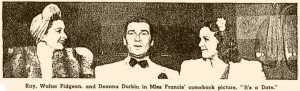
archive3


1943, July 4, 1943. SILVER THEATER RETURNS TODAY WITH KAY FRANCIS

Kay Francis, who has just returned from an extensive tour of service camps abroad, will be the first guest star as the Silver Theater returns to the air at 5 o’clock this afternoon over WBBM-CBS


1948, Saturday, January 24. [Front Page] KAY FRANCIS ILL; MYSTERY VEILS HOTEL DOINGS by staff writer.

COLOMBUS, O., Jan. 23 (Special)—Kay Francis, screen and stage star, was in serious condition from an overdose of sleeping tablets tonight after being rushed to a hospital in a furor of excitement during which her manager was arrested for “investigation of assault to kill.”

Mysterious circumstances were attached to the star’s illness by conflicting reports of police and the detention for several hours of the stage manager, Howard Graham, 37.

Two detectives said they found evidence of a “wild party” at Miss Francis’ hotel room, but the room was then padlocked by police and the detectives’ statement was overruled by Asst. Chief of Detectives Jay S. Teele, who declared the room was in order.

PUT IN OXYGEN TENT

Miss Francis lay unconscious in an oxygen tent for about four hours. Her physician, Dr. Maurice B. Rusoff, declined to comment on the circumstances that led to her illness, but announced:

“She is now groggy but conscious and able to talk. She is suffering from an upper respiratory infection. Her condition is serious but not critical. I believe she will live. She had not been assaulted.”

Graham, who was been Miss Francis’ escort as well as stage manager during their appearance here in the stage play, “State of the Union,” was held in jail after being booked by police.

He protested he had nothing to do with Miss Francis’ illness, and William Blair, company manager of the play, called his detention “a ridiculous mistake.” Graham was held, however, until the actress regained consciousness and confirmed his account of what had happened.

REPORTS SHE FAINTED

The stage manager said Miss Francis summoned him to her room in the hotel where both were staying and told him she was ill. While he was talking to her, she fainted, she said.

He telephoned the desk for a physician, and Dr. Rusoff was summoned, Graham said, adding: “The doctor told me she had taken an overdose of sleeping pills.”

Miss Francis’ legs were severely burned by a radiator in the room. According to one account given by police, she stumbled against the radiator while in a stupor, but Graham also was quoted as having said she was burned while he was holding her head out a window to enable her to get air.


1950, March 4. LOOKING AT HOLLYWOOD by Hedda Hopper

archive6Curious that Kay Francis would play in “Let Us Be Gay” at the Sombrero theatre in Phoenix. We made that into a picture starring Norma Shearer and Marie Dressler years ago [webmaster’s note: Hopper was in the 1930 film in which she is referring to with Shearer & Dressler].


Archives Main Page

New York Times Obituary

Archives Main

Published August 27, 1968 in the NEW YORK TIMES

Kay Francis, one of the foremost motion picture actresses of the 1930s, died yesterday of cancer in her apartment on East 64th Street. She was 63 years old.

Miss Francis had returned to her home on Saturday after having been a patient at New York Hospital. At her request, there will be no funeral service.

The actress, who quite frankly, wanted to make it to the top, went from the Broadway stage to Hollywood, where she was quickly established as one of the screen’s busiest, best-paid and most popular actresses.

Her tall slender figure and raven black hair, which framed a face dominated by large, moist eyes, were seen in more than 50 motion pictures from 1929 to 1945, and were frequently admired as of an almost regal beauty.

When she started, the lexicon of the screen had not jelled, and talking pictures were sometimes called “audible pictorial transcriptions” and actresses were said to “impersonate” characters. In 1931, as in one or two subsequent years, Miss Francis made seven pictures, whose titles suggest their distinction:

“Ladies’ Man” (with William Powell); “Scandal Sheet,” “Twenty-Four Hours,” “The Vice Squad,” “Girls About Town,” and “Guilty Hands” (with Lionel Barrymore).

MORE THAN A LIVING

It was, as it proved, more than a living. In 1937, Miss Francis received $227,500 in salary, in a year when F.A. Cudahy Jr., president of the Cudahy Packing Company, received $75,000 and Harvey S. Firestone, chairman of the Firestone Tire and Rubber Company, got $85,000.

The actress, who sometimes submitted to but loathed interviews, held strongly to the right of personal privacy for public figures, but there was a point in the mid-thirties when hardly a wink of her eyelash went unreported—especially if the wind seemed to be aimed at one or another of her swains or suitors.

Miss Francis, who could at times blaze up in anger, was not always at pains to be polite to reporters and film crew members. In 1934 it was reported that she “flew at a news photographer who snapped at her picture” at Newark Airport.

The actress had a way of landing near the top of various lists. In addition to the salary list, she was often included on the lists of the best-dressed women in films, and, in 1933, Maxwell Arnow included her, with Katharine Hepburn and Helen Hayes, as one of the “10 brainiest women” in motion pictures.

Her stately figure was sometimes wrapped in silken fur to the ear lobes; she would appear in a broad-brimmed hat with a pheasant’s feather curling smartly from its band; she was deemed the epitome of glamour and sexiness in the slinky evening gowns in which she often portrayed “the other woman” on the screen.

Miss Francis, who was afflicted with a faint lisp and could not always count on pronouncing her r’s correctly, tried something a little different in playing Florence Nightingale in “The White Angel.”

The New York Times critic called the film “dignified reasonably accurate, deeply moving and displaying pompous” and wrote that Kay Francis as the founder of modern nursing “talks, walks, and thinks like a historical character; when she speaks she is speaking for posterity.”

Miss Francis played the top roles in “Raffles,” “First Lady,” “One Way Passage,” “Mandalay,” “British Agent,” “Wonder Bar” (with Al Jolson) and “The House on 56th Street.”

“The Goose and the Gander” proved to be an especially perilous adventure since, as a critic wrote, its chief impediment to an evening pleasantly unimportant in the cinema comes from its insistence on cramming r’s, which have an embarrassing habit of becoming w’s when Miss Francis goes to work on them.”

Some of the most popular of her films had to do with frustrated mother love, as in “I Found Stella Parish” (1935) and “Give Me Your Heart” (1936).

In 1941 she appeared with Jack Benny in “Charley’s Aunt.” Miss Francis’ film career, which have been so notable, ended rather sadly with her departure from the major studios to Monogram, where she made what one film collector here described yesterday with grim sarcasm, as “The Monogram Trilogy:” “Divorce” (1945), “Allotment Wives” (1945), and “Wife Wanted” (1946), low-budget melodramas, in which she acted as well as was co-producer with Jeffery Bernerd.

Before going to Hollywood, Miss Francis had appeared on Broadway in “Venus,” “Crime,” and “Elmer the Great,” opposite Walter Huston. In 1946 she returned to the stage after an 18-year absence in “State of the Union,” the Howard Lindsay-Russel Crouse Pulitzer Prize comedy.

She ended her acting career in summer stock.

OKLAHOMA CITY NATIVE

Verity is rarely stressed in motion picture biographical data, and Miss Francis was listed as having been born at three places, but Oklahoma City appears to have been the site, on Jan. 13, 1905. She was educated in private schools and convents. A teenage marriage to Dwight Francis, scion of a socially prominent Massachusetts family, ended in divorce, as did her marriages to William A. Gaston, a lawyer, and Kenneth MacKenna, a Broadway actor.

Miss Francis had lived a rather secluded life here lately and expressed some bitterness at how her Hollywood fortunes had risen so high and sunk so low.

Archives Main

Daily Illini

The Daily Illini began publication in 1871.

Official Website.
Wikipedia Info.
Digital, online, free archives.

1931. January 13. KAY FRANCIS TO WED

LOS ANGELES, Jan. 12–Kay Francis, motion picture actress, stopped at the court house today while en route from a hospital in an ambulance and filed notice of intention to wed Kenneth MacKenna stage and screen actor.


1931. February 22. Announcing Scandal Sheet at a local theater.

1931feb22scandalsheetad


1931. October 07. Announcing Guilty Hands at a local theater.

1931oct7dailyilliniguiltyhands


1932. March 10. Announcing the arrival of The False Madonna at a local theater.

1932march10dailyillinoisfalsemadonna


1933. April 2. Announcing The Keyhole at a local theater.

1933dailyillinoiskeyholeapril2


1934. February 4. KAY FRANCIS SEEKS DIVORCE

LOS ANGELES, Feb. 3–Kay Francis, motion picture star, filed suit for divorce here today against her actor-director husband, Kenneth MacKenna, their true names were given as Katherine Gibbs Mielziner and Leo Meilziner.


1936. April 9. Announcing I Found Stella Parish at a local theater.

1936april9dailyinniifoundstella


1936. October 18. Advertising the release of Give Me Your Heart.

1936oct18givemeyourheartdailyilliniKAY FRANCIS, BRENT ARE STARS IN RIALTO SHOW STARTING TODAY
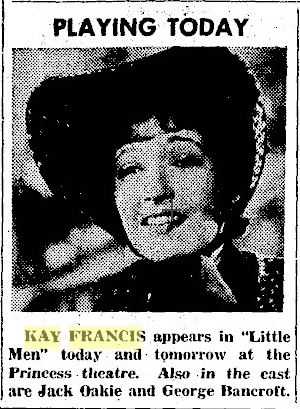
“Give Me Your Heart,” a powerful drama revealing the best in human emotions along with the worst, comes to the Rialto theatre today through Thursday.

Kay Francis, who stars in the picture, is supported by a cast which includes George Brent, Roland Young, Patric Knowles and Henry Stephenson.

The picture is based on the stage hit, “Sweet Aloes,” by Jay Mallory. It is definitely on the modern side, daring in trend, but handled with good taste.


1937. December 25. KAY FRANCIS ‘TOVARICH’ SUIT SETTLED. By staff writer.

HOLLYWOOD, CALIF., Dec. 24–Kay Francis’ suit against Warner Brothers studio to annul her $3,500 weekly contract–brought when she was not given the lead in “Tovarich”–has been settled amicably, the studio said today.

Claudette Colbert was borrowed by Warners from Paramount for “Tovarich.”

[Her salary was incorrectly reported here. The real figure was $5,250 per week, based on a 1935 contract Jack Warner had offered Kay before her old one had even expired.]


1938. May 5. GARBO , HEPBURN , OTHER STARS HAVE LOST APPEAL,  AD SAYS.

HOLLYWOOD , May 4–A group of motion picture exhibitors said today Greta Garbo , Mae West , Joan Crawford , Katharine Hepburn , Kay Francis and other movie stars had lost their drawing power at the box offices and should have their salaries slashed .

A representative of the movie actors countered with the charge that . the statement is the result of a group of brainfagged individuals trying to pick a fuss where none either exists or belongs . 

…Kay Francis is still receiving many thousands a week from Warners on an old contract . Yet, so far as her draw, she is now making B pictures.

[The article further detailed the struggles of these stars to bring in movie patrons.]


1938. September 9. ADOPTS BY PROXY.

Kay Francis recently added a new twist to the child adoption fad so popular with Hollywood stars. The Warner Brothers beauty backed and financed the adoption of a child by a lonely, childless film pair whose name she will not reveal. She has known them for years, however, and the mother played a bit part in “Women Are Like That,” Kay’s latest picture.


1941. June 12. Announcing Little Men.

1941dailyillinoisjune12littlemen


1948. January 24. Kay Francis III; Manager Freed.

COLUMBUS, O. Kay Francis, star of the stage play “State of the Union,” became seriously ill from an overdose of sleeping pills yesterday and police detained her stage manager for five hours while they investigated.

Howard Graham, 37, the stage manager, was released after the 43-year-old actress regained consciousness, and confirmed Graham’s story of what caused her illness. He had been booked for “investigation of assault kill.”

Police took Graham into custody at White Cross hospital , to which Miss Francis was removed about 7 a .m ., when they found she had second degree burns on her legs .

Graham , had reported that he was called to her hotel room about 6 : 30 a .m ., that she fainted and she burned her legs on a radiator when he took her to a window in an effort to revive her.