All posts by M.O.

Cynara (1932)

cynara321Cast:

Ronald Colman … Jim Warlock
Kay Francis … Clemency Warlock
Phyllis Barry … Doris Emily Lea
Henry Stephenson … John Tring
Viva Tattersall … Milly Miles
Florine McKinney … Garla
Clarissa Selwynne … Onslow
Paul Porcasi … Joseph, Maitre D’
George Kirby … Mr. Boots
Donald Stuart … Henry
Wilson Benge … Merton, Jim’s Valet
Halliwell Hobbes … Coroner at Inquest

Directed by King Vidor.
Produced by Samuel Goldwyn.

Screenplay by Frances Marion.
Original Music by Alfred Newman.
Cinematography by Ray June.
Film Editing by Hugh Bennett.

A Samuel Goldwyn Production.
A United Artists Release.
Released December 24, 1932.

Background:

After working successfully opposite Ronald Colman in Samuel Goldwyn’s production of Raffles (1930), Kay Francis was loaned out from Warner Brothers to United Artists for Goldwyn’s follow-up picture with the Colman/Francis teaming, Cynara (1932), one of the more interesting melodramas of the early 1930s.

Many authors have found parallels between Cynara and the Adrian Lyne’s classic, Fatal Attraction (1987), starring Michael Douglas, Glenn Close, and Anne Archer. In both, happily married men have extramarital affairs with women of mental instability. Cynara is modern in this fashion, but King Vidor’s direction of R. Gore-Brown’s “An Imperfect Lover” is different in tone and overall presentation of the subject matter at hand.

As mentioned, Cynara was based on Brown’s “An Imperfect Lover,” which had been turned into a London stage play by Brown and H.M. Harwood, and brought to the screen by Arthur Hornblow Jr., Myrna Loy’s future husband whom Kay later had an affair with herself. With a screenplay by Frances Marion, and a final production cost of $697,958, one would think that Cynara would rank a little higher up in popularity than it does. Yet, while some love this slow-moving melodrama, others can’t stand it.

Though Kay Francis is second-billed, she is seriously limited in her camera time. This is more of a showcase for Ronald Colman and Phyllis Barry, who made her film debut in Cynara. Having an uncanny resemblance to Kay, Barry’s career continued until the late 1940s, and most of her film work was in minor roles in small movies. It is perhaps her resemblance to Kay which limited her career in Hollywood. Knock-offs of big stars never quite turn out to achieve as much as the originals, but it is unfortunate since Barry shows us a great gift in her dramatic abilities as an actress. In styles and talent she varies between Kay and Ann Dvorak.

Slow-moving or not, Cynara was of major importance in the careers of both Ronald Colman and, in a way, Kay Francis. 1932 was Kay’s year to shine, perhaps the greatest she ever worked through. In that special year alone, she successfully switched studios, appeared in four of the most popular films of the year, and established herself as a star of major importance. She was no longer just an ordinary player in featured roles. Now Kay Francis had become one of the most watched and talked about stars in the entire movie industry, and her importance was represented in high box office grosses which were now topping that of Warner Brothers’ former female supreme, Ruth Chatterton.

But in her openly talked-about opinions, though, Kay Francis could honestly care less.


cynara19320815


Webmaster’s Review:

The setting is Naples. Jim Warlock was a successful barrister whose career has been ruined following an affair with a tragic young woman while his wife was away on a holiday in Venice. He tells Clemency, his wife, that he has no other choice but to leave the country. He’s now a ruined man. She asks him exactly what happened between him and this young girl, and we’re taken to a flashback some months before.

Clemency is planning to leave Naples for Venice because her younger sister, Garla, has had some romantic mishaps. Clemency and Jim have an ideal marriage, one built on honesty, loyalty to one another, and trust. Jim doesn’t want her to leave, but she insists that she must, that her younger sister needs to get away from Naples, but not without supervision to find the same sort of trouble in another location.

That night, after Clemency and Garla have left, Jim goes out to dinner with John Tring, a sinister old man who has a reputation for being a womanizer in his past. At dinner, he tells Jim that “no woman is respectable unless she’s dead,” and then he takes Jim to the next table to sit next to two young woman, Doris Lea and Milly Miles, who live and work together.

Following dinner, the four go to see a movie, Charlie Chaplin’s A Dog’s Life, and when Jim takes Doris home, she gives him her full name, number, and where she works. On the drive home, John jokes with Jim about having a relationship with Doris while Clemency is away, though he dismisses this with the gesture of tearing up the paper Doris wrote her contact information on, and then throwing it out the window.

Jim takes the offer of judging a swim competition, one which Doris is in, and wins first place for thereafter. When she collects her prize, she falls and sprains her ankle, and Jim picks her up and takes her back to her apartment where the two sit beside the fire and become more acquainted.

Weeks pass, and Jim and Doris become seriously involved with each other, so much so that her distraction from her work has caused her boss to dismiss her services. The two take a holiday together, and come to the conclusion that they must get used to seeing less and less of each other because Clemency will be returning home in a few days. Though Doris agrees, she is just telling Jim what he wants to hear, and when Clemency does return, Doris even goes as far as to call on him at his house, where he urgently meets with her in person to tell her to back off.

He caves due to her heartbreaking sincerity over her love for him, and agrees to see her again.

In his office, he writes a lengthy letter to Doris, telling her that he has changed his mind, and that their relationship must end at once. When he gets home, Milly arrives to tell him off, that he has cause Doris to loose her job, that she has no where to go, and that Jim won’t even help to pick her pieces up and place them back together again. He agrees to write her off with a check—pay her off to stay away from him, but it’s too late. A policeman arrives at the door to say that Doris has committed suicide by poison, and that she was found with the letter from Jim at her side.

A trial follows, with Clemency learning of the entire affair. While on the stand, Jim, a true gentlemen, doesn’t answer if Doris had been involved with other married men. The truth is she had, and when the scene goes back to Naples Clemency asks Jim if there were. He tells her the truth, and then tells her goodbye.

Right after Jim leaves, John shows up and guilts Clemency into tracking Jim down. He tells her that, first of all, the whole thing was Doris’ fault, and then tells her that Jim might take his own life, and that it would be Clemency’s fault in a way.

She arrives at the dock, where she and Jim embrace one another, then wave goodbye to John from the ship.

Forget Henry Stephenson. Forget Viva Tattersall. Forget Florine McKinney. Hell, even forget about Kay Francis. This one is all about Ronald Colman and Phyllis Barry, both of whom are excellent in this one. The relationship between their characters is the center of this movie, and the entire production revolves around their involvement with one another.

Being a veteran performer, Ronald Colman averages well. He really doesn’t have a best scene, though the final one with him and Phyllis Barry on the bench is quite touching. He does, however, garner audience sympathy before, during, and after his adulterous affair. While not exactly going out for it, he plays Jim Warlock as a man who is just lonely. A man who doesn’t want his wife to leave, and takes an interest to a young girl who has a striking resemblance to her (Kay Francis and Phyllis Barry look almost identical). Their affair is completely innocent as a whole without being childish.

There is a lot more to their relationship than sex. That’s what makes Cynara different then the other films of the time.

Phyllis Barry, who made her film debut in this one, comes across as mature of an actress who had been working in films for five or six years. She’s exceptional here, and doesn’t give Doris a dim-witted mindset. She’s an emotional young girl, with no family, who turns to anything who can give her the love she has been looking for since she was a girl.

That’s the starter conversation when she and Jim are first introduced at the restaurant; that she has no one but Milly in her life.

Henry Stephenson, always the wiser-older man, here gives advice that would make any feminist track him down with a pair of scissors and seal his goodies in a pickle jar. He has no respect for women here, so don’t be expecting him to be as kind and generous as he is in Give Me Your Heart (1936) or Marie Antoinette (1938).

It is, however, an example of his “versatility.”

Limited in camera time, though not totally overshadowed by a stellar cast and story, is Kay Francis as Clemency. She doesn’t have much to do but wear some nice costumes and make strange facial gestures. But catch a glimpse of her face when the police officer arrives at the Warlock residence when the movie is ending. She’s got one noticeably scowling look on her face. It’s a look that stays embedded in one’s mind.

Though it runs a bit longer than it needs to, the film has beautiful production values and stunning outdoor scenes. It probably would be a little more interesting had they trimmed some minutes off of it, but it’s not a bad film at all, and unlike the other precode movies of its time, perhaps one of the more mature films of the era.

Cynara deals with scandalous actions, but it doesn’t intend to “shock” or “stifle” audiences. The film just intends to show mature content for adult audiences ready to see more than flashy sets and ridiculous circumstances.


Film Advertisements: 

Original Lobby Card:

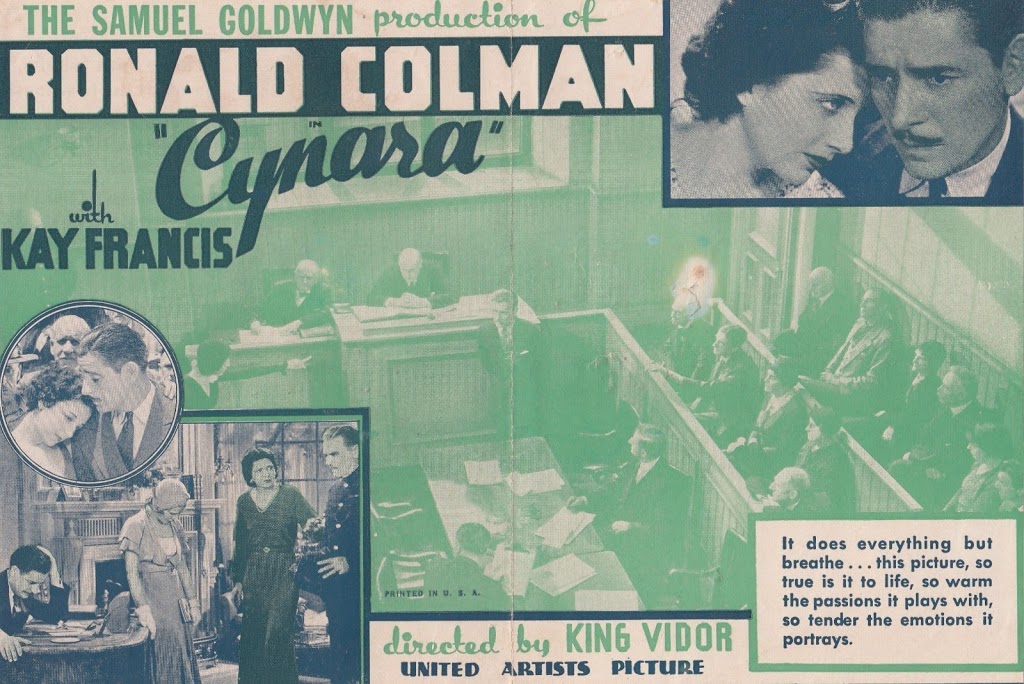
cynaralobby0810cynaralobby1cynaralobby2


Original Herald: 

cynaraheraldcynarak


Theater Slide:cynaraslide234


Foreign Program:

cynarafrench


Re-release Lobby Card:

cynaralobbycard1018


Re-release Poster:cynara1postercynaralobbycard32323

Street of Women (1932)

streetofwomen09282Cast:
Kay Francis … Natalie Upton
Roland Young … Linkhorne ‘Link’ Gibson
Alan Dinehart … Lawrence ‘Larry’ Baldwin
Gloria Stuart … Doris ‘Dodo’ Baldwin
Marjorie Gateson … Lois Baldwin
Allen Vincent … Clarke Upton
Adrienne Dore … Frances
Louise Beavers … Mattie, Natalie’s maid

Directed by Archie Mayo.
Produced by Hal B. Wallis.

Original Music by W. Franke Harling & Matty Malneck.
Cinematography by Ernest Haller.
Film Editing by James Gibbon.
Art Direction by Anton Grot.

Released May 26, 1932.
A Warner Bros. Picture.

Box Office Information:
Cost of Production: $195,000
Domestic Gross: $250,000
Foreign Gross: $89,000
Total Gross: $339,000

See the Box Office Page for more info.

Background

Street of Women (1932) provided Kay Francis her second consecutive starring vehicle for her new studio, Warner Bros.

The plot is that of a typical Kay Francis melodrama. She loves a rich, older man, whose daughter is in love with Kay’s younger brother. Francis is not only beautifully gowned in this tearjerker, but her character is another working, professional woman. This time, the owner of her own dress shop.

Alan Dinehart plays the lover, Allen Vincent plays the younger brother, and, in her film debut, Gloria Stuart is the daughter. Which relationship has to end for these victims to find stability? That is the question asked by Street of Women, answered in the final reel after many tears from its female lead.

Kay had sparkled in Man Wanted (1932), her first film for Warner Bros. after completing three years of employment at Paramount. Now an established star at a new studio, Kay Francis was hyped up with the typical studio-generated publicity. But Street of Women was a decent turnout from a studio which tended to overlook the strength of a story for sharp costumed characters placed in elaborate surroundings.

The film was based on the 1931 novel of the same name by Polan Banks, which was adapted to the screen by Charles Kenyon. Directed by Archie Mayo, Kay was placed in the guiding hands of genius Hal B, Wallis, perhaps the greatest producer at Warner Brothers at the time. Designer Earl Luick created some beautiful clothes for Kay to wear as the owner of a fashion boutique in the center of Manhattan. This film can be pointed to as the one which cemented Kay’s influence in the fashion world off the screen.

Still, some were not impressed…

Running only 59 minutes, Movie Mirror noted that “Kay Francis, since she went to Warners, has been working hard and fast, turning out pictures rapidly. The chief trouble is they look like it. Her first Warner film wasn‘t any wow. Neither is this.”

Reviewed favorable by critics or not, the film helped firmly establish Francis as a star in her own right.


Webmaster’s Review:

The people of New York are frantic over the construction of the Baldwin Building, soon to be the world’s tallest structure. Perhaps the most ambitious project man has ever undertaken, behind that powerful man, Larry Baldwin, is of course a woman.

Natalie Upton owns a dress salon in Manhattan. She has been involved with Larry Baldwin for some time now, though she is not the typical selfish, younger mistress. She actually loves Larry for who he is, unlike his wife, Lois, who is with him only for social clout.

While Larry has paved some of the way for Natalie’s success, make no mistake, her eye for fashion is what made her salon a sensation. And it is the money she has gathered from her own creations which have paid for her brother Clarke’s tuition for the Paris School of Architecture.

When Natalie hears that Clarke is coming home, she tells Larry that they can no longer see each other. She tearfully tells him that Clarke is still very young, and wouldn’t understand the situation. “We’ve had our happiness,” she tells Larry, who agrees to her request.

Larry’s daughter Doris is having her debutante party, and Clarke is invited. Him and Doris have known each other for sometime now, and, since he is coming home, begin to take their relationship a few steps further. Neither Larry nor Natalie knew of the relationship between Clarke and Doris, and, in Natalie’s mind, this is even more of a reason for them to give each other up.

In the mean time, Lois has become suspicious of Larry’s affair. Already having denied permission for a divorce, she walks into Natalie’s shop and demands to see her. Without once telling Natalie she knows about the affair, Lois makes sure Natalie knows her name and unofficially insults Natalie’s taste of style.

At Natalie’s apartment, Larry stops by to see her. As the two discuss their predicament, Clarke walks in, overhearing everything. “Well, who do I owe thanks to my Paris education,” he asks, “the lady who gave her services or the gentlemen who paid for them?” When Natalie tries to explain, he jerks his head to Larry and tells him that he will repay every cent. Natalie tries to plead with Clarke, telling him that the money came from her salon, but he wont have none of it.

Clarke packs his things and abandons everyone, including Doris.

The two run into each other sometime later at a party. Doris is too emotionally wrecked to talk to him, and heads out. Clarke takes off after her, and they hop in Doris car, getting into a terrible accident discussing their relationship and breakup.

The two decide to marry, and Clarke also reconciles with Natalie.

As for Lois, well, she has agreed to a divorce, and heads to Reno to get it. Larry and Natalie are reunited in front of the Baldwin building, where they embrace.

This is one of my all-time favorite Kay Francis movies. Street of Women represents everything she was so famous for.. She is a working woman, wears great clothes, is photographed beautifully, and of course she suffers relentlessly until the final reel. Everything in here is in place for her screen persona, and not one detail needs to be changed about this picture.

While not an artistic triumph like Give Me Your Heart (1936) or Confession (1937), this Warner Brothers film gives Kay some great moments to prove herself as an actress. In her first scenes with Alan Dinehart, she’s flirty and seductive, making us believe that a woman as beautiful as she is can really be in love with a man lacking in handsome appeal like Dinehart.

Their roles and performances play off of one another nicely.

Natalie has a motherly attitude towards Clarke that is touching. While he can not be too much younger than her, one can obviously tell she is of major influence in his life. Kay and Allen Vincent have a special chemistry between them that allows us to know that, whatever their situation is with their parents is, they always have each other, and are going to be their for each other no matter what choices the other one makes.

Roland Young has the wise character role in which he provides guidance for all of the character’s situations. Unfortunately, he is not as important in the film’s plot as he is in Give Me Your Heart

Street of Women was Gloria Stuart’s film debut. It shows in some scenes.

Fast-paced and ending just as soon as it unfolds, Street of Women is great for an introduction to Kay Francis movies. It’s one of the many brief movies she made in these years which kept the audiences going back for more.


Vintage Reviews:
Love and the construction of a tall building are discussed in “Street of Women,” a verbose triangle affair which is now occupying the screen of the Warners’ Strand. It has several cleverly composed scenes and praiseworthy acting, particularly by Roland Young and Marjorie Gateson, who interpret the rôles of the more or less unfortunate beings in the story. Miss Gateson appears as Lois, whose husband, Larry Baldwin, does not conceal the fact he would welcome the idea of being sued for a divorce. As for Mr. Young, he portrays in his usual facile fashion, Link Gibson, who is so enamored of Natalie Upton that he proposes marriage to her at least once a day. His hopes of success in this direction are, however, blighted, for Natalie happens to be in love with Baldwin, who reciprocates her affection.

There is also to be considered the love existing between Larry and his daughter, Doris, and Natalie’s devotion to her brother Clarke. Matters are further complicated by a romance between Doris and Clarke. Hence the idle thoughts of the young man in Spring are not neglected. But it does seem a pity that Link Gibson has to be left out in the cold, for he is far more sympathetic than Larry, who is seen in the person of Allan Dinehart.

Larry, who is supposed to be responsible for building Gotham’s highest skyscraper, in a radio talk gives credit to a woman for the inspiration. His wife is congratulated, but Larry really refers to Natalie.

At the psychological moment in this tale there is the inevitable contretemps. Clarke is indignant when he hears that his sister is partial to Larry and off he goes to South America, believing that Larry had footed the bills for his education abroad. He returns, however, as all juveniles do in motion pictures, and, as might be surmised, he next encounters Doris at a dance. He follows her to her car and insists on riding with her and there is a crash, when, one sees by the speedometer, they are traveling at seventy miles an hour. Both are injured, but it is this accident that causes Lois to be a little less flint-hearted, for she announces that she is going to Nevada.

Allan Dinehart does fairly well considering the writing of his part. Kay Francis is attractive and pleasing as Natalie, and Gloria Stuart is satisfactory as Doris.

Other pictorial subjects on the same program are S. S. Van Dine’s “Side Show Murder” and Bobby Jones’s golf lesson on “The Spoon.”
Published in the New York Times, May 30, 1932.


 Film Advertisements

Lobby Cards:

streetlobbystretofwomenlobbycard


Glass Slide:

streetslide

Man Wanted (1932)

manwanted0906Cast:
Kay Francis … Lois Ames
David Manners … Thomas ‘Tom’ / ‘Tommy’ Sherman
Una Merkel … Ruth ‘Ruthie’ Holman
Andy Devine … Andy Doyle
Kenneth Thomson … Fred ‘Freddie’ Ames
Claire Dodd … Ann Le Maire
Elizabeth Patterson … Miss Harper, Lois’ Secretary
Edward Van Sloan … Mr. Walters, French & Sprague Manager

Directed by William Dieterle
Produced by Hal B. Wallis

Original Music by Bernhard Kaun
Cinematography by Gregg Toland
Film Editing by James Gibbon
Art Direction by Anton Grot
Costume Design by Earl Luick

A Warner Bros. Picture
Released April 15, 1932.

Box Office Information:
Cost of Production: $171,000
Domestic Gross: $258,000
Foreign Gross: $59,000
Total Gross: $317,000

See the Box Office Page for more info.

Background

1932wbpub0815Of all the most significant years in Warner Brothers history, perhaps 1932 was one of the greatest. That year alone, the studio inherited Ruth Chatterton, William Powell, Kay Francis, Bette Davis, Dick Powell, Paul Muni, and Ruby Keeler–all of whom had a notable career in the entertainment industry in one form or another. But three of those stars, Chatterton, Powell, and Francis, came to Warner Brothers as major film stars. Others like Bette Davis and Paul Muni had done work in front of the camera, but nothing to really make them stand apart from their contemporaries.

In January, 1932, Darryl Zanuck purchased the rights to Faith Baldwin’s Week-End Marriage with the idea of starring either Kay, Ruth, or Barbara Stanwyck in the feminine lead. Since Chatterton was the most established star at the studio—being paid $8,000 weekly—she was cast in the film, retitled The Rich Are Always With Us (1932).

To satisfy Kay, Zanuck purchased Robert Lord’s Dangerous Brunette—retitled Man Wanted—with only Kay in mind. The great William Dieterle, who directed Kay in The White Angel (1936) four years later, directed Kay, David Manners, Andy Devine, and Una Merkel in this sixty-minute programmer which is really a promotion for Kay. Even the theatrical trailer is all about hyping a new Kay Francis in her first film for her new studio, Warner Brothers.

Cameraman Gregg Toland, designer Earl Luick, and still photographer Homer Van Pelt all attributed to the creation of the new, polished Kay Francis, whom Warner Brothers felt was best suited in urban, modern dramas about the “new woman” of the 1930s. In Man Wanted she plays the chief editor of one of the most influential magazines in the country. She’s married to a playboy husband, but falls for a male secretary to answer her every beck and call.

Unlike her Paramount features, which featured Kay in either supporting roles or second leads, Man Wanted is all about Kay Francis. This gesture from Warner Brothers (their turning of Kay Francis into a major household name) was something she never forgot, even long after completion of her final film, Wife Wanted (1947), for Monogram Pictures. Quotes from Kay years later still pay tribute to the studio that believed in her, while everybody else considered her unworthy of attention.

Man Wanted was released on April 15, 1932, and credited by the Los Angeles Illustrated Daily News as “good, light material which has the benefit of luxurious settings, pleasing dialogue, rather clever situations, and some good performances.”

With a successful film debut for her new studio, Warner Brothers began the idea of a long-term association with Kay Francis in which she would emerge as their most important asset. No female star employed by the studio during the 1930s would surpass her fame in that decade, until Bette Davis in 1938.


Webmaster’s Review:

Lois Ames is married to Fred Ames. She’s the professional in the marriage, being the editor and chief of the 400 Magazine while Fred enjoys his polo and affairs with easy tramps. She has difficulty finding a secretary to work for her; being completely involved in her work, she needs someone who has as much drive and dedication as she does.

Meanwhile, Tommy Sherman and Andy Doyle work in a sports goods shop. Their boss instructs Tommy, who is involved with Ruthie, some cheap, annoying bimbo, to go to the offices of the 400 Magazine and demonstrate a rowing machine to Lois Ames. He does so, and is taken in by her loyalty to her work.

When she and her secretary have a disagreement over the working hours, she employs Tommy to work for her, where his pay steadily but rapidly increases as she is increasingly impressed with his dedication working for her. Of course they begin to feel attracted towards each other, but Lois is insistent that this is a serious, professional relationship. Nothing more.

Ruthie becomes enraged that Tommy is spending so much time working, and begins seeing Andy, who is Tommy’s roommate, out of spite. Tommy pays no attention to this, Lois is the one he wants, but, unfortunately, she is a married woman.

Luckily for Tommy, the marriage between Lois and Fred is dissolving. While they do not become bitter towards each other, they come to a mutual agreement that their marriage has ended, and they do agree to a divorce after Lois becomes fully aware of her husband’s infidelity when she discovers the key to a mutual friend’s room in his pants pocket.

Before Tommy can know all of this, he makes plans to marry Ruthie, quit the office, and work for her father. On his last night working for Lois, he learns of her divorce, and Ruthie, enraged after being stood up for a date by Tommy, barges into the office to see the two dining intimately.

“You’ve humiliated me for the last time!” she exclaims.

Indeed she has, because now with Fred and Ruthie out of the picture, Lois and Tommy can go on together as a husband and wife team of the 400 Magazine.

To many Kay Francis fans, Man Wanted is one of her best films. It’s easy to see why. Not only does she complete her characterization as Lois Ames with an intelligent, knowing performance in a film which doesn’t give her much to do, but she’s refreshingly cheerful and overly flirty with her leading men.

Watch her in her opening scene with Kenneth Thomas in the office. As they make their plans for lunch, she flashes a huge smile and gently rubs her nose against his. Then when she and David Manners are taking their notes, she dangles her shoe off of the tip of her toes.

Also mentionable is her stunning photography. Look how cinematographer Gregg Toland has her steadily approach the camera reading a note only to look up and smile as she firsts meets David Manners in the office.

It’s a million-dollar shot.

Interestingly, many pointed to David Manners as being a perfect choice for Kay’s leading man because of his youthful persona opposite her mature professional. Four years older than Kay in real life, he is one of her best costars. The two have unusually good chemistry. All of their scenes have them looking at each other with emotions becoming visible from within the eye.

What makes this even more mentionable is the fact that they really didn’t click during the production. In Kay’s mind, David played around too much, while he considered her uptight and not easy to worth with.

Andy Devine is the comedian as usual, which is how it should be. On the opposite side of the fence this time, Una Merkel really goes all out with her performance as Ruth. She makes no attempts for audience sympathy, and shrieks her way through the film, making one want to hop on the other side of the camera and smack her.

William Dieterle, who directed Kay in The White Angel (1936), among other films, does great with the thin material. He makes this enjoyable fluff easy to watch by wasting no time with unimportant asides and silly, unnecessary scenes. His ability to succeed with this material is that he doesn’t make the drama too over the top, and the comedy is done with a hesitance and subtlety which makes it unlike the other films of that era which were either going completely in one direction or another.


Vintage Reviews:
Kay Francis radiates so much charm throughout “Man Wanted” at Warners’ Strand this week that the familiar theme somehow does not matter. She is ably assisted by David Manners and a well-balanced cast. The screen play, originally called “A Dangerous Brunette,” is the very thing for Miss Francis, who dresses with such good taste.

As for the story, it is that of two ill-matched persons, an ambitious woman and an indolent husband, who become bored with each other. She finds the ideal secretary in the person of David Manners and harmony in work leads to dangerous intimacy. And thus the theme unfurls itself in a manner to be expected. The husband, instead of the familiar boorish person, is quite likable; the secretary’s fiancée is not quite as refined as she ought to be, and Una Merkel does very well with this thankless rôle. As a picture “Man Wanted” is plausible and quite free from any jarring notes, and while it is neither original nor outstanding in any other way, it is somehow quite satisfactory.

The comic relief is injected in well-measured doses by Andy Devine. The directing work of Wilhelm Dieterle seems to be another feather in his cap.
Originally published in the New York Times, April 16, 1932.

From Photoplay, June 1932:

manwantedjunreviewphotoplay


Film Advertisements:

Lobby Cards:manwantedlc1


Film Posters:

manwantedwindowcard


Glass Slide:manwantedslide1

Living on Velvet (1935)

livingonvelet53Cast:

Kay Francis … Amy Prentiss Parker

Warren William … Walter ‘Gibraltar’ Pritcham
George Brent … Terrence Clarence ‘Terry’ Parker
Helen Lowell … Aunt Martha Prentiss
Henry O’Neill … Harold Thornton
Russell Hicks … Major at Flying Field
Maude Turner Gordon … Mrs. Parker
Samuel S. Hinds … Henry L. Parker (as Samuel Hinds)
Martha Merrill … Cynthia Parker
Edgar Kennedy … Counterman

Directed by Frank Borzage.
Produced by Edward Chodorov & Frank Borzage.

Original Music by Heinz Roemheld.
Cinematography by Sidney Hickox.
Film Editing by William Holmes.
Art Direction by Robert M. Haas.
Costume Design by Orry-Kelly.
A First National Picture.
Released March 2, 1935

Box Office Information:
Cost of Production: $276,000
Domestic Gross: $334,000
Foreign Gross: $170,000
Total Gross: $504,000

See the Box Office Page for more info.

Background:

Living on Velvet is one of those ideal Kay Francis films which is a perfect representation of what the “star product” meant back in the Golden Age of Hollywood. The film is fit to her screen personality, forcing her to rely not so much on her acting skills as her beautiful physique in stunning Orry-Kelly creations.

Apparently, Jack Warner had instructed Jerry Wald and Julius Epstein to come up with an ideal story to fit the Kay Francis formula. Wald and Epstein delivered a charming screenplay which may have not been another One-Way Passage (1932) or House on 56th Street (1933), but Living on Velvet was a reasonably entertaining story which didn’t require much from its audience.

Kay was reunited with George Brent for the second time since their first pairing, The Keyhole (1933). It was also her second film with the dashing Warren William, who had worked with Kay in Doctor Monica (1934). Both men played opposite Kay well, but Warner Brothers seemed more interested in Brent’s career than Williams’. By the time Living on Velvet rolled around, Warren William had been reduced to secondary roles, which is a shame considering he had so much acting talent and personality.

Costume designer Orry-Kelly went all out for Kay on this one. He designed a total of seventeen creations, most of which were inspired by samples by fashions which had struck Kay’s eye on a vacation in Europe. Louella Parsons predicted in her review for the film that “[Kay’s] gowns will be copied all over the world.” Obviously Warner Brothers thought so, too, because the theatrical trailer for the film showed a montage of a handful of Kay’s breath-taking wardrobe.

In another promotional effort, Kay, Warren, and George appeared on the radio show Hollywood Hotel on January 4, 1935 to reenact scenes from and promote the film. Released on March 2, 1935, Living on Velvet scored decent reviews but clearly had a more public appeal than critical one. Most reviews for Kay were favorable, but many pointed out that her role didn’t require her to do much.

That fact that she pulled it off is the proof of her magnitude as a star.

Webmaster’s Review:

It’s February 1933. Terry Clarence Parker, his mother and father and younger sister, Cynthia, are flying with Terry, who is an aviator. He notices that the fuel tank is dangerously low, and they soon run out and crash into the ground. Terry’s family is killed, while he survives with only a couple of scratches and a headache. In the following two years, his name reads across newspaper headlines for his dangerous pranks and stupid actions.

On June 10, 1934 he crashes an aviation derby, and is detained by officers for his dangerous stunts. There his good friend Gibraltar saves him from the felony charges they are attempting to put on him. Back at Gibraltar’s, Terry listens to him talk about Amy Prentiss, the girl Gibraltar is seriously considering settling down with. When Terry asks what she looks like, Gibraltar basically tells him that he’ll find out that night when he meets Amy at a party being thrown by Amy’s Aunt Martha in her Manhattan penthouse.

That evening, Terry receives the could shoulder from all of the snobby guests except for one man, who grabs hold of Terry in a conversation about global warming. Bored by the conversation, Terry looks across the room to see a beautifully dark haired young woman being spoken to about the increase rain levels by an elderly woman. They look goggle-eyed at one another, and Terry makes his way across the room and introduces himself. The two decide to head out and grab some real food.

They have a lovely night on the New York town. In a horse carriage, Terry tells Amy that he loves the sound of her voice, and when he notices her speech impediment, he asks her to repeat after him. “Around the rugged rocks, the ragged rascals ran.“ She repeats his saying, with every R slurred into a W, and he is taken in by her sense of humor about her own flaws. They walk through Central Park and have coffee and doughnuts at a small diner until the early morning hours. When Terry finally takes Amy back to her place, they make plans to spend the next day together.

Briefly Terry disappears. Unbeknownst to Amy until Gibraltar receives a call from the police station, he has gone on a bender. She ignores his stupid actions, and realizes that Terry is the one she really loves, and, against her Aunt’s wishes, she and Terry marry in a small ceremony with Gibraltar as the best man. After the wedding, the three of them sit on the steps of the chapel and wonder what to do next. Since Amy insists on not taking any money from her Aunt, the rely on Gibraltar’s present of a house out on long island that he owns.

Terry and Amy move out there, and have a real rough start with things by Terry’s inability to focus on getting on their feet. He doesn’t find a job or do anything responsible, and if it wasn’t for the money that Gibraltar sent them, they wouldn’t have anything. Amy can’t take anymore when Terry goes out and buys a plane for them. Though she still loves him, she’s come to realize that marrying him wasn’t the best decision.

“I’m leaving you, Terry,” she tells him with tears in her eyes. “But before I go, there’s something I want to say to you. I’ll try to be simple and straightforward. Terry, this attitude of yours towards life, this contempt that you have for people in the world, all the flying about, the happiness, the unrest, mean just one thing. There’s a void in your life, Terry. A distinct and terrible void.”

He words go almost unnoticed by him, though he does tell her that he doesn’t see her as a failure for not being able to succeed in changing his way of life. When he tries to get her back, she tearfully tells him that there is no way of a reconcile until he agrees to move on from what happened in the past.

It is at a party at Aunt Martha’s where Gibraltar receives a call that Terry has been in a Terrible car accident. He and Amy rush to his side, and she tells Terry that he can’t die because she loves him, and he promises that he’s not going to.

The final scene is of Terry and Amy sitting on a bench in Central Park with the snow gently falling around them. They agree to start over together, and Amy tells him that she’ll try to cope with his irrational decisions.

“Amy,” he confidently tells her, “if you love me, you’ll stop talking about a Terry Parker which doesn’t even exist anymore.”

On the official website for Warner Brothers, I was reading a biography on George Brent they had posted for him. In it they went on about his film with their classiest star, Kay Francis, and mentioned their work in Living on Velvet, among other titles. I can’t think of a better term to describe the Kay Francis in the Living on Velvet, Goose and the Gander films she made at Warner Brothers at the height of her popularity. She really defines the whole Park Ave sophistication with her clever hairstyles and outfits which border from the smart to the absurd.

This might not be her best acting, but these are still the types of movies I do enjoy seeing her in. Living on Velvet is a good vehicle for her, which allows her to display her strengths in comedy and drama in a seventy-five minute film which seems to come to a close just as it begins.

Perhaps this is one of the reasons why I have favored stars and films like Kay Francis and Living on Velvet over ones like Joan Crawford and I Live My Life. Francis’ films at Warner Brothers have everything Crawford’s or Loy’s did at MGM, only they are fitted into shorter timeframes by cutting out all the excess fluff and unimportant asides. This is not to take shots at Crawford or Loy, or to say that Francis is or was better than them. I’m only trying to write that I favor the way Warner Brothers made and produced their films, getting straight to the point rather than going on and on like the Metro Goldwyn Mayer output seemed to do.

George Brent does get a little old in this one. I would have rather seen the role played by Fredric March or Gary Cooper, someone who could have brought more star power to the film than Brent did. Warren William, however, is perfectly cast in a role that’s a departure for him. True, he is a doormat, but he looks incredible in those suits and top hats, giving Kay Francis a run for fashion favor in this one.

The cottage Terry and Amy live in that belongs to Gibraltar is breathtaking, so much so that it makes one wonder why Amy is so persistent on getting it redecorated. Just as I felt when I was watching The Goose and the Gander, I took a look around my own place and realized what a dump I live in. You won’t see any Bette Davis movies at Warner Brothers looking this good. It’s clear how expensive, modestly so, the production was.

Perhaps the funniest part of the film, since it also provided comic relief from Amy’s depression after hearing that Terry spent Gibraltar’s money on a plane, is when George has Kay christen the plane with a bottle of ketchup, since they have no champagne in the house.

Today most would write off Living on Velvet as unimportant Kay Francis fluff, the type of film which made the audiences of the 1930s grow bored with her. Some of that is true, but it’s not a bad picture at all, just a small piece of entertainment made for audiences to enjoy without having to be overwhelmed by million-dollar sets and long running durations.

It is the perfect type of box office formula which becomes addictive to the average moviegoer, and why Francis reached the height of her popularity playing parts like Amy Prentiss.

Film Advertisements

Stranded (1935)

stranded081120Cast:

Kay Francis … Lynn Palmer

George Brent … Mack Hale
Patricia Ellis … Velma Tuthill
Donald Woods … John Wesley
Robert Barrat … Stanislaus Janauschek
Barton MacLane … Sharkey
Joseph Crehan … Johnny Quinn
William Harrigan … Updyke
Henry O’Neill … Mr. Tuthill
Frankie Darro … James ‘Jimmy’ Rivers
John Wray … Mike Gibbons
Edward McWade … Tim Powers
June Travis … Mary Rand
Ann Shoemaker … Mrs. Tuthill
Gavin Gordon … Jack
Spencer Charters … Boatman
Joan Gay … Diane Nichols

Directed by Frank Borzage.
A Frank Borzage Production.

Based on a story by Frank Wead.
Screenplay by Delmer Daves.
Cinematography by Sidney Hickox.
Film Editing by William Holmes.
Art Direction by Anton Grot, Hugh Reticker & Arthur Gruenberger.
Costume Design by Orry-Kelly.

A Warner Bros. Picture.
Released June 20, 1935.

Box Office Information:
Cost of Production: $348,000
Domestic Gross: $349,000
Foreign Gross: $217,000
Total Gross: $566,000

See the Box Office Page for more info.

Background:

Every Hollywood star has a select number of films which can really be written off as almost completely unmentionable. Stranded is one of those movies in the career of Kay Francis. It neither hurt nor advanced her stardom, had little in its story and production to distinguish it, and was just and obvious attempt to cash in on the Kay Francis/George Brent chemistry by producing a cheaply made programmer with a major star.

By the time Stranded went into production, Kay Francis had emerged as the most popular female at Warner Brothers, despite Bette Davis’ Oscar-winning performance in Dangerous (1935). Kay’s box office hold was some-what represented in Stranded’s production value, with a replica of the Golden Gate Bridge—then under construction in San Francisco—as the center of it all. A lot of interesting footage of the construction of the real bridge was used in the film, which adds more energy to a film with virtually no other action.

Stranded was based on Frank Wead’s “Lady with a Badge,” and directed by the excellent Frank Borzage, though even a master of his craft like Borzage couldn’t pump life into Stranded’s script (Delmer Daves, Kay‘s then boyfriend, wrote the screenplay). Aside from the construction scenes, the only other notable aspect about Stranded is the beautiful musical score by Bernhard Kaun and Heinz Roemheld.

Production began March 6, 1935, and concluded on April 15.

Released June 20, 1935, critics and audiences shrugged their shoulders with Kay Francis’ latest film. It wasn’t good. It wasn’t bad. It was just something to make a boring day go by a little quicker; mindless entertainment which doesn’t require much attention from the viewer. The film just simply asks its audiences to relax and enjoy Kay in beautiful gowns, surrounded by lush settings while looking absolutely gorgeous.

Variety’s review pegged the film and Kay excellently: “Miss Francis gives a smooth and sensitive performance but she is wasted in an uninteresting role as a girl who takes her job too seriously.”

Decades later, Stranded simply asks us to do the same: sit back, relax, and enjoy the beautiful Kay Francis in all her alluring glory.

Webmaster’s Review:

Stranded opens beautifully with quick-moving credits and a memorable score by Bernhard Kaun and Leo F. Forbstein. This makes one anticipate another charming bit of fluff from Kay Francis and George Brent such as Living on Velvet (1935). In some ways, the film delivers.

In other ways, it doesn’t.

The film starts with an old man confiding in a stranger that “I was born in this town…probably die here. I don’t know where to go.” A beautiful backdrop of the San Francisco waterfront at night makes one wonder why he would want to go anywhere else, but, still, he is advised to “ask the lady with a badge.” When he arrives at the desk of Lynn Palmer, a Traveler’s Aid worker of six years, she suggests that he stay in their guest house, since he is hard on cash. He replies, “Guest house…another word for charity. No thanks…I’ve had my fill of charity.”

She continues getting ready to leave when she is stifled by gunshot. She turns around to find him lying on the ground of the railroad station, and calls and ambulance to pick him up.

Grace, a higher-up in the Traveler’s Aid organization, asks that Lynn let Velma Tuthill share an apartment with her since she has become their most recent employee. Velma’s mother donates a pretty check each year or so to the Traveler’s Aid, which is why they are being so generous. Lynn agrees, but replies that “you can’t make me like it!.”

As it turns out, Velma has no serious intentions of work. She just wants to be able to spend more time with a boyfriend her mother doesn’t approve of.

The next day, a rude contractor named Mack Hale arrives at the Travelers Aid desk to look for one of his workers. He insults both Lynn and Velma, before realizing that he and Lynn had something going on while they were children. When she was fifteen, he was the first boy to kiss her.

Though she’s got a date with John Wesley, she cancels it to go out with Mack, much to the enragement of Velma, who’s got the hots for Hale.

When Mack and Lynn arrive at the restaurant for their date, he turns to her with a smile on his face and realizes that “People look at you like a Goddess or something…that makes me a God.” Judging by the way she’s dressed, it becomes apparent to us that Lynn isn’t working for the money, but for the work itself and fulfillment of helping others.

Still, Mack sees her work as unimportant, and insists she leave it if she wants to be with him. “I like my job,” she says. “It’s part of me.”

Since the two can’t seem to find a reasonable explanation for what they should do, they decide to not see each other again.

Considering his own career, it becomes a little apparent why he has such strong feelings about the lack of seriousness in Lynn’s job. Mack is supervising the building of the Golden Gate Bridge, and runs his job with a tight fist. He doesn’t tolerate nonsense from anyone on such a serious undertaking. When a man named Sharkey tries to cause conflict on Mack’s bridge, a serious hell is raised.

Sharkey hires men to give Mack’s workers alcohol, get them drunk and get them fired. When a worker falls to his death, an uproar is heard all over the job site. They gather together, at Sharkey’s intentions, and have a meeting about over-throwing Mack as supervisor.

When Lynn finds out about Sharkey, and that Mack will not attend the meeting which determines his future as a contractor, she attends it herself and brings the men to their senses. Sharkey’s identity is exposed, and Mack leaves the men to deal with him, saying that everyone one but the men who supplied the alcohol can return to work.

And the picture ends with Lynn and Mack deciding that they can both continue on with their careers together.

It took me a few tries to watch this movie in its entirety. I kept getting bored and turning the DVD player off with intentions of going back and watching it again. For some reason, there’s just a lack of interest in the story, but it does have some good moments.

Kay’s part doesn’t give her much acting opportunity at all. The only time she acts is when she and Mack can’t agree on a lifestyle and break up, and when she attends the walk-out meeting at the end of the picture. The latter is the most memorable of the film, with Kay—gowned smartly—pushing through a wild crowd of enraged, uncontrollable construction workers. She gets pushed around, her hat ripped off, her hair pulled, and finally making it to the stage shouting and screaming (one of the few times you’ll see Kay raise her voice so high on screen).

She does good with the anger in this scene, and her ambition to save Mack is touching, considering the guy is such an asswhole. But other than that all Kay has to do is wear more smart clothing and flash her charming smile.

This is a real departure for George Brent. I have not had the opportunity to see a lot of his work, but I don’t ever remember seeing him as bold, masculine, and pushy as he is here. As Mack he is completely stubborn, but in most of his scenes with Kay he’s back to the same old George. One wonders if this film was an attempt from Warner Brothers to broaden his appeal with the male audiences, and try to make him into a more Gable-kind of screen lover.

Rounding out the cast is Patricia Ellis as Velma, Barton MacLane as Sharkey, and William Harrigan as Updyke, a European construction worker who remains loyal to Mack even after he is fired by him.

Hard to believe that this one was produced and directed by Frank Borzage. The film looks really good, but the story is dead.

But as I wrote above, sometimes its nice to sit back and enjoy some mindless entertainment. Stranded is the type of film to watch after a hard-day’s work on an early-summer evening.

Film Advertisements

Jewel Robbery (1932)

FrancesVinson1Cast:
William Powell … The Robber
Kay Francis … Baroness Teri von Horhenfels
Helen Vinson … Marianne Horne
Hardie Albright … Paul, Undersecretary of State
Alan Mowbray … Fritz
André Luguet … Count Andre (as Andre Luguet)
Henry Kolker … Baron Franz von Horhenfels
Spencer Charters … Johann Christian Lenz, Nightwatchman
Lee Kohlmar … Hollander the Jeweler
Clarence Wilson … Prefect of Police

Directed by William Dieterle.
Based on the play “Ekszerrablas a Vaci-uccaban” by Ladislaus Fodor.
Screnplay by Erwin Gelsey.
Cinematography by Robert Kurrle.
Editing by Ralph Dawson.
Musical Direction by Leo F. Forbstein.
Art Direction by Robert Haas.

A Warner Bros. Picture.
Released July 21, 1932.

Box Office Information:
Cost of Production: $308,000
Domestic Gross: $316,000
Foreign Gross: $110,000
Total Gross: $426,000

See the Box Office Page for more info.

William Powell’s salary: $100,000
Kay Francis’ salary: $27,000

Background:

PICTURE PLAY, 1932.
PICTURE PLAY, 1932.

Private Lives (1931, with Norma Shearer and Robert Montgomery), The Rich Are Always With Us (1932, Ruth Chatterton and George Brent), Red-Headed Woman (1932, Jean Harlow and Chester Morris)…some of Hollywood’s best romantic comedies were made in the early 1930’s. These polished, sophisticated, and racy films were among the most popular of the time, and Jewel Robbery was no exception.

Man Wanted (1932), Kay’s first film for Warner Brothers, had showcased Kay Francis in a new light. Suddenly she had a more modern, urban appeal to audiences that rivaled Ruth Chatterton’s. At Paramount, she had either vamped out her leading men, or played second lead for them. With her more complicated screen image perfected by her second film for Warner Brothers, Street of Women (1932), the studio paired her with her old Paramount costar, William Powell, of whom she appeared in four films with previously.

The film almost seems to serve as a pre-test for Kay before her marvelous work in Ernst Lubitsch’s Trouble In Paradise (1932), but to associate Jewel Robbery with any other film takes away from its distinction. Jewel Robbery was originated and produced first, and it’s one of the better comedies movies of the early 1930’s, with Kay adapting a more slinky sort of Norma Shearer kind of sex appeal.

Based on Ladislaus Fodor’s “Ekzerrabalas a Vaci-uccaban,” Jewel Robbery was directed by William Dieterle (The White Angel, 1936, was one of five movies Kay and Dieterle made together), and began filming March 2, 1932, concluding in early April. Released July 21, 1932, “William Powell is ideally cast,” thought Variety. “The same may be said for Kay Francis as the beautiful but bored and eccentric wife of an elderly banker.”

Jewel Robbery was a tremendous hit with critics and audiences in the summer of 1932. Today, it has lost none of its spark, and is one of the best films to use for introducing friends to classic Hollywood, particularly pre-code. The movie is straight and to the point, running only sixty some minutes which seem to blissfully end almost as quickly as they begin. Remade in 1943 with Anne Crawford and Donald Stewart, The Peterville Diamond failed by a long shot to meet the critical and public acclaim as its predecessor.

Perfection like this can never be remade or replaced. Jewel Robbery was made at the right time, with the right people, and by the right people. They should have left it at that.


From Photoplay, July 1932.

jewelrobberyjuly1932photoplay


Webmaster’s Review:

Technology is vastly improving the modern world in Vienna. In a polished jewelry shop, a new state-of-the-art burglary system has just been installed. Invisible lasers bounce off of mirrors strategically placed around the shop. If trespassed, an alarm will trigger, notifying the police immediately.

Unfortunately for this shop, the installation has occurred a little to late. While the system is being installed, the shop is robbed.

Baroness Teri is the wife of Baron Franz von Hohenfels, worth about eight-million. She’s bored with all that money can get her, including her stuffy, old husband with “chronic gout.” She is an openly-admitted shallow soul, who cares only about furs and jewelry, and her luck has just been tapped again. Franz is brining her to a jewelry shop to purchased her the Excelsior Diamond, which the owner of the shop plans on selling for $50,000.

Franz is not impressed enough to shell out enough money for that, and drives the price down to $30,000. Teri and her best friend, Marianne, go crazy over it. Marianne tells everyone in the shop how lucky Teri is that her own husband is buying her the ring “in the most respectable way!”

Unfortunately for these shallow snobs, a “fashionable, debonair young-man” walks into the shop, followed by about ten others, and they proceed to rob the shop blind. But this is anything but your standard jewel robbery. The robber passes out marijuana to the unsuspecting victims, plays music, and is very polite and frank about the situation, all of which arouse Teri.

He takes off, locking Franz and Count Andre (whom Teri is having an affair with), alone in the safe, and being persuaded by Teri’s charm to leave her alone in the shop, though this might connect her with the robbery.

The police show up, as does Marianne, who had left just prior to the robber’s entering of the store. Teri is smitten, much to her husband’s dismay. Her and Marianne are all excited about what has just happened, but when Marianne presses Teri to find out more about the robber, Teri purposely gives her inaccurate descriptions.

Teri and Marianne return to Teri’s mansion. In Teri’s bedroom they find a massive bouquet of roses, and when Teri asks the maid when they were delivered, she insists they never were. Teri, frenzy over the fact that the robber has returned to her home, soon panics that he might have taken her jewelry, but finds everything in the safe, including her excelsior diamond, which he had stolen from her in the robbery.

Suspicious noises around the room have Marianne leaving in fear, and Teri all alone. She soon hears a record go on, and the robber steps out from behind the curtains. They flirt and come close to a kiss, but Teri pulls herself together and insists that he must take the Excelsior Diamond back. He refuses, and there’s a loud knock at the door from a detective.

The robber hides in another room, and Teri opens the door. The investigation leads to the fact that Teri is a valuable suspect, and he plans to arrest her, though the robber steps out in the neck of time, gun in hand. Unfortunately, two police officers jump out and grab him.

All get into a car and go back to a dark location, and when the lights go on, Teri is inside of the robber’s luxurious apartment. She realizes the whole thing was a gag in order to kidnap her, and, as usual, she is smitten by his charm.

Unfortunately, the real detectives arrive at his door. They set the scene up to make it appear that Teri was kidnapped, and she and the robber plan to meet again in Nice. He gets away after a lengthy chase on the rooftops of the city, and everyone is in a panic over Teri’s situation.

She tells everyone that she assumes a vacation is in need to relax herself. Her location, well, she’ll go to Nice on the next possible train.

She moves into the camera, asking us for our silence.

After so-so material in Man Wanted (1932) and Street of Women (1932), this was the exact type of refreshing role Kay Francis’ career needed. There’s no melodrama here; no tears; no harshly dramatic circumstances. In Jewel Robbery she plays a woman of a completely different mold.

As a comedian, Kay was adept when put in the right part in a good movie. This is the definitive example of that. She gets to wear furs and show off her talent for fashion, and the character is suited to her screen strengths. But it is her lines and her performance which really make the audience take notice of her. Here she has once again split the honors with William Powell, and what a team they make together.

Like their previous efforts, Jewel Robbery moves quickly, ending just as soon as it begins. And while Kay photographs lovely as usual, William Powell has some of his best cinematography. He’s a little slimmer, and even more clean cut then one remembers him.

In the beginning, just after the first robbery, we’re introduced to Kay as she is taking a bath and getting ready to start her day well into the afternoon. It reminds one of her waking up at 5:00 PM with Lilyan Tashman in Girls About Town (1931).

Helen Vinson, in her film debut, plays the role of Marianne opposite Kay’s Teri with the skill of any screen veteran. She’s a perfect giddy match for Kay’s bored baroness; slightly envying everything Teri is fed up with.

As usual, Henry Kolker plays the rich, stuffy husband.

William Dieterle was one of Kay’s best and most frequent directors, and with Jewel Robbery they scored their greatest triumph.


jewelrobbery03189321Vintage Reviews:
What they have tried to accomplish in transplanting Laszlo Fodor’s Viennese comedy, “Jewel Robbery,” to the cinema pastures is probably more praiseworthy than the way they have accomplished it. The new resident at the Strand has most of the staples of excellent warm-weather comedy. The situation is as capricious, the dialogue as sprightly and the settings as sinfully luxurious as they ought to be. William Powell as the gentlemanly thief can kiss a woman’s hand—while relieving it of a diamond bracelet—or pay a compliment or mock the constabulary as prettily as an amusing scoundrel should in an amusing romantic comedy. Kay Francis, who can be a good actress, is a definitely bad actress opposite Mr. Powell, and that may be part of the reason why “Jewel Robbery” with its several endowments is only mild.

The robber, who has learned his trade in Paris, is none of your sub-machine gun dullards. He loots Hollander’s jewel shop with the delicate touch of a surgeon. There are four ravishing blondes on as many corners to take care of the police, drugged cigarettes for his victims, and epigrams. The Baroness Teri, who is as weary of her lovers as of her husband, has a first-hand description of the notorious thief but cannot help the police.

That night, while the city is being scoured for the daring burglar, the baroness finds her boudoir invaded, successively, by a box of flowers, her stolen jewels and the faultlessly attired bandit himself. The rest is impetuous love and impetuous flight, midnight alarums, more epigrams and a piquant rendezvous in the robber’s apartment.

All this is nervous, brittle comedy of a sort that is sufficiently novel in the films to be stimulating. Miss Francis interprets the countess as if she were giving an imitation of an imitation, and her performance is one in which her usual intelligence and sincerity are strangely absent. An excellent subsidiary cast has been assembled, and William Dieterle’s direction has the proper daintiness and wit.
Originally published in the New York Times, July 23, 1932.

Film Advertisements:

Lobby Cards:

jewelrobberylobbycard00jewelrobberylobbycard09


Posters:


Glass Slide:


Motion Picture Herald Advertisement: 

jewelrobberyherald

In Name Only (1939)

innmaeCast:
Carole Lombard … Julie Eden
Cary Grant … Alec Walker
Kay Francis … Maida Walker
Charles Coburn … Richard Walker
Helen Vinson … Mrs. Suzanne Ducross
Katharine Alexander … Mrs. Laura Morton
Jonathan Hale … Dr. Ned Gateson
Nella Walker … Mrs. Grace Walker
Alan Baxter … Charley
Maurice Moscovitch … Dr. Muller (as Maurice Moscovich)
Peggy Ann Garner … Ellen Eden
Spencer Charters … Fred, the Gardener

Directed by John Cromwell
Produced by George Haight
Gowns by Edward Stevenson

An RKO Picture.
Released August 4, 1939.

Box Office Information:
Cost of Production: $722,000
Domestic Gross: $926,000
Foreign Gross: $395,000
Total Gross: $1,321,000
Profit: $155,000


Background:

Before A Streetcar Named Desire (1951), there were few really serious, adult dramas which provoked a concerning thought from moviegoers. In Name Only, like Night Must Fall (1937) and Escape (1940), was one of those few thought-provoking films before the perfection of the serious drama took shape in the 1950s. This time, the drama revolves around a cliché plot: a man, his wife, and the woman he really loves. So far, this sounds like the ideal Kay Francis melodrama, but the assistance of Carole Lombard and Cary Grant both helped and hurt the final project.

RKO had purchased the rights to Bessie Breuer’s Memory of Love with the idea of casting Katharine Hepburn in the role of Julie Eden. Hepburn’s rapid career decline in the late 1930s caused the studio to look onward for their casting (ironically, Kate’s name appearing on the “box office poison” list solidified their position, which is strange considering Kay’s name was also mentioned on that same list). Carole Lombard read Memory of Love and insisted on playing the female lead. She signed a deal with RKO which she would appear in four movies over the next two years at $150,000 a picture, plus a percentage of the final earnings, all to star in the film, retitled In Name Only.

With films like Twentieth Century (1934), My Man Godfrey (1936) and Nothing Sacred (1937) under her belt, Lombard became identified with audiences as the “Queen of the Screwball Comedy.” Cary Grant, her leading man in In Name Only, had also gained such a comic reputation with The Awful Truth (1937) and Bringing Up Baby (1938). While Grant and Lombard are superb in their roles, audiences expected to see a winning slapstick comedy, not a melodramatic tearjerker manipulated in the favor of Kay Francis by director John Cromwell.

Of the three stars in the film, Kay benefited the most off of the critical hype of In Name Only. After her decline at Warner Brothers, and working for her first film after completing her obligations to the studio, she scored a major comeback which placed her back at the top of her game. Her career with Warner Brothers, which lasted seven years, ended in September, 1938, after which Kay was unemployed until February, 1939.

When Lombard began to gain enthusiasm for the In Name Only project, she urged RKO executives to cast Kay in the role of Maida Walker. The two ladies had played well opposite each other in Ladies’ Man (1931), which also starred William Powell, Lombard’s then husband.

Between Ladies’ Man and In Name Only, Lombard and Francis remained good friends. Myrna Loy later wrote that, although she herself adored Kay, Kay’s “use of four-lettered words” shocked Loy terribly. Lombard and the love of her life, Clark Gable, loved Kay’s company (including her use of swears). Gable and Lombard enjoyed Kay’s honest sense of humor, and appreciation of good liquor. So when Lombard saw her good friend down and out, she intervened, and helped Kay come back to the place she deserved to be.

Gaining more than twenty pounds amidst her Warner headaches, Kay was disgusted by her own wardrobe tests for the film, and dieted her figure back down to her usual 112lb figure. Her hard work paid off, and Kay earned some of the best reviews of her career. In retrospect, her performance as Maida Walker can easily be pointed to as her greatest piece of acting.

Bolstered by the confidence of her stunning comeback, Kay let her friends know that there was no greater victory against Warner Brothers than the sweet smell of success in her first film away from the studio.


Webmaster’s Review:

In Name Only opens with Julie Eden fishing in a lake in Ridgefield, Connecticut where passer-by Alec Walker informs her has been barren for twenty years that he knows of. Talk about symbolism. Julie plays off his little cute ways of trying to flirt with her, giving him little wise answers to his playful questions like if he can have one of the sandwiches she has made for a lunch.

Julie is a commercial artist who lives with her older sister, Laura, and Julie’s five year old daughter, Ellen. Her husband died recently, which is the reason she is so resistant to Alec’s flirting even before she finds out he’s married. She’s probably devastated with the idea of having her heart broken again, and her sister doesn’t help. Laura’s marriage was ruined by a woman who came in and stole her husband away. Because of this, Laura has absolutely no trust for men whatsoever, and she encourages Julie to think the same way.

Alec Walker is married to Maida, a cold-blooded, manipulative, cunning social climber who married Alec solely for position. She has succeeded in getting even his own parents against him, playing the saint act while Alec goes out and has meaningless affairs with Maida’s friends. Throughout the film, she creates situations in which his parents inform her that she “needn’t lie for Alec any more, darling.”

As Maida is throwing a small dinner party for Alec and his parents, he runs out on them and heads to a sleazy restaurant. There he meets Suzanne, supposedly Maida’s “best friend” who’s more interested in getting Alec in bed than she is having anything to do with Maida. On their way home, Suzanne and Alec go back and forth switching the car radio from music to the sports channel. Distracted, Alec drives off the road to avoid a coming vehicle, the car tumbling down a hill. Suzanne gets up and runs to, ironically, Julie’s house for help. Since she has no injuries, she informs Julie that “Mr. Walker’s wife is my best friend, and if people should discover I’ve been out with him, there might be talk.”

When Maida arrives at the scene of the accident, she discover’s Julie’s sketchbook in the car, and suspects that Julie was out with Alec for a good time. She coldly thanks Julie for her help, running off and confronting Alec about the situation a little later. He tells her that he was really out with Suzanne, but Maida won’t believe it.

In a heated conversation with Maida, Alec reminds her of a man named David. Maida admits that she knew him briefly, but not very well. Alec informs Maida that he learned the truth about David on their honeymoon, which is a direct result of his coldness towards Maida from the start. As it turns out, David and Maida were truly in love with each other, but Maida left him to marry Alec for money and position. A letter from Maida to David, which his mother mailed to Alec shortly after David’s suicide, reveals this entire circumstance.

“All right, it’s true,” she tells Alec. “I did love him. I was mad about him. What of it?”

“How could you do it?”

“I had a choice. I could take David and love and nothing else or I could take you and what went with you. I took you.”

The following week, Maida visits Julie’s home to welcome her to the neighborhood, and invite her to a garden party she is throwing back at her place. Julie suspects nothing, and goes with such confidence. At the party, Maida tells Ned that Alec told her he would see Julie “whenever and wherever he pleases,” prompting Ned to go over and inform Alec’s parents of his “treatment” of Maida. A cold scheme of Maida’s, she tells Julie to come exactly at four, when Alec comes home, so this way they walk into the house together where Julie learns of Maida’s intentions and the kind of person she really is.

Alec leaves after Julie, and when the two are alone they confess their love for each other, which makes Alec go to Maida for a divorce. She tells him sure, she’ll go to Paris and get it, but she really has no intentions of getting it done. She leaves with his parents, and makes Julie and Alec wait six long months before she finally tells both of them to forget about the divorce, and that if Alec dares to try and divorce her, she’ll counter sue both of them, Alec for bigamy and Julie for alienation of affection. With this comes one of my favorite lines I have ever heard Kay Francis speak with such confidence on screen, “You have a daughter Miss Eden, don’t you? How old is she, five or six? You’d better start teaching your daughter how to behave on a witness stand now.”

On Christmas Eve, Julie tells Alec that they might as well end things now—while they still love each other. She’s been offered a job in Paris, a permanent one where she can raise her daughter, and move on with her life. Alec refuses, saying that there will be one day they can really be together. She tells him to leave, and he goes out to a bar where he has several drinks, returning to his hotel room where he turns the heat off and opens the window, positioning himself in front of it. By morning he has pneumonia, and is in a serious condition. It is Julie’s promise that they can one day be together that saves him, one which prompts Maida to confront Julie about the situation. Maida is unaware that Alec’s parents are right behind her when she informs Julie that she can care less about Alec’s money, she’s only interested in what the death of his father will bring them.

Mr. Walker confidently informs Maida that she better get whatever she can out of Alec in their divorce suit, because she will get nothing from him. With this said, Alec’s parents go into his room with Julie, where the four of them can be alone while Maida is kicked to the curb.

This is an incredible movie. It’s a great one for not only fans of Kay Francis, but Cary Grant and Carole Lombard also. For Francis and Lombard, it’s a real departure from the type of roles Hollywood had identified them with. For Francis, there is nothing but a bonus to this. She’s strong, manipulative, and an absolute bitch. She makes no attempts for audience sympathy here. For Lombard, it’s only okay. She does good with portraying her character’s helplessness and vulnerability, but there are times where it just doesn’t seem very Carole Lombard-like to be teary-eyed over a man she can never really call her own. That’s the type of character audiences had strictly identified with Kay.

And as for Cary Grant? Well, Alec Walker was the first of the type of male lead we recognize as a “Cary Grant character.” As Alec, he is unafraid to look foolish or stupid, such as when he first arrives in New York to meet Julie and pretends to be conducting a Census survey, and wins the audience favor in the process. If The Awful Truth (1937) with Irene Dunne started him on this character path, In Name Only progressed it, and My Favorite Wife (1940) confirmed it. He is the only source for comic relief. Not even Lombard does much to lighten up the over-all dramatic mood of the finished product.

Katharine Alexander, as the devastated sister, and Peggy Ann Garner, as Julie’s daughter, are quite good with this parts. Garner doesn’t try to be cute, she just is, though it’s a bit disturbing when she tells Alec that she’s “going to take a bath,” throwing on, “want to come watch?!”

An impressive budget compliments the entire movie. The sets are overly extravagant, but not gaudy like many films of the era. It would be interesting to point out the fact that the credits make a note that Carole Lombard’s gowns were designed by Irene, while the “other” gowns were creations of Edward Stevenson. Lombard is seen mostly in casual slacks and blouses, while Kay parades a striking wardrobe of gowns, hats, and furs just as over the top as any of her Orry-Kelly creations at Warner Brothers. RKO seemed determined to capitalize on her reputation as a clotheshorse, and her lines are peppered with R’s.

As mentioned, director John Cromwell gives most of the attention to Kay Francis, even allowing her to have private moments in which the audience can see her mentally plotting her next move to keep Alec at her side. He was a phenomenal craftsman with the movie camera, and his work has been unjustly overlooked. In Name Only has many plot similarities to earlier films of the sound era, but there is an adult maturity to this one that sets it in a class apart from movies like The Divorcee (1930), Street of Women (1932), and even The Women (1939). The subjects of adultery, divorce, love and loss are displayed in a new light here. That is the reason why so many rave about this film, and the majority of that credit isn’t really owed to Grant, Lombard, or even Francis, but John Cromwell as a director ahead of his time.


Lobby Cards:

innameonlylobbycard223innameonlylobby06innameonlylobby07innameonlylobby08innameonlylobby09


Posters:

innameonlyposter2innameonlylobbyinsert01


Glass Slide:innameonlylobbyslide


Program Ads:


Motion Picture Herald Ads:innameonlyadmph08396innameonlyadmph08395innameonlyadmph0839

It’s a Date (1940)

 itsadateCast:
Deanna Durbin … Pamela Drake
Kay Francis … Georgia Drake
Walter Pidgeon … John Arlen
Eugene Pallette … Gov. Allen
Henry Stephenson … Capt. Andrew
Cecilia Loftus … Sara Frankenstein
Samuel S. Hinds … Sidney Simpson
Lewis Howard … Fred ‘Freddie’ Miller
S.Z. Sakall … Karl Ober
Fritz Feld … Oscar, the Headwaiter
Virginia Brissac … Miss Holden, Summer Stock Teacher
Romaine Callender … Mr. Evans, Summer Stock Teacher
Joe King … First Mate Dan Kelly
Mary Kelley … Lil Alden, Governor’s Wife
Eddie Polo … Quartermaster

Directed by William A. Seiter
Produced by Joe Pasternak
Story by Jane Hall, Frederick Kohner & Ralph Block
Screenplay by Norman Krasna
Orchestration by Frank Skinner
Musical Direction by Charles Previn
Camera by Joseph Valentine
Editor by Bernard Burton
Art Direction by Jack Otterson
Set Decoration by R.A. Gausman
Gowns by Vera West

Notable Songs
“Love is All” by Pinky Tomlin & Harry Tobias.
“Loch Lomond”, click here for Wikipedia info.
“Ava Maria” by Franz Schubert.

A Universal Picture.
Released March 22, 1940.

Background:

Jeanine Basinger pointed out in The Star Machine that “the career of Deanna Durbin is a fairy tale with no parallel in movie history. It began with a bang in 1936 and ended unexpectedly in 1948. Her original success was so sudden that she can actually qualify as a bona fide member of that dubious category ‘overnight sensation,’ and her ultimate stardom was so large that she has often been credited with ‘single-handedly’ saving Universal Pictures from financial ruin.”

Such claims of Deanna’s stardom can be proven with a film like It’s A Date (1940), one of the most popular films in the country when initially released. It wasn’t expensive to make, but caused a major sensation and is still to this day considered one of the best films she ever made. Luckily, Kay was wise enough to allow herself to play second-fiddle to this enormously talented and popular teenager. Walter Pidgeon, too, played wonderfully as the man who comes between the mother who is tired of her stardom, and the daughter who is trying to achieve it.

Kay’s test for It’s a Date was filmed in December, 1939 (PL), with filming beginning almost immediately after that. It’s a Date proved to be an even bigger box office hit than Durbin’s Three Smart Girls (1936), which had grossed $1.6 million at the box office (SM). With It’s a Date grossing around the $2 million mark (SM), this “bona fide success” was well received by critics, too, who credited the film’s cast as being “uniformly excellent” and the pictures as being “improbable entertainment” (CR).

Picturegoer Weekly’s review of the film was a triumph for Kay itself. The fan magazine noted that Kay was “back in the smarter, wittier setting which she should have never left, and she is acting better than ever. The tearful, trashy roles of the past five years are, I hope, gone forever. And Kay Francis at thirty-five is back on the road that she should have never left” (CR).

Metro Goldwyn Mayer remade It’s a Date in 1950 with Jane Powell and Ann Southern, titled Nancy Goes to Rio, which was not as successful as its polished predecessor, despite Technicolor.

Sources:
(CR) The Complete Kay Francis Career Record by Lynn Kear & John Rossman, McFarland, 2008.
(PL) Kay Francis: A Passionate Life and Career, McFarland, 2006.
(SM) The Star Machine, Jeanine Basinger, Vintage, 2007.


 Webmaster’s Review:

The film opens with Georgia Drake (Kay) singing “Gypsy Lullaby” (Kay’s lip-syncing to a previously recorded track). In the audience, Georgia’s daughter, Pam (Deanna Durbin) is mouthing the words to her mother’s singing. This is the final performance of “Gypsy Lullaby” for Georgia, who’s closing the show on Broadway that night.

At the end of the performance, the audience howls, in awe of her as a first-rate Broadway star.

Backstage, Pamela greets her mother in her dressing room. Pam is envious of her mother’s position in the theater, and is always pestering around her mother’s coworkers and, especially, Sidney Simpson, Georgia’s producer.

This pestering by Pam continues into Georgia’s after party for the closing of “Gypsy Lullaby.” There Pamela tries to upstage her own mother and impress “St. Anne” author Carl Ober. Sidney and Ober offer Georgia the part of “St. Anne”, which Georgia agrees is the best part she’s had in some time, and a role she can finally be completely identified with.

Unfortunately, Ober soon becomes less than enthusiastic about Georgia’s casting because the character is supposed to be a young girl. Sidney protests that Georgia isn’t THAT old, but Ober doesn’t want to hear it. The part of “St. Anne” must be played by a young girl.

Unbeknownst to Georgia, they’ve decided that Pam is just right for the part.

Georgia leaves for Hawaii, thinking she’s going for a vacation before preparations for “St. Anne” begin. Pam herself follows her mother to Hawaii, meeting John Arlen (Walter Pidgeon) onboard. After a weird flirtation between a 17-year-old Pamela and a 40-year-old John, they reach Hawaii where Georgia and Pam are reunited.

Pam sets up a date for her mom to meet John. When Georgia says she’s going to sleep by 8:30 to look refreshed for the part of “St. Anne”, Pam pleas with her mother that she told John he’d meet her mother and, “It’s a date!” (Hence the title.)

Anyway, Pam introduces John and Georgia. The rest of the movie becomes a sort of triangle between Pam who loves John, John who loves Georgia, and Georgia who is interested in John but slightly (and rightfully) disturbed by the idea that he might be interested in her teenaged daughter.

It plays out in a comedic style, but John declares his love for Georgia. They agree to marry, and Georgia, who still doesn’t know that Sidney and Ober think she’s too old for “Anne”, tells them she’s giving up the theater and that Pam would be right for the part.

In the end, all is right. Georgia gets John. Pam gets “St. Anne”. Sidney and Ober have a massive Broadway success.

It’s a Date was a remarkable success story for all. Although Deanna Durbin is annoying throughout most of the movie, the audience doesn’t dislike Durbin herself, but the character. She really was a great actress. Towards the end of the movie, when she’s in that odd love triangle with Kay and Walter Pidgeon, she emulates Kay’s mannerisms like resting her cheek on her hand. Durbin’s singing is absolutely beautiful, and all of the songs are fit-in perfectly. There’s no forcing the songs at all. They are performed exactly when they should be.

This is definitely one of the best musical comedies Hollywood ever produced.

In It’s a Date, Kay has one of her best freelance roles. Unfortunately, Kay does seem to disappear for about 25 minutes when her character is bound for Hawaii, but when Kay comes back onto the screen she’s fighting for (and winning) every scene for the rest of the film.

It was great that she and Durbin play a competitive mother and daughter, because their competition between one another is evident all throughout the entire film. No stories on animosity between the two, so it’s a true showcase of their talents. There are several interesting shots of Kay that allow us to see her character “thinking”. Not one of the other actors in the film gets that sort of treatment by the cameraman.

Reviewers at the time noted of how good Kay still looked, now two years free from her Warner Bros. days. There’s clear evidence why in her stunning photography in gowns by Vera West. It’s unfortunate that Kay wasn’t picked up as a contract star. She was only 35 when she made It’s a Date, and it shows that she still had that leading lady power in a first-rate production.

Watch for the scene where Pidgeon looks at a photo of Kay in a magazine. It’s a photo of her from First Lady.

The sets and costumes are excellent. Considering the majority of the films she made after this, It’s a Date can be considered the last big production she appeared in.

Walter Pidgeon is good in his role as John. It’s unfortunate he never made more movies with Kay Francis, however. They have terrific chemistry. His acting requires him to go from funny, to flirtatious, to serious, and he transitions his performance evenly. His scene where he proposes to Kay is very touching.

S.Z. Sakall is fun as Ober, who struggles with the English language throughout much of the film. And seeing Eugene Pallette and Kay interact is funny, considering his role in Girls About Town nine years earlier.

Thankfully, the only time we see Kay lip-sync is in the very beginning of the film. After that the rest of the singing is done solely by Durbin (with the exception of a few songs at the parties by the band). For me her best song in the film is “Love is All”.

Deanna Durbin, at the time one of the most popular stars in the country, has the sole star billing in this feature. But movie itself is a great showcase for not only Durbin, but Kay Francis and Walter Pidgeon as well.


Lobby Cards:


Posters & Other Advertising Materials:

Little Men (1940)

littlemen08122Cast:
Kay Francis … Jo March

Jack Oakie … Willie the Fox
George Bancroft … Major Burdle
Jimmy Lydon … Dan
Ann Gillis … Nan
Carl Esmond … Professor Bhaer (as Charles Esmond)
Richard Nichols … Teddy
Casey Johnson … Robby
Francesca Santoro … Bess
Johnny Burke … Silas
Lillian Randolph … Asia
Sammy McKim … Tommy
Edward Rice … Demi
Anne Howard … Daisy
Jimmy Zahner … Jack (as Jimmy Zaner)

Directed by Norman Z. McLeod.
Produced by Gene Towne.
Based on the novel by Louisa May Alcott.

Screenplay by Mark Kelly.
Cinematography by Nicholas Musuraca.
Film Editing by George Hively.
Art Direction by Van Nest Polglase.
Set Decoration by Darrell Silvera.
Costume Design by Edward Stevenson.
Second Unit Direction by Sam Ruman.
Associate Art Direction by Alfred Herman.
Sound Recording by John E. Tribby.
Special Effects by Vernon L. Walker.
Musical Direction by Roy Webb.


Released December 7, 1941.
A production by The Play’s The Thing Productions Inc.
An RKO Release.

Box Office Information:
Cost of Production: $424,000
Domestic Gross: $216,000
Foreign Gross: $118,000
Total Gross: $334,000
Film Recorded a Loss of $214,000

View the Box Office Page for more info.

Background:

Katharine Hepburn struck career-winning gold with her portrayal of Jo March in RKO’s production of Louisa May Alcott’s Little Women (1933). Alcott’s follow-up to Little Women, Little Men, was brought to the screen by RKO in 1934 with Ralph Morgan, Dickie Moore, and Erin O’Brien. (Interesting side notes, Moore played opposite Kay twice on screen in Passion Flower [1930] & My Bill [1938]. O’Brien later replaced Kay in a stage tour of ‘State of the Union’ in the late 1940s.) Unfortunately, the New York Times was correct in their review of this film, dismissing it as “too obviously rigged for tears and laughs.”

Kay’s free-lance career had been stellar prior to Little Men. She virtually walked off with In Name Only (1939) from Cary Grant and Carole Lombard, held her own against the temperamental Deanna Durbin in It’s A Date (1940), and surprised audiences with her appearance opposite Randolph Scott and George Bancroft in the Universal Western When the Daltons Rode (1940). But Little Men was not worthy of Kay’s talents, and besides, the role of Jo was already so identified with Katharine Hepburn that it was impossible for even the best actress to convince audiences she was indeed matching Hepburn’s portrayal all the way. When people talk of the unmentionable movies of Kay’s post-Warners career, it’s the films like Little Men they’re talking about.

Jack Oakie was the star of Paramount’s Let’s Go Native (1930), which featured Jeanette MacDonald as Oakie’s leading lady and Kay in a supporting role. The two play well off of each other, as do Kay and George Bancroft, who made their fourth and final film appearance together in Little Men. Their first pairing was in the comedy sketch “Impulses” in Paramount on Parade (1930), and they were costarred together in Scandal Sheet (1931) and When the Daltons Rode before appearing in this film.

Borden’s own Elsie the Cow was borrowed for the film, and apparently the milk manufactures insisted on a parade in Los Angeles, headed by Kay Francis, as a welcoming for the cow’s arrival (talk about real diva demands…). Filming began in July, 1940 and was completed in August. Released December 7, 1940 to unenthusiastic reviews (and as a second-rate programmer), Little Men was semi popular enough with children and adults to gain attention, though clearly the entire cast was worthy of better material.


Webmaster’s Review:


Despite hating society as a whole, especially children, corrupt Major Burdle realizes he has no other choice but to take in old pal Lefty’s son. He names the boy Dan, and, to the surprise of Willie, keeps the boy into his teen years, when he comes to realize that now is the time to send Dan off to a good school.

Dan doesn’t know that Major isn’t his father, and Major threatens Willie into keeping his mouth shut that the boy is really Lefty’s.

Plumfield is the chosen place of learning for Dan’s education, though he does not want to leave the man he believe is his father behind. The school is run by Jo and her Swedish husband. At Plumfield the children learn about everything from the basic subjects to yard work and music.

Unfortunately, Jo and her husband are in a financial predicament. They owe the bank about $5,000, and don’t have the means necessary to raise the money. On top of these financial problems, Dan does not get along with the other children. They see him as an outsider, and pathetic fistfights with the other boys and, yes, girls, push him further and further away from his classmates.

Perhaps Plumfield’s star piece is Buttercup, a cow that the bank is willing to take for $300. Jo insists that, even though they desperately need the money, she will never permit the selling of Buttercup. She tries to get Dan to learn how to milk her, but he is resistant in learning how to work the farm.

Jo tells Dan that they don’t punish children in the usual way at Plumfield. Instead of her spanking him, she hold out her hand and tells him to hit her with a stick. He hits her once, and she tells him to go harder, but he throws down the stick and begins to cry.

I’m not sure what this is all about, but the scene comes close to turning this movie into one of those pseudo-bondage flicks.

Financial strains force the bank to take the Plumfield house away from Jo, in a package which includes the selling of Buttercup, too. One of the boys suspects that Dan’s father was in on the bank’s taking of the house, and this leads to another ridiculous fight between adolescent boys.

Major decides to con money into Jo’s pocket, which leads to his ultimate arrest. Willie, a wanted man, tells Jo to turn him in, and take the $5,000 reward and use it to keep Plumfield open.

This is one of the most unusual movies Kay Francis ever made. She’s so miscast. In all of her costume movies, she seemed a little too-modern for the period wardrobe, and here again she stands out as slightly unusual.

Her hairstyle is also distractingly unattractive.

She doesn’t have any real opportunities to act, and just walks through this one without doing anything. She does try to give off her usual sweetness and light, but it fails to work here. In terms of her career, Little Men sticks out like a soar thumb, which is even more  unfortunate because it’s one of her most accessible films.

If only Give Me Your Heart was as available as this one.

Jack Oakie and George Bancroft are good to watch, and the perfect choices for their assigned roles. Bancroft is especially good, and I like the way he goes about hating the world. Probably the most believable actor in the movie, his character is also one which undergoes a major change throughout the movie, as does Jimmy Lyndon as Dan.

While the Plumfield school is beautiful to look at, and the sets are pretty realistic while also being nice to look at, the cinematography and sound recording are not up to the quality of the other films being produced in 1940. It places this movie between the A and B range. As mentioned, the sets were obviously a little more costlier than the other B movies of the time, but everything else seems to have been rushed through.

Little Men was the third and final of three movies Gene Towne produced. Towne spent most of his Hollywood career as a screenwriter, working on scripts for Goldie (1931), with Jean Harlow, and Eternally Yours (1939), with Loretta Young and David Niven.


Film Advertisements

Lobby Cards:


Posters:littlemenposter23


Glass Slide:littlemenglassslide


Herald Ad:

littlemenad0705

The Feminine Touch (1941)

femininetouch0601Cast:
Rosalind Russell … Julie Hathaway
Don Ameche … Prof. John Hathaway
Kay Francis … Nellie Woods
Van Heflin … Elliott Morgan, Publisher
Donald Meek … Captain Makepeace Liveright
Gordon Jones … Rubber-Legs Ryan
Henry Daniell … Shelley Mason, Critic
Sidney Blackmer … Freddie Bond, Elliott’s Lawyer
Grant Mitchell … Dean Hutchinson, Digby College
David Clyde … Brighton, Elliot’s Butler

Directed by Major W.S. Van Dyke
Produced by Joseph L. Mankiewicz

Screenplay by George Oppenhiermer, Edmund L. Hartmann, Ogden Nash.
Original Music by Franz Waxman.
Gowns by Adrian
Hairstyles by Sidney Guilaroff.
Art Direction by Cedric Gibbons.
Sound Direction by Douglas Shearer.
Cinematography by Ray June.
Special Effects by Warren Newcombe.


Released December 12, 1941.
A Metro-Goldwyn-Mayer Picture

Background:

The Feminine Touch, marketed then as a four-star prized piece of entertainment, provided Kay Francis another opportunity to upstage a cast of well known players, this time, Rosalind Russell, Don Ameche, and Van Heflin. It may not have been because of her personality or acting skills, but probably because she seemed the most comfortable onscreen than anyone else in the headlining cast.

Ironically, by the time Feminine Touch had gone into production, it was Kay who had the years of experience with comedy. Warner Brothers had beautifully showcased her sense of humor as early as Jewel Robbery (1932), and allowed her to amuse audiences with The Goose and the Gander (1935) and First Lady (1937). But such intense emotional dramas like Give Me Your Heart (1936), Confession (1937), and Another Dawn (1937) had solidified Kay’s screen image in the long-suffering category.

On the other hand, 1941 saw Kay in four comedies. She kicked the year off with Play Girl (with Margaret Hamilton) and enjoyed successes with The Man Who Lost Himself (with Brian Aherne) and Charley’s Aunt (with Jack Benny, and the eighth most popular movie of the year).

Rosalind Russell had a different career path. While today she is remembered for her quirky sense of humor, she had given excellent dramatic performances in Craig’s Wife (1936) and Night Must Fall (1937), the latter a brilliant drama starring Robert Montgomery. It wasn’t until The Women (1939) when her true comedic talents were showcased.

The Feminine Touch was based on a screenplay by George Oppenheimer, Edmund L. Hartmann, and Ogden Nash. Directed by Major W.S. Van Dyke, production began July 1, 1941 and was completed on the 29th. Critics noted that the film was neither terrible nor brilliant, but audiences loved the Russell/Francis combination along with Ameche, riding high at 20th Century Fox at the time.

Another bonus to the film was Van Heflin, promoted by MGM as the actor who “played the James Stewart role in the stage production of ‘Philadelphia Story.’” It was this film which kicked off Heflin’s years as an MGM contract player, where he enjoyed successes opposite Lana Turner, Judy Garland, and June Allyson.

Designer Adrian and hairstylist Sidney Guilaroff had the opportunity to costume and make-up Kay for the film. This was Adrian’s fourth time costuming Kay (how strange that Hollywood’s best-dressed woman and most brilliant designer didn’t collaborate more often). Guilaroff openly admitted his affection towards Kay. “I loved Kay Francis,” he wrote, “One of the great movie-going pleasures of the 1930s was Kay. She was exotic, poised, dark, and lovely. I did her hairstyle in a film with my good friend Roz Russell. Kay was a joy to work with. She possessed incredible eyes that were very expressive. She wore hats and turbans with such style and grace. She was very elegant on and off the screen.”


Webmaster’s Review:

Professor John Hathaway is a writer who has just finished writing his book, Jealousy and All Its Aspects and Universal Applications. Now looking to have it published, he and quirky wife Julie head to New York, where they meet with Elliot Morgan’s publishing firm.

Behind every powerful man is an even more powerful woman, and behind Elliot Morgan is Nellie Woods, who is the glue which holds Elliot’s company together. She likes John’s idea, and takes to him, much to the dismay of Julie, who is insane with jealousy. Nellie insists on having the title of the book changed to The Female of the Species, citing that jealousy is more attributed to the female side of the human race.

Throughout this movie, Julie is determined to prove her wrong.

What Julie lacks in mental stability she makes up for in appearance. Several men take to her, especially Elliot, a notorious womanizer. His philandering is the reason why Nellie has not married him, but, no matter how much he comes on to Julie in front of John, he can not arouse any anger from him, much to Julie’s dismay. John’s philosophy is to live by his book, and not let such catty things bother him.

Julie walks into their apartment one day to see Nellie and John relaxing on the couch, with John’s arm around her. Nellie quickly jumps up, but John doesn’t panic. Watch for the reaction on Julie’s face. He insists that there is nothing going on, and she comes to believe him.

Riding on a subway, John teaches Julie about how to avoid “subway mashers,” men who come onto unsuspecting women. He tells Julie that if any man comes up to her with cheap come-ons, to tell that fellow to beat it or she’ll call the cops. They do a prank of this, only the cop really suspects John is a masher, and he gets arrested.

Going to Elliot’s, Julie tries to get him to have John released, but Elliot has only Julie on his “to-do list.” He fakes a call to his lawyer to have John released, and then has a swarm of guests arrive at his apartment, thinking there is a party. Nellie planned all of this, trying to get back at him for having such feelings for Julie.

“If this is a come-as-you-are party, why don’t you have a phone in one hand and a knife in your teeth,” Elliot asks Nellie.

“Because my knife is in your back,” she replies.

They get alone in a room, where Nellie informs him that she is quitting the firm. Elliot, realizing he would be nothing without her, gets her to change her mind, then proposes to her. She accepts, and they plan to honeymoon at his island, though he has to go there and “burn” his past first.

In a last-ditch attempt to get John jealous, Julie heads to the island to be alone there with Elliot. She wants him to show-up, get into a physical confrontation with Elliot, and then win her affections. Unfortunately for her, the only reason John does show up is because Nellie drags him there in a rage over the idea that Julie was alone with Elliot on the island.

There, John and Elliot get into the fight that Julie has always dreamed of, and, after the two knock each other unconscious, she and Nellie get into a major catfight.

The film ends with the four leaving the city courthouse, presumably after they have had a double wedding ceremony.

This is one of those Metro Goldwyn Mayer movies that, had it been cut down a few minutes, it would have probably been better. The first ten minutes are completely useless, and have nothing to really do with the rest of the movie. It should have just opened with John and Julie entering the publishing office.

Julie Hathaway is the exact character type I love to see Rosalind Russell in. She’s quirky and makes facial expressions that will leave you in stitches. She’ll stop at nothing to get her husband insane with jealousy, which says a lot about her insecurity..

Matching Russell scene for scene is Kay. She’s just as good of a comedienne as Rosalind, and has some pretty snappy dialogue. Take notice of how raspy Kay was beginning to sound. On top of her smoker’s voice, she was also getting a puffiness from years of heavy drinking.

For wardrobe, the two women are costumed interestingly.

Don Ameche and Van Heflin do well in their roles.

Here is the prime example of a movie which isn’t as good as it should have been. Had the pace been picked up a little more, this would have been a stellar hit. Unfortunately, lengthy scenes and unnecessary plot asides plague this fine comedy to the more obsolete films of its headlining cast.


Vintage Reviews:
If women are perverse creatures with only the thinnest veneer of civilization, that is precisely the quality that makes them charming—at least if one is to believe “The Feminine Touch,” which arrived at the Capitol yesterday. As for ourselves, we prefer to believe it, especially when the lady in question is Rosalind Russell, as flip and adept a comedienne as is currently reading lines in Hollywood. As a matter of fact, the film has many too many lines, but they do have a sort of dizzy spin to them and Miss Russell knows how to deliver them mischievously. All in all, call it a lightly written conversation piece on the overworked subject of marital mix-up with Miss Russell in top form.

For women, or so the moral goes, insist on cavemen, thus frustrating the male’s attempt to lift himself out of the primordial ooze. When Professor Hathaway, for instance, comes down to New York with a prettily uncomplicated wife and a ponderous tome on the evils of Jealousy, revisions begin at once. He learns quite a lot— that one shouldn’t expose one’s wife to the literary cocktail crowd, that women dream of escorts who swing haymakers instead of polite retorts at rivals, and that a woman “wouldn’t marry a man she could really trust.” Urged by his spouse, the bestial side finally triumphs in the professor, he pops a blow at an over-zealous publisher, and the theories fly out the window. Retrogression, in this case at least, thy name is woman.

Generally, we’re more than a little fatigued at the mere mention of another husband and wife fracas with a lecherous camera always sidling away to a bedroom door. Also it is good to have more action than the authors or Director Van Dyke have caught before the lens. But around a much-used topic Oppenheimer, Hartmann and Nash have dropped some chortling repartee, and Miss Russell swings through it with glee. She receives able assistance from Kay Francis, a lady with a torch, Van Heflin as the will-o’-the-wisp male who is escaping it, and even Don Ameche, who looks remarkably subdued in the role of the high-minded male. In fact, they all make “The Feminine Touch” seem a little more novel than it really is.
Originally published in the New York Times, December 12, 1941.

Lobby Cards:

femininetouchlobby1femininetouchlobby2 femininetouchlobby3 femininetouchlobby4


Posters:
femininetouchinsert4223femininetouchinsert42

Poster
Poster

femininetouchposter12


Sheet Music:

'Jealousy' Sheet Music
‘Jealousy’ Sheet Music