All posts by M.O.

First Lady (1937)


firstlady112324Cast:

Kay Francis … Lucy Chase Wayne
Preston Foster … Stephen Wayne

Anita Louise … Emmy Page
Walter Connolly … Carter Hibbard
Verree Teasdale … Irene Hibbard
Victor Jory … Senator Gordon Keane
Marjorie Rambeau … Belle Hardwick
Marjorie Gateson … Sophy Prescott
Louise Fazenda … Mrs. Lavinia Mae Creevey
Henry O’Neill … Judge George Mason
Grant Mitchell … Ellsworth T. Banning
Eric Stanley … Senator Tom Hardwicke
Lucile Gleason … Mrs. Mary Ives (as Lucille Gleason)
Sara Haden … Mrs. Mason
Harry Davenport … Charles

Directed by Stanley Logan.
Produced by Jack L. Warner & Hal B. Wallis.

Based on the play by George S. Kaufman.
Screenplay by Rowland Leigh.
Art Direction by Max Parker.
Musical Direction by Leo F. Forbstein.
Musical Composition by Max Steiner.
Gowns by Orry-Kelly.
Cinematography by Sid Hickox.
Film Editing by Ralph Dawson.

A Warner Bros. Picture.
Released December 23, 1937.


Box Office Information:

Cost of Production: $485,000
Domestic Gross: $322,000
Foreign Gross: $102,000
Total Gross: $424,000 (Ouch!)

Please see the Box Office Page for more info.

Background:

For his lavish production of Romeo and Juliet (1936), producer Irving Thalberg had difficulty trying to find a leading Romeo to play opposite his wife’s, Norma Shearer‘s, Juliet. After Fredric March and Brian Aherne both walked off the project, Thalberg contacted Leslie Howard, Shearer’s costar in Smilin’ Through (1932), one of her most successful films.

Jack and Harry Warner agreed to loan out Howard, on one exception, however—that Thalberg loan out Norma Shearer to Warner Brothers in return.

George S. Kaufman’s First Lady had been a major hit on the Broadway stage with Jane Cowl in the Lucy Chase Wayne role. When Warner Brothers purchased the property in late 1936/early ‘37, it was designated to be Norma Shearer’s third film for Warner Brothers—she had completed two silents for the studio, Lucretia Lombard (1923) and Broadway After Dark (1924).

But Shearer turned down the opportunity to star in First Lady, and never completed her obligation for a loan out to Warner Brothers. After Romeo and Juliet, she completed only six more movies—all for MGM—one of which was the colossal Marie Antoinette (1938).

For box office security, considering how much money was going to be spent on First Lady’s production, Warner Brothers chose their top female star, Kay Francis, who had just been voted the sixth most popular female star in the entire movie industry by Variety. Preston Foster was the chosen leading man, and Verree Teasdale was selected to play Kay’s on-screen rival, Irene Hibbard (they should have chose Bette Davis, though Kay and Bette weren’t rivals, it would have made a much more intriguing film).

Kay was coming off a stellar box-office winning streak when First Lady went before the cameras in the summer of 1937. After ending 1936 on a high with Give Me Your Heart, Kay’s 1937 releases—Stolen Holiday (issues in February), Another Dawn (June), and Confession (August)—only topped her success in ticket sales. She was at the height of her movie stardom, and had earned the power to demand a real departure with First Lady’s production output.

First of all, she insisted that Orry-Kelly tone down the glamorous wardrobe, and instead gown her in more smart, modest clothing, fitting of what a Washington wife would wear. Second, she wanted the comedy to be brisk, sharp, and fitting to what higher social classes would find amusing. She was playing the wife of the Secretary of State, not the girlfriend of a construction supervisor over-seeing the construction of the Golden Gate Bridge (as she had in 1935’s Stranded).

While she wanted to mock the lifestyles of the snobbish politically-appointed employees who get into office solely by economical gain rather than hard work, Kay wanted it to be done in such a fashion where the honesty of their actions and values was the principle for the picture. First Lady was a comedy of truths, not fictions.

On the surface, this would appear to be why the film didn’t click. But analyzing First Lady on a closer scale reveals a bigger problem with the production which ultimately brought down the film, and the career of Kay Francis…

Stanley Logan made his film directorial debut with First Lady, which comes across as too-obvious. After a few reels, one doesn’t feel like he or she is watching a movie, but rather a stage play which has just been acted out in front of a stationary camera.

There aren’t many close-ups, or intriguing shots. The cinematography is cumbersome, and all we see are long shots of the entire cast playing out their scenes without any spontaneity.

It’s dead, and critics and audiences were largely unhappy with the film and Kay Francis, and she elaborated in an interview:

“The fans expect sincerity from me, a certain warmth and ‘sympatica.’ And if they don’t get it they howl. They didn’t like me in First Lady worth a cent. They told me so, by the hundreds.”

First Lady was the box office failure which ended Kay’s days as a reigning screen queen. Bored with the melodrama of Confession and Stolen Holiday, Kay demanded a change from Jack Warner, and insisted on being cast in First Lady. When the film failed, both felt the sting.

By the time First Lady completed its theatrical run, a major change was happening on the Warner Brothers lot, one which would hamper Kay’s career severely. She filed a law suit against the studio on September 4, 1937, and began the infamous “battle of the twentieth century.”


firstlady1937pictureplayspreadAbove: A spread from the November 1937 issue of Picture Play.


Webmaster’s Review

Lucy Chase Wayne is the granddaughter of former President Andrew Chase, which gives her a social standing in the Washington, D.C. circle. However, she is the wife of Secretary of State Stephen Wayne and insists that he has the presidential potential to succeed in the Oval Office. It is this, and her desire to earn the First Lady title, which are the main aspects of this movie.

Standing in Lucy’s way is Irene Hibbard, the wife of Carter Hibbard, one of the judges on the Supreme Court. Irene is another social climber, but one with an unfavorable past. She may not have been a lady of the streets, but she came from a lower-class, and first made herself important by marrying a “prince” Gregoravich, who turned out to be the heir to absolutely nothing after the First World War. It is because of this she left him and got with Carter, whom she finds dull and annoying.

Getting restless and irritated by her husband’s dull lifestyle, Irene decides that it is time for them to be divorced, that is until some of the Senators suggest that he has the presidential appeal to him which might win Irene the First Lady title for herself.

It is here where the story slightly picks up.

Lucy throws a dinner party to celebrate Carter’s decision to run for Office. On the phone with Stephen, she hears that Stephen has some work to finish with Gregoravich, and insists that Stephen bring him back to the house so Stephen can attend the dinner with their contemporaries. He does so, and while the others are in another room, Lucy silences Irene by introducing Gregoravich to her, in which he reveals the news that they are still technically married, which makes Irene’s marriage with Carter unofficial.

Because of this Carter is forced to resign from his campaign, allowing Stephen to move into his spot, which seems like a sure-fire win for everybody at the party.

Kay is upstaged by the majority of the cast, especially Verree Teasdale as Irene Hibbard, Walter Connolly as Carter Hibbard, and Marjorie Gateson as Sophie Prescott. The problem with Lucy Chase Wayne is that she is a character without range and depth. The lack of story and poor direction don’t help the situation either. Perhaps an actress like Katharine Hepburn or maybe Irene Dunne could have done a little better with the part.

Her best scene is after the small dinner party to celebrate Carter’s decision to run for President, in which she and Irene go about politely insulting each other, with Lucy winning the battle by brining Gregoravich to the house to meet with Irene. This is a pretty good scene, but again Teasdale succeeds at taking the audience’s attention and favor.

On top of things, Kay doesn’t have great chemistry with Preston Foster, though he does good in his part. The two are believable as a married couple, but couple married on a social status, not because of love and emotional attachment, which is supposed to be the real aspect of their life together which separates them from the rest of Washington, D.C.

There are two big scenes between Verree Teasdale and Walter Connolly in the Hibbard’s drawing room which stand out above the rest, though both are a little exaggerated and could have been cut down by several minutes. Connolly was a wonderful character actor, and it is his work as obese and sickly men like Carter Hibbard which won him favor with the audiences of the time.

This film should have been about Verree Teasdale’s Irene Hibbard. She’s a perfect snob; pretentious, uppity, and a projection of false values and what not to achieve. Irene Hibbard is a social climber who married for position, something Lucy Chase Wayne chose not to do.

Louise Fazenda is annoying as Mrs. Lavinia Mae Creevey, which is how she should be.

The poor story material doesn’t help this film at all. This is a perfect example on how Hollywood could ruin even the best of stage plays. It was horribly adapted to the screen, and Warner Brothers should have chosen a director with more experience to work on such a prestigious film.


Film Advertisements

Lobby Cards:firstladytitlelobby

firstladylobbycard3283fistladylobbyfirstladylobby32


Posters:firstladyposter

firstladywindowcard


Movie Herald:

firstladyadfirstladyad1


Theater Slide:
firstladyglassslide

Misc. Images:

firstladyherald


From the November 1937 issue of Photoplay

firstladynovember1937photoplayreview


Review from Screenland Magazine, December 1937

firstladyreviewdecemberscreenland

The White Angel (1936)

294894732_oCast:

Kay Francis … Florence Nightingale

Ian Hunter … Reporter Fuller of the London Times
Donald Woods … Charles Cooper
Nigel Bruce … Dr. West
Donald Crisp … Dr. Hunt
Henry O’Neill … Dr. Scott
Billy Mauch … Tommy, the Drummer Boy
Charles Croker-King … Mr. Nightingale
Phoebe Foster … Mrs. Elizabeth Herbert
George Curzon … Mr. Sidney Herbert
Georgia Caine … Mrs. Nightingale
Ara Gerald … Ella Stephens
Halliwell Hobbes … Lord Raglan
Eily Malyon … Sister Colombo
Montagu Love … Mr. Bullock, Under Secretary of War

Produced by Henry Blanke.
Directed by William Dieterle.

Screenplay by Michael Jacoby & Mordaunt Shairp.
Art Direction by Anton Grot.
Special Photography by Fred Jackman.
Musical Direction by Leo F. Forbstein.
Musical Composition by Heinz Roemheld.
Cinematography by Tony Gaudio.
Film Editing by Warren Low.
Gowns by Orry-Kelly.

A First National Picture.
Released June 25, 1936.


Box Office Information:

Cost of Production: $506,000
Domestic Gross: $886,000
Foreign Gross: $530,000
Total Gross: $1,416,000

[Please see the Box Office page for more info.]

Background:

Director William Dieterle guided Paul Muni to his most excellent screen portrayal with The Story of Louis Pasteur (1935), the film which garnered the legendary actor his only Academy Award. To cash in on the success of the film, Warner Bros.—who produced Pasteur—decided to produce an immediate follow-up biopic involving the life of a medical expert. For some unexplained reason, they chose Florence Nightingale.

The selected heroine was a great choice, but it was too late to produce a lavish biopic on the life of the lady with a lamp who survived the Crimean War—one of the bloodiest in history. The Production Code Administration had given Warner Brothers the green light on the project, but informed them that no violence could be shown on the screen (BF).

As a result, Florence Nightingale’s perseverance through Crimea was seen strictly in the medical hospitals where she treated her patients, and the offices of the generals who second-guessed her.

Newspaper ads printed in December, 1935 read about Kay’s casting in Angel of Mercy, her “greatest picture for Warners” (BF). Originally, Josephine Hutchinson was promised the part, and was not to happy when Kay got the lead and star treatment (BF). But, as Jack and Harry Warner made clear, Kay was their top box office star, and Angel of Mercy was to be a very important picture (BF).

Production began March 2, 1936 and concluded on April 22 (CR). Producer Hal B. Wallis recognized the film as a potential disaster from the beginning. “I felt [Dieterle] should have gotten more emotion from Kay Francis,” Wallis later remembered. “In scene after scene, reacting to the sight of the injured, or clashing with an official who refused to see things her way, she looked completely blank. We weren’t too happy with the picture. The White Angel was well-directed, but miscast, and Kay Francis lost the box office she once had. It was one of our box office failures” (PL).

Retitled The White Angel, the film received mixed reviews but it was not the box office flop history has exaggerated it to be, particularly with a gross of $1,416,000.

But in the years following The White Angel, and even before, Florence Nightingale’s life has never been produced on the screen with stunning results.

Sources:

(BF) Kay Francis: I Can’t Wait to Be Forgotten, Scott O’Brien, 2006.
(CR) The Complete Kay Francis Career Record, Lynn Kear and John Rossman, 2008.
(PL) Kay Francis: A Passionate Life and Career, Kear and Rossman, 2005.

greatangel


Webmaster’s Review:

The White Angel opens up with dramatic credits appearing before a portrait of Florence Nightingale standing with the lamp in her hand. “Towards the year 1850,” they tell us, “England was at peace with the world. Her men were following her ships to the four corners of the earth, building the great empire that is Queen Victoria’s monument. Women were only permitted to nod meek approval. In all England, only Her Majesty had the right to express herself with the independence of a man.”

It’s New Years, and while the respectable citizens of England, such as the Nightingales, bring in the New Year by toasting a glass of port to the Queen, after which retiring to sleep, the lower classes are busy making drunken asses of themselves out in the streets.

On that night, Florence Nightingale’s father promises her that all she desires will come true this year, sound advice Florence takes dear to her heart.

Mr. Nightingale serves on the welfare committee, and gets entangled in the charges brought upon hospitals for the lack of inefficient nursing staffs. One night, while Florence is going through her father’s papers, she comes across the accounts, horrified about what is really going on in the medicine world. It is because of this that she throws away plans to marry and settle down, opting instead to go to a sufficient nursing school in Germany and return to England to rebuild the reputation of the hospital nurse from the ground up.

In Germany, Florence scrubs the floors, disinfects the rooms, cares for patients, and learns the true responsibility of the nursing profession. She returns to England only to have every door slammed right in her face. No one will hire her because nursing, or even having any sort of a career in general, is something that the “respectable” English woman is not supposed to do. The respectable young ladies are supposed to marry, produce children, and dedicate their lives to their families and their households. Only women of unstable financial homes are supposed to be out working.

Florence sees life differently.

When the Crimean War breaks out, Florence manages to get herself a job in Crimea managing a nursing staff in a service hospital. She has a major recruitment of followers determined to go over to Crimea and help out, but Florence only chooses a select few she is convinced can actually handle the gruesome responsibility about caring for wounded soldiers.

Florence and her staff arrive in Crimea during a downpour—symbolic of the animosity she is about to meet at the hospital from the male higher-ups convinced that women make irresponsible nurses. Charles Cooper, the man most against women having anything to do with the professional world, leads the pack against Florence.

As the nurses enter the hospital, they are at first taken back by the horrific conditions they have encountered. On top of overcrowding, filth, vermin, disease, and lack of fresh air, there is a lack of supplies for the reconstruction. Watch Kay’s face when she first opens the door into the hospital. For a slight second she looks like she’s about the burst into tears, but then quickly pulls herself together, knowing that crying is exactly what Charles Cooper would expect her and her nurses to do.

Within weeks the hospital has become totally revamped by Florence and her nurses into a functional, productive, and healthy facility were the injured soldiers can regain their health and rebuild their lives.

Fuller, a reporter from the Times, follows Florence on her journey through Crimea, reporting everything back to the printing house in England where the entire country has become fans of Florence’s achievements. As the Queen hears of her work, she decides to send Florence to Balaklava for a similar assignment. Here the conditions are even worse than the ones in Scutari, and Florence gets ill with chorea as a result. She recovers, and continues to impress the people of England and Queen Victoria, who calls Florence back to England for a personal meeting and a promotion to a Superintendent of Nurses title.

While waiting to meet the Queen, Florence encounters the man who has been leading the resistance against her for the past two years. She ignores his ignorance, and begins to recite the Nurse’s pledge, to which the Queen overhears. She gives Florence a brooch with an inscription which reads “Blessed are the Merciful.”

I actually really enjoyed this one. Kay is miscast, and looks a little odd in the period wardrobe, but it’s still a good one to see her in considering it was a landmark film of her career. The glamour is really toned down, even in the scenes before she goes to nursing school in Germany. Her makeup is rather plain, her outfits not too outlandish; the only aspect of her appearance which is slightly exaggerated is her complicated hairstyle. Other than that, she’s really broken down from the Hollywood mystique into the plainest possible form.

Her performance is a bit inconsistent. She’s blank-faced throughout much of the film, and emotionless while responding to dying soldiers, amputations, and hostile resistance. The only scene in which her acting leaves an impression is when she first enters the hospital at Scutari. Other than that, she almost seems totally uninterested in everything.

Donald Cook does a really good job with his ignorant Charles Cooper, a type of character he usually played, at least in his films with Kay. Ian Hunter really isn’t that mentionable. There’s not much for him to do here but follow Kay around with a pen and paper. The role of Fuller should have been given to an actor of less prestige.

The White Angel was directed by the brilliant William Dieterle, the man responsible for the success of The Story of Louis Pasteur (1935), with Paul Muni in the title role. Dieterle and Kay had previously worked together on Man Wanted, Jewel Robbery (both 1932), and Doctor Monica (1934). All of those films feature Kay giving strong, sincere performances. It’s hard to tell what happened here, but when one reads into the behind the scenes information on White Angel, apparently the film was a disaster from the pre-production stages.

Supposedly, this is the best film version of Nightingale’s life, and it’s actually pretty much historically accurate. And while is may not be the best film of Kay’s career, it’s still pretty decent, and worth more of a consideration than it gets.


Vintage Reviews:

The Warners, prompted by the success of their “Story of Louis Pasteur,” are offering a new medical biography in “The White Angel,” which had its first metropolitan showing at the Strand yesterday. A respectful—in fact, a worshipful—history of Florence Nightingale, founder of modern nursing, the picture is dignified, reasonably accurate, deeply moving and dismayingly pompous. These descriptives are contradictory, which cannot be helped, for the film itself is a curious admixture of good and bad. Perhaps we had best stand on the adjective “worthwhile.” The epithet is not as faint as it sounds; not too many of any year’s pictures are truly worth the seeing.

Biography always is a courageous undertaking for a motion-picture studio, particularly when (as in this case) the producer obviously is anxious to adhere to the essential facts. Since life usually does not fit the pattern of the successful scenario, the producer of a screen biography either must change the course of history or run the risk of displeasing the romanticists in his audiences. To the Warners’ credit let it be noted that “The White Angel” is guilty of only minor infidelities and these are not along romantic lines. Miss Nightingale, unlike the probationers in the Loretta Young school of nursing, is not unduly torn between a handsome juvenile and a professional career.

The film’s fault is not so crude as that, but it is as readily discernible. Simply stated, it is that the life of its heroine has been editorialized: Miss Nightingale—as Kay Francis portrays her—talks, walks and thinks like a historical character. When she speaks, she is speaking for posterity. When she makes her nightly round through the hospital ward you are sure she is striving to live up to Longfellow’s “Lady With the Lamp.” When she tells her opponents they cannot stop her work you cannot escape the feeling she is speaking less out of sublime faith than certain knowledge gleaned from a twentieth century encyclopedia.

This, of course, is all wrong, and the treatment becomes all the more incomprehensible when we realize that the film was suggested not by the more reverent biographies but by Lytton Strachey’s extremely human sketch of Miss Nightingale in his “Eminent Victorians.” An angel of mercy she was, no doubt, and a woman of infinite compassion, humanity and far-reaching influence. But she was, too, a lively, forceful, direct, sarcastic and present-minded personality, who, in all probability, did not regard herself (as Miss Francis would have us believe) as a Joan of Arc, mystically responding to the promptings of heavenly voices and moving with an air of lofty serenity and other-worldly detachment on a pre-ordained mission.

In most other respects the picture presents honestly, graphically and dramatically the major episodes in Miss Nightingale’s gallant crusade in behalf of nursing—a crusade which long has been recognized as one of the most important in the history of medicine and public health. The tale begins in London in 1850, when nursing was considered a “peculiarly disreputable profession” and Miss Nightingale was eyed suspiciously and disapprovingly by her mother’s friends when she announced her intention of entering hospital service.

The picture pretends she was ignored in London after gaining her training abroad, and compels her to wait until the outbreak of the Crimean War before finding an opportunity to use her new-won knowledge. It returns to fact thereafter, with the record of her dramatic journey to the military hospital at Scutari, where, with her band of thirty-eight female nurses, she took care of 10,000 wounded and diseased soldiers who previously had been dying like flies because of the indescribable filth, neglect and mismanagement typical of war hospitals.

There, too, she encounters the stubborn and unbelievably stupid hostility of the army surgeons and aides, the administrative inefficiency of the supply department and other evils which she must overcome before a climatic scene when she is received by Queen Victoria and presented with the historic brooch bearing the inscription: “Blessed are the merciful.”

Like “Pasteur,” the film is a chronicle of conflict between enlightenment and ignorance; a dramatization of forces beyond the usual interests of Hollywood. And, in the main, it has been excellently served by its cast and director. Miss Francis’s performance is sincere and eloquent, however we may regret its reverential tone. Donald Crisp, Nigel Bruce and Montagu Love are shrewd personifications of conservative, stand-pat medical and army men. There is some valuable minor assistance from George Curzon as the sympathetic Secretary of State, Ian Hunter as the Times correspondent, Halliwell Hobbes as Lord Raglan, Eily Malyon as a nursing sister, Henry O’Neill as a helpless surgeon, and many others. The sincerity of the Warners’ attempt deserves our respect, even if the picture does not fully achieve its destiny.
Written by Frank S. Nugent.
Published June 25, 1936 in the New York Times.

From Photoplay, August 1936:

whiteangelaugustphotoplayreview


Film Advertisements

Lobby Cards:

whiteangellobby32whiteangellobbywhiteangellc16whiteangellc15whiteangellc14whiteangellc13whiteangellc12


Posters:thewhiteangeltckaywhiteangelnightangelposter


Theater Slide:whiteangelslide


Misc. Images/Heralds:whiteangelposter1whiteangelposter2whiteangelposter323

whiteangeltmph whiteangeltmph1 whiteangeltmph2


German Ads:florencenightingalegerman


Confession (1937)


confession311Cast:

Kay Francis … Vera Kowalska
Ian Hunter … Leonide Kirow
Basil Rathbone … Michael Michailow
Jane Bryan … Lisa Koslov
Donald Crisp … Presiding Judge
Mary Maguire … Hildegard
Dorothy Peterson … Mrs. Koslov
Laura Hope Crews … Stella
Robert Barrat … Prosecuting Attorney
Ben Welden … Defense attorney
Veda Ann Borg … Xenia


Directed by Joe May.
Produced by Hal B. Wallis.

Original Music by Peter Kreuder.
Cinematography by Sidney Hickox.
Film Editing by James Gibbon.
Art Direction by Anton Grot.
Costume Design by Orry-Kelly.
Makeup by Ward Hamilton.
Hairstyles by Ruby Felker.

A First National Picture.
Released August 19, 1937.

Box Office Information
Cost of Production: $513,000
Domestic Gross: $457,000
Foreign Gross: $187,000
Total Gross: $644,000

See the Box Office page for further information.

Background:

confession1217For certain stars, there is a special film made within their career which holds the distinction of captivating more interest than any other. For many, Confession is that special film in the career of Kay Francis. It represented the ideal body of her work better than any other film; it was the ideal Kay Francis melodrama in which she proved she was more than a glamorous clothes-horse, but a serious actress capable of damn good work.

And it also holds the unfortunate distinction of being her last great film…

Confession’s roots can be traced back to Willi Forst’s Mazurka (1935), which starred Pola Negri as Vera, a woman whose fall from a beautiful opera singer to decrepit cabaret attraction is wonderfully displayed in a ninety-minute running time. To many, Mazurka was the film which would revived Negri’s career as an international sensation. She had reigned as one of the most popular stars (Kay’s personal favorite, growing up) of the silent screen until her predictable fall with talking films doomed her at the box office. But her comeback in Mazurka would not make it to the screens of American theaters, with the exception of screenings on the set of Confession, much to fury of Negri, and the cast and crew of Confession.

After viewing the film over in Germany after its premiere in Berlin on December 10, 1935, Warner Brothers purchased all distribution rights of Mazurka to limit its theatrical run. Their intention was a sneaky one: buy the rights and withdraw the film from circulation to remake it as a vehicle for our top female star and profit heavily off of the revenues.

Throughout 1937, there was one star on the Warner Brothers lot who reigned supreme over all of their leading female contract stars, Kay Francis. She was the only actress at the studio to make it to the top ten popularity polls that year, was named the sixth most popular female star in the entire movie industry by Variety, and, at $5,250 dollars a week, was the highest-paid star in Hollywood. According to the movie magazines and fans, she deserved it. As a result, Confession would be produced by Hal B. Wallis and Jack Warner himself, while the budget would estimate around a costly $500,000.

Originally, Fredric March had been considered for the role of Michael Michailow, the musician who ultimately seduces Vera and brings upon her downfall. But the part went to Basil Rathbone when March proved unavailable, while a studio executive unsuccessfully petitioned for a last minute casting change with Bette Davis as Vera and Warner Baxter as Michael. This offer was overruled, and production began in early March, 1937, with Joe May slated to direct.

May proved to be the one who not only ruined Confession for its cast and crew, but made it brilliant for audiences as well. After viewing Mazurka, he decided that his Confession would be a take for take remake, even keeping a stopwatch in his hands as to time certain scenes to make sure they weren’t running over Mazurka’s time frame. Him and Kay fought furiously over the film, which may have resulted in Kay’s furious fighting with the studio executives during filming as well. The tension got so intense on the set that when Kay’s dachshund Winnie died on March 7, 1937, she took the day off for the first time in her entire movie career.

Critics, however, considered Confession to be the best work from Kay Francis in several seasons. They agreed that it was unlike anything she had previously done, which is where one does have to give May the benefit of the doubt. Yes, he did copy and paste Forst’s work onto his own canvas, but Confession is still a magnificent film regardless, as is Mazurka in a different way. Both films are classics, one just happens to be a great remake of a great film. Rarely are the remakes as good as the original, but, according to those who have seen both Confession and Mazurka, Joe May’s work is an exception to that old rule.

But the finished product didn’t justify the means for the players in Confession. Jane Bryan remembered the film’s direction as “ridiculous,” and mentioned that “there was absolutely no spontaneity.” Kay’s memory of the film wasn’t that far off, and after bitterly fighting with the studio heads for a change of pace (she was sick of, as she called it, “suffering from my art”) she was given the lead in the film adaptation of the Broadway comedy, First Lady (1937), which proved to be the flop which ended Kay’s career as a headlining attraction.


 confession1937pictureplayspreadaugust(Above: A spread in the August 1937 issue of Picture Play.)


(Below: From the October 1937 issue of Screenland.)

confessionjuly1937screenland


Webmaster’s Review:

Confession…the prime example of the Kay Francis melodrama. The film opens up with Lisa giving her goodbyes to her mother, who is about to leave town for a few days. Accompanied by Hildegarde, a girlfriend, Lisa notices a peculiar older man watching her from a distance. He’s been following the girls, and sends them tickets to attend a concert for pianist Michael Michailow. What the girls don’t realize is that the man watching them is Michael Michailow himself.

At the concert, Lisa is given a note from a gentlemen which has been written by Michael. This note asks her to meet him backstage, where after he insists on going out with her for dinner. She refuses, especially since Hildegarde must return home for curfew.

A few days later, Michael shows up as the instructor of Lisa’s music lessons. Alone, they share an intimate kiss which nearly knocks Lisa off of her feet.

When her mother returns home soon after, Lisa is surprised by the gift her mother brought home for her. While she is unwrapping the gift, her mother receives word that there is a visitor at the door. Anxious to express her gratitude to her mother, Lisa gives her a quick hug before her mother rushes back to discuss an important issue with the woman who came to the door.

Michael calls upon Lisa that very night to ask her to accompany him to dinner. They go to a cheap cabaret, the kind of place where the alcohol is cheap, and the entertainment is second-rate, but the audience howls anyway.

Vera Kowalska, a heavily made-up singer, takes the stage and begins to sing “One Hour of Romance.”

Walking through the audience, sipping drinks and putting little effort into her performance, Vera spots Michael and Lisa in the far corner of the cabaret, and faints into the audience. While she is brought backstage to recover, Michael hurries Lisa up to get them out of the club immediately.

Running up the stairs, Michael and Lisa pause at the top when they hear a scream.

“Michael Michailow!” Vera screams.

He turns his back, and continues to rush Lisa and himself on, until bullets are fired, and Michael tumbles down the stairs, landing at Vera’s feet.

She drops the gun right next to his body.

At Vera’s trial, Lisa is called to testify. She recites everything that had happened that evening, and returns to her seat with an obvious “what the hell was I thinking going out with this creep…” looming in the back of her head.

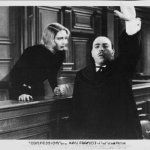
Now it’s Vera’s turn to talk, but she refuses. “What do you all want of me?” she bitterly asks. “I killed him; sentence me.” Her unwillingness to talk is ended when a man bursts into the courtroom with a suitcase in his hand. Suddenly, Vera agrees to testify, but only if the courtroom is cleared of all spectators. The judge agrees, and the room is emptied.

It is then when Vera begins to tell her story…

A flashback to Warsaw, circa 1912, follows. Vera is on the stage performing “Mazurka,” in a first-rate opera house. As the lavish production finishes, she takes the stage to accept her standing ovation, while the conductor, Michael Michailow, makes a personal gesture of gratitude regarding her triumph.

Backstage, in Vera’s dressing room, Michael enters and begins to try to manipulate Vera. She is tired of being an opera star, and is ready to settle down with Leonide Kirow, her future husband whom Michael deems a “stolid soldier.” Michael tries to change her mind, but it’s too late. Leonide enters, Michael leaves, the two embrace each other.

After marriage and a child, Leonide is called off for duty in the First World War. Because of this, Vera becomes most concerned with their daughter’s well-being. She makes every effort to ensure that her daughter is protected, calling upon a doctor for the silliest of problems.

It is because of all the stress she is brining upon herself that her doctor advises her to go out and leave the baby home, at least for one night. Have fun. Relax. Forget about all of your responsibilities for one night.

Unfortunately, it is this advise which brings upon Vera’s fall…

Enjoying drinks and laughs with old friends, Vera accompanies her friends back to Michael’s home, where the party continues until the very early hours of the next morning. As he is accompanying a drunk Vera, however, Michael sees a sexual opportunity he could possibly take advantage of. The two go upstairs to Michael’s room, and engage in “One Hour of Romance.”

The next morning, Vera wakes up on Michael’s bed (the hysterical part of this is, she is completely gowned as if not one piece of clothing ever came off). She rushes home and throws herself into a scalding tub to wash off.

Soon after this Leonide returns home. Vera is resistant to him, and he automatically suspects his injury has caused her not to love him (he lost an arm during battle). She insists this isn’t the problem, and when she gets another letter from Michael, she leaves the house immediately.

Vera has not been answering one of his many letter, and an irritated Michael demands and answer.

At Michael’s house, Vera tells him to back off. That she didn’t come for a “stupid rendezvous” with him. They discuss, bitterly, what happened, and what Vera doesn’t know is that Leonide has followed her to Michael’s, and now knows everything that happened.

Leonide divorces Vera, taking their daughter far away with him, and even going as far as to change his name. Unable to find employment, Vera is forced into a disgraced lifestyle…wandering the streets, working in cheap cabarets to make some spare dimes to barely feed herself.

She has reached rock bottom.

One day, Vera manages to track the home down where Leonide moved himself, their daughter, and his new wife who has come to raise Vera’s daughter as her own. Vera hears that Leonide has died when she arrives at the door, but catches a brief glimpse of her daughter, Lisa, when she runs to thank her mother for the beautiful gift she purchased for Lisa while she was away. Vera’s eyes briefly tear up, looking at how much Lisa has matured, and how much she has missed out on forming a solid bond with her.

When Leonide’s wife returns to Vera, she explains that Leonide insisted that Lisa be brought up with the idea that she was her real mother. Vera decides that maybe this was better, and leaves the house with the idea in her head that, if she dies, at least she can say she knows her daughter is happy.

Then, “that very night,” Vera goes on the stage at the cheap cabaret to perform her act. She spots Michael and Lisa in the back corner, and decides to save Lisa before Michael can seduce her as well.

It was out of a mother’s determination to save her child that Vera shot Michael, and her sentence is minimal. When the public is brought back in, they hear that Vera is sentenced to only three years, “the time of which the accused has been under arrest is to be subtracted from her sentence.” He then goes to discuss—without telling any information about Vera’s real reason to kill Michael—that Michael’s murder was justifiable.

Vera can now rest knowing that Lisa will never know she is her real mother.

Leaving the courtroom, Lisa gives her “mother” a hug, only to go and approach Vera after.

“Madame Kowalska,” she calls out. Vera unemotionally turns around, only to come to quick attention when she realizes its Lisa. “I just wanted to tell you that…I just had to tell you…that I want to wish you the best of everything.” She extends her hand for a handshake, only to get a cold vibe from Vera and gently pull it back towards herself.

A ghost image of Vera appears—and a mother reaches out to give her daughter the one thing she would never dare to attempt, an embrace of her daughter, showing the true love from her true mother.

“Thank you, Miss Lisa,” Vera solemnly says, turning her back and walking on to serve out her sentence.

Confession is Kay Francis’ film. Though she doesn’t appear until about the twenty-minute mark, she keeps herself the center of attention throughout the rest of the movie. The introduction gives Jane Bryan a great chance to prove her naturalness to her acting, and perhaps this was a move from Warner Brothers to not only allow Francis to be beautifully represented, but Bryan as well.

Jane Bryan was the first of the Teresa Wright, Joan Leslie generation of young, fresh actresses of the late 1930s/early 1940s. However, she was the best, and Confession is one of the greatest examples of her work. Unfortunately, her career didn’t last long. She left the screen for a successful marriage which drew her attention elsewhere.

This is another deceiving part for Basil Rathbone. His typecasting in such parts rivaled Kay’s typecasting in her vamp roles in films such as A Notorious Affair (1930), in which the tables were turned, and the plot had Kay seducing Rathbone. Still, he is an interesting aspect to the film, and I can’t really picture Fredric March, the original contender for the role of Michael, doing better than he.

Rathbone had such an experience in these types of parts; he was one of the finest character actors of his generation. In the opening scenes, he provides a distant, eerie touch to the film which brings out the dismal realities of post-war Europe, largely destroyed by the economic slow-down from the expenses, worsened by the Treaty of Versailles.

Ian Hunter again plays his ideal role. He is an honorable soldier, but he gets some deserved attention in the way he reacts to finding out Vera’s affair with Michael. It is then, in that brief moment as she chases after him, when Leonide finally becomes alive. During most of the film, he really is just a “stolid soldier.”

We first spot Kay in the cabaret scenes. She wears gaunt make-up, exaggerated around her intense eyes, which makes her look like she’s about to finally have a nervous breakdown. This adds to the realism of her reaction to the overwhelming shock she gets when she spots Lisa dining with Michael.

As the glamorous opera star, Kay Francis is what we expect her to be: glamorous, honorable, charming, and slightly naïve, though considerably intelligent. Her hairstyle is a little distracting, though. Well, maybe not so much the overall hairstyle as the upside-down heart formed in her bangs. It’s distracting, and I couldn’t keep my eyes from staring at it.

She’s beautiful when Hunter comes to greet her backstage after her performance of “Mazurka.” I don’t have any knowledge about “Mazurka,” but Kay and the rest of the people on the stage make the finale seem so good that I would have liked to see a performance of that, too.

Of course her singing is dubbed, though.

Her greatest scene is also her last. I will always consider that long walk down the hall one of the best movie finales ever achieved. The score—a character itself throughout the film—adds a considerable amount of drama to this.

Confession turned out to be Kay’s last real great movie of her career, and definitely the final one which best represented her as a screen star. Though she and the cast had a number of problems with Joe May’s direction throughout filming, a behind the scenes struggle does not come across in this film at all.

It’s an unappreciated classic, worthy of a prestigious DVD release.


Vintage Reviews:

No matter to what clime the Warner cameras travel in search of Old World décor to piece out a production schedule that can’t, obviously, be composed entirely of important matters like “The Life of Emile Zola,” Miss Kay Francis keeps turning up, like the black queen in the fortune teller’s cards, presaging ill fortunate, misunderstanding, heartbreak and a charmingly slurred consonant or so.

The Strand’s current “Confession,” is, however, the first film that has discovered Miss Francis performing the neatest of tricks, darkly brooding in a blond peruke. In “Confession” Miss Francis is an operatic contralto, who, reduced to torch singing in Continental cafes by cruel fortune, kills that eternal satyr, Basil Rathbone (the man whose machinations had separated her years before from her husband and girl baby), when she discovers him attempting to seduce her now grown daughter.

The story is not particularly well conceived, its tragedy growing out of a situation that a good, plain heart-to-heart talk might have cleared up in a trice, even in prissy pre-war Poland.

The leading characters are stuck off from familiar matrices: Ian Hunter, the honor-bright husband; Basil Rathbone, a most unmitigated scoundrel, and Miss Francis, a heroine who seems able to find words for every situation except the one that brings the whole affair on. The refreshing note is the presence in the cast of Miss Jane Bryan, one of the most promising of the Warner stock players, who seems to provide a concisely sincere performance no matter how artificial the rest of the piece may be.

Written by John T. McManus. Published on August 19, 1937 in the New York Times.

From the October 1937 issue of Screenland:

confessionoctober1937screenland


Lobby cards & Film Posters:

Lobby Cards:

confessionlobbylllconfessionlobbyconfession7433confession742confessiolobby8


Posters:

confessionlobbyconfessiontitlelobbyconfessionposter2confessioninsert confessionposter42


Misc. Images

confessionmpherald837


Raffles (1930)

raffles10021Cast:

Ronald Colman … Raffles
Kay Francis … Gwen
Bramwell Fletcher … Bunny
Frances Dade … Ethel Crowley
David Torrence … Inspector McKenzie
Alison Skipworth … Lady Kitty Melrose
Frederick Kerr … Lord Harry Melrose
John Rogers … Crawshaw
Wilson Benge … Barraclough

Directed by George Fitzmaurice & Harry D’Arrast.
Produced by Samuel Goldwyn.

Based on a novel by Ernest William Hornnung.
Screenplay by Sidney Howard.
Art Direction by Park French & William Cameron Menzies.
Cinematography by George S. Barnes & Gregg Toland.
Film Editing by Stuart Heisler.

A Samuel Goldwyn Production.
A United Artists Release.
Released July 24, 1930.

Background:

Raffles was Kay Francis’ first prestige Hollywood production. But don’t be fooled right away, this isn’t her movie. Ronald Colman, already a legend as early as 1930, received solo star billing in this one, which became one of the highest grossing movies of the year.

For such a popular movie, Raffles was dated material as early as 1930. Film versions of Ernest William Hornung’s novel, “The Amateur Craftsman,” had been produced in 1905, 1917, and 1925. John Barrymore had starred in the 1917 version, which was directed by George Irving and featured Frank Morgan and Evelyn Brent.

But it’s Sam Goldwyn’s 1930 film version which most critics consider the quintessential version, despite the excellent handling of the material by David Niven and Olivia de Havilland in the 1939 remake. This, Goldwyn felt, was the perfect star vehicle for his protégé, Ronald Colman, who had been one of the foremost leading men in silent films. Now with talkies, which enabled him to really show off his distinct British accent, in vogue, Goldwyn decided his star should be highlighted amongst lesser known players, such as Kay Francis.

Surprisingly, even lesser names were considered. Bette Davis—yes, Bette Davis—was one of the suggestions for the role of Lady Gwen. “What are you guys trying to do to me?” Goldwyn asked when her name came up in the pre-production months. He flat out refused, and she continued her string of B movies at Universal.

Kay Francis, however, was a different story. She was relatively new to movies, making her film debut only the previous year in Gentlemen of the Press (1929), with Walter Huston. She completed The Marriage Playground (1929) with Fredric March, and Street of Chance and For the Defense (both 1930) with William Powell. Borrowed from Paramount, Raffles really introduced Kay Francis to a wide range of moviegoers in a sophisticated, sympathetic role which would become the antithesis of her later roles at Paramount (once her vamp characterizations were over, that is). He considered her the perfect choice; she was sophisticated and popular, but not popular enough to distract attention from the film’s real star.

She made her test for the movie on January 2, 1930, and thrilled Goldwyn and Colman so much she was asked to reteam with the two men for Cynara (1932), on loan out from Warner Brothers. The latter film proved to be another must-see, though not on the level of this one, which garnered a 1.2 million-dollar profit at the box office.

“Considering the condition of the country,” wrote Sam Goldwyn to his General Manager Abe Lehr on October 2, 1930, “I think this is marvelous.”


Webmaster’s Review:

This movie opens with bored policeman discussing the Amateur Craftsman as they sip their tea. “They all get nabbed sooner or later,” says one officer.

We see A.J. Raffles, a shadowy figure, stealing from a safe during the middle of the night. Outside, a silhouette of a police officer patrols the outside grounds. Taking jewelry, he leaves a note reading “The Amateur Craftsman-His final appearance.” This skilled “Amateur” is so brilliant, he leaves his location of crime through the front door.

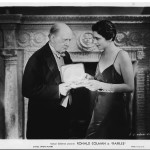
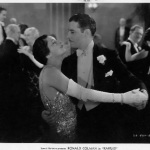
At an elegant party, Raffles dances with the beautiful Lady Gwen. He often confesses his love for her, but she refuses to see him in the serious, marrying way, or at least that’s what she wants him to think. They celebrate their plans to marry with a drink with friends. He places a stunning diamond bracelet, the one which he stole from the safe, around her wrist and kisses her goodnight.

Back at his home, Raffles and his servant discover Bunny Manders lying on the floor of his bathroom; a suicide attempt with gas poisoning because he fears his own future. “I’m a thief!” he exclaims to Raffles, telling him he wrote a bogus check for $1,000 pounds. “They might even arrest me!”

“We’ll have to use our wits,” Raffles informs him. “Or I should say, my wits.”

Raffles spends the weekend at the Melrose Estate, the home of Lord Harry Melrose and his wife, Lady Kitty. At dinner, Inspector Mackenzie of Scotland Yard arrives to inform Lord Harry of a coming robber to the Melrose Estate. Trying not to panic, they prepare the house for the worst, but Lady Melrose goes into a complete over the top fiasco. She takes advice from Raffles which is to hide the case for the necklace in the safe, and keep the real thing around her neck the entire night.

She sees his point with this. The first stop a robber is going to make is at the safe. He’s going to grab the case, thinking that the necklace is already inside, and head out as soon as possible.

During the night, Raffles goes into the room where the burglar alarm is set up and turns it off. Crawshaw breaks into the house and steals the necklace from the fat neck of Lady Melrose while she sleeps. As he is heading out, Raffles grabs hold of him by taking him at gunpoint. Alone with him, Raffles gets the necklace and tells Crawshaw to beat it.

Mackenzie notices that a window in the hall has been opened, and he closes it at once and resets the alarm. When Raffles tries to aid Crawshaw out of the window, the alarm sounds, and the entire house goes into a panic. Crawshaw is captured by the detectives, and threatens Raffles with a coming revenge.

During all of this, Lady Melrose remains asleep, and when the detectives find nothing on Crawshaw, they let him go, assuming all is in the safe. When the morning comes, however, Lady Melrose is in a panic that he necklace is gone, but Mackenzie doesn’t assume that it was Crawshaw, but Mr. Raffles himself.

Adding to Mackenzie’s suspicion is the fact that Raffles insists on leaving for London the following day. He decides to follow him back, and arrives at Raffles apartment to search around for the missing necklace. Gwen overhears Mackenzie’s plan, and heads to Raffles to warn him of coming danger.

In London, at Raffles apartment, the two hide the necklace in a tobacco tin. When Mackenzie casually arrives, he looks over Raffles’ apartment, and then sits down on the couch and goes straight for the tin to add tobacco to his pipe. Gwen distracts him for a brief second, allowing Raffles to quickly grab the necklace from the tin.

Crawshaw arrives in Raffles apartment, looking for the necklace. Raffles struggles for the gun Crawshaw has drawn, then again helps him escape from the house before Mackenzie and the other detectives spot him. There comes a big confrontation in the main room, and Mackenzie confronts Raffles, in front of Gwen, as being the Amateur Craftsman. Raffles returns the necklace, and Gwen returns a bracelet Raffles had stolen for her, and the police go to arrest him.

Like a true debonair criminal, he manages to get away. “They’ll nab him downstairs,” Mackenzie says.

“I wonder,” Gwen says with a charming smile on her face.

This is Ronald Colman’s movie. He’s the perfect sort of actor for the Raffles role. Only he had the right balance of charm and danger to pull off being such a slick English criminal. He’s at his best when Crawshaw breaks into the Melrose Estate and steals the necklace from Lady Melrose. He’s so sneaky and on his toes, just ready to grab a hold of Crawshaw so he can steal the necklace from another robber already after it.

It’s a great example of irony of the situation. A robber hustling another robber for a valuable necklace.

Kay Francis doesn’t have many scenes, but she’s beautiful to look at. She’s sophisticated and has great chemistry with Colman, particularly in an early scene when the two are in the back of her car, kissing and cuddling. When she learns what Raffles is up to, she doesn’t panic, but if anything, loves him even more. She becomes determined to help him, not run away.

Kay makes this believable without coming off as stupid or corny.

Look at the dress Alison Skipworth wears at the dinner at the Melrose Estate. For such a large woman, it is quite a revealing dress, but she’s hysterical as the out of her mind Lady Melrose, and the dress adds to this strange bit of comedy.

The film as a whole is a little slow moving, but it doesn’t have a ridiculous running time, and once things get going the action unfolds quickly. The last ten minutes of the movie, which are supposed to be the climax of the story, are actually the longest, to me at least.

It’s a great companion piece to The Last of Mrs. Cheyney (1929, with Norma Shearer and Basil Rathbone). Anyone who likes one picture, will certainly like the other.


Film Advertisements:

Lobby Card
Lobby Card
Lobby Card
Lobby Card

raffles

I Found Stella Parish (1935)

founstellaparish4Cast:
Kay Francis … Stella Parish
Ian Hunter … Keith Lockridge
Paul Lukas … Stephen Norman
Sybil Jason … Gloria Parish
Jessie Ralph … Nana
Barton MacLane … Clifton ‘Cliff’ Jeffords
Eddie Acuff … Dimmy
Joe Sawyer … Chuck
Walter Kingsford … Reeves, the Editor
Harry Beresford … James
Robert Strange … Jed Duffy

Produced by Harry Joe Brown.
Directed by Mervyn LeRoy.

Story by John Monk Saunders.
Screenplay by Casey Robinson.
Music Direction by Leo F. Forbstein.
Original Music by Heinz Roemheld.
Art Direction by Robert M. Haas.
Gowns by Orry-Kelly.
Cinematography by Six Hickox.
Film Editing by William Clemens.

A First National Picture.
Released November 4, 1935.

Box Office Information:
Cost of Production: $392,000
Domestic Gross: $461,000
Foreign Gross: $374,000
Total Gross: $835,000

(See the Box Office Page for more info.)


Background:

To top one of the most memorable years in the film career of Kay Francis, Warner Brothers’ release of I Found Stella Parish (1935) at the end of 1935 did more than solidify Kay as the Queen of Warner Brothers, it really got her name out there as one of the most profitable box office attractions in Hollywood.

A star at Warner Brothers for three years before I Found Stella Parish went into production, Kay Francis emerged as the Queen of Warner Brothers lot after the public wane of Ruth Chatterton around early 1933. When The House on 56th Street (1933), a Ruth Chatterton reject which was subsequently given to Kay, emerged as one of the most profitable of Warner Brothers’ films of that season, Kay got the royalty title at the studio, but there was still a level she needed to rise up to. It was a star level which boosted celebrity names like Norma Shearer, Joan Crawford, and Greta Garbo.

I Found Stella Parish matched the success of the films all three ladies were making at Metro Goldwyn Mayer, and now Warner Brothers could proudly hype their Kay Francis as Crawford’s box office equal. The film might not have been original or brilliant, but it was a commercial blockbuster, doing record business in New York and forcing Jack Warner to give Kay a significant salary increase before her old contract had even expired.

By 1935, Kay Francis was the undoubted Queen of Warner Brothers. Her yearly salary registered at $115,000 while Bette Davis, despite an Oscar for Dangerous, registered at $18,000—a startling difference, but proof that an Oscar didn’t hold much importance with the public perception of film stars. Today, one movie isn’t really better than the other, but Dangerous will automatically get all the notoriety because of Davis, which is, no offense, ridiculous.

Stella Parish was based on John Monk Saunder’s “The Judas Tree,” and involved a backstage plot about an actress’ desperate attempt to protect her daughter from knowing the secrets of her shady past. It was the ideal Kay Francis formula, and filmed with a prestige that surpassed a number of Warner Brothers’ other releases of that year, headlined with names nearly as big as Kay’s.

Director Mervyn LeRoy and producer Harry Joe Brown seemed to go all out on I Found Stella Parish. Filming began on August 19, 1935 and much detail was paid attention to in terms of costumes and sets. The Complete Kay Francis Career Record pointed out that Kay’s Grecian scenes required Perc Westmore to design a blue-white wig, to which Orry-Kelly responded by designing a blue-white gown. Because of this, LeRoy insisted on using a blue-white set, which Lynn Kear and John Rossman admitted “seems like a lot of work for a black-and-white film.” But it was proof of Kay’s importance at the studio.

The New York Daily Mirror noted that the film was “Splendidly directed and played by an unusually strong company.” Other reviews had nothing but mostly strong praises for Kay’s work.

I Found Stella Parish did record business in New York,” Kay biographer Scott O’Brien wrote in Kay Francis: I Can’t Wait to be Forgotten. Because of the movie’s massive commercial success, Jack Warner gave Kay a new contract before her old one even expired. This was the one which promised her the lead in Tovarich, and gave her a major salary increase. It was because of this bonus that Bette Davis went right back supporting parts at Warner Brothers while Kay triumphed in top productions which made her a major box-office attraction.


ifoundstellaparish

Trivia: I Found Stella Parish was the first and only time Kay Francis would work with legendary director Mervyn LeRoy.

I Found Stella Parish was the first of seven onscreen pairings between Kay Francis and Ian Hunter.

Sybil Jason, who plays Kay’s daughter in the film, also played Kay’s daughter three years later in Comet Over Broadway (1938). She’s best known for playing “Becky” in Shirley Temple’s 1939 classic, The Little Princess -which also featured Ian Hunter.

The film opened on November 4, 1935 at the Strand Theatre in New York City.

The film reunited Kay with Paul Lukas, who had appeared with her in Illusion (1929), Behind the Makeup (1930), and The Vice Squad (1931). It was also their last appearance together onscreen.

The film was an immediate success, which prompted Jack Warner to give Kay a new contract although her old one had yet to expire. On November 6, 1935, the Los Angeles Examiner printed the news from Louella Parsons, “Jack Warner told her that she had accepted any story given to her without a word and had always been gracious and lacking in unpleasant temperament, that he wanted to show his appreciation by handing her a voluntary three-year contract.”

That three-year contract was the same one Kay would eventually try to legally get herself free from in 1937. It also made her one of the highest paid actresses in Hollywood and, eventually, the highest paid actress on the Warner Brothers lot.

By 1935 Warner Brothers was already receiving negative feedback from fans about their lack of care about Kay Francis vehicles. On February 16, 1935, gossip queen Louella Parsons reported in the Los Angeles Examiner, “[Hal Wallis] says they are acquiring plays, one by one, suitable for her, so that they will have a list to choose from. A few days ago, I Found Stella Parish, the dramatic story of an actress, by John Monk Saunders, was purchased for Kay in mind.”

On October 30, 1970, I Found Stella Pairsh and Torch Singer (1933) were screened at The New School, for the purpose of showing the difference between PreCode melodramas to those made under the tyrannical Production Code. Torch Singer starred Claudette Colbert and Ricardo Cortez. Colbert was given the lead in Tovarich (1937) which was originally purchased for Kay. Cortez appeared with Kay in four films.

On November 1, 1935, Kay, Sybil Jason and Ian Hunter promoted the film on the Hollywood Hotel radio show.


ifoundstellaparishherald


Webmaster’s Review:

I Found Stella Parish opens in London, England. Opening scenes reveal huge promotional ads reading “Stephan Norman Presents Stella Parish in ‘The Brief Hour.’” This is opening night, and Stephen greets Stella backstage before the show to wish her luck and give her a pep talk before she goes on. They have known each other for three years, ever since Stephen discovered her in some small gig and gave her a major chance. They agreed to build an air of mystery about her, making her aloof and socially unavailable to the public. The only time she is scene is in lobby stills, and she has never granted interviews to reporters.

However, tonight is crucial in the careers of both Stephan and Stella, and he persuades her into accepting an invitation to a party he is throwing after the show ends. She takes to the stage and is welcomed by a major audience appreciation. When the curtain closes, a standing ovation is followed by huge bouquets of flowers being brought to Stella as she receives her audience appreciation. But a mysterious visitor awaits in her dressing room, one who knows the dark secret of Stella Parish’s shady past.

“You sure had those monkeys goggle-eyed out there tonight. I’d like to see the looks on their faces if I told them what you and I know. I bet you they’d swallow their monocles.”

“You can’t scare me,” she insists, with tears running down her face.

The guests wait at Stephan Norman’s for two hours and still no sign of Stella Parish. One of the notable guests is Keith Lockridge, a legendary reporter who is an expert at getting the juiciest stories for his publishers. He is with Stephan when they receive word from a cable that Stella has decided to leave the stage forever. On the hunt for the dirt, Lockridge goes with Stephan to Stella’s apartment only to hear that she has packed and left, leaving only the maid behind to straighten up the place for the landlord. Lockridge takes the maid out to a bar and gets her drunk so she’ll loosen her lips about Stella’s life and maybe her whereabouts.

Keith manages to track Stella back to a steamship heading to the United States. Onboard he hears nothing of Stella’s presence onboard, but is taken by an elderly woman whose toes are stepped on by Keith twice before he starts to suspect something else is going on. Interested, he takes to a little girl named Gloria, whose elderly aunt just happens to be the elderly woman who Keith had the bad run in with. What Keith doesn’t yet know is that the elderly woman is Stella Parish in disguise, and that Gloria is her daughter, not her niece.

When they reach the United States, Keith goes to kiss Stella’s hand, realizing that it is the hand of a young woman, and draws in on the information he has gathered that this is the real Stella Parish in disguise. He wires his publisher: “I have found Stella Parish. Withhold publication until I secure all details. Lockridge.”

In New York, Keith pretends to run into Stella, Gloria, and Nana, Stella’s Mother, in a park, pretending not to know that Gloria’s mom is Stella Parish. They go to lunch, and Keith feeds Stella a bunch of fluff about how the elderly woman he met onboard the steamship was one of the best people he has ever met in his life. This is trick into manipulating Stella that she can trust him, and she begins to.

Alone with Gloria in their apartment, Keith pumps her for information on her mother while they play around as performers. Stella and Nana return, and Stella realizes that she has come to fall in love with Stephen. Thinking he can be trusted, she tells him her story.

Back in her starting days, Stella was married to vaudevillian Clifton Jeffers, a hard drinking jealous husband who was very possessive of Stella. When she realized she was pregnant with his child, she consulted a male friend, her husband walked in, though the worse, and killed him. Both Stella and Clifton were convicted for murder, and Stella’s baby was born while she was in prison. She got out quick, moved to England, met Stephan Norman, and the rest is history.

Keith tries to get his publishers to cool on the idea of printing the information on Stella because he has fallen in love with her. Of course, it’s too late, and there is a major explosion in the media.

Surrounded by reporters in her apartment, Keith walks in and receives a deserved scolding in front of the other reporters. She explains how he sucked his was into her life, and even pumped her kid for information. With that, she tells them all to hit the road and gets Nana alone for a chat about what has to be done about this.

Stella decides that Nana should take Gloria away—raise her alone. Stella promises to support them by working as an actress, taking jobs only where she is going to make the most money. Unfortunately, time begins to take its toll, and people loose interest in Stella, and she is lowered into working cheap burlesque shows for small cash. She has his rock bottom, with Stephan Norman coming right on cue.

Alone with Stella backstage, he explains that she should return to England, where she was made a star in the first place. She reluctantly agrees to cross continents again, and return to the London stage for “This Brief Hour.”

Doubting her own talent and chances for a comeback, Stella begs Stephan to draw the curtain and forget the whole thing. Giving her a pep talk, Keith appears and tells Stella she has no choice but to go on, and tells her that Nana and Gloria are in the audience. Crying, she asks how he could do such a thing to her, and he explains that she doesn’t have to comeback for Stephan, Nana, or even herself, but for Gloria. Stephan then explains that it was Keith who urged him to contact Stella for a comeback, and that it was Keith who did major damage control in the press, and now it is Stella’s time to return to what she does best.

With that, she blows Gloria a kiss from the stage, and takes her call, receiving a major audience applause as she makes her entrance. Smiling, tears flow down from Stella’s face as she enjoys the fact that she has come to perceiver.

The cast is uniformly excellent in this one, though I was never a big fan of Sybil Jason. She tries too hard to be cute, not sure if that’s her fault of the men who directed her. She wasn’t a Shirley Temple, and it’s a shame Warner Brothers tried so hard to make her be. She is especially annoying in the scene where she and Keith play in the apartment alone. Wearing one of Stella’s old costumes, she has an oversized hat on that she keeps preventing from falling off of her head. After a dozen or so times, one wants to grab the damn thing and throw it across the room.

Ian Hunter probably was a wise choice for Lockridge. I can’t think of another actor who could have won the audience sympathy after acting like such a snake. By the final scenes, one really does want Stella to forgive him, even after all he has done, and when he goes to see her when she is confronted by all the reporters, one just wants to jump into the scene and explain everything to Stella for him. It’s funny to watch him play the wolf opposite Sybil Jason’s Little Red Riding-Hood in the apartment. His growls and facial expressions are completely realistic.

Paul Lukas and Jessie Ralph do well with their roles, even though they aren’t allotted much camera time and are given dull characters.

The real star of this piece, of course, is Kay Francis. She rises to top form here as a movie star. While this isn’t her best acting, I Found Stella Parish is the type of film which represents Kay Francis as a movie personality. She’s intelligent, talented, stylish, and has a heart of gold underneath her exotic persona.

She’s stunningly photographed throughout the entire production. Even in the scenes where she is wearing no makeup she is gorgeous. Watching her perform in “This Brief Hour” makes one want to see her in a production of Troy or something. She’s gorgeous in those Trojan costumes. This was her first work with director Mervyn LeRoy, and was also her last.

Released to inconsistent reviews, Stella Parish became a commercial blockbuster, one which solidified Kay Francis as a top contender in Hollywood. She had already earned the Queen of Warner Brothers title, but now she was giving stars such as Joan Crawford and Norma Shearer a run for their box office. Not surprisingly, I Found Stella Parish was one of Warner Brothers’ most successful films of the 1935 movie season.


Vintage Reviews:

Kay Francis, who has been skirmishing with light comedy in her recent pictures, returns to the lachrymose drama in the Strand’s new photoplay, “I Found Stella Parish.” If First National has overlooked any of the familiar devices for wringing the last tear from the reluctant duct, the omission is not sufficiently marked to be mentioned. Not merely is the story too, too tragic, but Mervyn LeRoy has directed it in the cadence of a graveyard processional.

Against the constant burblings of the players and the amazing style parade that Miss Francis always manages to stage, the picture unrolls the somber tale of a woman who found life thwarting her at every turn. The great Stella Parish, only of the London stage, wants only to protect her child from learning the sad facts of life—particularly those of her mother’s early life.

When those facts threaten to become known, Miss Parish flees in disguise to America, only to be betrayed by a British newspaper man with whom she had come to love. Seeking still to protect the child, the mother makes the traditional sacrifice. She sends the youngster away and, to provide for her care and education, goes so low in the theatrical scale as to make “true confessional” appearances in burlesque and the eight-a-day vaudeville circuits.

A happy ending—although, naturally, Miss Francis faces it with tear-filled eyes—is contrived at last, but with what contortions no one will know unless he happens to visit the Strand this week or can gather it from the sobs of departing audiences. All told, here is a sorry tale and one that has but few redeeming qualities. Among these may be mentioned Ian Hunter’s portrayal of the reporter and Sybil Jason’s (with some reservations) performance as the child. Miss Francis’s unfortunate lisp continues to plague this corner; it makes even more unbelievable the notion that London could regard her Stella Parish as the Duse of the day.
Published in the New York Times, November 4, 1935.


Movie Advertisements:

Lobby Cards:


Posters:


Window Card
Window Card

ifoundstellaparish09243


Misc Images:ifoundstellaparishad232


Polish Ads:stellaparishpolish3stellaparishpolish2stellaparishpolish1

German Ad:ifoundstellaparishgerman

Allotment Wives (1945)

allotmentwives

Cast:
Kay Francis … Sheila Seymour
Paul Kelly … Major Pete Martin
Otto Kruger … Whitey Colton
Gertrude Michael … Gladys Smith
Teala Loring … Connie Seymour
Bernard Nedell … Spike Malone
Anthony Warde … Joe Agnew
Matty Fain … Louie Moranto
Jonathan Hale … Brig. General H. N. Gilbert
Selmer Jackson … Deacon Sam
Terry Frost … George Shields
Reid Kilpatrick … Philip Van Brook
Doris Lloyd … Alice Van Brook
Marcelle Corday … Madame Gaston
Evelyn Eaton … Ann Farley

Directed by William Nigh.
Produced by Jeffery Bernerd & Kay Francis.

Story by Sidney Sutherland.
Screenplay by Harvey Gates & Sidney Sutherland.
Art Direction by Dave Milton.
Set Decoration by Vin Taylor.
Cinematography by Harry Neumann.
Film Editing by William Austin.
Miss Francis’ Gowns by Odette Myrtil.
Miss Francis’ Hats by Keneth Hopkins.
Musical Direction by Edward J. Kay.
Special Effects by Bob Clark.

A Monogram Picture.
Released December 29, 1945.

Background:

Allotment Wives takes the form of campy film noir, a sort-of take on Mildred Pierce (1945) in which a self-sacrificing mother will do anything to gain happiness for her daughter. While Mildred Pierce asks the question “could this mother really have committed murder?” Allotment Wives asks “who the hell didn’t this manipulative monster-mommy didn’t have gunned down?”

Kay Francis is, of course, the monster-mommy. It’s one of her best roles.

By 1945 Kay’s generation of Hollywood (Norma Shearer, Garbo, Dietrich, Joan Crawford) had been all but eclipsed by the younger Judy Garland, Greer Garson, Lana Turner, and Betty Grable. At that time, Joan Crawford’s career had slumped considerably, though not as much as Kay’s. When Warner Brothers gave her the title role of Mildred Pierce, the budget was limited due to a belief that Joan, like Kay, was still “box office poison.”

The film exploded at the box office, being one of the top-ten grossing movies of the year, and Crawford won an Oscar for Best Actress for her performance. As usual, the smaller “poverty row” studios, such as Monogram Pictures, were quick to market off of the success of Mildred by producing their own version. Since the Production Code Administration paid less attention to studios like Monogram, a character like Shelia Seymour could virtually kill off an entire city population as long as she was gunned down—by honest policemen— at the end.

Similar to Divorce, Allotment Wives was co-produced by Kay with Jeffery Bernerd. The cast, with the exception of Kay, was an unfamiliar one. Gertrude Michael, who played Gladys Smith, was one of the more promising starlets of Pre-Code Hollywood. Her battle with alcoholism seriously limited her chances at emerging into a famous celebrity. But that’s about it, and it’s unusual that Kay didn’t get star billing in this one, but then again, maybe it’s better she wasn’t picky about such things at the end of her career in films.

A typical low-budget programmer, Allotment Wives was completed within ten days and released to smaller theaters of lesser quality. It didn’t become a box office record-breaker, but had a respectable run because of Kay, who, in the eyes of most moviegoers, was not in favor of a rebirth—in Hollywood, at least—like Joan Crawford. Perhaps it’s better that Kay ended her career when she did.

But then again, perhaps not…


Webmaster’s Review:

Allotment Wives opens with a brief explanation about the War Department Office of Dependency Benefits (ODB), and their effort to aid the families of servicemen giving the ultimate sacrifice for their country by serving in World War II.

However, the narrator also describes the attempts made of those who saw the ODB’s efforts as a quick way to make some serious cash. Women were married off to naive servicemen, collecting their checks from the ODB and giving them back to racket-leaders who organized the whole ordeal.

These women became known as “Allotment Wives…”

The film opens with Colonel Pete Martin reporting to General Gilbert to learn more about the racket, and tips on how to uncover new leaders and expose this scam by destroying it from the inside out. Gilbert uses the Sheila Seymour case as a prime example of how intelligent and unsuspecting these criminals can be.

Of anyone involved in this ordeal, Shelia Seymour would be the most unlikely of criminals. She ran the most successful canteen for servicemen, aside from running her own beauty salon, which was a front for where her crew would hold their emergency meetings.

Gilbert begins to explain the case…with the story really being told in flashback, though there is no narration or returns to Gilbert’s office, with the exception of the end of the film.

On a beautiful day, Shelia Seymour lunches with businessmen, discussing plans for her canteen. At the other end of the diner, a woman and her man are busted for passing money across a table, before an unsuspecting serviceman sits down at the table to meet a “swell” girl someone he knew put a good word in for. A policeman busts the two, sends the officer on his way, and arrests the allotment wife and her organizer.

When the organizer tries to pull a gun on the officer, Pete succeeds in breaking his plans, and the two are walked off to jail.

Shelia returns to her beauty salon where she holds an emergency meeting in her office. There her men discuss what’s been going on, and the ODB’s realization as to what’s been going on. When one of the men suspects danger, Shelia responds that “A hot breath on my back is sometimes more stimulating than a cold shower.”

Moranto, a slimeball who had been planning to take over Shelia’s racket, is thrown out of her group and gunned down after they disperse. Watch when Kay scolds him and then tells him “You’re through! Get out!”

Shelia and Whitey, probably the man most closest to her in her life, sit down and begin to discuss things. Most important to Shelia is Connie, her daughter, who the two spot drunk in a bar just a Shelia begins to tell him that “the only decent though in the world I ever had was for her.” They get her home, put her to bed, and Shelia heads over to her canteen.

There she runs into Gladys Smith, an old associate of hers who she pretends to have no idea of when Gladys first approaches her. Shelia, whose real name was Edna, and Gladys were buddies on the streets, growing up as kids. They were sent to reform school, after which Shelia married rich and manipulated what she couldn’t get to her advantage. Gladys remained on a more obvious path, and is now working for Moranto’s crew.

When Shelia returns home, Connie comes down the stairs to have a blow-out with her mother which rivals the one between Joan Crawford and Ann Blyth in Mildred Pierce. “I’m tired of your preaching!” Connie screams. “I’m tired of being another stupid mother’s daughter. I’m tired of you!” Of course she gets slapped, then covered in remorse from Shelia, who promises that if Connie returns to school and finishes, she, Shelia, and Whitey will go on a special vacation together.

The two have a drink, while Gladys spies through a window. She was given the cold shoulder by Shelia when she approached her at the canteen, and wanted to make sure that Shelia was really “Edna.” She shakes her head and tells her accomplice she’s “sure,” and the two drive off into the night.

Later, when Gladys returns to Shelia’s home, the two discuss their past while Gladys gleefully throws out how they used to share the things they stole growing up. “Stealing was a stupid way to get up in the world,” Shelia tells her, right before she offers Gladys a job at her beauty salon as a chance to make some money.

Both are on to each other from there on, and Shelia arranges to have Whitey set Gladys up so she gets arrested and taken out of the game. The charge is bigamy. Shelia believes that, before Gladys married her second serviceman, she was still married to the first one.

Unfortunately, this proves to be false. The first husband was killed in action literally right before Gladys remarried. But while in the cell, Gladys finds out some interesting information from her cellmate…

Remember the woman in the diner who was arrested? Turns out she is Gladys’ cellmate, and the two begin to discuss things by writing with lipstick on a stool (Gladys suspects they have the cell rigged with “electric ears,” which proves to be true). Through this Gladys learns that Shelia arranged Moranto’s death, and now has a full-blown dedication to go after her old partner in crime, and get back at her by targeting the one thing more important to Shelia than anything else: Connie.

Gladys takes Connie under her wing, and plans to make big money off of her by marrying her off to unsuspecting servicemen. When Shelia hears of this, she is enraged, telling Whitey that “I want Connie and I want her quick. And also, I want Gladys Smith. I want her all to myself. Tell the boys to bring her to me. There’s $5,000 for the one who gets her. Trouble for all if they don’t.”

That very night Gladys and her accomplice, Spike, show up at Shelia’s during the middle of the night. Armed with guns, Spike goes downstairs to clear out Shelia’s safe, while Gladys stays in Shelia’s room. Gladys grabs the phone, calls the ODB—planning on having them go arrest Connie—and before she can mention Shelia’s name, Shelia grabs her gun and shoots Gladys dead.

As soon as Shelia’s boys shoot Spike dead, they meet her upstairs where she orders them to “Get rid of that,” glancing at Gladys’ body. They all run out to get Connie out of the jail. Shelia goes as an unsuspecting friend of one of the officers. She offers to “talk to the girl,” while her men come in and pretend to kidnap Connie, bringing her to home.

There’s a shoot-out during this, and Whitey is gunned down by the officers.

Back at Shelia’s place, she and Connie plan to leave the country for their trip. After years of a rocky relationship, the two begin to make fresh start. “Mother, I think you’re wonderful,” Connie tells her.

Meanwhile the police uncover Shelia’s racket, and arrive at her house right before she and Connie are to leave. Standing at the top of the stairs, just after she pulls her gun, Shelia is shot down by the officers, her last words being “Nice shooting.” She then tumbles forward.

Back in General Gilbert’s office, discussing what happened, Pete chimes in that they convicted Connie Seymour, also. They agree that Connie was the least innocent of them all, considering she was Shelia’s “adopted daughter.”

Before her death, Shelia made sure that, if anything were to happen to her, people would believe that she had adopted Connie, found her on the street, anything but know the truth, which was that she was born to a criminal mother with no sense of good or evil.

It was Shelia’s last heroic effort to protect the only thing she considered valuable in her life, her own daughter.

I love this film. Luckily, it was one of the first Kay Francis movies I ever saw, and I consider myself so lucky because of that.

Her performance is superb, and her best scenes are in the meeting at the salon, when she argues with Whitey over Connie’s behavior, her argument with Connie about her leaving of school, and the one when Gladys and Spike enter her room in the middle of the night.

There’s a hardness, a bitterness, to this performance which makes it unlike anything Kay had ever done. She really makes one picture her on the street as a kid with Gladys, stealing and cheating to get back what life denied her.

Kay’s hairstyle in the film is a little ridiculous; clearly a cheap imitation of Joan Crawford’s in Mildred Pierce. It adds to the campiness of the overall production.

Gertrude Michael, as Gladys, also is phenomenal. She’s unbelievably fake, manipulative, and deceiving. Connie is an annoying character, but Otto Kruger does wonders with his Whitey. He’s all-knowing, and tells Shelia everything she needs to hear, whether she wants to believe him at first or not.

There’s a sleaziness to this cheap Monogram output which makes it one of the best the studio ever released. It’s one of their most popular films, for obvious reasons. Old crime movies like these are so irresistible, with all the shootings, smack-talk, slang, and perverseness to the over-all atmosphere.

William Nigh also directed Kay’s first Monogram feature, Divorce (1945), but he did not direct Wife Wanted (1946). He creates a blood-thirsty atmosphere with a direction which is far superior to Divorce. There’s a lot more action to Allotment Wives, and the story gets around a lot more, too. Granted it gives him more opportunity for artistic freedom, but Nigh runs with it to his fullest possible extent.

For this he is due a major credit.

On the scale of “must-sees” in Kay Francis’ work, one being the least notable and ten being the highest, I’d rate Allotment Wives at around eleven or twelve. It’s great, ridiculous crime entertainment, and surely anyone who watches it will agree they would like to see it again, and again, and again…


Film Advertisements:

allotmentwives532

allotmentwives0765

Gentlemen of the Press (1929)

Photoplay, October 1930Cast:
Walter Huston … Wickland Snell
Kay Francis … Myra May (as Katherine Francis)
Charles Ruggles … Charlie Haven
Betty Lawford … Dorothy Snell
Norman Foster … Ted Hanley
Duncan Penwarden … Mr. Higgenbottom
Lawrence Leslie … Red
Harry Lee … Copy-desk editor

Directed by Millard Webb.
Produced by Monta Bell.

Based on the play by Ward Morehouse.
Screenplay by Bartlett Cormack.
Cinematography by George J. Folsey.
Film Editing by Mort Blumenstock.

A Paramount Picture.
Released May 4, 1929.

IMDb Info.
TCMDb Info.

About the film:

“So we all immediately went to Tony’s,”  remembered Ward Morehouse, writer of Gentlemen of the Press, years later. “And in the haze of that famous backroom we found Kay Francis. She was resting comfortably behind a Tom Collins. She was tall, dark, and interesting-looking but had made far more appearances at Tony’s than she had on the Broadway stage…Her career began that very day.”

Actually, there are a few stories about how Kay Francis received her film debut. The Morehouse version is one. Another states that Kay, already romantically involved with the director (Millard Webb), just asked for it. Another states that Walter Huston (Kay’s “Elmer the Great” costar) got it for her. Whatever the case, Gentlemen of the Press was Kay Francis’ movie debut. What a strong impact she had on moviegoers of the time.

Kay’s stage career had been legit. Though she clearly was no Ruth Chatterton or Ethel Barrymore, her pre-Hollywood stage career was actually busier than that of Bette Davis, and hits like “Crime” and “Elmer the Great” had made her popular enough with reviewers and audiences to draw attention from Hollywood.

But make no mistake. Katherine Francis was by no means a star.

Her affair with the director of the movie had a lot to do with her impact in the production. Kay was given a great deal of camera time, second billing, and great scenes with Walter Huston, as well as her other costars. The “office vamp” had made such an impact with a reviewer for Photoplay, the magazine credited her with one of the greatest film debuts in the history of the movies.

Strangely enough, Kay wanted no part of fame from the very beginning. She was convinced her screen test was hideous, and that her voice was too harsh. What she didn’t understand was that her intense looks and personality made her the perfect candidate for the “vamp of talking pictures.” Silent screen legends Theda Bara and Pola Negri (the latter being Kay’s favorite movie star) became popular with the vamp image approximately fifteen years earlier. With both ladies a thing of the past, Kay Francis was one of the stars who turned the popular character type into something completely different in talking films. Now they were out of the exotic locations and into the heart of every-day American life.

For one reason or another, audiences loved this stuff at the time. It was typecasting from then-on for Kay Francis.

Gentlemen of the Press was produced by Monta Bell, the same director at Metro Goldwyn Mayer who had made a major star out of Norma Shearer in films like The Snob (1924), Lady of the Night (1925), and Upstage (1926). The film, a minor production, scored well with critics, though most agreed that it lacked a real climax. The Huston-Francis teaming worked so well, though, that they were teamed again in three more movies: The Virtuous Sin (1930), Storm At Daybreak (1933), and Always in My Heart (1942).

As for Millard Webb, his affair with Kay ended soon after the film’s completion, and he directed five more movies before his death on April 21, 1935 of an intestinal ailment.


Images:

Below: From the March 1929 issue of Photoplay. On the set of Gentlemen of the Press. Notice the sound recording technology.Photoplay, March 1929

Below: A screenshot from Yasujirō Ozu’s 1930 silent film, That Night’s Wife (Sono yo no tsuma). A poster from Gentlemen of the Press is shown several times throughout the movie. This was the best shot of it.


What the Picture Did for Me:

Exhibitor Herald-World‘s long-running column for theater owners to tell each other what type of business was made and what the quality of the product was for newer films.

October 19, 1929:
Special cast — Good from every standpoint. Speaking is clear (sound-on-film), and patrons praise it to their neighbors. — Carl Veseth, Palace theatre, Malta, Mont. — General patronage.

Walter Huston— September 25-26. An excellent picture that lost plenty of dough for us. Paid too much for it. However, it seemed to have pleased what few turned out. Disc recording good. Do not believe this type of a picture will go over in the majority of the small towns. Ten reels. — Walker & Donnell, Leroy theatre. Lampasas, Tex. — Small town patronage.

January 11, 1930:
Special cast — November 9-10. Not a bad picture, but it appears that some of the country folks did not understand newspapermen stuff. In general, I think it was enjoyed, although not so much of a small-town picture. Disc recording from fair to very good — that is, in a few scenes fair, rest good. Eight reels. — George J. Rhein, Manchester theatre, Manchester, Wis. — Small town patronage.

July 12, 1930:
Special cast – June 20-21. A good talking program picture. The star great. Story good. But picture did not draw at box office. – Bert Silver, Silver Family theatre, Greenville, Mich. – General patronage.


Contemporary Reviews:

Published in Photoplay, June 1929. (Click image to read.)

A generally amusing and creditable piece of talking film fiction has been produced from Ward Morehouse’s play, “Gentlemen of the Press,” in which the rôle of the inevitable dyed-in-the-wool rewrite man, Wickland Snell, played on the stage by John Cromwell, is acted by Walter Huston. It is a dialogue effusion in which the players appear frequently to be waiting for a signal before they speak their lines. These hushed interludes, brief though they may be, cause some discomfort, for it is quite evident that the characters are not thinking of what they are going to say.

The setting of the city room is more reminiscent of that of a very small country paper rather than that of a metropolitan daily. The reporters and others are an improvident lot, sneering at life, greedy and eager for food and alcohol. Of course, no newspaper man by any chance ever refers to a “death watch” without cracking jokes about the dying individual, and once a reporter is intoxicated he stays intoxicated, this being an expedient that permits one of the culprits in this talking version of the romantic sketch to forget on which paper he is working. It is an incident that recalls Richard Harding Davis’s story, “The Derelict,”

This film generated laughter in the Paramount Theatre, particularly when one of the reporters gathers in enough sandwiches to last him for three or four meals.

Wickland Snell staggers his colleagues with the big news that he has been offered a publicity job at $15,000 a year. One can readily imagine how the writers who have been passing a $5 bill from one to another feel on hearing that the speedy Mr. Snell is coming into his own.

Mr. Higginbottom, the real estate operator with ulterior motives, is impersonated by Duncan Penwarden, who also played the part before the footlights. Here he is working frightfully hard to get the public interested in having mausoleums instead of cemetaries. He doesn’t quite trust his “big story” to his publicity promoter and the idea is a flop. Mr. Snell gives Mr. Higginbottom a piece of his mind and then the rewrite man decides to return to his old job.

Mr. Penwarden gives a clever performance. Mr. Huston also does well in the major part. His voice registers naturally and he lends enthusiasm to the rôle. Betty Lawford is attractive and competent as Snell’s daughter. Katherine Francis overacts the conspiring Myra May.

Rudy Vallee and his band are seen in the surrounding program in Jack Partington’s stage offering, “Fifth Avenue.”

A Newspaper Play.
Published in the New York Times, May 13, 1929.


Advertising:

Click here or the image below to download/read Paramount’s
full mock newspaper herald for
Gentlemen of the Press!


Movie Posters:

3315616839_3e49f715fc

Misc. Printing Products:
gentlemenofthepressad2
gentlemenofthepressad1


Magazine advertising:

Motion Picture Herald announcement:gentlemenofthepressad939


King of the Underworld (1939)

king55Cast:

Humphrey Bogart … Joe Gurney
Kay Francis … Dr. Carole Nelson
James Stephenson … Bill Stevens
John Eldredge … Dr. Niles Nelson
Jessie Busley … Aunt Josephine
Arthur Aylesworth … Dr. Sanders
Raymond Brown … Sheriff
Harland Tucker … Mr. Ames
Ralph Remley … Mr. Robert
Charley Foy … Slick
Murray Alper … Eddie
Joe Devlin … Porky
Elliott Sullivan … Mugsy
Alan Davis … Pete
John Harmon … Slats

Produced by Jack Warner & Brian Foy.
Directed by Lewis Seiler.

Based on the novel “Dr. Socrates,” by W.R. Burnett.
Screenplay by George Bricker & Vincent Sherman.
Costumes by Orry-Kelly.
Musical Direction by Leo F. Forbstein.
Original Music by Heinz Roemheld.
Art Direction by Charles Novi.
Cinematography by Sidney Hickox.


A Warner Bros.-First National Picture.
Released January 14, 1939.

Box Office Information:
Cost of Production: $235,000
Domestic Gross: $319,000
Foreign Gross: $179,000
Total Gross: $498,000

See the Box Office Page for more info.

Background:

Warner Brothers’ attack on Kay Francis reached a new low when she was sent to producer Brian Foy to work out the final four films of her contract: My Bill (1938), Comet Over Broadway (1938), King of the Underworld, and Women in the Wind (1939). Foy was the executive producer of the B-picture unit for the Warner Bros.-First National Pictures Association, and to work under such conditions was a huge embarrassment for a star of Kay’s magnitude.

However, King of the Underworld sunk her to a new low.

Humphrey Bogart had been working in such pictures since his film debut in Up the River (1930), which was also the film debut of Spencer Tracy. Often playing supporting roles or second-rate leads, he reached the height of his fame in the 1930’s with his performance in The Petrified Forest (1936), but that was pretty much it aside from good work in Angles With Dirty Faces (1938) and Dark Victory (1939). Other than that, he was still a supporting actor, far from being a star on any level of notoriety.

So when Warner Brothers gave him the star billing in King of the Underworld, and lowered Kay’s name below the title, it was another devastating blow to her career. One would be surprised about how billing can affect a star’s career. Already, Kay had been lowered below the title and was billed equal to names like Ian Hunter, George Brent, and Dickie Moore, all of whom were far from the level of Kay’s fame. But to now be lowered in such a significant way really showed her worthlessness to movie audiences in the eyes of her home studio.

If films like My Bill and Comet Over Broadway made audiences look upon Kay as a thing of the past, King of the Underworld solidified it. She was now an official has-been. This was confirmed in the review of the film by the New York Times (see below).

Originally, Ann Dvorak was considered for Kay’s role in the film. Dvorak, an amazingly talented actress, was another female whose career was notably hurt by Warner Brothers. While they had given her good roles, they had failed to really find a niche for her, and her career decline is probably one of the more serious misfortunes of screen history. She was as talented as she was beautiful, and she could have made some really great dramatic achievements.

Interestingly, Dvorak had been second billed to Paul Muni in Dr. Socrates (1935), which was the film that inspired this cheap remake. Ann had played the role of “Josephine” in the original film, and in the remake she was supposed to play Dr. Carole Nelson, Muni’s character which underwent a sex change in the script for King of the Underworld. The role was passed along to Kay, who mentioned in her diary that she was going to be “Paul Muni in skirts.”

Production began May 25, 1938 and ceased sometime in June. However, the film was withheld from distribution until January 14, 1939, when it was theatrically released. A few years later, Warner Bros. recycled to property again for another programmer, Bullet Scars (1942), which was directed by D. Ross Lederman and had an almost unknown cast.

Critics dismissed the film and largely came to Kay’s rescue by defending her against the studio. “Indeed, considering the plot and everything,” Frank Nugent wrote in the New York Times, “it is our settled conviction that meaner advantage was never taken of a lady.”

Luckily, by the time production of King of the Underworld wrapped, a light began to appear at the end of the long, dreary tunnel. Two months later, at 5:30 P.M. on September 28, 1938, Kay’s employment with Warner Brothers was terminated when her contract expired. She became free from the studio and made her stunning comeback the following year in In Name Only (1939), with Carole Lombard and Cary Grant.

Billed as a costar in Underworld, it should be noted that, in her first film away from Warner Bros., Kay received equal star billing with Lombard and Grant for In Name Only. This proves her popularity with fans as late as 1939.


Webmaster’s Review

Warner Bros. Pictures, INC. presents… HUMPHREY BOGART in KING OF THE UNDERWORLD

…with Kay Francis

That’s how the credits for this movie start out. One can almost see the grin on the faces of Jack and Harry Warner as they watched their revenge on Kay unfold reel by reel in the projection room.

The film opens with Carole and Niles Nelson preparing to operate on a gunshot victim. Molls hide in the hospital to inform Joe Gurney, the gangster who arranged the shooting, what’s going on. When the news comes that the victim will survive, the hostage being held in Gurney’s apartment is shot and killed.

Joe goes into Doctor Nelson’s office and insults him for being a man with “million dollar hands in a dump like this.” Nelson receives $500 from Joe, but doesn’t understand why. “Skip it. Well, I’ll be seein’ ya.” When Joe leaves an Carole returns, she figures he got the money from gambling, a habit of his she hates. He agrees to stop gambling if they move their location uptown. He repeats Joe’s quote of working in “a dump like this,” and Carole agrees, but then scolds him for not paying attention to his work.

Joe gets on the phone and asks Nelson to help one of his boys. Nelson refuses, then realizes there’s no way out of it. Carole grabs her coat and follows him. The police, hiding, watch Nelson enter the gangster’s lair. Carole pulls up and looks for him, but can’t find any trace of him. A detective walks up with her and decides to use her to break into Gurney’s lair.

A hail of gunfire follows.

Carole is brought in for questioning by detectives. Unfortunately for Carole, she learns that he husband died in the shooting. There’s some really great lighting and close-ups of everyone involved in the scene. The scandal is all over the papers, and Carole is threatened with the loss of her doctor’s license if she doesn’t prove her innocence within three months.

She moves her office to Wayne Center in the mean time.

On the run, Joe and his gang drive through some desolate area. When one of their tires blow out from a nail, they accidentally accuse a passer-bye on the road. It wasn’t him. Joe jokes, quotes Napoleon, then gives him something to drink when he faints. Joe is fascinated by the man’s knowledge of Napoleon, and offers to give him a “lift” when he realizes how intelligent he is.

Joe’s gang forces a jailbreak. In the gunfire, Bill Steven‘s, the man Joe picked up, is shot and arrested. Carole is sent to treat his wound, and tells her story about Gurney’s shooting of her husband. Working back at the office, Carole gets a ring at her door. It’s Joe. He’s been shot. She treats his wound and he tells her he can take the pain. “Some people aren’t sensitive to pain,” she responds. “Especially moronic types.”

They make fun of her and give her a $100 bill.

Bill Stevens is released, and Carole offers him shelter until he’s physically better. Joe kidnaps him to help write his autobiography. When he’s talking to Bill, he realizes that Bill is starting to fall for Carole, and says he’d go for her types himself (probably a code reference to a one-night stand with her).

Working on his autobiography, Joe tells Bill that his father was the type of man who let people push him around. Joe says he himself was like that too, then got tired of the beatings from other kids and decided to stand up for himself and get what he wanted.

Joe’s men arrive at Carole’s door and take her to his hide-out. They keep her blindfolded until she’s in the house. She scolds him for taking the risk of his wound getting infected. She tells him to keep his mouth shut when he makes a few wise-cracks about Bill and her liking each other. Joe offers to make Carole his “queen,” then tells her to come back in the morning.

The $100 bill that Carole received was traced to a robbery. The grocer she gave it to comes early to warn her the sheriff and police—who hate her any way for being part of the scandal back in the city—are coming to arrest her. Carole goes back to Joe’s hide-out.

She tells him that his eye is badly infected, and he could go blind within six hours. He decides to make Bill his guinea pig, and makes Carole drop the medicine in his eyes first. Since nothing seems to be wrong, Joe asks that all of his men get the drops and he be the last to receive.

Back at Wayne Center, Carole’s Aunt Josephine tells police where Gurney’s hide-out is.

The men realize that Carole tricked them. The drops have blinded their vision. There’s a suspenseful chase of Carole from Joe and the boys all over the house. It’s probably the most heart-racing moment in any Kay Francis movie.

Police surround Joe’s house and a hail of gunfire follows. They come out of the house and are taken by police. The most suspenseful part comes when Carole opens a door and realizes Joe is in the house. Still unable to see, he follows her and Bill the best he can. A policeman guns down Joe right behind Carole on the stairs.

A few years later, Carole is shown coming home to her husband, Bill, and their son.

This really isn’t that bad of a movie. It’s filled with more action and excitement than any other Kay Francis movie, especially compared to the ones she was making at this point in her career. Oddly enough, Kay and Bogart have great chemistry. They should have been paired more often in good suspense films, their dark features play well off of each other.

Ann Dvorak was the original choice to play Kay’s Carole Nelson. Kay is (besides billed second to the then-unknown Bogart) billed much smaller than Humphrey. This was another attempt to get Kay to quit. Jack and Harry Warner figured that, by embarrassing her into playing a supporting role in a B gangster film, Kay might decide to walk out on her contract.

Famously, she refused.

Critics dismissed this movie as unimportant, and the public really didn’t take any notice of it, either. But in retrospect, it’s interesting to see two film greats paired at interesting moments in their careers. Kay was on her way out and Bogart on the way in, and the pairing of the two today signals the transition between two generations of great Hollywood stars.


Vintage Reviews:

By Frank S. Nugent, January 7, 1939.
Published in the New York Times.
Back in the old days of friendly panning, it never occurred to us that one day we might be the organizer of a Kay Francis Defense Fund. But after sitting through “King of the Underworld” at the Rialto, in which Humphrey Bogart is starred while Miss Francis, once the glamour queen of the studio, gets a poor second billing, we wish to announce publicly that contributions are now in order. Not that it wouldn’t have been a great advantage to Miss Francis if her name had been omitted altogether from the billing: we simply want to go gallantly on record against what seems to us an act of corporate impoliteness.

For “King of the Underworld,” which is said to be the farewell appearance of Miss Francis (who evidently had no first-billing guarantee in her contract) in a Warner Brothers production, is not merely bad: it is, unless we are misled by all the internal evidence, deliberately bad. The script writers, knowing as they perfectly well do that Miss France always has “r” trouble, have unkindly written in the word “moronic.” Indeed, considering the plot and everything, it is our settled conviction that meaner advantage was never taken of a lady.


Film Advertisements:

Lobby Cards:kingoftheunderworldlobby3131

kingoftheunderworldlobby12 kingoftheunderworldlobby13 kingoftheunderworldlobby14 kingoftheunderworldlobby15 kingoftheunderworldlobby16


Reissue Lobby Cards:kingoftheunderworldreissuelobby14kingoftheunderworldreissuelobby15


Posters:kinginsertkingoftheunderworldposter0823kingoftheunderworldposter234kingoftheunderworldposter321kingoftheunderworldwindowcard03


Spanish Advertisement:kingoftheunderworldspanishpos021


Newspaper Ad:kingoftheunderworldnewspaperad321


From the July 05, 1938 issue of the Motion Picture Herald
announcing the production of the film:

kingoftheunderworld0705mph

Play Girl (1941)


playgirlmain45Kay Francis … Grace Herbert

James Ellison … Thomas Elwood Dice
Mildred Coles … Ellen Daley
Nigel Bruce … William McDonald Vincent
Margaret Hamilton … Josie
Katharine Alexander … Mrs. Dice
G.P. Huntley … Van Payson
Kane Richmond … Don Shawhan
Stanley Andrews … Joseph Shawhan
Selmer Jackson … Fred Dice
Marek Windheim … Dr. Alonso Corivini

Directed by Frank Woodruff.
Produced by Lee Marcus & Cliff Reid.

Story & Screenplay by Jerry Cady.
Cinematography by Nicholas Musuraca.
Film Editing by Harry Marker.
Art Direction by Van Nest Polglase.
Special Effects by Vernon L. Walker.
Miss Francis’ Gowns by I. Magnin & Co.
Other Wardrobe by Edward Stevenson.

An RKO Picture.
Released January 29, 1941.

Box Office Information:
Cost of Production: $221,000
Domestic Gross: $219,000
Foreign Gross: $95,000
Total Gross: $314,000
Loss of $16,000

See the Box Office Page for more info.

Background:

For her first release of 1941, audiences saw Kay Francis in a small little bit of fluff titled Play Girl. Today, the film becomes worthwhile for several reasons. One is because this is the type of movie Kay accelerated so well with in the early 1930s, most notably in George Cukor’s Girls About Town (1931). It’s a reminder of her wonderful Pre-Code career which was cut short far too soon. The second reason is because this is Kay Francis accepting her age, unlike her contemporaries who seemed to be running from it.

While the film is clearly no Philadelphia Story (1940; with Cary Grant and Katharine Hepburn) or My Favorite Wife (1940; with Irene Dunne and Grant), Play Girl does have its funny moments, most of which come from Margaret Hamilton as the wise-cracking maid to Kay’s glamorous gold digger. It was also the first of the unintentionally unfunny comedies which headlined a fading female star. Soon Greta Garbo was given a major promotion in a dud titled Two-Faced Woman (1941). Norma Shearer headlined two losers called We Were Dancing and Her Cardboard Lover (both 1942). And Joan Crawford replaced the late Carole Lombard in a piece of dull fluff titled They All Kissed the Bride (1942).

Like the other stars of those unremarkable films, Kay Francis had clearly passed her prime by the time Play Girl was made and released. But one thing that set Play Girl apart from the rest was a spark which the British Press condemned as “unmoral.” The plot revolved around a down on her luck glamour girl who is in desperate need for money. She takes a young ingénue under her wing to benefit only herself financially. To some religious critics at the time, Kay’s “lessons” for Mildred Coles borderline prostitution. She teaches Coles to use her “charms” to get the big bucks from men who don’t want to spend it.

Ten years earlier, this could have been the perfect vehicle for Mae West. What got the film by the Legion of Decency in America was the fact that it was a glorified programmer from RKO. Kay’s only punishment in the plot is time, which can not be reversed to obtain the beauty of youth. It was enough for the PCA to get this movie done and over with and focus on bigger issues. Unfortunately, it seems as if RKO had that same attitude about Kay, who had completed three movies for the studio as a free-lance actress. Play Girl was the final movie she made for them.

“After Play Girl,” biographer Scott O’Brien wrote in Kay Francis: I Can’t Wait to be Forgotten, “Kay’s career definitely needed another shot in the arm. It was soon and forthcoming.” Her other releases of the year, The Man Who Lost Himself, Charley’s Aunt, and The Feminine Touch, provided Kay with the suitable comedic material needed to express her talent as an actress.

Below: Kay and Margaret Hamilton showcase their comedy skills as the real “charms” in Play Girl.

playgirl1

Webmaster’s Review:

Opens with credits included as notes on luxurious gifts. The first scenes are in Lake Placid, and we see a montage of skiing and winter sports, none of which include Kay, who makes her appearance looking beautiful in ski wear which makes it clear she hasn’t stepped foot in the snow. Grace has been romancing Don, a younger man who is an obvious target to manipulate.Don’s father arrives at Grace’s room, and tells her that their engagement is off. He works for the New York Evening Chronicle, and has gone over her lengthy past with breach of promise suits; she romances men, gets them to spend enormous amounts of money on her, then files a law suit against them claiming that they had given her the idea of marriage only to take it away. It’s all a bunch of bull to get money without having to work; clearly people haven’t changed. Everyone’s always looking for ways to get ridiculous amounts of money without having to do everything.

Unfortunately for Grace, however, her luck is beginning to slip. She has only $1,500 to her name, and decides to go to Florida to pick up on naïve young Southern “gentlemen.” A montage of games, dinners, and newspaper titled follows. “What’s a gal to do when she’s past thirty…?” Grace admits when realizing her age is beginning to limit her abilities to attract men. To get a little extra money, she has to sell a pin “Prince Michael” gave to her for “$25,000.” Clearly it couldn’t have been that much, because she willingly accepts $6,000 for it.

Ellen Daley arrives at Grace’s room physically and emotionally exhausted. She’s an orphan, and looking for secretarial work. Grace decides that with Ellen’s age and looks combined with Grace’s years of experience, they can swindle loads of money from unsuspecting men. She’s hesitant at first, but agrees to follow Grace to Chicago.

In the car on 52, the girls get a flat tire. Josephine, Grace’s personal nurse, makes a few sarcastic comments to pass time until a train pulls up. Tom Dice decides to help them, and he’s taken with Ellen and she with him. Since he’s a cowboy, Grace automatically suspects he’s a loser and tells Ellen not to waste her time, but she can’t keep her mind off Tom anyway.

Grace rings on William McDonald, an older wealthy man who has known Grace for years. Back in the day, it was Grace who was able to get the money out of Bill, but now she’s got to use Ellen’s charm. A car, fox fur, flowers, and false intentions later, Grace tells Bill that he’s left Ellen heartbroken. Ellen was “so sure” that Bill wanted to marry her, and is going to file a breach of promise suit against him for $50,000. They settle for that sum outside of court. They’ve got their first victim down.

“And all you did was kiss him goodnight,” Grace reminds Ellen, who’s more interested in finding Tom in Chicago. Grace has Ellen swindle auto manufacturer Van Pasen next. Attending a symphony with him, she sees Tom, and agrees to meet him later.

Ecstatic to find out that loser cowboy is really work $11 million dollars, Grace insists that Ellen marry Tom right away. “This ruins everything…” Ellen goes on, and leaves Grace the following morning because she can’t use him the way Grace wants her to. Back on her own, she decides to manipulate Tom herself, dusting off her old charms and experience and getting as far as en engagement with the boy who’s especially younger than herself. 

Out of nowhere one morning, Tom’s mother arrives at Grace’s apartment. She’s sincere in saying that all she wants is the best for her son, and that is whatever will make him happy. If marrying an older woman—who’s old enough to be his mother—is what will make him “happy,” then she sees no reasons why Grace can’t be with him. It’s only then we see her heart start to emerge, and then Tom arrives at Grace’s apartment, she tells him that it’s obvious he’s still in love with Ellen, and tells him that she really did love him and ran away because it frightened her. She gives Ellen’s location away, and tells Tom to run off and marry her as soon as possible.

Realizing how kind Grace can really be, Tom’s mother sets Grace up with Tom’s uncle, who’s even richer than they are and needs someone to settle down with. Grace jumps at the chance, and tells Josephine that this really is the “last time.” She’s decided that it’s time to marry and be a wife.

Kay is beautiful throughout the entire movie. There’s not one flaw to her appearance; her hairstyles are exceptionally well and she’s gowned as good as in any of her Warner Brothers films. Her performance falls somewhat between Girls About Town and Allotment Wives. The first because she’s using her beauty to obviously distract men into spending ludicrous amounts of money on her, and the final because she’s a social climber. Kay’s Grace seems to have a hidden amount of street smarts underneath those designer hats and hairstyles.

Clearly most remembered as the Wicked Witch of the West in The Wizard of Oz (1939), Margaret Hamilton really showcases her ability as an actress in this one. It’s the complete opposite of her evilness in Oz; she’s charming, funny, and shows the talent for being a comedienne on the level of Polly Moran or Marie Dressler. Too bad she became identified only with that role, even if it has preserved her memory far better than an entire career preserved Kay’s. 

Nigel Bruce does a great imitation of Kay’s speech impediment when he realizes he’s been milked for money by Grace: “If you weally weally want to do something nice for [Ellen], I’ve seen the most gorgeous mink coat. I’m sure Ellen will be wild about it.” As Ellen, Mildred Coles varies somewhat between Teresa Wright and a young Debbie Reynolds. Her brief career included only twenty movies, most of which were low-budget Westerns.

Interestingly, James Ellison made his movie debut in Play-Girl (1932), which starred Loretta Young and Winnie Lighter. He had a career as usually the best friend or young naïve all-American type in smaller movies such as this one.

Play Girl is a good movie, but one without much excitement or suspense. It should be seen really only by fans of Kay Francis, who dominates the film from opening to closing.

Vintage Reviews:

“[Play Girl is] the most unmoral movie we have been invited to see since the Legion of Decency cut Mae West short in her prime. . . Kay Francis, one of the screen’s First Ladies and an actress who has helped to bring dignity to films, should not have to lend herself to such dubious movie material as Play Girl.”
Picturegoer, 1940

As a chapbook on the technique of gold-digging, “Play Girl,” now at the Palace, is a listless comedy on a dismal subject. A distaff version of a rake’s progress, it finds Kay Francis as superannuated gold-digger who tries to compensate for her failing charms by teaching the tricks of her trade to a winsome young novice. As might be expected, said novice (in this case, Mildred Coles) falls in love with an itinerant cowpuncher (in this case, James Ellison), and the resultant conflict between love and a career, so to speak, is considerably less than heart-breaking. As it happens, the cowpuncher is discovered to have his pockets lined with an odd $11,000,000, so that makes everything just dandy. But somehow, we couldn’t learn to care very much.
Published in the New York Times, January 30, 1940..


Film Advertisements:

Lobby Cards:

pglobby2 pglobby3 pglobby4 pglobby5


Posters:

pginsert43pgposter532


Glass Slide:

pgslide0233


RKO Herald:

Women in the Wind (1939)

womeninthewindmain

Cast:
Kay Francis … Janet Steele

William Gargan … Ace Boreman
Victor Jory … Dr. Tom ‘Doc’ Wilson
Max ‘Slapsie Maxie’ Rosenbloom … ‘Stuffy’ McInnes
Eddie Foy Jr. … Denny Corson
Sheila Bromley … Frieda Boreman
Eve Arden … Kit Campbell
Charles Anthony Hughes … Bill Steele
Frankie Burke … Johnnie
Spencer Charters … Farmer Henry Dickens
Vera Lewis … Farmer’s Wife
William Gould … Mr. Palmer, the Banker
Gordon Hart … Drew, Air Races Official
Ila Rhodes … Joan Bridges, an Aviatrix

Directed by John Farrow.
Produced by Mark Hellinger & Bryan Foy.

Based on the novel by Frances Walton.
Screenplay by Lee Katz & Albert DeMond.
Art Direction by Carl Jules Weyl.
Musical Direction by Leo F. Forbstein.
Gowns by Orry-Kelly.
Cinematography by Sid Hickox.
Film Editing by Thomas Pratt.

A Warner Bros. Picture.
Released April 13, 1939.


Box Office Information:

Cost of Production: $301,000
Domestic Gross: $262,000
Foreign Gross: $88,000
Total Gross: $348,000

(See the Box Office Page for more info.)

Background:

“The last film under Kay’s contract, Women in the Wind, was mediocre and a sad finale to her days at Warner Brothers,” Lynn Kear and John Rossman, Kay Francis: A Passionate Life and Career.

By the time Women in the Wind was completed through its rushed production and released under the B unit for Warner Bros., Kay Francis accomplished a lot. She had emerged as the top box office sensation for the studio, earning more than Bette Davis, James Cagney, Dick Powell, and Paul Muni. She had earned—and continued earning through the Women in the Wind shoot—one of the highest-paid salaries in Hollywood, $5,250 weekly. She’d been named the sixth most popular leading lady in the entire movie industry by Variety in 1937, and “Box office Poison” the following year by the Independent Film Journal.

Hell-bent on getting Kay Francis to quit (firing her would have cost the studio too much money in legal fees), Jack and Harry Warner tossed her to producer Brian Foy, head of their B-picture unit, and had Foy give her the works. She made three B pictures released in 1938 for Foy, a gangster tale with Humphrey Bogart with the producer which didn’t see release until the following year, and this tale of a female pilot who’s determined to win a lavish cash prize in an air derby to pay for her invalid brother’s operation.

Originally (and strangely for a studio so ready to get rid of her), Warner Brothers had announced Kay as the star of The Gay Nineties, a lavish musical to be directed by Lloyd Bacon and costar Dick Powell, Ann Sheridan, Humphrey Bogartm Olivia de Havilland, and George Brent. Unfortunately, Gay Nineties was never given the green light, and production on Women in the Wind continued with Kay Francis as the featured star amongst unknown names.

But Women in the Wind isn’t that bad of a film. Actually, it’s pretty fun. There’s some great flying scenes, and a suspense about “is Kay or isn’t Kay going to win this thing and save her brother?” Of course we Kay fans know she’s going to win the money and save her brothers life, but the thought of her not winning keeps us on our toes for a movie most would consider predictable and pointless. But forget the critics who want nothing to do but get on their knees for Marlon Brando and Spencer Tracy, Women in the Wind is probably the best movie Kay made under the supervision of Brian Foy, an expert at producing campy low-budget programmers.

Production on the film started September 2, 1938 and concluded on the 27. Additional scenes were shot in December, and this movie was held from release until April 1939 to give audience members enough time to watch Kay’s other B products to be released: Secrets of an Actress (released in October, 1938), Comet Over Broadway (December, 1938), and King of the Underworld (January, 1939).

On the set of Women in the Wind, Kay gave an interview with journalist Dick Mook for Photoplay’s March 1939 issue. Titled, “I Can’t Wait to be Forgotten,” she vented her frustrations with life and Hollywood in a frank interview while struggling against the tears running down her face. When Mook suggested to Kay that at least she’d be leaving Warner Brothers—and the screen for good since she originally announced that Women in the Wind would be her last film—she snapped back with an honest response:

“Don’t kid me, darling. A year ago, yes. But not now. The parade is passing me by and I don’t care. Perhaps I’d have been better off if I had fought for better stories, but the end didn’t justify the means. I’d have been suspended and the time I was under suspension would have been added to the end of my contract. So, instead of being free now, I would probably have had another year or two to go. And, even then, I’d have no guarentee the stories I picked would have been any better. Even if they had been, the only difference would have been that I would be retiring in a blaze of glory instead of more or less inconspicuously—and this is the way I want it. I’ll be forgotten quicker this way.”

Thank God Carole Lombard stood in the way of Kay and giving up. Lombard is larrgely responsible for Kay continuing on with her movie career, and her legendary comeback as “Maida Walker” in In Name Only(1939).

Women in the Wind was released to unenthusiastic reviews, but was a potent box office success; maybe not on the level of I Found Stella Parish (1935) or Give Me Your Heart (1936), but it made an impressive profit which reminded some at the studio why she deserved her lush salary—which was higher than that of any other Warner Brothers star of the era.

Kay Francis returned to the studio only once, for Always in My Heart (1942). It was the end of an era overlooked today by historians. It’s easier to just go on about Bette Davis fighting Jack Warner instead of actually studying history and realizing that there were people far more important than her. Numbers don’t lie.


Below: Kay places first in the air race.

womeninthewindkaywins


Webmaster’s Review

We first see a plane riding high in the sky. A newspaper headline appears onscreen, “ACE BOREMAN DUE SOON, CIRCLING THE WORLD WITHIN EIGHTY HOURS. Flyer nears New York; Record Well in Hand.”

Ace and “Stuffy,” his buddy, arrive in New York with a parade which rivals that any president ever had in his honor. Sitting at home, Janet Steele and her brother Bill are listening to Ace’s parade over the radio. Bill was a phenomenal pilot of his time, and they make hopeful remarks about his returning to the cockpit, but it’s unlikely. He was involved in a terrible accident a while back which ruined his legs.

Reading the paper while talking with Bill, Janet notices an ad, “Entries Swell in Women’s Air Race. Los Angeles Flying Association Announces $15,000 First Prize in the Women’s Air Derby.”

Outside Dr. Wilson is talking to a banker who gives him the bad news that a loan for Bill’s operation can not be conceived. They need a specialist from the east, but Janet tells him to forget the banker and get him on the phone. She’s got a plan to get some money.

Janet takes a walk around an airport and runs into her old friend, Kit Campbell, who’s been flying for Ace Boreman. Kit introduces Janet to Ace, but tells her not to let on that she knows how to fly. Ace and Janet lock eyes and flirt immediately, and he agrees to take her to the cockpit and show her around.

Playing stupid, she purposely drops her purse outside of a window. This is a great example of Kay’s comedic abilities. When he goes to pick it up, she starts the plane and takes off—in heels, too. She does some risky stunts the scare the crap out of him. “Hey, look at that,” observes Stuffy. “Who says she couldn’t fly?”

“Turn off that motor!” Ace shouts. “Turn off that plane and get out in a hurry!”

“Some plane!” Janet charmingly says stepping down.

“And some crust. Get away from here before my temper really gets the better of me.”

“You’re not peeved, are you?”

“No. It’s a habit of mine to let any screwball take my plane up for acrobatics. Here’s your purse, sorry to have known you.”

It’s a funny moment with Kay really enjoying the whole thing. She presses Ace’s emotions by hiding in his office when he storms in. He forgives her and they talk for hours, with him agreeing that he can fly that plane, “Polly,” anytime she wants. It’s his fastest plane, and he plans to retire her to the Smithsonian Institute.

Making a phone call to Dr. Wilson about Boreman’s allowing of her to fly “Polly” in the air derby, she overhears Ace telling stuffy that it’s all a gag. “Fly ‘em and forget ‘em” Ace suggests to Stuffy. He’s not allowing her to fly that plane in the woman’s air derby.

A few days later, she’s flying Ace back to her chicken ranch. He’s a little amused, but suspicious when she says she likes to “fry ‘em and forget ‘em.” Once there, Ace is introduced to Dr. Wilson, who informs Ace that Bill—and old friend of his who was the one who taught him to fly—is in need of an operation. Ace is a taken back by Janet’s set up. Now he really can’t deny Janet’s access to “Polly” for the woman’s air derby.

Before he gets ready to take Janet out to dinner, Ace gets a call from Frieda, who is legally still his wife. The slime-sucking creep insists that she’s going to fly “Polly” in the air derby, not Janet. When ladies meet, they exchange bitchy remarks and evil stares. Janet realizes that there’s no way she can fly “Polly.”

Denny Corson arrives at the airport to see Ace. Denny just beat Ace’s record within days of Ace’s record-breaking flight. Denny wants to apologize, and allows Ace to use the plane that he used to beat the record. Corson’s plane is the only one faster than “Polly,” and Janet is going to fly it and win.

Janet’s the first to arrive in Wichita, Kansas, the checkpoint in the derby. She coldly acknowledges Ace’s presence when he congratulates her. She has yet to know it was him who got her Denny’s plane. Frieda places second, and, since the bitch can’t play fair, has to get someone to screw with the gas tank in Janet’s plane.

Because she placed first, Janet gets a ten minute start before the rest of the girls. Her advantage is sidelined by Kit’s crash into the ground. Luckily, she’s okay, and when Janet decides to stay with her, Kit informs her to “get in the plane, ya dope.”

Back in the air, Janet reads a letter Kit handed to her. It reveals that it was Ace who got her the plane, but is soon distracted by her plane which is out of fuel. She lands at a remote farm, takes some gas, fixes the nozzle on the tank, then takes off again.

The race between Frieda and Janet becomes neck and neck. When it becomes clear one of Janet’s landing wheels is wrecked, Frieda actually slows down to let her know about the potentially dangerous landing she’s about to make. Because of her actions, Frieda loses the race to Janet, though she wouldn’t have won anyway. Janet had the better plane, and she would have won fair and square had Frieda not intervened.

Back in Ace’s office, Janet hears that Kit’s alright, and that the Mexican divorce Frieda got year back, which they didn’t think was legal, is official. Ace is free to marry Janet, who is now able to save her brother’s life.

This is really great fun, on the level of Girls About Town (1931) when it comes to putting me in a good mood. I don’t know why I like this film so much, I just do.

Yet again, Kay isn’t required to do a thing in this movie, which is how this reviewer likes to see her at times. She just goes with the flow, and her being there makes up for a lack of acting needed in this quickie. For an aviatrix, her permanent is way to fancy for a woman of her economic background, her clothes are too elaborate, and she seems to live in a trailer placed on a chicken farm…talk about bizarre situations! Still, that’s how fans of Kay Francis liked to see her, and, as Turner Classic Movies host Robert Osborne has said many times, people weren’t supposed to ask questions about Kay Francis movies.

I’ll always consider this one of her best formula films, and, honestly, this is just as good entertainment for me as One-Way Passage or Jewel Robbery.

Call me crazy, but I guess I’m just that much of a fan.

Sheila Bromley is completely despicable as Frieda, which is how she should be. Her part as the blonde vixen rivals Kay’s vamp roles, yet, in the end, she has a change in attitude, allowing Kay to win more than just the race.

William Gargan doesn’t have much of a part, but he has some great lines himself when Kay first steps down from that plane.

Max Rosenbloom had been one of the foremost boxing champions in the country in the early 1930s. The last thing one would expect him to do is end up in a Kay Francis movie. But he did, and is really a scene stealer as Stuffy. Another one is Frankie Burke, a James Cagney look-a-like, who plays Johnnie, Ace’s office boy. Both Rosenbloom and Burke have great lines and use them to their full advantage.

Eve Arden was an excellent character actress. She’s hysterical in every film I can remember seeing her in. I especially like when Kay rushes to her side after the crash, and Eve informs her to “get back in the race ya dope!”

So what if this movie was a B programmer; it’s more entertaining than half of the “A” product being made by Warner Brothers in the 1930s. I don’t care what anyone has to say, I’ve always considered this a Kay Francis-must-see.


Below: Max ‘Slapsie Maxie’ Rosenbloom was one of the greatest boxers of his generation. Odd, but interesting, that he ended up in a Kay Francis movie. Here he is in a behind the scenes shot.

womenmaxie


Vintage Reviews:

Written by Frank S. Nugent.
Published April 13, 1939 in the New York Times.
Caught in the backwash of “Tailspin,” which flew over much the same terrain, the Palace’s “Women in the Wind” never quite gets off the ground, even though most of its action is in the sky. It is another commonplace little fiction embroidered upon the Powder Puff Derby, the annual transcontinental race for the women fliers, with Kay Francis as the girl who simply has to win the race to get money for her brother’s operation. Everything happens according to formula, including the spiteful rival’s last-minute change of heart which not only permits Miss Francis to land her crippled plane safely but William Gargan as well. Although Frank Walton wrote the book, we suspect a few changes: he never would have sanctioned stunting over an airport, even by so charming a flier as Miss Francis.


Lobby Cards:


womenlobby

womenlobby3womenlobby2womenlobby1


Posters:
womeninthewindlobby3221womeninthewindposter