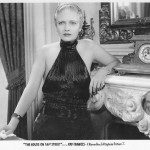
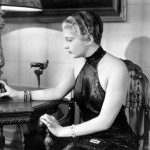
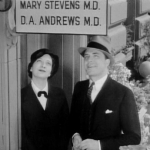
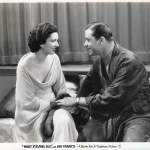
All posts by M.O.

Stolen Holiday (1937)


stolenjgCast:

Kay Francis … Nicole ‘Nicky’ Picot
Claude Rains … Stefan Orloff
Ian Hunter … Anthony ‘Tony’ Wayne
Alison Skipworth … Suzanne, Nicole’s Assistant and Friend
Alexander D’Arcy … Leon Anatole, Orloff’s Assistant
Betty Lawford … Helen Tuttle
Walter Kingsford … Francis Chalon, Publisher
Charles Halton … LeGrande
Frank Reicher … Charles Rainer, Credit Municipal
Frank Conroy … Dupont, Crooked Policeman
Egon Brecher … Bergery
Robert Strange … Prefect of Police
Kathleen Howard … Madame Delphine
Wedgewood Nowell … M. Borel, Swiss Printer

Directed by Michael Curtiz.
Produced by Hal B. Wallis.

Story by Warren Duff & Virginia Kellogg.
Screenplay by Casey Robinson.
Musical Direction by Leo F. Forbstein.
Musical Composition by Al Dubin, Werner R. Heymann, Heinz Reomheld, & Harry Warren.
Art Direction by Anton Grot.
Gowns by Orry-Kelly.
Special Effects by Fred Jackman.
Cinematography by Sid Hickox.
Film Editing by Terry Morse.

A Warner Bros. Picture.
Released February 1, 1937.


Box Office Information:

Cost of Production: $524,000
Domestic Gross: $502,000
Foreign Gross: $272,000
Total Gross: $774,000

(See the Box Office Page for more info.)

Background:

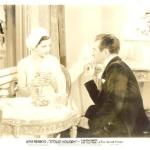
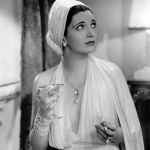
Kay Francis’ importance at Warner Brothers was showcased beautifully in Stolen Holiday, one of the best examples for Kay’s consideration of being the most glamorous woman to ever grace the screen.

She plays a Parisian fashion model—of American decent—who teams up with a creepy Russian to form an economical empire, only to watch it crumble as she falls in love with an honest Englishman. For the casting of that “honest Englishman” the studio had clearly only one player who fit the bill, Ian Hunter, who had worked so well opposite Kay in I Found Stella Parish (1935) and The White Angel (1936).

The scandal was based on, surprisingly, a real life story which took Paris by storm. Andre Stavisky, the man who Claude Rains’ character was based, was a notorious embezzler who sold false bonds and ran a corrupt pawn shop to cover his tracks. Arlette Simon was a Coco Chanel model who had married Stavisky; her exact play in his actions is unknown, and Warner Brothers may have exaggerated her importance to enhance the plot for Kay, the film’s real star.

Either way, the plot works.

Michael Curtiz was one of Kay’s best directors. His work with her on Mandalay and British Agent (both 1934) were especially remarkable, and Warner Brothers went all out for Kay on this one. The production values are of the utmost quality, she’s beautifully lit and breathtakingly gowned. Clearly this was an expensive movie, and it proved to be one of their most profitable of the season. Filming began July 20, 1936 with locations shoots including Lake Arrowhead, California.

Critics raved about Stolen Holiday, and after its release, Kay was voted the sixth most popular female movie star in the entire industry. Her $209,000 salary for that year topped producer Hal Wallis’, and made her one of the highest paid females in the entire country. Clearly she was anything but “washed-up” as late as 1937, and—finally—people are beginning to wake up and realize that there was more to her falling out with Warner Brothers than a declining status.


1937pictureplayjanuaryAbove: A spread from the January 1937 issue of Picture Play.


Webmaster’s Review:

The film opens in Paris, 1931. Beautiful mannequins parade the latest fashions, and we are introduced to Nicole Picot right away. She is one of the models parading a beautiful wardrobe. Kay’s hair is slicked back as it was in her Paramount years, which gives a great affect to help date the setting.

Stephan Orloff takes Nicole back to his home to model clothes. Inside the beautiful, but mysterious mansion, Nicole quickly realizes they are alone. He tells her to put on the dress she was wearing when he walked into the shop, and when she can’t find him, she begins to yell. “Don’t do that!” he shouts.

Realizing his sick intentions, she decides to leave, but he locks her in. Steven mentions that he is in need of money, and Nicole will be used to get it for him. He tempts her with the offer of a sophisticated lifestyle, and she accepts.

Five years later they have everything they want, including the House of Picot, which has become one of the biggest, most important companies in the fashion world. A huge parade of mannequins modeling either some of the most beautiful or ridiculous fashion one will ever see follows.

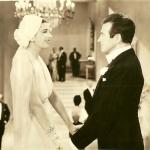
Stephen throws a ball in the White Room of the Hotel Eugenie, and Kay makes one of her greatest entrances in a white evening gown with a white turban. The set is beautiful, completed with marble floors and breath-taking chandeliers.

Nicole meets British Diplomat Anthony Wayne when he refers to her dress as “frightful.” She thanks him and smile, making him look absolutely stupid as he dances with another woman.

When Stephen and Nicole have a drink and cigarette, they briefly discuss marriage, and the rumors surrounding their relationship. After he leaves to discuss his shady business deals, Nicole and Anthony make eyes at each other.

Nicole and Stephan board a plane to Switzerland. Anthony is on board the plane two, and is surprised to see Nicole, who snubs him for his “ugly” coat. Suzanne, who hates Stephan, like Anthony, and tries to play matchmaker. She sets the two up on a date, where they laugh, flirt, and get to know each other.

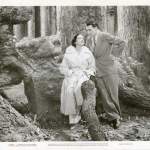
Anthony and Nicole go for a ride. Kay wears one of the ugliest dresses of her career, and the two hit a bump on the road, which kills the engine. Laughing it off, the two decide to walk. When they reach a house for help, they realize no one is inside, but of course there is food and chickens for them to make a meal out of. Typical of the Hollywood fluff at the time, the two are clearly falling in love.

The French police invade Steven’s bogus bank. “Don’t exaggerate it into a flood,” he snaps to his associates. “In your fright you gentlemen forget that we still have the most valuable asset of all, time. Time to cover up the pawn shop affair, time to sell our bonds and come out with a tremendous profit.”

Back in Switzerland, Nicole and Anthony return to her room where they kiss. Their making out is interrupted by a telephone call, informing her that Stephan is in a major scandal. She returns to Paris to find out what’s going on. Stephen completely lies to her, saying that he trusted thieves and he’s completely innocent. He talks Nicole into marrying him. Inviting important people to a lavish wedding might save him. “But I don’t see how a wedding could save you,” Nicole says.

“We will have such a wedding as Paris has never seen,“ Stephen responds. “Invite only the most important people.”


Anthony and Nicole are broken hearted, realizing they will be forced to break up. On the day of her wedding, Nicole appears almost suicidal. After the wedding, the police arrive to investigate the scandal. Nicole refuses to run away with him, and his disappearance causes a major headlined sandal.

The people of Paris are livid, and mobs form outside Nicole’s shops where rocks start being thrown through the windows. Director Michael Curtiz makes this almost as dramatic as the mobs of Paris storming the Palace of Versailles during the French Revolution.

Anthony arrives at the mansion to persuade Nicole to leave Stephan for good. It doesn’t exactly work, but she leaves to find him and give him a piece of her mind. When he learns that she will still do anything for him, Stephan realizes how much of a creep he is for taking advantage of her friendship.

When he walks outside, Stephan is shot down by police, but it is announced that he put a gun to his head. Since Nicole and Suzanne are innocent, they are free to carry on with their lives. However, Nicole finally agrees to marry Anthony, even if she is a “marked woman.”

This is one of Kay’s best (but frustrating) movies. It’s not good because of any stellar story line, but mostly because she’s beautifully lit in gorgeous gowns and placed in expensive surroundings. Stolen Holiday is proof of Kay’s importance to Warner Brothers at this point in her career. You won’t find any of Bette Davis’ movies of this era looking so good.

And, boy, does Stolen Holiday look good.

She doesn’t have to act here—though she does have her emotional moments when she longs for Ian Hunter. But, please, this is Kay Francis just being Kay Francis. There’s no acting involved here. She doesn’t have to. Kay was interesting enough to allow her presence to act for her. She’s just along for the ride, beautifully gowned in breath-taking clothes and surrounded by beautiful sets, lavishly produced to the point where they look like real places, not like the grandoise castles MGM surrounded Joan Crawford, Norma Shearer, and Garbo in.

I was never a big fan of Claude Rains, and in this movie he is completely despicable. But my personal opinions aside, he gives a damn good performance as the rat. His acting is so convincing, it almost makes one wonder how oblivious Kay’s Nicole is to let his intentions go unnoticed.

Kay and Ian Hunter never really had great chemistry, but they do good with their characters’ situations. The two of them are really charming in the countryside scenes, even if it is a little ridiculous for them to find an empty house completely loaded with fresh food—including bread—but no trace of a family who lives there.

Hunter is another one who doesn’t need to put a performance on here. All he is required to do from us is support Kay, and be the man who loves her despite her association with Orloff.

Still, they both play togther nicely, and Stolen Holiday may be the best film the two made as a romantic team. I wouldn’t recommend this as an introduction to Kay’s work, though. While it’s a perfect movie for her, there’s something about this one that everyone finds slightly unlikable, though no one has ever really figured out what it is.

My guess would be that it’s a film that, had just a little more effort been put into the script, it would be flawless.

Stolen Holiday was a major success for everyone involved. Kay was voted the sixth most popular leading lady in Hollywood by Variety shortly after the film was released, and the critics loved the movie as much as the audience did.

Today, it survives as the ideal Kay Francis vehicle, and gives us a clear explanation on why she was so popular at the time.


Film Advertisements:

Lobby Cards:

stolenholidaylobbycard32


Posters:

stolenholidayposter0914stolenholidayslidel_28310_5f2c4ad0


Movie Herald:stolentradeadstolenttradee


Misc. Images:stolenholidayad0914stolenholidayposter0827givemeyhsoct1936mph1


Vintage Reviews:

Written by Frank S. Nugent.
Published February 1, 1937 in the New York Times.

Despite an unusually insistent bit of prefatory splutter about the similarity of its characters to “persons living or dead” being pure coincidence, the Strand’s Stolen Holiday, the Warner Brothers’ latest film setting for the darkly lithesome charms of Miss Kay Francis, is a highly romanticized although essentially accurate account of France’s celebrated Bayonne pawnshop scandals.

As film entertainment it moves listlessly, freighted as it is with leisurely assemblages in incredibly lavish surroundings and conspirators who play hide-and-seek with a frock-coated prefecture. It is considerably over wordy, too, because this in one Miss Francis’s heart is torn between love and friendship, and the brief advanced for each is paradoxically lengthy. If the picture is at all distinguished, it is because Claude Rains does a superb job with the character whom the film’s producers would have you believe is not patterned after the late M. Serge Alexandre Stavisky; and because, first as a manikin and later as a successful modiste, Kay Francis parades the most striking wardrobe that Hollywood’s couturiers can conceive in the Paris manner.

The film’s Stefan Orloff, a Russian fortune hunter with an unsavory background, is protected by financiers, police officials, legislatures, and Cabinet Ministers in his ingenious swindle, and when the inverted financial pyramid begins to tepple he flees to the South of France. This is a very remarkable series of coincidences, because it is past what M. Stavisky did. At that point in his career, M. Stavisky was either murdered or committed suicide. The film’s M. Orloff is definitely murdered, probably due less to the Warner convictions in affaire Stavisky than to the fact that the Legion of Decency objects suicide in pictures. At any rate, the passing of this character leaves the widow, Miss Francis, free to follow the dictates of her to-way heart concerning Mr. Ian Hunter.


From the November 1936 issue of Screenland Magazine:
(The article is just a detail of the plot–this is here for the pictures.)

stolenholidaynovemscreenland1

stolenholidaynovemscreenland


From the December 1936 issue of Photoplay:

stolenholiday1936decphotop


The Goose and the Gander (1935)

goosegande0811Cast:
Kay Francis … Georgiana Summers
George Brent … Robert ‘Bob’ McNear
Genevieve Tobin … Betty Summers
John Eldredge … Lawrence Thurston
Claire Dodd … Connie Thurston
Ralph Forbes … Ralph Summers
Helen Lowell … Aunt Julia Hamilton
Spencer Charters … Detective ‘Wink’ Winkelsteinberger
William Austin … Arthur Summers
Eddie Shubert … Sweeney, Attendant Leaking Gasoline
Charles Coleman … Jones, Georgiana’s Butler
Olive Jones … Miriam Brent
Bill Elliott … Teddy
John Sheehan … Murphy, Gas Station Attendant
Wade Boteler … Sprague, Hotel Detective

Produced by Hal B. Wallis.
Directed by Alfred E. Green.

Story and Screenplay by Charles Kenyon.
Art Direction by Robert M. Haas.
Gowns by Orry-Kelly.
Music Direction by Leo F. Forbstein.
Original Music by Bernhard Kaun & Heinz Roemheld.
Cinematography by Sid Hickox.
Film Editing by Bert Lenard.

Box Office Information:
Cost of Production: $245,000
Domestic Gross: $329,000
Foreign Gross: $ 177,000
Total Gross: $506,000

See the Box Office Page for more info.


Background:

Kay Francis had begun 1935 on a winning streak with two commercially successful pairings with George Brent, Living on Velvet and Stranded. It was common sense for Warner Brothers to reunite the two again for what turned out to be what is considered by many to be the best of their pairings, The Goose and the Gander.

Her success at the studio strangely played out well within this film. Kay had eclipsed Ruth Chatterton as Warner Brothers’ Queen of the Lot with the massive successes of The House on 56th Street (1933) and Mandalay (1934), two Chatterton rejects. In The Goose and the Gander, she was paired opposite two of Chatterton’s ex-husbands, George Brent and Ralph Forbes. The actors were not on speaking terms throughout the production of this film, and worked together only once more in Adventure in Diamonds (1940), a low-budget programmer from Paramount.

None of the drama carried over into Kay’s life or performance. She’s a pleasure to watch throughout the film, and stunningly photographed, too. A glorified B movie about a woman who’s determined to show her ex-husband his new wife is a two-timing tramp, it’s one of her best roles.

Comedy is something scarcely associated with Kay’s legacy as an actress. Luckily films like The Goose and the Gander not only provided melodramatic relief, but showed her versatility, too, for Kay Francis was an excellent comedienne.


gooseandtheganderpictureplay

Above: From a 1935 Picture Play spread.


Webmaster’s Review:

This movie opens on a beach. George Brent, Genevieve Tobin, and the especially feminine William Austin head into the ocean for a swim. For some odd reason…they hold hands as they run to the ocean. Arthur, of course, has to be a total klutz in the water. Betty and Bob swim to a pier, where Georgiana hears overhears on their conversation to get married.

A beautiful shot of Georgiana holding a cocktail at a dinner party follows. Bob accidentally walks into her arm, forcing her to spill the drink on him. A shocker really follows. Arthur and Georgiana spot each other. They were once married. They go outside into the night to discuss what has gone on in their lives. (You would think that George Brent or maybe even Ian Hunter would have played the ex-husband role, right?)

Arthur introduces Georgiana to his wife, Betty, who was the same woman on the pier with Bob, discussing possible marriage plans. From here the chase to expose Betty’s intentions to Arthur are on.

Bob and Betty meet at a local station, where Betty gets into Bob’s car and they drive off. The Thurstons, jewel thieves, pull up and take Betty’s car to throw off the cops chasing them. Bob’s car then runs out on gas, and, since this is the movies we’re talking about, they arrive on the door of Georgiana’s home, where she has planned to catch them in the act.

To play foolish, Georgiana talks to them as if they are man and wife. And to make things more awkward for them, she tells Betty that she was once married to an Arthur Summers, but keeps taking to her as though she is Bob’s wife and nothing is unusual or peculiar.

None other than the Thurstons arrive at Georgiana’s door for the same gas reason. Georgiana says how “bizarre” it is that both of Arthur’s wives are under one roof, only she says it to Mrs. Thurston, not Betty. Georgiana then tells the Thurston’s her plan to expose Betty Summers’ infidelity because it was Betty who broke up her own marriage. The real Betty Summers gets more and more nervous because she still believes that Georgiana is clueless to the real circumstance.

One problem follows. This is a post-code movie, and Betty and Bob aren’t married. How are they supposed to stay in the same room? Especially when Georgiana locks them in there until morning? The comedic answer is to have Bob take a blanket and sleep on the roof, where the dog spots him and begins a barking fit. Because of a smallpox outbreak, all guests are quarantined in Georgiana’s home.

When she goes outside to see what’s wrong. Georgiana spots Bob on the roof and begins that charming Kay Francis laugh. Bob gets down and goes for a walk with her in the land surrounding her beautiful home. When the Thurstons hear a siren, they panic and hide their stolen jewels in Georgiana’s room. Of course her Aunt Julia secretly catches them in the act.

In the woods, Georgiana tells Bob she can’t wait to have Arthur over for lunch tomorrow so he can “catch ‘Betty.’” Bob tries to change her mind. They flirt a little. Then kiss in the moonlight so the real Betty can catch them. After Georgiana walks into the house, she dumps water on Bob. “Good night.”

When Aunt Julia tells Georgiana of the Thurstons hiding of the jewels, Georgiana looks at them to realize that they’re hers. Back at the hotel, Arthur hears that Betty had run off with another man, so he sets out to catch her in the act of infidelity. In the mean time, the Thurstons are all over Georgiana to see if they can get her to slip out where the jewels are hidden. She reveals this to Bob, whom she has come to like.

Arthur and his brother pull up and are mistaken as police by the Thurstons, who bring them up to their room at gunpoint. During this, Georgiana and Bob sit out on her porch, where Bob tells her he is in love with her. Georgiana condemns him, saying how wrong it is for a “married man” to say that to any woman.

Betty talk to the Thurstons, reveals her identity and lets them know that her husband and his brother really aren’t policemen. When the real policemen arrive only moments later, everything is revealed to everyone after a few misunderstandings with some stupid detectives. The Thurstons go off with the police. The Summers go off with each other. And Bob stays with Georgiana, whom he now plans to marry.

This is typical of the Kay Francis movies of the period. The Goose and the Gander (1935) might not be the funniest comedy, but it has a warmth to it that makes the movie admirable. As Georgiana, Kay has one of her best unimportant roles. While it may not be a Vera Kowalska of Confession (1937) or Maida Walker of In Name Only (1939), Georgiana is the type of character Kay was equally good at. Actually, the part is similar to the types of roles Myrna Loy was just beginning to play at MGM.

The sets in this movie are beautiful in that rustic, country New York cottage sort of way. It’s all so cozy and polished that, when I took look around my living room, I realized what a dump I live in.

George Brent plays the same character he always plays in Kay Francis movies. Genevieve Tobin is slightly annoying as Betty Summers. But, as a whole, this is definitely one of the better movies of Kay’s career, and a film that really shows her range as an actress (making her more than just the “epitome of 1930s glamour”). It’s a shame that Kay didn’t have more assignments like these, but, maybe because of its rarity, films such as The Goose and the Gander or Living on Velvet (1935) shine just a little brighter than they normally would.

There’s no scene stealing from anyone else, here. This is Kay Francis’ movie all the way.

Vintage Reviews:

Andre Sennwald, September 12, 1935.
Published in the New York Times.
The new film at the Strand Theatre has been plotted with a mechanical skill which can be compared only with the assembly of a Ford car. It is not written so much as blue-printed, with all the parts neatly joined, the characters identified as A, B and C, and the situations prepared to formula down to the last entrance and exit. You imagine the story conference began and ended when the producer said: “Rewrite A58762, boys, and spin it out to seventy minutes flat.” “The Goose and the Gander” emerges as a well made minor farce, which scrambles its people the way they have been getting scrambled ever since “Seven Keys to Baldpate” and probably before.

The narrative is so deviously complex that if you stop to light a cigarette or talk to your neighbor it requires five minutes to reorient yourself in its labyrinthine ways. Miss Kay Francis, you see, is seeking revenge on a flirtatious lady, Miss Genevieve Tobin, who stole her husband away from her and married him. She plans to embarrass the lady and Mr. George Brent, with whom she is dashing about, by getting them stranded in the mountains and forcing them to spend the night at her country home as man and wife. Then she plans to trap her former husband in the same predicament and have him discover his wife in the act of cheating. But a pair of escaping jewel thieves fall into the snare arranged for the husband, and so they all spend the night together in a pother of chagrin because nobody dares to expose any of the others for fear of being exposed himself. This doesn’t seem, to make much sense, but “The Goose and the Gander” works it out rather well.

Its chief impediment to an evening pleasantly unimportant in the cinema comes from its insistence on cramming the dialogue with r’s, which have an embarrassing habit of becoming w’s when Miss Francis goes to work on them. The film is played with the proper consternation by all the principals. It ceases to be predictably slick and becomes momentarily hilarious when Spencer Charters arrives on the scene as a rural police chief who isn’t going to let anything be put over on him.


From the November 9, 1935 issue of
the Motion Picture Herald:

goosenov91935mph

Film Advertisements:

The House on 56th Street (1933)

hhouseCast:
Kay Francis … Peggy Martin Van Tyle, aka Peggy Stone
Ricardo Cortez … Bill Blaine
Gene Raymond … Monte Van Tyle
John Halliday … Lyndon Fiske
Margaret Lindsay … Eleanor Van Tyle Burgess
Frank McHugh … Chester Hunt
William ‘Stage’ Boyd … Mr. Bonelli
Hardie Albright … Henry Burgess
Sheila Terry … Dolly, a Sextet Girl
Phillip Reed … Freddy
Philip Faversham … Gordon
Walter Walker … Dr. Wyman
Nella Walker … Eleanor Van Tyle

Directed by Robert Florey.
Story by Joseph Stanley.
Screenplay by Austin Parker & Sheridan Gibney.
Art Direction by Esdras Hartley.
Gowns by Orry-Kelly & Earl Luick.
Cinematography by Ernest Haller.
Film Editing by Howard Bretherton.
Music Direction by Leo F. Forbstein.
Music Composition by W. Franke Harling. & Bernhard Kaun.

A Warner Bros. Picture.
Released December 1, 1933.


Box office information:

Cost of Production: $211,000
Domestic Gross: $410,000
Foreign Gross: $284,000
Total Gross: $694,000
See the Box Office Page for more info.

Background:
For her last release of 1933, Warner Brothers had decided that it was time to pair their top male and female stars, Paul Muni and Kay Francis, in Ever in My Heart. Unfortunately, Kay and Paul were never paired, and the property went to Barbara Stanwyck. As a result, the studio gave Kay a Ruth Chatterton reject, The House on 56th Street.

When Kay, William Powell, and Chatterton arrived at Warner Brothers in 1932, Ruth had been the top star under contract at Paramount. Her clout was carried over to Warner Brothers, where the roster consisted of B players like Bette Davis and James Cagney. With only a year at the studio, Ruth was beginning to decline in public favor, and Kay was really starting to emerge as an important asset for Warner Brothers.

Ruth blamed the reason for her decline rightfully on Paramount and Warner Brothers, who, after her success in Madame X (1929), paired her in cliché melodramas with little distinction. She had had enough, and her passing on of The House on 56th Street might have not been the worst decision of her career. It’s another mother-child melodrama, with the mother going to great lengths to protect her daughter. This time, the mother takes the blame for the murder her daughter committed, though she walks away unpunished at the end of the final reel.

The previous year, Kay had triumphed in a streak of four excellent movies, Ernst Lubitsch’s Trouble in Paradise among them. The year this movie was produced and released, she had only two notable roles, The Keyhole and Mary Stevens, M.D..

But it was The House on 56th Street which would turn her into a major household name. Film Weekly noted that the production made Kay “a power to be reckoned with at the box-office.” As where Chatterton would have been typecast with this film, Kay was given a transition. It established her as a top melodramatic star and actress, and with Chatterton’s refusal to play the heroine of Mandalay (1934), Kay would complete her eclipse of her as the Queen of Warner Brothers.

Adolphe Menjou was the original choice for the Ricardo Cortez role, and the film was remade in England in 1938 with Bebe Daniels as The Return of Carol Deane. But, as the case with many remakes, Carol Deane lacked the spark of the original version so fondly remembered by critics and audiences of the day.


Webmaster’s Review

The Gotham Theatre Follies are the opening attraction of this picture. After three chorus girls parade in period wardrobe, we see Peggy Martin with a smile from ear to ear. She’s drawing attention from both Monte and Lyndon, who are both in love with Peggy and knowledgeable of the situation. “You certainly draw them in, Peggy!” says one of her fellow chorus girls back stage. Her friends insist that she should be with Monte, considering he’s young, handsome, and rich.

When Monte and Lyndon meet at a bar for a drink, Lyndon announces that he’s seen thirty performances, while Monte’s only watched twenty-eight. “I’m two up on you, Monte…” The men exchange competitive stares at each other.

Backstage, Peggy impresses her fellow dancers with the card tricks she learned from her father, who learned from her grandfather.

After the show, Peggy accompanies Lyndon to an elegant party. He raises his glass and makes a toast, “Here’s to the ladies, God bless them. We can’t live with them, and we can’t live without them.” Monte sneaks up on Peggy at the party and confesses his love for her. They makes plans for a ride in the park. “I’d feel so happy…if I didn’t feel like I was hurting someone else,” she tells Monte. He not only proposes marriage, but tells her she can not go on with her career onstage.

As Peggy returns home, Lyndon is already there waiting for her. He begins to tell her to watch out for Monte, because his family record is one filled with cheating men who love their women until they tire of them.

Monte and Peggy marry, and spend their honeymoon in Paris, watching a performance at the Moulin Rouge, taking a ride on a gondolier, and partying at luxury gambling houses. Unfortunately, Peggy shows signs of having a gambling problem, and Monte shows concern for their future if she is unable to stop her addiction to cards.

The Van Tyle’s return to their beautiful home in New York. Monte has spent an unbelievable amount of money furnishing their new home, the house on 56th Street. “I love it so much…that I can just sit on the floor and…pat it!” Peggy says, teary eyed and everything. A newspaper clipping tells the news of the Van Tyle’s delivery of a baby girl.

Years later, Peggy’s mother in law introduces her to a friend of hers, Lyndon Fiske. “I’ve missed you more than I thought it was possible for one person to miss another,” he says. A few more years later, Peggy receives a note from Lyndon announcing that his doctor is sending him to Europe, and that he would like to see her one more time before he departs. “I made one great mistake in my life, giving you up,” he tells her.

“I should have known we couldn’t go on being friends,” Peggy tells him as he goes overboard with the confessions of love. She tells him that she’s leaving forever, and Lyndon shoots himself as a result. When the butler walks into the room, Peggy is seen with the gun in her hand, and charged with the murder of Lyndon Fiske.

Charged with manslaughter, Peggy gets twenty years for the crime she didn’t commit. “I wish it were possible for you to go ahead without ever thinking of me again,” she says with tears in her eyes. Out of interest for their daughter, Eleanor, Peggy tells Monte to take her far away, that she’s giving Eleanor up as a daughter, and hopes that Monte will find someone respectable to fill that role.

A montage of newspaper headlines appear as we see Kay playing cards, and a pendulum of a clock swinging back and forth. 1925 arrives, and Peggy is now free. A culture shock has her startled. All of a sudden there are cars and skyscrapers which fill up New York City, and she learns that Monte was killed in action in World War I. Eleanor has been brought up to assume her mother is dead.

“I want everything. A manicure, a massage, the color of my hair changed,” she tells the owner of a beauty salon. “I want to go out of her a completely different person.” We see a makeup process until, finally, it’s Kay Francis!

Onboard a ship, sultry Ricardo Cortez (Bill Blaine) approaches her from behind. Trying to get some, as always in these PreCodes, he asks her for cocktails. She is warned that Mr. Blaine is a compulsive gambler. She can care less. Peggy’s learned from the best of them.

Peggy has a crowd breathless as she basically kicks Blaine’s ass in an intense game of cards. Realizing they can get a shit load of money by ripping others off as a team, they decide to work together. Different gestures by Peggy indicate what moves Bill should make while he plays some innocent morons in unfair games.

A newspaper clipping announces the wedding of Eleanor to Henry Burgess.

In the back of a car, Bill tells Peggy that she’s going to be a sensation as the first female black jack gambler in New York. When they arrive at the gambling house, the house on 56th Street, it, of course, is the same one that Monte had built for Peggy and himself when they were first married. The beautiful bedroom Monte had shown her when they first entered back in 1905 is now one of the hottest spots to gamble away massive amounts of money.

One night, a friend visits Eleanor at the bar. She confesses that she’s had a huge gambling problem in her past, and that she is staying clear of the card table because she’s finally got healthy finances. When her husband decides to let her play, Peggy realizes that she’s going to be playing her own daughter. She lets Eleanor win, of course, until Bill tells her to teach her a lesson that will prevent her from gabling the rest of her life. By the end of the game, she’s more than $5,000 in the red.

“Don’t you think you’d better stop?”

“I don’t stop until I win.”

Morning comes, and Eleanor has gambled away $15,000. Bill tells her to come back after some sleep, where they can “talk” in his office. Later, the two get into an intense argument, and Eleanor pulls out a gun and shoots Bill dead. Peggy runs into the room to see Eleanor standing there emotionless. “He…he was telephoning my husband…”

“Wait out there,” says Peggy.

When Peggy gets to Eleanor, she finds her sobbing, saying that her mother had shot a man and was taken away to jail for it. Overwhelmed with guilt, Peggy tells her that Bill’s still alive, and that she needs to get as far away from New York as possible. When Bill is discovered dead, Peggy takes the wrap for it, but the owner of the house realizes that he needs her to make the money. Peggy agrees to the owner, just as she had to Monte, that she will never leave the house, the house on 56th Street.

This was the movie that made Kay Francis a household name. Ruth Chatterton had turned the property down, and, with the failure of Chatterton’s Frisco Jenny (1932), it was clear that Kay had eclipsed Ruth as Queen of the Warner Brothers lot.

Mary Stevens, M.D. (1933) had Kay suffering from the death of her child at the end of the picture, and she was next loaned out to Metro Goldwyn Mayer for Storm at Daybreak (1933). The House on 56th Street was her return to Warner Brothers, and the mother-love drama caused such a sensation that this movie officially began the formula for which most of the subsequent Kay Francis movies were based.

I Found Stella Parish (1935), Give Me Your Heart (1936), Confession (1937), and Comet Over Broadway (1938) had plot similarities to this movie, at least in terms of Kay’s relationships with her onscreen children. All were made for Warner Brothers, who took immediate notice of the public’s desire to watch Kay suffer for the sake of her children.

Kay’s performance rides along dramatic excellence and slight camp. The ridiculous situation doesn’t help (arriving at the gambling house which is the same home she once shared with her heavenly husband?). But, still, it’s one of her best roles. Gene Raymond is one of my favorite actors, and he’s a real gift in this movie. It’s a shame he didn’t make more movies with Kay like Ricardo Cortez (who, by the way, is excellent and unusually natural in his role of the gambler) did.

Michael Curtiz didn’t direct this one. Robert Florey did, and made an excellent job of doing so. Though Curtiz directed nearly all of Kay’s most notable Warner Brothers features (Mandalay [1934], British Agent [1934], Stolen Holiday [1937]), Florey never directed her again after this one.

It’s a great film.


Film Advertisements: 

Lobby Cards:

houseon56thstreetlobbies


Poster:houseon56thstreetposter0914


German Poster:


houseon56thstreetgerman


Polish Herald:

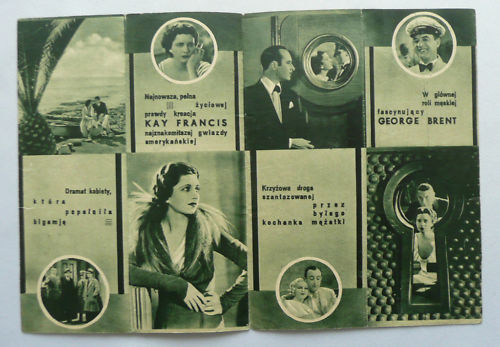
Polish Trade Ad Cover
Polish Trade Centerfold
Polish Trade Ad
Polish Trade Ad

Vintage Reviews:

Published December 12, 1933 in the New York Times; Written by Mordaunt Hall.
Kay Francis is the leading player in “The House on 56th Street,” which is quite an original and intriguing pictorial drama. The actual story is secondary to the interesting idea of depicting what happens to a dwelling in the East Fifties in the course of a quarter of a century. The narrative is an adaptation of a novel written by Joseph Santley, and the introductory scenes in the film show life in the pre-automobile era.

The house in East Fifty-sixth Street is presumed to be a gift from Monte Van Tyle to his bride, Peggy, who was one of the alluring members of the “Florodora” sextet. On their honeymoon they visit France, Italy and other countries, and when they return Monte takes great pride in escorting his pretty wife through her spacious new home. Being blessed with an enviable bank account, Monte has anticipated every wish of his wife. It is a home which shall be hers as long as she lives.

The happy existence of the Van Tyles is brought to an abrupt ending when Lindon Fiske, Peggy’s companion before she was married, decides to shoot himself. Peggy goes to visit him because he is ill, and, although she struggles with her former paramour to prevent his ending his life, the pistol shot is fired and he drops dead. This leads to her conviction and sentence to prison for manslaughter.

After nearly twenty years Peggy is freed. Her husband has been killed in the World War and his relatives give her a substantial check to keep away from her daughter, Eleanor. Peggy, being by nature a gambler, in the course of time finds herself back in the Fifty-sixth Street house, not as a tenant but as a blackjack dealer, for the dwelling has been turned into a gambling place and speak-easy. How she is forced to remain there and what further tragic happenings she experiences are set forth in several exciting episodes.

It is a film possessing no little irony, particularly in the latter interludes. Peggy’s first sight of her daughter in many years is depicted very effectively. Miss Francis, as Peggy, gives an adequate performance. She looks charming in the costumes of the Nineties. Margaret Lindsay is excellent as Eleanor. Gene Raymond is satisfactory as Monte Van Tyle, and John Halliday’s acting of Lindon Fiske is highly commendable. Ricardo Cortez gives an expert conception of a cardsharp and William Boyd does well as a grim underworld authority.

Photoplay, January 1934:

housejan1933photop

Mary Stevens, M.D. (1933)

marystevensssCast:

Kay Francis … Dr. Mary Stevens
Lyle Talbot … Dr. Donald A. Andrews
Glenda Farrell … Glenda Carroll
Thelma Todd … Lois Rising
Harold Huber … Tony
Una O’Connor … Mrs. Arnell Simmons
Charles C. Wilson … Walter Rising
Hobart Cavanaugh … Alf Simmons
George Cooper … Pete
John Marston … Dr. Lane, S.S. Bellocona
Christian Rub … Gus, Mary’s Janitor
Walter Walker … Dr. Clark

Directed by Lloyd Bacon.
Produced by Hal B. Wallis.

Based on the story by Virginia Kellogg.
Adaptation by Rian James & Robert Lord.
Gowns by Orry-Kelly.
Music Direction by Leo F. Forbstein.
Music Composition by Bernhard Kaun.
Edited by Ray Curtiss.
Art Direction by Esdras Hartley.

A Warner Bros. Picture.
Released August 3, 1933.

Box Office Information:
Cost of Production: $150,000
Domestic Gross: $360,000
Foreign Gross: $139,000
Total Gross: $499,000

See the Box Office page for more info.


Background:

“The Pre-Code’s Last Frontier,” wrote Mick LaSalle in Complicated Women, “was presenting women onscreen as successful professionals. Kay Francis, in the final stage of the era, emerged as an actress home in such parts.”

And that’s the significance of Kay’s work in Mary Stevens, M.D. (1933), a film which provided her with one of her best roles. She’s a successful doctor who gets pregnant with the illegitimate child of a married man. She decides to raise the child herself, and after saving countless lives with the dedication to her practice, she fails to save the life of the one most important to her.

It is then Mary must decide to give up, or move on with her work…

Warner Bros. was the studio where Kay Francis really came into her own as an actress. Professional roles like this one and Man Wanted (1932) made her accepted by audiences as a legitimate star. She had finally found her niche, something Paramount was really undecided about. The adult atmosphere of the Pre-Code movies between 1929 and 1934 emphasized her success on the screen. In films like Mary Stevens, M.D. she is successful, yes. But she is also human, and giving into sexual temptation is something that not many people can resist.

It is with characters like Mary where audiences realized that they can have success without having to conform, which is what the Catholic Legion of Decency was most against.

The film was based on a story by Virginia Kellogg, which Warner Brothers had adapted for the screen specifically for Kay. Originally, George Brent was to play her foolish male counterpart. But his honeymoon with Ruth Chatterton upset this concept, and the part was given to Lyle Talbot, who would work again with Kay in Mandalay (1934), a Ruth Chatterton reject which cast Talbot again as a doctor on unstable grounds.

Lloyd Bacon, who had directed Kay in First National’s A Notorious Affair (1930), was chosen to direct Mary Stevens, M.D. Bacon was one of Kay’s finest directors, one who did good at refreshing recycled plots and showcasing them in a new light. This film can sort of be an example of that, but there is a spark to it which makes it stand out among the rest of its Pre-Code predecessors.

Of that era between 1929 and July 1934, Mary Stevens, M.D. would become one of the most memorable. Variety considered the film “exceptionally good, adult entertainment,” and thought that Kay “avails herself of unusual opportunity.”

Over eight decades later, it still doesn’t fail to entertain.


Webmaster’s Review:

Mary Stevens and Donald Andrews are new to the world of medicine.

The film opens with an emergency call to 1112 Orchard Street. Kay Francis is introduced to the audience right away. Arriving at the front door she is immediately underestimated by the patient’s husband who “needs a man doctor.” (The irony being that his wife is about to deliver a baby.) After threatening to kill Mary if the “bambino” dies, the sexist jerk is silenced when she walks out the door holding twins. We next see Mary and Don completing their training in medical school and opening their own office. “You said a woman couldn’t do it,” says Mary.

“A woman couldn’t,” responds Don. “But you, well, you’re a super woman.”

“I don’t know whether to take a bow or be insulted.”

Mary next assists Don in surgery. Don’s irresponsibility makes one realize it should be the other way around. He eventually leaves with Mary taking over. She lectures him about his drinking before a surgery and drive for only money. “If that’s all you want then I’m out,” says Mary. A friendship which has lasted since childhood now ends.

A year passes. Mary and Don meet again on a ride to a local hotel. They dance, make eyes at each other, talk about how much has changed, then confess their love to each other. It’s old mush, but done in a charming manner. Kay looks stunning with her hair down and costumed in a beautiful white evening gown. They make love, plans for marriage, and then face trouble when Lois, Don’t wife, is talked out of getting a divorce by her father. Adding to the melodrama, Mary realizes she’s pregnant. What’s surprising about the situation is how care-free she is about her status as an unwed mother, at least until she realizes that Lois has no intentions of divorcing Don. There’s a beautiful close up of Mary’s eyes tearing as Don assures her they can still go on with their romance, while Mary keeps her pregnancy a secret.

Being an intellectual, Kay’s character decides to vacation in Europe, have the baby, then come home and tell everyone she’s adopted a child. Unlike her contemporaries, Kay always seemed genuine when portraying the love between her and her onscreen children. It makes one wonder what kind of mother Kay would have been had she not terminated her pregnancies. Her sentimentality almost brings a tear to one’s eye as she gives her child a bath.

On a house call, Mary leaves her purse outside where a little girl goes through it, putting a pen in her mouth. The purse is returned to the room where Mary is staying, and her infant puts his mouth on the same pen, catching the same fever she was on a house call for. The child dies. Kay’s photographed beautifully in a tragic way. As she mourns for the loss of her child, she looks up not wearing any elaborate make up and with tears running down her eyes. Its simple photography, but the situation and Kay’s response to it play out excellent. Unlike how some of her contemporaries may have handled the situation, Kay legitimately cries for the one child she couldn’t save, her own. She doesn’t scream or go over the top, just mourns and down plays the entire scene. It’s one of the better examples of Kay’s acting abilities.

After thinking about nothing but her child, Mary begins to contemplate suicide. She looks out a window, gets herself ready, but is cut off by an emergency call. A baby has swallowed a safety pin. Mary insists that she has given up practicing, and then relents when Glenda tells Mary it’s her chance to redeem herself. Mary saves the child with a hair pin, and then gives off one of the best feminist lines, “I was just wondering, they say medicine is a man’s game. I wonder what a man would have done in a case like this.”

Mary then decides to go on with her work, and ends up with the perfect balance of Don (who is now free to marry) and her career.

Lloyd Bacon was one of Kay’s better directors. Aside from this movie, he had also directed her wonderfully in A Notorious Affair (1930). Her acting throughout Mary Stevens M.D. is excellent, but so is that of the rest of the cast. It’s too bad that she was never assigned to Bacon more, perhaps she may have been better regarded as an actress.

The scene where Mary contemplates suicide is probably the best dramatic acting of Kay’s early career. It’s difficult, as an actor, to get the audience to understand what your character is thinking at all times. In that scene, Kay’s nerves are on the edge, and she has us completely understanding her lack of direction. “Dare I or not?” Is the question Mary is faced with.

Saved, ironically, with an emergency about a baby who has swallowed a safety pin, she’s able to pull herself together realistically. To come back from such a drastic circumstance in such a short amount of time is a true estimate of Kay’s dramatic range.

For some reason, Glenda Farrell never really interested me. I like her better in this one than the other films I’ve seen her in—Life Begins (1931) and The Keyhole (1933)—but she just never gave me any ambition to stand up and take a real interest in her. This isn’t a strike against her talent, it’s just that she never really clicked with me.

Lyle Talbot does okay with his role, but I really liked him much better in Ladies They Talk About (1932). This one doesn’t require much from him, and the fact that he would show up to a surgery drunk really just turns one off. Situations like this shift the audience attention more towards Kay, which is probably why this is remembered solely as a Kay Francis Pre-Code Melodrama.

Taped from Turner Classic Movies, the black and white photography is excellent, and the sound is crisp and clear with virtually no static. One of the more famous movies of the PreCode Hollywood years, the film was rereleased in 1936 but denied the seal of approval by the Legion of Decency. “An unmarried woman having a baby was just too, too much,” wrote Lynn Kear and John Rossman in The Complete Kay Francis Career Record.

Reviews for the movie were strongly positive, and one can easily see why. A big hit of its time, Mary Stevens M.D. is one of the better pictures of Kay’s career, and is long overdue for a major rediscovery.


Film Advertisements: 


Vintage Reviews:

(Below) From Photoplay, September 1933:

sept1933maryreviewphotop


Life, as the song writers have already pointed out, is so mysterious that it may not be altogether safe to question the realism of the melancholy events described in “Mary Stevens, M. D.,” which is at the Strand. Kay Francis, in the new film, is a woman physician who has a startling amount of trouble preserving a professional detachment toward the primitive emotions.

When Dr. Andrews, her suppressed desire, marries the daughter of a political boss and reveals himself as an unhallowed rogue by performing operations on children while under the influence of whisky and also by getting mixed up in a political scandal, she continues to find it impossible to live without him. The result of several illicit rendezvous with the fellow is that Miss Stevens, now a great baby specialist, finds herself in an interesting condition and has to run off to Paris. On the boat coming back the baby dies of infantile paralysis. The good doctor is on the point of hurling herself out of a fashionable hotel when Dr. Andrews bursts in with the glad tidings that he has obtained a divorce and can now make an honest woman of her.

This is as sad a story as the cinema has offered recently, and it is a disagreeable circumstance which makes it necessary to point out that it also is one of the shabbiest of the Hollywood contemplations of the medical profession.

Although the story, written with proper sincerity, might have been an interesting study of the problems confronting a woman physician in her work, this fatuous exhibit does not come within miles of dramatic integrity. There are the customary operating-room scenes and, for humorous sidelights, there is the customary flip and caustic nurse.

Both Kay Francis and Lyle Talbot (the latter as the vacillating Dr. Andrews) perform competently, and there is one brief and excellent bit of acting by Una O’Connor, the English actress, who appeared as the cockney wife in “Cavalcade.”
The New York Times, August 5, 1933.

The Keyhole (1933)

keyhole232Cast:

Kay Francis … Anne Brooks
George Brent … Mr. Neil Davis
Glenda Farrell … Dot
Monroe Owsley … Maurice Le Brun
Allen Jenkins … Hank Wales
Helen Ware … Portia Brooks
Henry Kolker … Schuyler Brooks
Ferdinand Gottschalk … Brooks’ Lawyer

Directed by Michael Curtiz.
Based on a story by Alice D.G. Miller.
Screenplay by Robert Presnell.
Cinematography by Barney McGill.
Film Editing by Ray Curtiss.
Art Direction by Anton Grot.
Costume Design by Orry-Kelly.
Music by Leo F. Forbstein, W. Franke Harling & Ray Heindorf.

A Warner Bros. Picture.
Released March 30, 1933.

Box Office:
Cost of Production: $167,000
Domestic Gross: $301,000
Foreign Gross: $227,000
Total Gross: $528,000

See the Box Office page for more info.

Background:

The Keyhole was of major importance to Kay Francis’ career. She had gone on a four-picture winning streak with Jewel Robbery (1932, with William Powell), One Way Passage (1932, with Powell again), Trouble in Paradise (1932, Ernst Lubitsch’s comedic masterpiece), and Cynara (1932, with Ronald Colman, produced by Samuel Goldwyn). Now back at Warner Bros. as a full-fledged star, the year she made Keyhole represented another major transition for her career. Those four movies had made her one of the most famous actresses in Hollywood, and Keyhole gave her the ideal star formula which became typical of the Kay Francis melodramas at Warner Brothers.

Recognizing the magic that had been created in Robbery and Passage (not to mention some previous movies at Paramount), Jack and Harry Warner thought it would be best to reunite Kay with William Powell for this production of Alice D.G. Miller’s “The Adventuress.” Problems with studio executives led to his replacing with George Brent, a studio new-comer who had already romanced Barbara Stanwyck in So Big!  & The Purchase Price (both 1932) and Ruth Chatterton in The Crash & The Rich Are Always With Us (again, both 1932). 

“In their day,” wrote James Robert Parish in Hollywood’s Great Love Teams, “Francis & Brent were Warner Bros. melodramatic equivalent of MGM’s droll Myrna Loy and William Powell, and were regarded by the bulk of steady filmgoers as the height of refined, upper-class romantics; personified, sartorial elegance.”

Certainly they were one of the most popular couples of the 1930s, but Kay was the real star of their movies; Brent was an added bonus for movie audiences. They weren’t Fred Astaire and Ginger Rogers; Kay Francis had her own identity as an independent star.

Michael Curtiz, one of Kay’s favorite directors, did a splendid job of directing her in Keyhole (as in all of her movies with him). Do not let the hugely impressive sets fool you; this is a glorified B movie, produced on a budget of only $167,000. Production began in late November 1932 and wrapped in twenty-five days.

The success of The Keyhole led to Warner Brothers’ absolute refusal to loan her out. Storm at Daybreak (1933), her following movie made for MGM (she was agreed to do the film prior to Keyhole’s release), would be the last time Jack Warner would allow her to work for someone else. After Keyhole she was too valuable, but it was a curse in disguise. His refusal to lend her services elsewhere would play a major factor in her law suit against him in the fall of 1937.


Webmaster’s Review

The film opens with the shot of…a keyhole. Inside we see Maurice smoking and looking through a scraps book of Maurice and Valentine’s dancing days. Anne, the former Valentine, arrives at his home because she has read his suicide note. “In the neck of time,” he says. “Come in.” Maurice has been milking Anne for money, threatening to tell her rich husband of their secret past. She’s already given him $10,000, now he wants $50,000 to stay out of her life forever. He makes a cheap move on her, and she smacks him across the face pretty hard.

“And the next time you try to kill yourself,” says Anne, “let me know. I’d love to help you.”

The home Anne and her husband, Schuyler, live in is spectacular. Clearly this movie is a sign of Kay Francis’ importance at Warner Brothers. The sets are huge, larger than any you’ll find in any Bette Davis, Ruth Chatterton, or Barbara Stanwyck feature of this time.

Schuyler is suspicious of Anne’s latest activities. He questions her and her chauffer like a real detective. He’s convinced his wife is cheating.

The next day, Anne has lunch with Schuyler’s sister, Portia. She explains her relationship with Maurice, and explains that the two are still married. Portia tells Anne to lure Maurice out of the country so a friend of hers can prevent his coming back. Maurice is not a US citizen, and Portia knows someone who can cancel his visa.

At dinner, Anne tells her husband that she would like to go to Cuba. More suspicious than ever, Schuyler hires a detective to stalk her every move. This agency specializes in catching unfaithful wives in the act of adultery, and Neil Davis is the hired stalker at hand.

Back at her lavish home, Anne packs her luggage and hears the telephone ring. Portia answers it, and lets Maurice know that she is sailing to Cuba, so of course the loser has to follow her onboard.

For his first move, Davis takes a small suitcase of Anne’s into his room, so he can have an excuse to walk into her cabin and introduce himself. Hank, Davis’ assistant, goes outside and makes sure that Davis’ chair is next to Anne’s on deck.

Hank becomes interested in a snobbish brat named Dot at the ship’s bar. She insults the bartender’s drinks, intelligence, and quality of service. Apparently this movie was made before people noticed that such an attitude would land spit–or worse—in one’s drink. But Dot’s no dope. She and the bartender are in on a gold digging job. She lures men with money to spend it on her, but what she doesn’t realize is Hank hasn’t really got a dime.

In the mean time, Maurice gets a hold of Anne and attempts to blackmail her, again. Sitting next to Davis at the ship’s pub, she tells him that Maurice is pestering her. When he tries to work in a little charm of his own, Davis realizes that Anne isn’t interested in cheating on her husband like Schuyler suspects.

Anne, Davis, Hank, and Dot all book rooms at the Hotel Metropole when they arrive in Cuba. Of course Davis and Anne have rooms next to each other, and wine and dine together all night long. But Anne is beginning to fall in love with Davis, and he with her. Unwilling to cheat on her husband, she decides to have her room switched. It’s useless, he tracks her down and they go for a carriage ride across Havana.

A montage shows Anne and Davis having a wonderful time in Cuba. From the letter’s Davis has been sending to Schuyler, it is obvious that he is falling in love with her, so Schuyler catches the first plane to Cuba to bring his wife home. On a beach, Anne confesses everything to Davis, Maurice, Schuyler and all. A few days later, Davis reveals everything to Anne, including the fact that he loves her.

Maurice arrives at Anne’s room. Davis tricks Maurice into thinking that the police are on their way to arrest him for blackmail. He ditches the scene of the crime. In reality, it’s Schuyler who is pounding on the door, and when he bursts in, he sees Anne and Davis kissing. She tells him off, tells him that he’s getting exactly what he wants to see, and that she’s leaving him for Davis.

When Schuyler leaves, they hear sirens and look outside to see Maurice lying dead on the ground. They take out his suicide note so the police can understand what happened, and kiss to begin their new life together.

This movie borderlines fiction and complete fantasy. Many Kay Francis fans rate The Keyhole among the best of her roles. I like this one a lot, largely because it moves quickly and has a certain spark to it, but it’s not on my list of favorite Kay Francis titles.

Kay’s character doesn’t really require her to do much. She desperately tries to keep her secret past from her rich husband, only to give up and get with the guy her husband sent as a spy to watch her every move in Havana. Outside of a few snappy lines to the sleazy Maurice—”Next time you try to kill yourself, let me know. I’d love to help you.”—there isn’t much brilliant dialogue for her, either.

But it’s still a nice little picture for her.

George Brent almost seems to be imitating Robert Montgomery in these kinds of films where he’s just playing second fiddle to the leading lady. He tries to be cute and charming, and succeeds in doing so only somewhat. Monroe Owsley, as Maurice, is a total creep. There is nothing to like about his character, and Owsley makes no attempt to get audience sympathy. Its nice to see someone just play the part as is.

Of course Helen Ware knows all the tricks as Schuyler’s sister. She takes the side of his wife—the right side—and is of great assistance to Ann throughout the story. And as Schuyler, Henry Kolker is dumb-founded from the opening credits all the way to the closing titles. He plays the incredibly rich, intelligent man who lacks common sense and self confidence well. 

The Keyhole was shot in 25 days on a budget of $167,000. A glorified B movie, this is typical of the Warner Brothers features of the time. The same year this movie was released, Barbara Stanwyck caused a sensation in Baby Face, a sex drama about a prostitute who sleeps her way to the top of a banking empire. Ruth Chatterton had a memorable role in Frisco Jenny. Production values of both films rate slightly lower than The Keyhole.

With Chatterton fading fast and Stanwyck an independent star, the success of The Keyhole made it clear to Jack and Harry Warner that Kay Francis was becoming their Queen of the Lot. Her position was solidified with a salary increase to nearly $4,000 a week. After the release of The House on 56th Street (1933), Kay Francis was a household name, and one of the biggest movie stars in the entire world.


Film Advertisements:

Lobby Cards:

theykeyholelobbycard


Theater Slide:keyholeglassslide


Trade Ad:keyholead


Polish Trade Ad:

Polish Trade Ad
Polish Trade Ad
Polish Trade Ad
Polish Trade Ad
Polish Trade Ad
Polish Trade Ad


Spanish Ad:keyholeposter


One-Way Passage (1932)


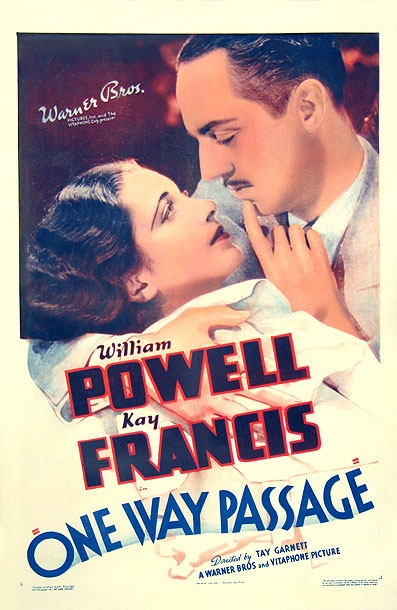
onewaypassagemainCast:

William Powell … Dan Hardesty
Kay Francis … Joan Ames
Aline MacMahon … Countess Barilhaus (Barrel House Betty)
Frank McHugh … Skippy
Warren Hymer … Sgt. Steve Burke
Frederick Burton … The Doctor

Directed by Tay Garnett.
Produced by Robert Lord and Hal B. Wallis.

Original Music by W. Franke Harling & Bernhard Kaun.
Music Direction by Leo F. Forbstein.
Cinematography by Robert Kurrle.
Film Editing by Ralph Dawson.
Art Direction by Anton Grot.
Costume Design by Orry-Kelly.

A Warner Bros. Picture.
Released October 13, 1932.


Box Office Information

Cost of Production: $350,000
Domestic Gross: $791,000
Foreign Gross: $317,000
Total Gross: $1,108,000

For more information, please see the Box Office page.

Background:

When movie fans talk about the ideal Kay Francis kind of suffering melodramas, One Way Passage (1932) is one of the names always mentioned. And for a movie so full of tragedy, it is clearly one of the most entertaining and lovable films ever made.

Kay Francis and William Powell had won critical and audience favor in five films prior to One Way Passage, Street of Chance (1930) and Jewel Robbery (1932) among them. One Way passage turned out to be the final film the duo ever made, and undoubtedly their best.

However, Warner Brothers executive Darryl F. Zanuck was reluctant to cast Francis at first. The dying Joan, he felt, was too heavy for an odd-looking actress with such an obvious speech impediment. Tay Garnett, the film’s director, insisted on using Kay, and promised to have the script written around Kay’s vocal difficulties. “It’s your problem,” Zanuck snapped back.

Kay was cast, and, as Scott O’Brien wrote, “She brought a genuine vulnerability to a role that would have eluded many of the era’s high-strung actresses.”

One-Way Passage was released to critical and commercial acclaim. Photoplay credited Kay’s performance as one of the “Best of the Month,” and wrote that the film was hands-down the best of the Francis-Powell pairings. With a box office gross of $1,108,000, One Way Passage shot Kay up to the top of the Warner Brothers charts. With this [and her subsequent 1932 films: Trouble in Paradise and Cynara] Kay Francis solidified herself as the Queen of Warner Brothers.

1937 saw a re-release of the film, and two years later a remake starring Merle Oberon and George Brent, titled ‘Till We Meet Again (1939), failed to meet up to the critical and commercial praise Kay’s version had garnered. That same year, Kay and William Powell recreated their roles for a radio performance on Lux Radio Theatre, which turned out to be the last time the two actors worked together in their distinguished careers.


onewaypassagepictureplayspread

Above: A Picture Play spread from 1932.

Webmaster’s Review

“Of all the movies our star of the month Kay Francis ever made,” said Turner Classic Movies host Robert Osborne, “this next one may be the best of them all.”

This is one of the best Hollywood romances ever made. Everything, from the score to the story line, to Kay’s costumes to the settings, is given such a beautiful, sentimental touch. It makes one wonder how the same studio that made such bitter dramas as The Public Enemy (1931) or Baby Face (1933) could make something so sweet.

One Way Passage opens in a bar in Hong Kong. Dan and Joan are introduced immediately when they bump into each other, causing Dan to spill his drink. They have a drink to celebrate their first meeting, then smash the glasses on the bar. A shot of the glasses intertwined follows. Dan leaves the bar, and turns around to wave Joan goodbye. He is then arrested by Steve, who is bringing him back to San Quentin to hang.

The two run into Skippy, a drunken petty criminal they both know, who helps Dan out over the course of the film.

Dan and Steve board the S.S. Maloa, where Dan finds out that Steve can’t swim. Handcuffed together, Dan opens up a latch to a gate on the deck and jumps into the water. Steve is oblivious to this, and thinks that it was an accident, that the gate gave out. “You know, someone must have left that rail unfastened.“ He gives Dan credit for saving his life. While bringing him to safety, Dan sees Joan on board the ship deck.

Since the two are onboard a ship where there’s no place to go, Steve does Dan a favor and lets him have freedom onboard, before they arrive in San Francisco where Dan is to be condemned to die for crime.

Joan is a dying woman. We see her sitting in her room where her doctor tells her avoid the glamorous party life she leads. It’s another one of those Hollywood illnesses in which there are no signs or symptoms, but has a fatal outcome. Nonetheless, the two meet in the bar on the ship, where they have another drink. They again smash the glasses on the bar, and a shot shows them lying intertwined.

Steve is in awe of The Countess when he sees her playing the piano. In reality, The Countess is Barrel House Betty, a criminal acquaintance of Skippy’s and Dan’s. “Betty don’t they ever get on to ‘ya?” Skippy asks. “You’ve been gettin’ away with this stuff for years.”

Dan and Joan enjoy watching the sun set, walks on the deck, and spending every minute of every hour together. While dancing, Joan begins to faint. They go outside for some fresh air.

The ship arrives for a top in Honolulu. Dan is locked in the ship’s holding cell by Steve, but is broken out by Skippy and The Countess. When he takes Joan for a ride in an automobile, Dan arranges plans to board another ship, where he can escape San Quentin and perhaps meet up with Joan.

The two next arrive at a beach, where they’re beautifully lit, smoking cigarettes, flirting, and kissing. He tries to tell her he is a criminal, but “if it’s serious” she doesn’t want to listen. When he tries to tell her he’s not going back on the ship, she faints. Having no other choice, he brings her back onboard where she remains in her cabin, in fatal condition.

Betty beings to really fall in love with Steve, in the mean time. She reveals her identity to him, that she’s not really a Countess, and that she should be taken back to face punishment for her crime. Steve already knows this, because before she tells him, he has already received a telegram which informs him of her identity. Considering her honesty (and the fact that he is ready to leave the detective world), Steve decides that it is best to put their pasts behind them and start over again, together.

He tosses the telegram overboard when they kiss.

Dan and Joan have a final drink in the cabin, and agree to meet in Ague Caliente on New Year’s Eve. They smash their glasses and depart to their cabins to pack.

Dan is handcuffed, willingly, back in the cabin by Steve. While packing, Joan begins to feel uneasy, and starts searching for Dan all over the ship. She arrives at his cabin, where the servants inform her of his arrest and murder charge. Still, she loves him, and spots him with Steve on the deck.

They kiss and Joan watches, with tears in her eyes, as Dan is taken away by Steve. She waves goodbye and faints, dying soon after.

In a bar in Agua Caliente on New Year’s Eve, everyone is dancing, drinking and enjoying a fresh start. Two bartenders are drying glasses, and hear two smash against the bar. A shot of two glasses intertwined follows, then they slowly disappear.

Kay gives a stellar performance in this one, hands-down one of her best. She’s believably fragile, which is difficult to pull off when one is suffering from an illness which is never named throughout the entire film, and has no signs or symptoms whatsoever. She’s especially good searching the boat for Powell, hearing that he is a condemned criminal guilty of murder, than locating him on deck and wishing him good-bye as if nothing has ever happened. With the tears in her eyes, she gently falls into the arms of her doctor. It’s a great indication of how good of an actress she really could be.

William Powell does good without really putting any effort into his performance. He seems to just say most of his lines, which works well with his character’s lack of conscious. It’s not until Dan falls in love with Joan, and his conversations solely with her, where we finally start to hear Powell put some life into his performance.

Watch for the scene where the boat reaches San Francisco. Kay and William are solemnly photographed by the camera. Both standing absolutely still, the eeriness of the shot is embedded in my memory. There we see two people, both unaware the other one is to die, tragically looking onto their destination with an uneasiness which can send a shiver down your spine.

As with Give Me Your Heart, One-Way Passage is a film perfectly cast from its headlining stars down to supporting players. And the supporting players in this one are a real treat. Frank McHugh (as the pickpocket), Aline McMahon (as the phony countess), and Warren Hymer (as the detective) nearly steal the film right away from Bill and Kay. The three play off each other famously, and their characters relationships could have made an interesting film in itself.

This was Kay’s favorite of all her movies, and the only one she owned a copy of. It’s easy to see why this was so popular with critics and audiences at the time of its release.

One Way Passage was remade in 1939 as ‘Til We Meet Again, with Merle Oberon and George Brent. The remake was planned as a Bette Davis vehicle, but she wouldn’t do it. Satisfied with her own performance in Dark Victory (1939), she wanted something different outside the glamorous, dying heiress roles.


Vintage Reviews
By Mordaunt Hall, October 14, 1932.
Published in the New York Times.

In its uncouth, brusque and implausible fashion “One Way Passage,” a pictorial comedy drama which arrived at the Warners’ Strand last night, offers quite a satisfactory entertainment. It has an original idea and the characters stand out clearly in their voyage aboard a vessel bound from Hongkong for San Francisco.

Here, there is Dan Hardesty, a murderer, who soon after the introductory scene is apprehended by a sleuth named Steve Burke. Dan is a polished criminal, which can be readily understood when it is said that he is portrayed by the facile William Powell. Just before the voyage Dan encounters the attractive Joan Ames, played by Kay Francis. It is a matter of a spilled cocktail and love at first sight. He expects to expiate his crime at St. Quentin and Joan is an invalid who is well aware that her days are numbered.

Dan is handcuffed to Steve, who admits that he cannot swim, and the murderer, taking advantage of this, pushes down a loose rail and Dan and his captor plunge into the water. Dan virtually succeeds in rescuing Steve, who thereafter does not persist in the use of the steel bracelets. Steve, however, keeps an eagle eye on his man, until he (Steve) chances to be ensnared by a supposed “Countess” whose fingerprints are actually in several police headquarters. The slow-witted detective decides to go ashore with the “Countess” at Honolulu, and he therefore sees to it that Dan is locked up in the ship’s brig. Skippy, the “Countess’s” pal, who is an adept at picking pockets, soon gets the brig key from Steve and releases Dan.

Dan gallantly sacrifices his chance for freedom when Joan suffers a heart attack. He carries her back to the ship, instead of going aboard a freighter, as he had arranged to do with one or the officers. The physician informs him that a shock would kill Joan, and therefore he conceals from her the fact that he is going ashore at San Francisco a prisoner, and when the time comes the handcuffs are concealed by his overcoat. Dan has one hand free and he bids Joan auf wiedersehen, saying that he will meet her on New Year’s Eve at Agua Caliente. In the meantime she has overheard the remarks of a steward and knows the truth, but pretends she does not.

Besides the capable performances by Mr. Powell and Miss Francis there is some good comedy contributed by Frank McHugh as Skippy. Aline MacMahon is excellent as the “Countess” who one minute speaks in broken English and the next relieves her feelings with American slang. This impostor is as cool as a cucumber when it comes to taking the proceeds lucked by Skippy from the wallets of unsuspecting men. Warren Hymer impersonates Steve, who at least once reveals that he can be alert.

Tay Garnett’s direction is clever. He keeps the story on the move with its levity and dashes of far-fetched romance.

Below: From the October 1932 issue
of Photoplay.

onewaypassageoctober1932photplay


Lobby Cards:

onewaypassagelc72 onewaypassagelc73


Posters:

onewaypassageonewaypassageposter09


Movie Advertisements:

German Ad
German Ad
German Ad
German Ad


From the 1937 re-release:

onewaypassagererelease1936novmph1

onewaypassagererelease1936novmph

Paramount on Parade (1930)

paramountonparademph

Cast: Iris Adrian, Richard Arlen, Jean Arthur, Mischa Auer, William Austin, George Bancroft, Clara Bow, Evelyn Brent, Mary Brian, Clive Brook, Virginia Bruce, Nancy Carroll, Ruth Chatterton, Maurice Chevalier, Gary Cooper, Cecil Cummingham, Leon Errol, Stuart Erwin, Henry Fink, Kay Francis, Richard “Skeets” Gallagher, Edmund Goulding, Harry Green, Mitzi Green, Robert Greig, James Hall, Phillips Holmes, Helen Kane, Dennis King, Jack Luden, Abe Lyman and his band, Fredric March, Nino Martini, Mitzi Mayfair, Marion Morgan Dancers, David Newell, Jack Oakie, Warner Oland, Zelma O’Neil, Eugene Pallette, Joan Peers, Jack Pennick, Russ Powell, William Powell, Charles “Buddy” Rogers, Lillian Roth, Rolfe Sedan, Stanley Smith, Fay Wray.


Produced by: Albert S. Kaufman, Jesse L.asky, and Adolph Zukor.

Directed by: Dorothy Arzner, Otto Brower, Edmund Goulding, Victor Heerman, Edwin H. Knopf, Rowland V. Lee, Ernst Lubitsch, Lothar Mendes, Victor Schertzinger, A. Edward Sutherland, and Frank Tuttle.

Original Music by Howard Jackson.

Cinematography by Harry Fischbeck & Victor Milner.
Film Editing by Merrill G. White.
Art Direction by John Wenger.
Choreography by David Bennett.

A Paramount Picture.
Released April 19, 1930.


Webmaster’s Review

This is movie was one of the most important motion pictures produced in 1930, and Kay Francis was given a major exposure in her Technicolor sketch titled “The Toreador.” It was the only time movie audiences saw Kay in color, but the real stars of the show were clearly Jack Oakie and Maurice Chevalier. The importance of both men on the Paramount lot at the time is represented by the care and dedication put into their appearances. For the rest, such as Clara Bow, Ruth Chatterton, William Powell, and Fredric March, Paramount on Parade was just another opportunity to make some money.

Nonetheless, this is early talking Hollywood at its finest.


My print opens with Jack Oakie, Skeets Gallagher, and Leon Errol singing “We’re the Masters of Ceremony.” The three men are in top hats and tuxedos, making their entrances in three different directions. They introduce Charles “Buddy” Rogers and Lillian Roth, who sing “Love Time.” On top of a huge cuckoo-clock, the two seem to be aware of the ridiculousness of their sketch. It’s pure fluff. Rogers and Roth are humbly dressed, and end the song with a smile stretching from ear to ear. Dancers arrive from the sidelines and begin to sing and dance, with Rogers and Roth coming down on the hands and joining in, until both hop back on the hands and meet at the top at twelve.


Jack Oakie is next seen greeting Clive Brook, William Powell, and Eugene Pallette in what appears to be the studio commissionary, or a set of it, and each man is talking about his work in the spoof detective scene they are scheduled to appear in. The detective scene begins with Pallette as Sergeant Heath, arriving at the murder scene of Oakie. Powell pulls up, in a moving coffin (don’t ask), as Philo Vance. Brook is Sherlock Holmes, and the three begin their spoofing on the legendary detective series. By the end of the sketch, Warner Oland, as Dr. Fu Manchu, shoot Powell and Brook to prove to them he is capable of killing, and leaves Pallette at the scene of the crime when the police arrive. Oakie then turns around, taking off his mustache, and says, “It’s a mystery play, written especially for me.”


Skeets Gallagher introduces a sketch from Rudyard Kipling’s “Gunga Din.” Harry Green briefly arrives onstage, telling Gallagher that he’ll one day make it into the show. A Frenchman arrives onstage, and the two men introduce Maurice Chevalier, who beings to talk about the public’s desire to watch him “perform something French.”


Evelyn Brent and Chevalier begin their scene. Apparently, she’s angry with him for flirting with another woman. After singing and flirting, the two begin to fight and…take their clothes off. What’s more eye-catching is the bed right behind them. We see clothes fly on both sides of the room, only to catch them fully clothed and in big fur coats as they leave arm in arm.

“In a Hospital,” a comic sketch with Jean Arthur, Leon Errol, and David Newell, follows. In the original version, a Technicolor musical titled “Song of the Gondolier” proceeded this, but my copy excludes all Technicolor sequences.

The hospital sketch involves early slapstick, ending with Gallagher popping his head into the room and saying “He’s dying to announce Jack Oakie and Zelma O’Neil.”


Chorus girls begin an impressive tap dance in a gym. Oakie and O’Neil sing “I’m in Training for You,” a jazzy number with ridiculous dance moves which are supposed to be funny, but more frightening in its approach to humor.


Ruth Chatterton is greeted by Gallagher in her dressing room, who tells her that the audience is growing impatient to see her. He then introduces her scene, “The Montmartre Girl,” which takes place in France shortly after World War I. In a bar, three marines, one of whom is Fredric March, are taken by Chatterton who is supposed to be either a prostitute or just plain creepy. With a wonderful French accent, she sings “My Marine” fairly well.


A long shot of a beautiful yard follows, and there are couples of different nationalities telling each other they are in love. Chevalier appears as a French police officer in this sketch, titled “Park in Paris.” He beings to sing “All I Want Is Just One Girl.”


Oakie takes the center again, telling us about the present he is going to buy a girlfriend. He’s interrupted by Mitzi Green, an eight-year-old child star who impersonates Maurice Chevalier—badly—singing “All I Want Is Just One Girl.”


Helen Kane next appears in “The Schoolroom.” She sings “What Did Cleopatra Say?” while the students answer “Boop Boop Boopa Doop.” This sketch gets annoying quickly, but ends with Gallagher back onstage with a shoebox in his hand. Placing it on the table, Nancy Carroll and Abe Lyman’s Band appear in miniature size performing “Dancing to Save Your Sole.”


Jack Oakie is sitting at a piano when we next see him. He’s getting ready to introduce the next act with Gary Cooper among the stars set to appear. “Dream Girl,” the sketch ready to follow, fades out before it even begins. This is another Technicolor scene deleted from the television print. Stations wanted to show the glimpse of Gary Cooper in black and white to add his name on the credits, making more people sit down and watch the movie on their station. Unfortunately, his real scene is in color and since it was deleted his appearance is no more than ten seconds.


“I’m True to the Navy” is sung by Clara Bow. The number was made to promote the movie she made with Fredric March that same year. Clara Bow’s voice was never as bad as film history made it out to be, and it’s a shame she didn’t go on to extend her career a few years. But her image was so identified with the 1920s that, when the decade ended, so did her career.


George Bancroft and Kay appear in “Impulses.” This is a comedy sketch which takes place at a party. Kay looks beautiful in her light-colored gown, mannish haircut, and string of pearls as she tells Bancroft that’s he’s no so mean in real life, even though he’s always playing villains in his movies. We see the same party turn upside down. People insult each other, and Kay breaks a vase over Bancroft’s head. It’s a funny comedy scene, and the physicality and violence makes it the most hysterical scene in the movie.


Chevalier again takes center stage in song. He sings “Sweepin’ The Clouds Away,” the finale which features him as a chimneysweep on the rooftops of Paris with unusual energy and enthusiasm toward his difficult job and life. Chorus girls dance all over the rooftops with Chevalier, and the scene ends with a beautiful shot of a rainbow in the clouds.


One can’t really call this a favorite Kay Francis movie, but it’s one production I really like. Out of the major all-talking, Technicolor studio revues of this era, Paramount on Parade is the most enjoyable despite its flaws.


The print I watched was the one edited for Television. All Technicolor prints were excluded, with the exception of Chevalier’s “Sweepin’ The Clouds Away,” which I saw in black and white. Only one of Kay’s two appearances was included, the “Impulses” sketch. Her Technicolor appearance as Carmen was considered lost until 1996 when UCLA restored the movie.


Jack Oakie is lovably annoying throughout the entire movie. Him, Chevalier, and Gallagher get the most camera time, though Gallagher spends much of his time introducing acts, though he’s given some funny dialogue to do so.


This movie was enormously popular at the time of its release, and continues to remain so nearly eighty years after its premiere. Perhaps one day a complete version will be able to be viewed on Turner Classic Movies. Until then, this remains an incomplete movie which sits in the studio vaults for no one to view but other forgotten gems which are stored around it. 


What a shame.


About Paramount on Parade…

Paramount on Parade was Paramount’s most prestigious movie of the early talking era. “Every contract player in the studio had been spending weeks and weeks preparing for his or her sequences for the picture,” Jack Oakie later recalled. “They were carefully fitted for wardrobes that were to suit the elegance they were to represent.”
 

With the arrival of sound, and even a little bit before, there was increasing interest in the Technicolor film process. With big-budget features such as The Vagabond King (1930), Paramount had proven its lead in the world of color film. No studio, with the exception of maybe Warner Brothers, made so much of an effort to bring color movies in vogue.

Paramount on Parade featured a total of twenty sketches, six of which were in color. They included “Showgirls on Parade,” “Song of the Gondolier,” “The Toreador,” “The Gallows Song,” “Dream Girl,” and “The Rainbow Revels.”

The first was an opening number with unknown chorus girls performing a choreographed dance. “Song of the Gondolier” was originally planned for Nino Martini and Jeanette MacDonald. Their duet of “Torna a Sorrento” was trimmed down—at MacDonald’s expense—into a solo number by Martini with an unknown extra at his side. Since it proved to expensive to re-shoot the entire scene in color, Paramount decided to leave that opening shot of MacDonald and Martini in the gondolier and replace her in the close-ups with a bit player.

“The Toreador” was Kay Francis’ only time photographed in color. She, Harry Green, and some chorus girls dressed in Spanish attire perform a lavish Spanish dance. Or, at least the chorus girls do. Kay Francis just sort of struts her stuff around color, showing off her beautiful silver gown and red rose attached to the side of her head. “The Gallows Song” was a sketch which included Dennis King’s performance of “Nichavo!” a number from The Vagabond King.

“Dream Girl” featured Gary Cooper, Jean Arthur, Fay Wray, Richard Arlen, Mary Brian, James Hall and extras. “Let Us Drink to the Girl of My Dreams” was the musical number featured in this sketch. And the finale of “The Rainbow Revels” was for years the only trace of the Technicolor magic this movie featured when first completed. Unfortunately, for decades it existed only in black and white. That’s how my print shows it, but the huge set and performances by Chevalier and the chorus girls are breath-taking to watch in color glory.

As with The Hollywood Revue (1929) and the other marquee musicals of the era, there was little opportunity to make money off of Paramount on Parade once its theatrical run was complete. For years it sat, completely untouched, on the vault shelves until the arrival of television.

In an effort to make money during the legendary battle for profit from Hollywood when television caught on, Paramount sold most of its catalogue to Universal in 1958 for distribution. Unfortunately, all color scenes were cut out of nitrate negatives, and most of the prints were all but destroyed or simply tossed in the trash.

Luckily in 1996 UCLA stepped in and finished the movie to the best of its ability. The color scenes wer restored, and the scenes with missing sound were given title cards and musical score. This is the closest it seems we will ever get to watching a complete version of this movie.

Vintage Reviews:

THE SCREEN; A Hollywood Studio Frolic.

By Mordaunt Hall.
Published: April 21, 1930 in the New York Times
A bright and imaginative audible film, with more than twenty of Paramount-Famous-Lasky’s stellar performers, is now holding forth at the Rialto. This thoroughly enjoyable work is called “Paramount on Parade,” and it is aptly described as a “film frolic.” Judging by the evident glee of the participants, the making of it must have been a merry task. Besides the players, scenic designers, music composers, writers and photographers, eleven directors contributed their bit to this production, which was supervised by Elsie Janis, who is to be congratulated on the high standard of this diversion.

This jovial satire is beautifully staged, and virtually all the sketches are endowed with wit, surprises, competent acting and tuneful melodies. If there are scenes of dancing girls, Miss Janis has seen to it that they are never too lengthy to be tedious, and she has wisely included three numbers with Maurice Chevalier, who, if anything, is perhaps even more engaging in these glimpses than in his own feature films; it is the type of work that is well suited to him.


The sequences in this offering are of such excellence that they aroused genuine applause yesterday afternoon. The audience brought their hands together zealously for M. Chevalier, Mitzi Green, the clever child player who was seen in “The Marriage Playground” and “Honey”; Leon Errol, Clara Bow, Harry Green and others, just as though the shadows could hear as well as move and speak.


Jack Oakie, “Skeets” Gallagher and Mr. Erroll are introduced as the masters of ceremony. As such, these entertainers do far better work than any of the masters of ceremony in the Broadway cinemas and it might be well for those men who believe in patting performers on the back and patronizing audiences to take a leaf from the book of these three. There are times when the introduction of features is as interesting as the subject that follows. Mr. Erroll, for instance, is perceived on a hospital bed “dying.” His wife enters. She is already dressed in mourning and she refers to floral tributes. His sons indulge in a vociferous discussion as to how they are going to benefit by their father’s worldly goods. The nurse, admitting that the patient is “dying,” absents herself for luncheon, it being noon, admonishing Mr. Erroll to keep himself covered up. Mr. Erroll, without once exhibiting the weakness of his ankles, gives a humorous exhibition of a man trying to roll himself up in half-width blanket, and finally one learns that Mr. Erroll is just “dying to introduce the next sketch.”

M. Chevalier first gives an amusing travesty on the origin of the Apache dance. He is subsequently perceived as an agent de police in a Paris park, who satisfies himself as to the addresses and telephone numbers of some of the girls occupying the benches with their sweethearts. M. Chevalier’s third sketch is a musical affair with chorus girls. It is all about “sitting on top of a rainbow and sweeping the clouds away.” This particular sequence, like several others, is in Technicolor, with a rainbow of pretty girls. The colors may not be true to the prism, but here, at least, they are effective, although most of the tinted episodes in other parts of this picture are not in focus—or, they were not yesterday afternoon.

Clara Bow is in this “Paramount on Parade.” She appears with a dancing chorus of bluejackets. She is vivacious and her voice registers better than in any of her own films.


One of the high lights of this production is a satire on murder mysteries, including Fu Manchu, acted by Warner Oland; Sherlock Holmes, portrayed by Clive Brook; William Powell as Philo Vance, Eugene Palette as Sergeant Heath and Jack Oakie as the victim. This sketch affords plenty of laughter, particularly when Fu Manchu, a confessed murderer, is impelled to shoot both Vance and Holmes to prove to these experts that he is not lying and is really a murderer.


Ruth Chatterton has not been overlooked, for she appears as a distraught French girl looking for “her” marine and singing “My Marine.” Little Mitzi Green gives an astounding imitation for an 8-year-old child of Mr. Mack, the deep-voiced “black crow.” She also mimics Helen Kane and M. Chevalier. Miss Kane,herself, is seen in a laughable skit in which she is a teacher in a school with amazing, modern furniture. From her song one gleans that Julius Caesar probably said “Boop boopa doop” immediately after describing Gaul as being divided into three parts. Nero did not fiddle, but “Boop boopa dooped” while Rome burned and at one time or another many an outstanding figure of the past has sought relief in pronouncing “Boop boopa doop.”


Nancy Carroll emerges from a shoe and her orchestra appears in the box in which the shoes were packed. The winsome Miss Carroll sings and dances and then like a charming Mother Hubbard retires to her shoe—one with a rhinestone buckle. Harry Green, arrayed as a Spanish bullfighter, parodies the “Toreador” song from “Carmen,” with a contribution called “I’m Isidore, the Toreador.”


It is to be hoped that the Paramount stars will have further frolics, for a person would have to be frightfully cynical even to pretend one did not care for this production.


Street of Chance (1930)

streetofchance0817Cast:
William Powell … John D. Marsden
Jean Arthur … Judith Marsden
Kay Francis … Alma Marsden
Regis Toomey … ‘Babe’ Marsden
Stanley Fields … Dorgan
Brooks Benedict … Al Mastick
Betty Francisco … Mrs. Mastick
John Risso … Tony
Joan Standing … Miss Abrams
Maurice Black … Nick
Irving Bacon … Harry
John Cromwell … Imbrie


Directed by John Cromwell.
Produced by David O. Selznick.

Based on the story by Oliver H.P. Garrett.
Adaptation by Howard Estabrook.
Original Music by John Leipold.
Cinematography by Charles Lang.
Film Editing by Otho Lovering.
Costume Design by Travis Banton.

A Paramount Picture.
Released January 31, 1930.

About the Film:

Though Street of Chance was the second of six parings between William Powell and Kay Francis, the film can be argued as the one which really established them as a recognized team. Their chemistry shines through in all of their scenes together, which have a sort of bitterness of broken promises to them. Their characters are John and Alma Marsden, whose marriage is unfortunately on the rocks because of John’s corrupt gambling lifestyle.

Of their four Paramount features, Street of Chance is undoubtedly the best of the whole bunch. But the majority of the credit goes to two men behind the entire production.

The film was produced by David O. Selznick, who not only had a strong belief that William Powell could really go somewhere as a leading man, but that Kay Francis could also establish herself as a leading lady. She had come to promise vamping out Walter Huston in Gentlemen of the Press (1929), Fredric March in The Marriage Playground (1929), and William Powell in Behind the Make-Up (1930), and now a year into her movie career, Selznick decided it was time for Francis to progress from her vamp roles.

“David Selznick did more to buoy my self-confidence than anybody else,” Kay later remembered. “He was the one who always believed I was capable of playing leads.” She remained grateful to him for the rest of her career.

The other man who is due a great credit is director John Cromwell, who did a lot for Kay within the course of her Hollywood years. This is not only the man who made her star by directing her in this film as well as For the Defense (1930), but he revived her fame ten years later when he gave Kay most of the attention in In Name Only (1939), her comeback vehicle after her battle with Warner Brothers.

Kay Francis fans owe both men a major recognition of respect.

Street of Chance was based on a story by Oliver H.P. Garrett, which many believed was based on the life of Arnold Rothstein. Nicknamed Mr. Big, Rothstein was one of the more notorious criminals of the first half of the twentieth century, even being speculated as to having fixed the 1919 World Series. His legacy was immortalized in Hollywood with not only Street of Chance, but also Samuel Goldwyn’s production of Guys and Dolls (1955). Ben Hecht, Charles MacArthur, and Howard Estabrook—who received an Oscar nomination for her work on the film—adapted Garrett’s story to the screen brilliantly. Street of Chance is one the most mature and adult dramas of the early talkie years largely because of their work on the script.

Many point to Street of Chance as the one which made a Kay Francis a star. It at least got her name out there to get Paramount to give her more important roles, but she still had a while to go before she really hit her stride. But of her first few years in Hollywood, this is one of her most important films. She’s not only more believable, but also more comfortable in front of the camera, which does photograph her favorably throughout most of the film. Critics gave her, and the entire picture, rave reviews which made it reasonably popular with audiences.

Four years later, Fox remade Street of Chance under the title of Now I’ll Tell (1934), which starred Spencer Tracy, Helen Twelvetrees, and Alice Faye. Three years after that, Paramount remade the film as a programmer with Gail Patrick and Ricardo Cortez. Titled Her Husband Lies (1937), it was the final film version of Garrett’s story. Paramount’s Street of Chance (1942) was a low-budget programmer which used the early elements of film noir—special lighting tricks, and melodramatic plot involving sticky situations. It was completely unrelated to any of the film versions of Garrett’s story.

Today, Street of Chance remains a forgotten treasure in the Universal film vaults. As Roger Bryant, the author of William Powell: The Life and Films, pointed out about Behind the Make-Up, “its relative neglect even by movie buffs is understandable, given the poor quality of videotapes, likely third or fourth generation transfers, that circulate on internet auction sites.”

The same can be said for this film.


What the Picture Did for Me:

Exhibitor Herald-World‘s long-running column for independent theater owners to tell each other what type of business was made and what the quality of the product was during their showings. Some also wrote the days the film was shown in their theater. 

April 19, 1930
William Powell- Very good on Sunday crowd. But oh, how it flopped on Monday. Worst in months. Good picture of its kind. — A. E. Jarboe, Ritz theatre, Cameron, Mo. — General patronage.

June 14, 1930
William Powell – In second week of talker crowds fell off abruptly. This play is only fair, and despite William Powell’s superb voice and acting, it is not a play to attract people. Plot is not so good. Type has no draw. No love plot of younger people. No music. A man’s play only. Leave it off your buying if possible. – Phillip Rand, Rex theatre, Salmon, Idaho. – General patronage.

July 12, 1930
William Powell – June 22-23-24. A good talking program picture. The star fine, story good of the kind, but it is the kind people have had too much of. Murder and rough stuff. This making a hero of the crook has had its day here. They just won’t come and see them. Picture did a terrible flop at the box office. – Bert Silver, Silver Family theatre, Greenville, Mich. – General patronage.

July 19, 1930
William Powell – Too much dialogue, not enough action. – Jack Greene, New Genesco theatre, Genesco, Ill. – Small town patronage.

William Powell – Very good. Pleased the few who ventured out. Eight reels. – Harold Smith, Dreamland theatre, Carson, Ia. – General patronage.

August 2, 1930
William Powell – In playing your favorite game you make a shot off a long run on the green for a cup and your fellow players call it before you sink it. That’s a putt! And now I will tell you after all that lingo, here’s a picture, and what a picture! Perfect in story, perfect in talking. What more do you want?  Set it in now. – W.H. Brenner, Cozy theatre, Winchester, Ind. – General patronage.


Trivia:

Judging by her billing, this was Kay Francis’ first real lead. It was her fifth film and the third time her name appeared in the top three billed positions. There aren’t any real closeups (of Kay or any of the cast besides Powell), but Cromwell gives her some interesting private moments, especially when she and Powell’s plans for a second honeymoon are interrupted by a phonecall from one of the gamblers.

Street of Chance was remade by Fox in 1934 as Now I’ll Tell, with Spencer Tracy, Helen Twelvetress, and Alice Faye. Paramount remade the movie again in 1937 as Her Husband Lies with Gail Patrick and Ricardo Cortez. Paramount’s Street of Chance (1942) was not a remake of this film, but an early, low-budget film noir.

Kay’s eyes were permanently damaged during production. “It took a day and a half for them to set up the equipment,” Kay later told reporters, “and as the arc light came nearer and nearer for the close up, I didn’t want to break the scene by complaining. It hurt my eyes, but we did the scene. It never had to be reshot. When it was over, tears came streaming down my eyes, and I had to spend ten days in a dark room.”

This was Kay’s first sympathetic role, and to prepare her for it, Paramount had her “butch” hairstyle—which had such an impact on her look while playing vamps—transformed into what the authors of Kay Francis: A Passionate Life and Career called “a sophisticated coiffeur.”

Kay credited David O. Selznick as being the first person to really believe she could be more than just the supporting vamp. She always credited him as being the first person to believe that she could be made into a star, and Selznick rightfully claimed credit as having given her a nice showcase (and career boost) with Street of Chance.


Film Images:


Vintage Reviews:

Review originally published in Exhibitor Herald-World
January 25, 1930:
A TAKEOFF ON ROTHSTEIN CASE. Produced and distributed by Paramount. Story, Oliver H. P. Garrett.  Direction, John Cromwell. Scenario, Howard Estabrook. Photography, Charles Lang. Supervised by B. P. Schulberg. Cast: William Powell, Kay Francis, Regis Toomey, Jean Arthur, Stanley Shields, Betty Francisco, Brooks Benedict and John Risso. Previewed at the Paramount West Coast studios.

WILLIAM POWELL is starred in Street of Chance. Paramount assembled an excellent cast in support of the new star and the result is real entertainment. The story is a takeoff on the Arnold Rothstein murder which still baffles New York police. There is a Larry’s cafe in place of Lindys, an ambulance ride with the dying gambler refusing to name his gunman. It’s interesting and exceptionally well done.

Powell is John B. Marsden, broker, alias “Natural” Davis, gentleman gambler deluxe. His phenomenally uniform success over the table wins him the monniker of “Natural.” His role is sympathetic.

Broadway furnishes a background and the lack of music only adds to the story. Kay Francis deserves praise as the estranged wife. A reconciliation is in order but it comes too late. Powell takes a “spot” that he himself created and dies like a trouper.

Regis Toomey and Jean Arthur as the newly married couple add romance. Powell has deep silvery speaking voice and uses it to advantage in choice bits of well written dialog. Of course, most of the ardent Powell fans will not approve of their hero getting “bumped off,” but it is for the best.

Credit goes to John Cromwell for splendid direction. — T.  J.  H.

Mordaunt Hall, February 3, 1930. The New York Times:
William Powell, who has had his innings as Philo Vance in the films of the S. S. Van Dine stories, is now to be seen at the Rialto as “Natural” Davis, a prototype of the late Arnold Rothstein. This talking film, known as “Street of Chance,” is admirably acted and its incidents are so craftily devised that they compel attention.

It is a picture charged with excitement growing out of the stealth suggested in its scenes of Times Square and other sections on Broadway. There are instances where it might have been still more impressive, but, even so, there is no little originality in the handling of the high-stake gambling games.

John Cromwell, the director, with the aid of the author, Oliver H. P. Garrett, gives the breath of life to the persons involved in this adventure. There are the welchers, the faithful one-armed newsboy, the square-jawed money-grabbers who think no more of the death of a welcher than they do of the smoke from their cigars. The law of these “grand” gamblers is that a man must “go for a ride” if he’s in the way, and while the killing of an individual is entrusted to a couple of thugs, they pile up big money on a roll of the dice or a turn of the cards.

“Natural” Davis, whose real name is John B. Marsden, is the gambling leader and his orders are carried out until he finds himself in the same predicament as others and he is “put on the spot,” which means that his chances of continuing to live are about one in a hundred.

Davis, of all men, is caught with an ace in his palm and the poker players refuse to listen to his ex- planations or to his offer to refund the money. He is to walk the plank, so to speak.

Davis has a more human side to his nature where his own brother is concerned. He sends that young fellow $10,000 as a wedding present and “Babe,” as this brother is called, unknown to “Natural,” turns the $10,000 into $50.000, by gambling in California. He comes to New York, having heard all about “Natural” Davis, but never suspecting that this king of gamblers is his own brother. “Babe” fancies himself with the cards, and when John B. Marsden tells him not to gamble, “Babe” returns the $l0,000 to his brother. When John B. knows that “Babe” is going to get into a game with his own colleagues, he asks these hardened veterans of the round table and the dotted bones to fleece the kid. But it happens otherwise, for “Babe” has a run of luck that brings “Natural” Davis to the gambling table. Prior to “Natural’s” arrival, “Babe” looks forward to meeting this foeman worthy of his steel, and when he realizes a little later that Davis is his own brother, he decides to make the older man eat humble pie or go broke.

“Babe’s luck continues. Do as he will Davis can’t help adding to his brother’s stacks of chips. “Grands” are poured into the game as if they wore pennies and something like $250,000 decorates the table in one pot. Davis himself is being wiped out by this “Babe,” and although others are in the stud pot, Davis palms an ace. And Mr. Davis might just as well have stood up then and there and permitted himself to be peppered with bullets as to wait a day, for his name is mud.

And a little later, “Natural” Davis is seen staggering at the front door of a big hotel and is finally taken to a hospital in an ambulance. At that moment “Babe” and his bride are aboard a train bound for the West.

Mr. Powell does extraordinarily good work as the power among Broadway gamblers. Kay Francis is believable as the gambler’s wife. John Risso makes the most of the crippled news boy, Tony. Regis Toomey almost rivals Mr. Powell in his interpretation of “Babe.”

From a 1930 issue of Motion Picture

streetofchance1930motionpicture

From the May 1930 issue of Screenland.

screenlandmay1930streetofchance


Film Advertisements:

Posters:

streetofchancelobbycard09


Lobby Cards:


Herald Advertisements:


Tie-in Novel:

Glass Slide:

streetofchanceglassslide


Give Me Your Heart (1936)

1936givemeportraitCast:
Kay Francis … Belinda ‘Bill’ ‘Linda’ Warren
George Brent … James ‘Jim’ Baker
Roland Young … Edward ‘Tubbs’ Barron
Patric Knowles … Robert ‘Bob’ Melford
Henry Stephenson … Edward, Lord Farrington
Frieda Inescort … Rosamond Melford
Helen Flint … Dr. Florence ‘Bones’ Cudahy
Halliwell Hobbes … Oliver Warren
Zeffie Tilbury … Aunt Esther Warren
Elspeth Dudgeon … Alice Dodd

Directed by Archie Mayo.
Produced by Jack L. Warner and Hal B. Wallis.

Based on the play “Sweet Aloes” by Jay Mallory.
Cinematography by Sidney Hickox.
Film Editing by James Gibbon.
Art Direction by Charles Novi & Max Parker.
Costume Design by Orry-Kelly.
Music Direction by Leo F. Forbstein.
Music Composition by W. Franke Harling & Heinz Roemheld.

A Cosmopolitan Picture.
A Warner Bros. Release.
Released September 17, 1936.


Box Office Information:

Cost of Production: $436,000
Domestic Gross: $633,000
Foreign Gross: 402,000
Total Gross: $1,035,000

(Source: “The William Shaefer Ledger”, USC Cinematic Arts Library.)

Background:

Give Me Your Heart can be written off as perhaps the most underestimated movie of Kay’s entire Hollywood career. Along with Trouble in Paradise (1932), One Way Passage (1932), and Confession (1937) it’s one of her top four greatest movies.

Ruth Chatterton had created a sensation in the mother-love dramas such as Madame X (1929), Sarah and Son (1930), and Frisco Jenny (1933). It was Chatterton’s tour de force in such films which had the studios placing stars like Kay in vehicles like The House on 56th Street (1933), a Chatterton reject. Those stories about fallen women forced to give up their children, and the idea of having to love those children from a long distance, was a favorite of subject of those depression-era audiences. Sometimes, when the idea of complete happiness seems unachievable, it’s a little easier to watch those movies of complete fantasy and feel just a little better at the end of the hour and whatever minutes it takes that production to run.

As the mid-1930s progressed, however, and Americans started to finally feel some relief, those harshly dramatic mother-love dramas had begun to decline. The production code also had a lot to do with it, but the clever movie studios began finding ways to cheat around the censorship hypocrites of the day, producing movies such as this excellent Kay Francis melodrama.

Jay Mallory’s “Sweet Aloes” had triumphed on the English stage with Diana Wynyard in 1934. Though the American version was less successful, Warner Brothers felt it had that certain spark which would make it a Hollywood triumph. The production studio William Randolph Hearst and Marion Davies owned, Cosmopolitan Pictures, agreed to finance the film on an impressive budget, with Warner Brothers distributing it as a regular attraction. Scripts were sent to a great choice of contenders for the part: Ann Harding, Claudette Colbert, Bette Davis, and Kay, whose impressive work in I Found Stella Parish (1935) and The White Angel (1936) had Warner Brothers ready to give her an equally dramatic boost.

To ensure the movie’s success, Kay was reunited with her frequent leading man, George Brent. Roland Young, Frieda Inescort, Patric Knowles, Henry Stephenson, Helen Flint, and Zeffie Tilbury were selected for the supporting characters. No part could have been selected better.

Director Archie Mayo and Kay had worked together previously. Strangely, considering how much they disliked each other, he was one of her best directors. Famously, he had gone as far to tell her that she couldn’t act, which, maybe in her determination to prove him wrong, gave way to her excellent work in this picture as well as the others they completed together.

Production began May 4, 1936, and Kay and George Brent appeared on Hollywood Hotel (a radio program) on September 25, 1936 to promote the movie. A few critics noted that it was unusual the Production Code Administration allowed Give Me Your Heart to even be considered, let alone produced, as a major attraction, considering adultery and unwed motherhood violated the code. But Mayo made sure, without going overboard, to let viewers know that the characters in the film were “three nice people who have happened to get themselves involved in a serious ‘mess.’”

givemeyourheart1With the bonuses of Kay’s beautiful wardrobe by Orry-Kelly, and Leo F. Forbstein’s excellent score, Give Me Your Heart became one of Warner Brothers’ most successful films of the 1936-1937 season. It’s affect on critics and audiences had three more excellent movies of this sort of nature being produced the following year: Stella Dallas (made by Samuel Goldwyn and starring Barbara Stanwyck), Confession (made for Warner Brothers and starring, of course, Kay), and That Certain Woman (made for Warner Brothers, and starring Bette Davis). Fortunately, as Variety noted, this sort of film subject did not become redundant by the major studios, making movies like this one so special among a group of predictable, unimaginative others.


From the July 1936 issue of Photoplay magazine:

july1936photplayfashionkay


Trivia:

The movie was released with the title Sweet Aloes in England (the film was based on the famous English play of the same name).

The director of the film, Archie Mayo, had already directed Kay in Street of Women (1932) and would go on to direct her again in Charley’s Aunt (1941). Mayo hated Kay, and often made rude comments to her about her acting talent, or lack of.

This was the fifth paring of Kay Francis and George Brent. Their other efforts included The Keyhole (1933), Stranded (1935), The Goose and the Gander (1935) and Living on Velvet (1935). After completion of this film, they would team up only one more time for 1938’s Secrets of an Actress.

Roland Young made his second and last movie with Kay in Give Me Your Heart. Their other pairing was Street of Women (1932).

Henry Stephenson was a popular character actor in classic films such as Marie Antoinette (1938) and The Private Lives of Elizabeth and Essex (1939). Give Me Your Heart was his second of four pairings with Kay. Their previous film together was Cynara (1932) and their others would include It’s A Date (1940) and The Man Who Lost Himself (1941).

Patric Knowles appeared in 1938’s The Sisters, a vehicle originally slated as a second paring between Kay and Errol Flynn. Give Me Your Heart was the only time he appeared in a Kay Francis film.

The beautiful Frieda Inescort would appear in Another Dawn (1937).

While Ann Harding and Claudette Colbert were considered for the lead, Bette Davis unsuccessfully fought for the part. Kay got it, largely because she was still a bigger star than Davis. But her reign over Bette would not last much longer.


Webmaster’s Review:

givemeyourheart4This is a wonderful film. Give Me Your Heart (1936) has many similarities to Stella Dallas, Confession, and That Certain Woman (all made and released in 1937). But Give Me Your Heart, however, has the distinction of being the first of the streak of four well-executed and lavish productions.

The movie opens in the English countryside (probably the Warner Brothers back lot in real life, but the effect is convincing Hollywood magic). Tubbs, a smart but slightly annoying know-it-all, finds women’s gloves lying inside of an automobile he recognizes. It is the car of Bob Melford, a lonely man with an invalid wife incapable of having children. He and Linda (a neighbor) are taking a romantic walk in the woods. They don’t seems as in love with each other as they are with the idea of being in love with each other. While Bob’s invalid wife is warm and loving, he’s lonely. Linda lives with her miserable Aunt Esther, who has one nasty attitude towards Linda. As a result, Bob and Linda seek escapism with each other.

One of my favorite shots of Kay is when she returns home from the walk, sits on the windowsill, and gazes out at the beautiful night sky. The music is touching, too. Not to all-over-the-place as the score of Stella Dallas is, but the score for Give Me Your Heart has a simple, touching sincerity to it.

Unfortunately for Linda, she realizes she is pregnant with Bob’s child. Obviously because of the code, there is a lot of implying to her pregnancy, and lecturing of her actions, especially when Tubbs (who is a good friend of Linda’s) brings Lord Farrington, Bob’s father, to her house for an emergency talk about the situation. Bob makes Linda an offer she can’t refuse: to take the child as his grandson, and send Linda away to America where she can be financially supported by Lord Farrington until she is married. Unfortunately, she must give up her child to Rosamond, Bob’s invalid wife.

On her way back to America, Linda meets James Baker, a wealthy man who she comes to know and marries. Years pass, and Linda is haunted by memories of the past. She can’t eat or sleep. She lashes out at Jim constantly. And seems to only be able to smoke countless cigarettes, drink martinis, and wear gorgeous costumes (typical of a Kay Francis movie!). She consults her doctor, Florence, but nothing seems to cure her.

Finally, Tubbs tracks Linda down out of curiosity, but does it in a sneaky, annoying way. He’s in America to get “help with his taxes” from Jim. When he runs into Linda at Jim’s apartment, the two get a moment alone and talk of the past. Linda learns that Lord Farrington has died, Bob has taken over his father’s name, Rosamond’s health has taken a serious upturn, and that Linda’s son is named Edward, and looks like her “in the eyes a little.”

Tubbs takes Linda, Jim, and Dr. Florence out to dinner. Unknowingly to Linda, Tubbs has arranged for Bob and Rosamond to be the other guests. Since Linda has not mentioned a word of her past to anyone, Jim doesn’t suspect a thing because he was well aware Linda was emotionally damaged when he married her. They’re all “introduced” to each other, although Rosamond doesn’t know that Linda is the real mother of her child. Well, at least not yet.

Sitting at the bar, the subject of little Edward (named after Bob’s father) comes up. Rosamond shows Jim a mirror which has Edward’s picture pasted onto it. Jim brings the mirror to Linda, and one of the most heartbreaking shots in any film follows. Through the mirror, we see a teary-eyed Linda caress the photograph with her index finger. The others move to the table where their dinner is served, and Bob walks over to Linda at the bar. “Linda, I…I’m most frightfully sorry. I… I mean I…”

“Will you take this back to your wife please,” she interrupts, looking away from him (right past the camera) with tears in her eyes. As she says this, she hands Bob the mirror with the picture of little Edward inside.

“Has it been retched misery for you?”

“What do you think?”

During dinner, Linda can’t take any more of the heartache, and grabs her coat and heads for the door. Rosamond gets up and follows her into the hallway. They being to talk, and Rosamond pieces together that Linda is the mother of Edward. “You don’t like me very well, do you?” she asks Linda.

“Like you?” she responds. “I hate you.”

They discuss the topic more, and Rosamond decides to bring Linda upstairs to her hotel room where little Edward is asleep. Linda kisses his cheek, cries, then caresses his arm. When she walks back to Rosamond, they come to an understanding that little Edward has been given a position that Linda could have never afforded to give him.

“Oh, I do wish that we could be friends,” says Rosamond. “See a lot of each other, I mean. Funny that our greatest bond makes that impossible, isn’t it?”

Linda and Jim and Rosamond and Bob say good night to each other. Tubbs and Florence decide to get married. All couples disperse, and Linda and Jim walk home and discuss the “strange” evening. Jim, who still has no idea of Linda’s past, is slightly surprised when she implies that she’s ready to have his children. But he agrees with her, and the two walk off into the New York City night.

This movie was based on the 1934 English play “Sweet Aloes,” by Jay Mallory. Diana Wynyard played Kay’s part on the stage. The American adaptation for the stage was less popular. Sweet Aloes was the film’s release title in England. Movie posters and advertisements can still be found with that title.

Give Me Your Heart was an enormous success for Kay. Along with Stolen Holiday (1937), Give Me Your Heart marked Kay’s peak at Warner Brothers. Both films have solid production values, good scripts, beautiful lighting, and a great supporting cast. Another Dawn (1937) had everything but a good script, and was perhaps the movie in which Kay’s public appeal began to wane. Confession (1937) was successful, but not as much as it should have been. First Lady (1937) tanked, and brought down the end of Kay Francis’ reign as the Queen of Warner Brothers.

In the early 1930s, Ruth Chatterton has a series of successful roles as suffering mothers. Madame X (1929) and Sarah and Son (1930) are her best examples. In the mid-1930s, the popularity of such films came back because of Give Me Your Heart. Barbara Stanwyck’s Stella Dallas (1937) followed. Confession (1937, with Kay and Basil Rathbone) and That Certain Woman (1937, with Bette Davis and Henry Fonda), didn’t prove to be as stellar as their predecessors. As a result, these types of films went into the shade again. It was not until perhaps Mildred Pierce (1945) where these mother/love dramas proved to be so valuable to Hollywood.

Kay’s performance is strong, sincere, and one of the best of her career. From the naïve American girl living in an English village, to the nerve-struck socialite on the verge of a nervous breakdown in New York City, to finally getting relief with the satisfaction of being reunited with her son again, she dominates the film with her acting and personality. Belinda Warren was one of the more complicated characters of Kay Francis’ career, and her ability to pull it off is a true example of her power as an actress. However, she is thrown into a typical Kay Francis situation, which is where her beautiful screen personality is able to shine through and satisfy her fans.

Aside from Kay, the other real spark to Give Me York Heart is Roland Young, who does a pretty good job at almost stealing the film. Some point to his performance as “annoying,” but he just plays a busybody whose actions are slightly deceptive, yes, but his intentions are anything but. He rescues Linda from insanity, her marriage to James Baker, and gives Rosamond the satisfaction of knowing the real mother of her husband’s son whom she must call her own.


Speaking of Rosamond, Frieda Inescort is breathtakingly beautiful as well as talented. A wonderful Scottish actress whose career was hampered by her battle with multiple sclerosis, she is able to make herself believably delicate in the first half of the film, only to physically save herself with the love of her son she didn’t even bare. I don’t know when exactly she was diagnosed with MS, but if it was before Give Me Your Heart was filmed, she does a great job at recreating her own physical limitations during relapses. As her husband, Patric Knowles nearly rivals Kay and Frieda for the title of the most beautiful performer in this weepy.

Henry Stephenson is good as Lord Farrington, the only one with the right solution to the problem at hand. Also good in their roles are Helen Flint as Dr Florence “Bones” Cudahy, Zeffie Tilbury as Aunt Esther Warren, and George Brent as Jim Baker.

One could easily go on. Give Me Your Heart is one of those films with an incredible cast. There is not one part which is worth a reconsideration of its player.

Considering how much they didn’t get along, Archie Mayo was one of Kay’s best directors. One would never think there were any problems between the two, but perhaps his underestimation of Kay’s talents caused her to get up and prove him wrong. Don’t have an answer for that one, all I know is that he does an excellent job.

With all of that said, this film and its cast are worth a major reconsideration and discovery by today’s critics. Until then, all remains underestimated perfection.


Screenland Fashion Spread:

givemeyourheartscreenland


Modern Screen Fashion Feature:

givemeyourheartmodernscreen


Movie Reviews:
Into the New Criterion—with its Chinese red seats, fluted ceiling, indirect lighting, fawn and huntress murals and general atmosphere of air-conditioned comfort—has come the Warners’ film version of last season’s “Sweet Aloes.” On the behest of the nation’s showmen, who feared every one would confuse it with “Sweet Alice,” the Brothers obligingly changed its name to “Give Me Your Heart,” which has definitely a musical comedy ring and may not prepare you, unless you are familiar with the play, for an affecting, mature and sophisticated drama of mother love and applied psychiatry.

It is Kay Francis this time, not Diana Wynyard or Evelyn Laye, who is the Belinda Watkins of the tortured memories and agonizing self-reproach. She has had a child by a married man, Lord Farrington’s son, whose wife is a semi-invalid and childless. She has yielded that child to its father, on the familiar appeal of Lord Farrington and her friend and confidant, Tubbs Barrow, that he will receive advantages which she could not give him. She has fled to America and married prosperously and well, but she is neurotic, tense, consumed by fears and uncertainty for her child; stifled with thoughts which she is trying to force back into the dead-letter chamber of her mind.

This is, if you will, a trite and patterned beginning, but the picture comes electrically to life when the irrepressible Tubbs—splendidly played, we might mention, by Roland Young—follows her to New York to prove the author’s theory that ghosts exist only because we keep them in dark corners. It is a crackling scene they have contrived where Belinda and her husband meet the new Lord Farrington and his wife, now recovered and intuitively aware that she is facing her boy’s real mother. Out of the meeting, out of the touching womanly talk of the child and his pony cart and fear of loud noises, Belinda wins release and surcease from anguish.

Tripping lightly through the heavier theme and wisely balancing its tragedy is a genial elf of comedy in the increasingly stocky form of the aforementioned Mr. Young. He has one moment in particular which ranks with the trial scene in “Mr. Deeds,” with the feeding-machine bit in Chaplin’s “Modern Times” and the stork episode in “The Country Doctor.” It comes when Mr. Young meets the picture’s Florence Cudahy (played by Hazel Flint) and we shall say no more about it, so as not to deprive you of discovering it for yourself, except that never has Mr. Young been more abashed, timid, self-effacing and altogether delightful. Miss Flint, of course, had to be admirable too, or the effect would have been spoiled. Let them share the bow.

The cast, in other respects, is thoroughly up to the task of bringing a basically exaggerated story to a convincing measure of credibility. Miss Francis, still amazingly gowned and handicapped by that distressing difficulty with her “r’s,” plays Belinda with pathos and reticence. Frieda Inescort is charming, understanding and tender as the hapless Lady Farrington. George Brent gives to the role of Belinda’s baffled husband a blunt, masculine incomprehension of his wife’s turmoil, which is precisely what the part required. There are valuable minor bits by Henry Stephenson, Zeffie Tilbury and Patric Knowles. In sum, a promising première for Broadway’s newest theatre. We bid them both welcome.
By Frank S. Nugent. Published in the New York Times, September 17, 1936.

From the September 1936 issue of Photoplay:

givemeyourheartseptphotop

From the September 1936 issue of Modern Screen:
givemeyourheartmodernscreenreview


Lobby Cards:

givemlobby1 givemlobby2 givemlobby3


Posters:

givemeyourhearthalfsheetgivempostergivemeyourheartinsert


Herald Advertisements:

givemeyhsept1936mph1givemeyhsept1936mph2givemeyhsept1936mph3givemeyhsept1936mph4


Girls About Town (1931)

gilsabouttown1031Cast:
Kay Francis … Wanda Howard
Joel McCrea … Jim Baker
Lilyan Tashman … Marie Bailey
Eugene Pallette … Benjamin Thomas
Alan Dinehart … Jerry Chase
Lucile Gleason … Mrs. Benjamin Thomas
Anderson Lawler … Alex Howard
Lucile Browne … Edna
George Barbier … Webster
Robert McWade … Simms
Louise Beavers … Hattie
Judith Wood … Winnie

Directed by George Cukor.
Produced by Raymond Griffith.

Based on the story by Zoe Akins.
Screenplay by Raymond Griffith & Brian Marlow.
Cinematography by Don Haller.
Costumes by Travis Banton.
Still Photography by Frank Bjerring.

A Paramount Picture.
Released October 30, 1930.

Background:

After two years of supporting parts or secondary leads, Kay Francis was finally given the star treatment from Paramount in Girls About Town, a wonderful comedy from George Cukor produced in August 1931. Based on a story by Zoë Atkins, the film revolves around two professional gold diggers, one of whom (Francis) decides it’s time for her to quit the racket and settle for love with her ideal suitor (McCrea).

Paramount had showcased Kay just fine in Gentlemen of the Press and Dangerous Curves, but her subsequent films were less than stellar, particularly Let’s Go Native (1930), in which she was fifth-billed in the ridiculous Jack Oakie and Jeanette MacDonald pairing. Two movies opposite William Powell, Street of Chance and For the Defense, along with her loan out to First National for A Notorious Affair made Hollywood stand up and realize that perhaps Kay could emerge as a true star on the Joan Crawford or Norma Shearer level.

But Paramount just didn’t see it. Not knowing what to do with their brunette beauty, she continued in second leads until she was top billed in this production, which became one of the best Pre-Code comedies ever produced.

Kay was top-billed in Girls About Town, which was technically her second to last film under contract. After The False Madonna, the studio was so impressed with her that they gave her the opportunity to work with Fredric March in Strangers in Love (1932) at the same salary her new studio, Warner Brothers, was to be paying her when she began her employment there later in the year. It was a nice gesture she later admitted, but it was time for her to move on in her career, and only Warner Brothers had the plans and assets to turn her into a major star.

There is no one star of Girls About Town, however. Kay, Joel McCrea, Lilyan Tashman, and Eugene Pallette share the spotlight perfectly; clearly this was a movie without any self-centered personalities. Even in the scene where Kay and Joel McCrea go swimming, it’s hard to focus concentration on just one star with McCrea’s perfectly tanned skin and Kay’s revealing bathing suit (which leaves nothing about her figure to the imagination).

According to Kay’s diary, Lilyan was often drunk on the set, but the two ladies were friends. Tashman had told the press that she considered Kay the most beautiful actress of the screen, and appreciated the fact that Kay wasn’t catty, a rare personality trait for Hollywood stars—female or male.

Webmaster’s Review:

This movie opens up with some really fun credits. As jazzy music plays, we see a montage of glam girls partying and wearing gorgeous gowns with a shot of New York City’s skyline in the foreground. When the credits end, there’s a montage of lades in the powder room applying makeup, combing their hair, and doing their nails. “It’s been an evil night,” Marie Bailey says to girlfriend Wanda.

“Isn’t is a relief to get away?”

“All through the show he talked about nothing but Des Moines.”

“Is that all? I’ve got a callas on my knee from my boyfriend’s suddel approach.”

Wanda admits that she’s “fed up with all this,” and the two go to dinner with their sweethearts of the night. A montage of drinking and fun follows. We see all sorts of weird facial expressions, including a teary-eyed Wanda. Marie goes back to the apartment, strips as far as censors will allow her, then gets ready for bed (in what looks like a comfortable robe topped with lots of fur). Wanda comes home, admits she’s sick of the socializing, then smiles and admits “someone had to pay for this dress” when she gets her $500 check.

The two ladies wake up at five in the afternoon, have some grapefruit juice and some aspirin, and Marie gets a phone call from Jerry about a big party on a yacht for a Mr. Benjamin Thomas.

Later that evening, Jerry informs the girls that Mr. Thomas is the wealthiest man in Michigan. Wanda, peeking out of a window, spots a handsome Jim Baker, but thinks that he’s Thomas. Wanda leans into Marie and insists on having Mr. Thomas. Marie can care less, and they meet the real Mr. Thomas when he plays practical jokes on both of them.

“You know I should have warned you ladies that Ben is a famous practical joker,” says Jerry.

When Wanda and Marie are alone, they decide to swap men. Marie does a swell job at seducing Benjamin, but Wanda has a hard time even keeping Jim awake. He’s immune to her charm, but agrees to play a game with her where he pretends to be her boyfriend. They flirt, kiss, and hours go by and Wanda forgets all about the game. When he says that she can come back home with him, Wanda gets all excited, but Jim thinks that it was only a part of the game.

“Oh… so it’s all been pretending…?”

“Maybe not, maybe you think I just fell on my head as a baby.”

The next morning, Marie is woken up by Ben, who has placed a scary mask in her window to frighten her. She pushes a bottle out the window, knocking him into the water. “Oh, dear, what have I done! Oh, Benjy-wenjy, darling…”

Jim and Wanda go on the deck and sunbathe, then jump into the water. When Wanda starts to drown, Jim rescues her. Kay’s bathing suit is quite revealing, and this is really the only time, besides a scene in Let’s Go Native (1930), where you see her legs, which don’t seem as bad as she made them out to be throughout her career. Anyway, the two settle their disagreement and kiss for real.

With everyone on the deck, Ben sees the opportunity for a joke. He has golf balls which disintegrates when placed in water. He offers to give the girl who finds the ball $3,000. Marie catches on, gets a ball from his own luggage, then comes up from the water holding it.

Jerry gives the girls their pay for the entertainment, and Wanda secretly tears up the check. She can’t receive money to pretend to love Jim, because she really does. At a zoo with Jim, he asks her to marry him. She doesn’t say yes without really saying no. The reason is because she’s still married to a slime ball who sees her as a profitable cause.

But Wanda is different from the other potential brides of 1930s cinema. She tells Jim about her husband, that he doesn’t mean anything to her and that she’ll try to get a divorce.

The trip ends. Back at their apartment, Marie gets a visit from Benjamin’s wife. Marie learns of what a prick Ben has been to his wife, and agrees to get him back. Wanda’s husband, Alex, also arrives at the apartment with a discussion about divorce. She says Jim will pay for all of it when Alex says he’s having financial problems. The little slime ball makes a few wisecracks. He doesn’t want her to be happy at all.

At a jewelry store, Ben and Marie see Ben’s wife. She’s complaining that her cheap husband doesn’t buy her anything, so Ben goes crazy getting Marie plenty of jewels. It’s all set up by Marie and his wife. Later on, at Ben’s birthday party thrown by Marie, he informs everyone he’s changed forever. No more cheap Mr. Benjamin Thomas.

Unfortunately, Wanda’s husband shows up, and realizes that Jim’s got a lot of money.

Unpredictably, he refused to let Wanda give him a divorce, but says he’ll file some alienation of affection sort of suit against Jim. Alex can care less, he just wants Jim’s money. By threatening him with suits, he gets Jim to give him a check for $10,000. After signing it, he knocks Alex out cold. When Wanda comes in, Jim insults her, thinking that the two of them set him up.

Wanda changes, then says she’s going to get that $10,000 if it’s the last thing she’ll do. At his apartment, Wanda meets his sick wife and daughter. Alex turns out to be even more a slime when he tells Wanda they have been divorced a while back, she just never knew about it. She lets him keep the money, and decides to play back the $10,000 to Jim herself. They auction off their jewelry and furs to their gold-digging friends.

They make the money, and Wanda goes to where Jim’s staying and throws the money down on the table. Marie is with her, and opens up the door to show Ben his wife wearing all of the jewelry that he gave her.

Jim asks Wanda to forgive him, but she resists until he kisses her. They decide to marry and go to Michigan and start their new life together.

This film couldn’t have been more fun. As best friends, Kay Francis and Lilyan Tashman have excellent chemistry. Not one single scene shows any signs of cattiness between the two—something Tashman said was the best part about working with Kay.

Kay has one of her best roles as Wanda. Easygoing, fun, and true to herself, Wanda has all the aspects of a comedic character in which Kay excelled best at. This is a total departure from the type of melodramatic roles she is best remembered for. One has sympathy for her when her troubles with Jim arise.

Check out the swimsuit Kay has on. Though she still is pretty well covered—considering what some people wear on the beach today—it still is pretty revealing, and leaves us nothing to the imagination regarding her figure.

Tashman was a party girl. Both on and off the screen she knew how to have fun. It’s evident in this movie.

A great example of the character personalities of the time, Pallette plays his fat, rich man well. Thinking he has a beautiful blonde wrapped around his finger, isn’t he surprised to find out it’s really the other way around. And when he does become aware of Marie’s real intentions, his calling her a “girl about town” is a scene which makes one laugh.

I do like all of his little gags, my favorite being when he is outside the ship, making noises through the girls’ window, and they push him over the edge on “accident.”

Joel McCrea doesn’t have to do much, but photographs especially dark for some reason. My guess is he didn’t wear the proper make-up. But his mannered-down and natural acting is overshadowed by the grandiose presence of Francis, Tashman, and Pallette.

Why this isn’t a more appreciated work of George Cukor’s I don’t understand. It’s probably because of the film’s unavailability, which is a shame. If people knew that more movies like this existed, they would be drawn to the actors who played in them, therefore stretching the market in which they are desirable.

Trivia:
This was the second movie Kay made with Lilyan Tashman. Their first appearance together was in The Marriage Playground (1929), and Girls About Town was their last collaboration. This was also the only movie Kay made with Joel McCrea.

George Cukor had directed Kay in The Virtuous Sin (1930), with Walter Huston and Kay’s real-life husband, Kenneth MacKenna. He does an excellent job directing Kay. It’s a shame they didn’t make more pictures together.

Below: No, this isn’t a picture from the film, but it looks like it would be, right? Photographed during production at Lilyan’s beach house, clockwise from bottom left the guests include: Doug Fairbanks, Jr., Lilyan Tashman, Clifton Webb, Kenneth McKenna, Edmund Lowe (Tashman’s husband), Kay Francis (McKenna’s wife), Ivor Novello, and Joan Crawford.

31tashmanbeach

Vintage Reviews:

By Mordaunt Hall, November 2, 1931.
Published in the New York Times.

Lilyan Tashman and Kay Francis impersonate lilies of Broadway’s fields in “Girls About Town,” the present attraction at the Paramount. This handsomely staged and ably directed production is one that affords no little laughter, but unfortunately it is burdened in the latter stages by highly improbable serious sequences.

“Girls About Town” has something akin to “The Greeks Had a Word for it,” for it is chiefly concerned with the crafty methods of attractive gold-diggers in obtaining gifts from susceptible provincial men of means. Like the play, it was written by Zoë Akins and George Cukor is responsible for the compelling direction. In some respects it is an excellent fashion show, for both Miss Tashman and Miss Francis avail themselves of every opportunity to appear arrayed in the glory of the latest creations, which include gowns pajamas and bathing suits. And these actresses, representing the blonde and the brunette, look very attractive. The blonde, who is named Marie Bailey, sticks to her last, but the brunette, Wanda Howard, being of the species that gentlemen marry, falls in love and becomes the wife of a young man who only has to worry about the income tax.

Eugene Pallette has the rôle of Benjamin Thomas of Lansing, Mich. Thomas has an emphatically parsimonious streak in his nature, but so long as he has money, Wanda and Marie feel sure of getting some of it from him. Thomas, a copper king, has a weakness for playing practical jokes, with the consequence that while Marie calls him Benjy to his face, he is an annoyance to her when she is talking about him to Wanda in the privacy of their boudoir.

Thomas has discovered a golf ball that dissolves in water. Aboard his yacht one bright morning he offers as much as $3,000 to the girl who will dive and bring up a golf ball he throws into the water. It chances that Marie has observed Thomas, watching one of the golf balls dissolve in a glass of water. She therefore gets a real golf ball, makes her dive and, to Thomas’s dismay, appears above the water with the little white sphere in her hand. The stingy Thomas is astonished and he spars for time before paying the $3,000.

Marie and Wanda are on call as chatty charmers who consent to dine or sup with millionaires who might otherwise be lonely. One, Jerry Chase, a business man, is in the habit of calling them up and rewarding them with $500 or $1,000. Thomas, being mean, actually believes that Marie likes him for his cheerful disposition, if not for his appearance. On hearing his wife speaking of him as a skinflint when in a jeweler’s store, Thomas buys gems worth more than $50,000, just to contradict his spouse, but he gives the bracelets, necklace and a watch to Marie, expecting to have them returned to him.

The adapter of this story, however, decided that both Marie and Wanda must do something tinged with nobility. What Marie does with the jewelry has a humorous turn, but Wanda’s conversation with her ex-husband over a matter of $10,000 has a ludicrous turn.

Mr. Pallette is capital. Joel McCrea does quite well as the young man to whom Wanda loses her heart and Allen Dinehart gives a good performance as Jerry Chase. Others who help this film are Robert McWade and George Barbier.


Review from Silver Screen, November 1931.

girlsabouttown1931silverscreen


Film Advertisements:

Lobby Cards
Lobby Cards
Lobby Card
Lobby Card

girlsabouttownherald232girlsabouttown1931hearald

Poster
Poster