All posts by M.O.

Doctor Monica (1934)


Cast:
Kay Francis … Dr. Monica Braden
Warren William … John Braden
Jean Muir … Mary Hathaway
Verree Teasdale … Anna Littlefield
Emma Dunn … Mrs. Monahan, a Nurse
Phillip Reed … ‘Bunny’ Burton
Herbert Bunston … Mr. Pettinghill
Ann Shoemaker … Mrs. Hazlitt
Virginia Hammond … Mrs. Chandor
Hale Hamilton … Dr. Brent
Virginia Pine … Louise

Directed by: William Keighley.
Produced by Hal B. Wallis.
Cinematography by Sol Polito.
Film Editing by William Clemens.
Art Direction by Anton Grot.
Costume Design by Orry-Kelly.
Musical Direction by Leo F. Forbstein.
Musical Composition by Heinz Roemheld.

A Warner Bros. Picture.
Released June 20, 1934.

 
Box Office Information:

Cost of Production: $167,000
Domestic Gross: $294,000
Foreign Gross: $140,00
Total Gross: $434,000
Profit: $70,962

[Please visit the Box Office page for more info.]


Background:

Dr. Monica was Kay Francis’ twelfth movie with Warner Bros., and the last of her Pre-Code career. It was her second picture which featured Kay as a doctor, and the success of Mary Stevens, M.D. (1933) had WB ready to get something out there that Kay Francis fans would love to see. To build the film from the groundwork Mary Stevens had completed for her, the studio decided that Kay’s Pre-Code career would go out with a bang that audiences would wait in long lines to see.Originally, the film was to be a reunion of Barbara Stanwyck and Joel McCrea (CR), who had worked so well together in Gambling Lady (1934, Warner Bros.). Two versions of the story reveal Kay’s casting in the title role. The first tells historians that Stanwyck just turned the property down, feeling that it was just a glossy weepy with little going for it. The other insists that Kay, riding high from her successes in The House on 56th Street (1933) and Mandalay (1934), was rewarded with this commercially safe vehicle—a picture that the studio knew people would run to see.

Whatever the case, Dr. Monica met with a major backlash from the Catholic Legion of Decency and the Production Code Administration (SISF). Not only did Monica deal with her husband having an affair, but he also fathers a child out of wedlock. Not even regarding the pregnancy of Mary, Monica’s desire to have her own baby with John—which is physically impossible for her—was already too much for the Studio Relations Committee. With the added pregnancy of John’s mistress, one of Monica’s closest friends, and her considering of an abortion made SRC head Joseph Breen furious:

“In the bedroom scene between Monica and Mary, you will delete the following lines: ‘Just what do you mean?’ [and] ‘You know!'” (SISF)

As of March, 1934, when Dr. Monica was in production, there was little the SRC could do to control the studio’s actions. Warner Bros. made the suggested cuts, but the film still infuriated Catholic censors, who condemned the film before it even was shown on the movie screens. The rave reviews and great public response only added fuel to the fire.

With the enforcement of movie censorship as of July, 1934, Dr. Monica never completed its theatrical run (read article below). It was pulled from theaters and locked away within the studio vaults until showings on TCM revived its legacy and that of its stars, Kay Francis and Warren William.

Sources:

(CR) The Complete Kay Francis Career Record, by Lynn Kear and John Rossman, 2008.
(SISF) Sin in Soft Focus, by Mark A. Vieira, 1999.


drmonica1934augpictureplay
DR. MONICA spread in the August 1934 issue of PICTURE PLAY magazine.


Webmaster’s Review:

A maid servicing at a cocktail party answers a telephone call. The caller is searching for Dr. Braden, who enters just as the maid is on the phone. She arranges to see the caller first thing the following morning. “I’m seeing that precious husband of mine for the first time in two days,” she says to a friend who greets her. Monica walks over to her husband, who introduces her to Mrs. Hazlitt, a critic on the Chicago Globe. Mrs. Hazlitt is very impressed with what she believes is Monica’s writing, only it is John’s, who is one of those “wonderful” husbands of the 1930s who allows his wife to be the breadwinner and center-stage.

The one thing that Monica wants more than anything in the world is to have John’s baby. Her chances aren’t too good, and while John’s abroad she plans to visit another doctor to see what the exact problem is. While sitting around a piano with friends, Mary Hathaway begins to play but collapses (1934’s way of telling the audience she’s pregnant illegitimately). She clears up and rushes to her home and is informed by her maid that John Braden has called twice and is on his way over. Looking solemnly into a mirror while fidgeting with her wardrobe, she announces that she plans to return home.

John arrives and makes drinks for both of the (even though she’s pregnant, she drinks it anyway). The two, who have been having a passionate affair, agree to end their relationship when he sails to Europe. John has no idea she’s pregnant, and with his child, too.

Either way, he leaves America the following day.

Monica, Anna, and Mary are at Monica’s home where a solemn Mary drinks as Monica goes on about her desire to have a child. She considers adoption as her only resort; she’s physically unable to have a baby.

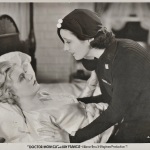
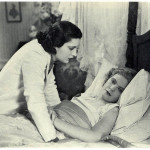
On a horseback ride through the country with friends, Monica worries about Mary’s reckless drinking and horseback riding, which results in her hitting a wall and flying off of a horse. Resting in bed, Monica and Mary come to a mutual agreement that it’s obvious Mary’s pregnant, and when she implies that she would like to have an abortion Monica absolutely refuses. “How I envy you,” she admits.

Returning from Europe at Christmas, John presents Monica with a beautiful watch which she knows he “possibly couldn’t afford!”

Monica arrives at Mary’s place to deliver the baby, but is silenced when she hears her calling for John because “he’s hot to be here!” Delivering the baby of a close friend who has committed the ultimate betrayal causes Monica to tell the nurse to “find someone else.” Anna smacks her across the face, “You’re a doctor with an oath to deliver her child.”

She delivers the child emotionless, refusing to even look at it when the labor is complete. “Don’t ever mention that baby to me again,” Monica tells Anna. “And when I come to check on the patient please keep it out of sight.” But her doctor’s instincts tell her otherwise. She realizes the baby is weak because Mary refuses to see it, so Monica brings it to her anyway for care and attention (in reality, the baby was probably in need of breast milk, which it obviously wasn’t getting placed in another room).

Now focusing on saving her marriage, Monica relaxes in a rowboat with John and watches the sun set in the country side. There she announces that she’s leaving for Vienna on business for six weeks. The day before she sails, Anna informs Mary that Monica knows everything; that she delivered the child knowing everything. In return, Mary decides to leave the baby girl with Monica while she flies back to Ohio. Or at least that’s what she wanted everyone to think. The maid hands Monica a hand-written note from Mary regarding the child:

“Forgive me, Monica. I’ll never bother you again. The baby is yours and John’s. Can’t you forgive me and be happy, Mary.”

Mary flies her plane—not to Ohio—but over the ocean to die, leaving Monica and John to raise the child as their own, without John ever knowing that it’s really his own with Mary.

“Hold her John, she’s yours,” Monica tells him as she passes the baby to him.

This film is tiny, running only fifty-one minutes, which is unusual, considering it’s one of Kay’s most famous movies. It was released to enormous success, grossing well over four-hundred-thousand within its tiny theatrical release. Dr. Monica was released in June, 1934, and pulled from the screen in July by the Production Code Administration which condemned the film.

Kay and Warren William were teamed for the first of two occasions on this one (their other film was Living on Velvet, 1935). They don’t have great chemistry, and aren’t too believable as a truly happy couple, which actually serves a purpose because it makes the idea of William cheating on her more believable. The performances of both actors are fair, but make no mistake, this is a Kay Francis movie all the way.

Jean Muir gives an excellent performance as Mary. She’s a little theatrical in some scenes, but she gets the point across. Maybe Ann Dvorak would have been slightly better, but Muir still deserves recognition.

Kay’s gowns are remarkable. One wouldn’t think of female doctors of being so glamorous, but this is Kay Francis we’re talking about. She’s not only a doctor but stylish, also. Sometimes that’s all that matters in a Kay Francis melodrama.

Obviously audiences in June 1934 thought so.


 Vintage Reviews:

Written by Mordaunt Hall.
Published June 21, 1934 in the New York Times.

In “Dr. Monica,” a picturization of a Polish play which reached the Strand screen last night, the handsome Kay Francis is cast as a renowned obstetrician. The film is not especially suspenseful, but judging by newspaper comments on the original, It is superior to the parent work. It moves apace and the acting is excellent.

Miss Francis acts Dr. Monica Braden, who is devoted to her husband, John, little knowing that he has had an affair with her attractive friend, Mary Hathaway. John comes to life in the person of Warren William, and Mary is played by Jean Muir. Verree Teasdale helps the story along as a loyal friend of both Mary and Dr. Monica.

The women in the case are Trojans and the man is—well, one might almost say, vile. His infatuation for Mary is apparently not considered with great seriousness by him. He goes to Europe and hopes to forget. Thus there is the scene with Dr. Monica, Mary and Ann Littlefield (Miss Teasdale) on the pier waving good-bye to Braden. Dr. Monica is sad because she is going to be separated from her husband for several weeks, and Mary is sad—because she is about to become a mother.

Young as she is, Mary reveals a sudden inclination thereafter for strong drink. She is averse to letting Monica know that Braden is responsible for her condition, but she does tell Ann. When the time comes for her to enter a maternity hospital, John, now back in America, nonchalant and selfish in his love for his wife, does not give much thought to Mary. But through a hospital scene Dr. Monica learns the girl’s secret. At first the wife declines to officiate as the physician in the case, but she is more or less forced to do so by Ann.

Subsequently it develops that Monica has decided to be sacrificial, so that her husband can be happy with Mary, and later Mary proves herself to be the most gallant lady. It is scarcely a story in which the male figures in anything but a bad light, which is probably as it should be. Braden, however, is too thoughtless to deserve the happy ending—for himself—in the narrative.

Miss Muir gives a touching portrayal. Miss Francis is believable in her rôle and Miss Teasdale adds to the general interest of the film. Warren William does quite well in his thankless part.


From the August 1934 issue of Screenland:

 drmonicaaugustscreenland

Below is a brief article published July 31, 1934 in the New York Times. It is one of many articles published throughout the country, which revealed the news that Dr. Monica had been pulled from the screen no more than two months after its theatrical release.

MAYOR BANS ‘DR. MONICA.

‘Bagg of Pittsfield Acts on Complaints Against Picture
Special to the New York Times

PITTSFIELD, Mass, July 30—Mayor Bagg, acting as a censor, today ordered the Capitol Theatre, Edward Harrison, manager, to withdraw ‘Dr. Monica’ in which Kay Francis is starred. Mrs. Henry A. Francis, mother of James Dwight Francis, former husband of the actress, protested.

“I am as much opposed as any one to vulgar and gangster pictures, but ‘Dr. Monica’ does not come within either of these categories,” she said. “It is a clean picture, well acted. ‘The Thin Man’, with William Powell and Myrna Loy, is light, amusing, and certainly inoffensive. Yet it was banned. Such tactics will lead to the Pollyanna type, which is neither good art nor entertaining.”

The Mayor admitted he had not seen ‘Dr. Monica’, but had received many complaints.


Advertisements from the Motion Picture Herald, 1934.
Another Dawn (1937)

With Ian Hunter
With Ian Hunter

Cast:
Kay Francis … Julia Ashton Wister 
Errol Flynn … Captain Denny Roark
Ian Hunter … Colonel John Wister
Frieda Inescort … Grace Roark
Herbert Mundin … Wilkins, Wister’s Orderly
G.P. Huntley … Lord Alden
Billy Bevan … Pvt. Hawkins
Clyde Cook … Sergeant Murphy
Richard Powell … Pvt. Henderson
Kenneth Hunter … Sir Chas. Benton
Mary Forbes … Mrs. Lydia Benton
Eily Malyon … Mrs. Farnold

Produced by: Harry Joe Brown.
Directed by: William Dieterle.
Original Music by Erich Wolfgang Korngold.
Cinematography by Tony Gaudio.
Film Editing by Ralph Dawson.
Art Direction by Robert M. Haas.
Costume Design by Orry-Kelly.

A Warner Bros. Picture.
Released June 18, 1937.

Box Office Information:
Cost of Production: $552,000
Domestic Gross: $572,000
Foreign Gross: $473,000
Total Gross: $1,045,000

[Please see the Box Office page for further info.]

Background:
anotherdawn5323Another Dawn was the first of the “final three” movies Kay Francis made in which Warner Bros. expressed a care about their top-moneymaker. Confession and First Lady, Kay’s final two movies made and released in 1937, were the last two of notable quality. It was only down-hill from there, and fast, for Kay Francis.

But at the time Another Dawn was finally in production as a Kay Francis vehicle, Variety had named her the sixth most popular female star in the entire movie industry (BF). Fawcett Publications polled thousands of moviegoers over the course of 1937 to find out the twenty most popular stars; Kay and Errol were the only two Warner Bros. stars to place on the list (BF). Clearly she was still a bigger name at the studio, so nothing but the best was given to her in Another Dawn.

Somerset Maugham’s “Caesar’s Wife” had been purchased by Warner Bros. for Bette Davis in 1935 after her triumph in Of Human Bondage (1934) at RKO (CR). During her contract dispute with the studio in 1936, she was replaced with Tallulah Bankhead, who had even gone as far as to test for the part of “Julia Ashton” (CR). Perhaps because of her slipping movie public, she was replaced with Kay Francis in the fall of 1936 when Give Me Your Heart (1936) had become one of the biggest successes of that season for the studio.

Production began September 26, 1936, and went on a hiatus while Kay vacationed in Europe during the late fall/winter of 1936/’37. She had exhausted herself by filming The White Angel, Give Me Your Heart, and Stolen Holiday without a break, and it was beginning to show in her lack of energy on the set of Another Dawn. To refresh her energy and emotions, she spent that much needed time about Europe doing absolutely nothing. When she returned to the set of Another Dawn, she was able to give that melodramatic punch Jack Warner knew she was capable of (BF). Production completed in February of 1937 (CR).

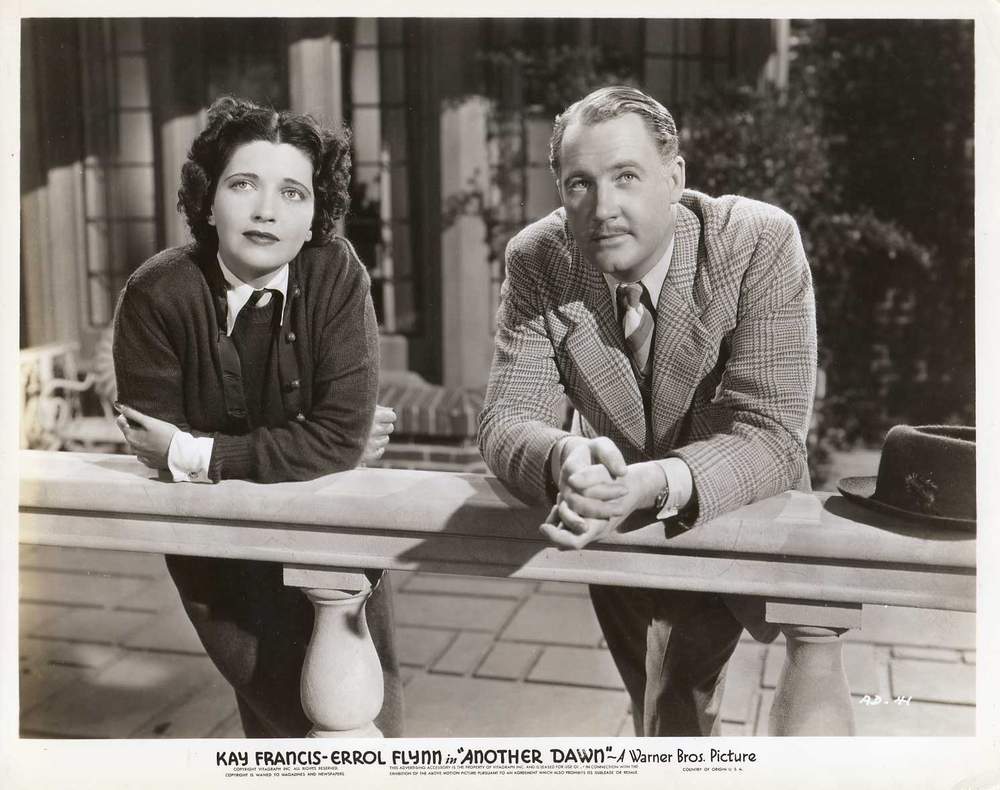
Warner Bros. went all out on the film, spending a small fortune on palm trees which almost killed Kay and Errol during a take by toppling over (CR). The props could only be shot for three minutes at a time; the heat from the lighting was too much for them. Locations for shooting included Imperial County, California; Lasky Mesa, West Hills, Los Angeles, California; and Yuma, Arizona. Kay was reunited with Ian Hunter (her costar in I Found Stella Parish and The White Angel) and Frieda Inescort (Give Me Your Heart) and paired for the first time with the handsome Errol Flynn, who had caused a sensation with Captain Blood (1935) and his subsequent films.

Completed at a production cost over $500,000, Another Dawn scored well with audiences, grossing about one million dollars more than its cost. With a healthy profit in the bank, Warner Bros. bowed their heads to Francis and Flynn for their success, and planned to reunite the stars in All Rights Reserved. Unfortunately, the project never materialized.

After a long, public battle with Jack and Harry Warner in a messy lawsuit during the fall of 1937, it was down-hill for Kay Francis from there. But just like her character in Another Dawn, she persevered, scoring a major comeback opposite Carole Lombard two years later in In Name Only (1939).

As for Errol Flynn… well, history and box office records were made with his success in Robin Hood (1938) and his following work throughout much of the 1940s.

Sources:

(BF) Kay Francis: I Can’t Wait to Be Forgotten, Scott O’Brien, 2006.
(CR) The Complete Kay Francis Career Record, Lynn Kear and John Rossman, 2008.


anotherdawnjune1937pictureplay


Above: A spread from the June 1937 issue of Picture Play.


Below: A fashion spread from the
June 1937 issue of Screenland, showing Kay’s film wardrobe.


Webmaster’s Review

This is an exotic, desert location. Captain Denny Roark returns from military action. He walks into Colonel John Wister’s office to hear him giving orders that Roark will be in charge while Wister vacations since he’s so responsible. Roark calls his sister who tells him to be especially careful since the Army is full of Colonels but she only has one brother.

At the train stations, John kisses Grace goodbye. She loves him, though it’s obvious he will never see her in that same way.

The first shot we see of Kay is her stylish shoes lounging at the tip of a deck chair on board a chip. The camera slowly moves up to reveal this well-groomed and gowned beauty reading a book. The foreign men on-board consistently try to flirt with her, but she shows little interest. To get one slime ball to back off, John walks over to act like they have plans. “I’m very grateful to you,” she says. Soon they begin to get attached to each other.

Julia’s a widow who’s convinced she will never be able to love again. Her husband was a Colonel, so she takes interest in what John has to say. Of course they’re on destination for the same location, and a friend tells John all about Julia’s brave husband, a British officer, who went for a night flight over Ireland and “never came back the next morning.”

Julia and John meet each other on a golf course the next day. She teaches him some tricks around the course, and they spend the after hours talking about the beauty of flying, so naturally they get on the subject of Julia’s husband.

“His luck gave out,” she tells John. “He died clean and young, before anything could grow old and dimmer. He was always ahead of life and finally lost it in the sunset, before it could catch up and make him pay for all the beauty, and glamour, and laughter it gave him. He died owing life…My luck held out, too. You know, although they’re ashamed of it, every honest woman knows her life has only but one love; and however long it lasts, it’s hers forever. Mine was three years. Three ecstatic years. In which I spent all the love I had buying memories so beautiful they never compensate for never being able to love again.”

Kay does an excellent job with that clunky, but beautiful monologue. The music and setting play out beautifully; only an actress of the up most talent could give such difficult lines a deep, thought-provoking meaning.

One evening, John receives word that there’s trouble back at the military base. Julia asks him if there is anything wrong, and he tells her he must leave immediately, and asks her exactly why she has to return to America. “I haven’t the talent for a career,” she responds. “Nor the capacity for happiness, anymore. All I’m looking for is contentment, and the opportunity to be useful enough to justify living.” John tells her that he could make her useful as his wife, and she is hesitant at first because she’ll never love him like she loved her old husband, and he’d soon hate her because of it.

Either way, she decides to go.

Back in the desert, Roark is in awe of Julia’s beauty, not knowing that she is John’s wife. Grace is there, and heartbroken when John tells her that he and Julia have been married. She disguises it as best as she can, though clearly she’s resentful.

No sooner than they arrives does John learn he has to leave for about a week. Roark and Grace will show her around, he promises. Besides, the excitement of living in an Army post will finally make her happy, she tells John.

Julia decides to go horseback riding on Roark’s horse. He laughs when it jumps up to greet him, and she freezes because she “used to know someone who used to laugh just like that.” Immediately she becomes aware that it is Roark who can really help her move on with life and love, not John.

There is a beautiful dinner party thrown. Julia and Roark are dressed beautifully, and the location where the party is held is breath-taking in its Arabic style. The two go for a walk, alone, and embrace for a kiss. “Forgive me,” Julia responds. “It was one of those things that happens without cause, and, without meaning.”

That very night, John returns home. She says nothing about Roark, though she’s clearly suffering in love with another man. It’s Kay Francis, what do you expect?

When John announces more work which will take him away, she asks if he can send Roark instead. All three are enthusiastic, especially Roark, who will benefit greatly if this mission is a success.

On the mission, a battle between English and Arabic soldiers takes place. There’s firing from both sides, and of course the English have to win, but Roark was shot in the process. Luckily, he can be healed. Only two men have survived the battle.

To make her visiting of Roark even more dramatic, Julia has to visit him the middle of a sand storm. He admits his love for her, and she comes to realize that she loves him, too. But they’ve both known it for some time. “We can’t be blamed for what we want,” Julia promises. “Only for what we do.”

To save John from heartbreak, Roark requests a transfer. Grace isn’t fooled one bit; she knows he loves Julia. “You, see, I’ve loved John for seven of the longest years of my life,” Grace tells him. She goes on about how there are two different kinds of love, one which stems from wanting and the other having. She knows that John will never love her anymore than Julia will love him [John].

In an urgent telegram, John receives word that there is a dam which must be destroyed at once because of Arabic actions. It will be a suicide mission, but someone has to go.

After talking about the situation with Grace, John decides that he is the one who has to go. He loves Julia, and wants her to be happy, and knows that Roark, since he’s so “honorable” like Julia, will never accept marrying John’s ex-wife. In an effort to settle this painful situation, John sneaks into a plane without Roark’s knowledge and completes the destruction of the dam himself. The mission is “successful.”

“He’s gone out there to die for me,” Roark says to Julia. “Not even a miracle can save him.”

“Why did he do it, Denny?” she responds.

“To give us that.” He points at the sky. “Another dawn.”

As the sun begins to rise over the Arabic desert, Roark embraces Julia, so they can face “another dawn” together.

This movie is an obvious romantic melodrama approached in a different light. All four leading actors, Francis, Flynn, Hunter, and Inescort, do some of their best acting with their difficult lines and situations.

Another Dawn has solid production values, and was especially popular when first theatrically released, though reviews were tepid in favoritism. Sometimes, it’s enough to just watch a favorite star be beautifully lit in stunning production values with very little film action. That’s what makes Another Dawn a decent picture.

Kay Francis does especially good in this one, as does Errol Flynn. The only problem with Francis’ work is she tends to feel a little too sorry for herself as Julia Ashton. Her character hasn’t moved on because she won’t allow herself to live and love again. At some points, one just wants to jump on the other side of the camera, shake her, and tell her to forget about her dead husband.

As with Stolen Holiday, she is beautifully gowned and lit, being surrounded by what appears to be the most expensive movie sets she ever stepped foot on. Actually, in terms of sets and production value, Another Dawn tops Stolen Holiday reel to reel—a good example of how, even as late at 1937, Warner Bros. was still building her as a star.

anotherdawn3123The difference here is that Kay is given more of an opportunity to act—or at least give us the impression that she is doing so. For fans like me, these are the Kay Francis movies which are most addicting, showcasing her at her best.. The whole film is custom-fitted to her strengths.

What is most interesting to point out, is how well Kay and Flynn’s screen personalities play off of one another. They have beautiful chemistry, and they match each other perfectly. Read into the history books, and you’ll learn that the studio had plans to reunite them, but those fell through with Kay’s legal problems with the studio.

What a shame, right?

For Errol Flynn, there are some great gun-fighting scenes for his followers to view. Like Kay, he’s just giving us his movie star treatment here. There’s not much of a performance but one still has to see him in this one anyway. Flynn, like Kay, was at his peak in sex-appeal, photographed beautifully, and wearing a bunch of fancy suits.

Frieda Inescort, a beautiful English actress who never got past supporting parts, again plays the all-knowing beauty who will never feel accomplished with herself. In Give Me Your Heart she has to suffer with the fact that her child is really the son her husband fathered with another woman. In Another Dawn she has to suffer with the realization that the only man she will ever love will never return that to her.

On top of the beautiful lighting, sets, and scenery, the music for Another Dawn is one of the best ever composed for a Kay Francis movie.

A guilty favorite which will never be considered a “must-see” by any critic, Another Dawn just gives us the opportunity for total escapism. As mentioned, sometimes, that’s enough.

Movie Reviews:

“Flynn and Miss Francis, playing together for the first time, have keyed their performance nicely to the mood. It has the lure of adventure in strange places and of a love theme that scratches deeper than the surface.”
Los Angeles Evening Herald Express, June 24, 1937

“Trapped so painfully trite a triangle, Another Dawn‘s cast coolly do their theatrical best. Ian Hunter, in what is apparently an air-conditioned oasis, is properly stoic. A raging sirocco does not discourage Miss Francis from exhibiting her usual sweeping evening gowns and Grecian neckline.”
Time, July 5, 1937

From Silver Screen, June 1937:

anotherdawnreview1937silverscreenmay

From Screenland, June 1937:

anotherdawn1937junscreenland


Lobby Cards:

anotherdawnlobby1 anotherdawnlobby2anotherdawnlobby087


Movie Posters:

anotherdawnposter anotherdawninsert08anotherdawnposter23anotherdawnposter241anotherdawnposter2423anotherdawnspanishanotherdawnforeign