All posts by M.O.

Kay Francis Art

  Artworks of Kay Francis

Artists and dates have been credited when known. If you have any other pieces of art of Kay Francis that you completed or you know someone who did, email me if you would like them published and credited on this site. If you have further inquiries about the art on this page, please email me as well.

The artist’s name, title & date (if known) are in bold red text.

Sir Gerald Kelly, 1925. This is the one on exhibit at The Seeing Eye, Inc. in Morristown, NJ,
(Courtesy of Scott O’Brien)

1925geraldkellyportrait


Charles Baskerville, 1925. Kay-biographer Scott O’Brien took a photo of this painting while visiting Kay’s friends Jetti and Lou Ames. Kay had willed it to them.

KF Charles Baskerville c 1925


By Thos Bodley, circa 1931.

artwork1932thosbodley


Hollywood’s Malibu Beach, Miguel Covarrubias, 1933. Originally published in Vanity Fair.

1933beachparty

Below: A close-up of where Kay is, beside her
then-boyfriend Maurice Chevalier, Joan Crawford
Leslie Howard, Adolphe Menjou, and Dolores Del Rio.

1933beachpartyclose


George K. Holt (1934). Found this in the Motion Picture Herald. The caption provides further information. 

artwork1934holt


Jesus Rodriguez Valero (c. 1935).
(Courtesy of Scott O’Brien)

artkayunknown


Sotero Cosme. (c. 1936)
Katharine Hepburn, Kay & Marlene Dietrich.
More info on Sotero: click here & for bio info click here.

artsotero


J. Forrest Qualis (1936).
Appeared in the February 1, 1936 issue of the Motion Picture Herald

artjune201936mph


Henry Major (c. 1938)
(Courtesy of Scott O’Brien)

Kay Francis by Henry Major


Completed by artist James Montgomery Flagg, 1951 for Vanity Fair.

Clockwise from top-right: Claudette Colbert, Joan Crawford, Kay Francis, Marlene Dietrich, Katharine Hepburn, Constance Bennett (Mae West, center).

1951jamesflagvanityfair

Kay Francis Clippings

 Advertisements

Ciro Pearls

1932kayciroad


Lux Toilet Soap


Max Factor Cosmetics:


Clippings

Picture Play, August, 1929

1929augpicplay


New Movie Magazine, 1930

1930newmoviemagazine


From a 1932 issue of Photoplay:

1932photoplayfashion


Screenland Magazine, October, 1932:

1932octscreenlandfashion


Screenland Magazine, September, 1937:

coronationseptember1937screenland


 Warner Bros. Studios:

1931wbtradeaadmph


1931julywbmphad


1932mphadwb


1933wbadmph


1933franciswb


1935wbadmph

Portraits of Kay Francis

This pages exists solely to make it easier for fans to view images of Kay Francis that either did not have a purpose for a specific film she was working on, or because the photo was used to promote a film of her’s. I’m always seeing the gorgeous photographs of her which were not done for a particular film, but just done for general publicity, so I’m throwing all of the photos which strictly have Kay and only Kay here. I’m trying to keep them in chronological order to make it easier for viewers (and, more importantly, ME!).

Remember to click the image for a larger view!

1928:

1926kaystuart27


1929:


1930:1930publicity23123

I believe these are from the June 1930
issue of Screenland. Kay was asked to
pose as a historical figure.
She chose Cleopatra.
Photos by Otto Dyar.


1931:

The following were done by Otto Dyar.

Fashion Images:

1931portaitphotoplay

1931photoplayclippingback


1932:

1932publicitypicture


 1933:

1934:


1935:


1936:

1936incolorgreendress


1937:


1938:


1940:


1941:


1944:


1945:


1946:

1945KayFrancisColor46


1948:

1948kaywatermarked

Kay Francis Magazine Covers

Lady of the Press

Kay Francis appeared on many magazine covers during her Hollywood career. It has taken me some time but I have finally started a gallery to showcase all of the covers I have saved from the internet over the past few years or so.

Click here for a page that has ads, articles, and various clippings from inside various magazines.


Click the thumbnail for a larger view!

 cenaapril1938  cineapril1941  cineartejuly30
A Cena Muda
April 1938
A Cena Muda
April 1941
Cine Arte
July 1930
cinejune1933
cinemundialjan1936
cinesept1931
Cine Mundial
June 1933
Cine Mundial
January 1936
Cinelandia
September 1931
 defilmnovember21935
De Film
November 2, 1935
 filmpictorial1933
 filmpictorialjune1935
Film Pictorial
1933
Film Pictorial
June 1, 1935
 filmpictorialaugust1936
 filmpictorialjune111938  filmpicjan71939
Film Pictorial
August 1935
Film Pictorial
June 1938
Film Pictorial
January 1939
(Read the headlining title,
this was right after KF
left WB on terrible terms.
Very telling title.)
 filmweeklyfeb61932  kaymagazinekover
Film Weekly
February 1932
Film Weekly
September 1932
 filmweeklymarch1938
Film Weekly
March 1938
 illibrofavoritounknown  1939spanishmagazine
Il Mio Libro Favorito
1935
Il Mio Libro Favorito
March 26, 1939
 1935lefilmmag
Le Film
1935
 modernscreennovember1930  modernscreendecember1933  modernscreenaugust1934
Modern Screen
November 1930
Modern Screen
December 1933
Modern Screen
August 1934
 modernscreencover35
Modern Screen
May 1935
 motionpicturejuly19301
Motion Picture
July 1930
 movieclassicjanuary1933  movieclassicmay1934
Movie Classic
January 1933
Movie Classic
May 1934
 movieclassicmay1935
Movie Classic
May 1935
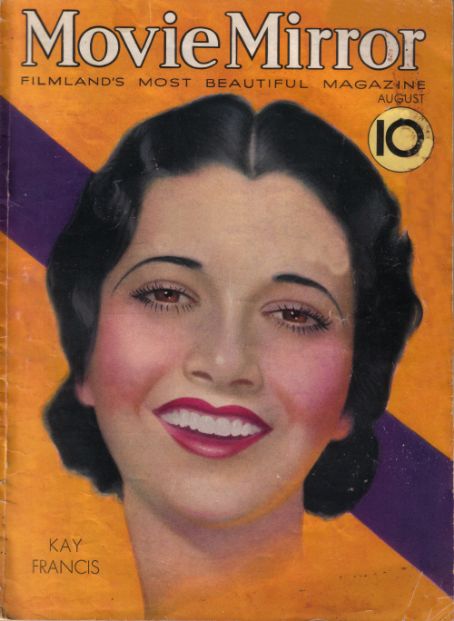
 moviemirroraugust1932  moviemirror1933
Movie Mirror
August 1932
Movie Mirror
1933
 newmovieoctober1932  newmovieapril1931
The New Movie
April 19, 1931
The New Movie
October 1932
 nowplayingseptember2008
Now Playing
September 2008
 philladelphiainquiererjanuary1938
Philadelphia Inquirer
January 3, 1938
 photoplay1930  photoplay1932  photoplay1934
Photoplay
1930
Photoplay
1932
Photoplay
1934
 kayfashionmag
Photoplay Fashions
Year Unknown
 piccolojuly1934  piccollonovember181937
Piccolo
July 1934
Piccolo
May 23, 1937
 picturegoerdeceber1933  picturegoerjuly241937  picturegoeroctober1937
Picturegoer
December 1933
Picturegoer
July 24, 1937
Picturegoer
October 1937
 picturegoer1941
Picturegoer
1941
 pictureplaymay1931  pictureplay1934  pictureplay
Picture Play
May 1, 1931
Picture Play
1934
Picture Play
January 1936
 pictureplayfeb1937  pictureplaynovember1937
Picture Play
February 19, 1937
Picture Play
November 1937
 pictureshowoctober51932  pictureshow  pictureshow1936
Picture Show
1932
Picture Show
1935
Picture Show
Fall 1936
 pourfeb1935
Pour Vous
February 1935
 romanticmoviedecember1935
Romantic Movie
December 1935
 screenbookmay1931
Screen Book
May 1, 1931
 screenlanddecember1930  screenlandapril1933  screenlandmarch1934  screenlandjune1936
Screenland
December 1930
Screenland
April 1933
Screenland
March 1934
Screenland
June 1936
 screenplaymay1931  sreenplay1135
Screen Play
May 1931
Screen Play
November 1934
 silverscreenmarch1931  silverscreenaugust1934  silverscreenmarch1937
Silver Screen
March 1931
Silver Screen
August 1934
Silver Screen
March 1937
1938japmag
Stage & Screen
1938
wbsong
Warner Bros.’ Song Folio
1938

The Vice Squad (1931)

vicesquad0815Cast:
Paul Lukas … Stephen Lucarno
Kay Francis … Alice Morrison
Judith Wood … Madeleine Hunt
William B. Davidson … Magistrate Tom Morrison
Rockliffe Fellowes … Detective-Sergeant Mather
Esther Howard … Josie
Monte Carter … Max Miller – Public Defender
Juliette Compton … Ambassador’s Wife
G. Pat Collins … Pete – Detective
Phil Tead … Tony – Waiter
Davison Clark … Doctor
Tom Wilson … Night Court Attendant
James Durkin … Second Magistrate
William Arnold … Prosecutor

Directed by John Cromwell.
Story by Oliver H.P. Garrett.
Original Music by Rudolph G. Kopp & Ralph Rainger.
Sound by E.C. Sullivan.
Camera by Charles Land & Robert Pittack & Franklin Titius.
Still Photography by Ray Jones.

Released June 5, 1931.
A Paramount Picture.

IMDb Info.
AFI Catalog.

Background Information:

The Vice Squad paired actress Kay Francis and director John Cromwell again. The combination had collaborated for an earlier release titled Scandal Sheet, and worked again many years later on In Name Only (1939), which would provide Francis a much needed comeback after a major falling out with Warner Bros.

But that was all in the future. At the time The Vice Squad was in production, Francis was still ranking among the undistinguished featured players on the Paramount lot. She had arrived at their Hollywood location in the spring of 1929 after completing her first two movies in New York City. While Hollywood and the moviegoers in the dark theaters had grown to appreciate Francis’ unique beauty and personality, her employer seemed to be unsure about her talents.

Paramount clearly had lost interest in Francis early on, despite public response to her minor assignments in mediocre films. The fan magazines had picked up on her, and by June of 1931, when The Vice Squad was released, Francis was well covered in the press.

Fay Wray and Lilyan Tashman were considered for the role which ended up going to Francis here. Still, a lot of the attention in The Vice Squad went to Paul Lukas, the film’s real star, and Judith Wood.

Of Francis’ performance, Variety reported that “she stands up as always.”

From The Vice Squad, in which she was briefly shown, Kay Francis went on to star in Transgression (1931). The movie would team her with Ricardo Cortez, who she would work with more notably once she transitioned to her new studio, Warner Bros., when she became a top notch star in her own right.


Vintage Reviews:

By Mordaunt Hall. Published June 6, 1931 in the New York Times.

The first of the pictures in which Hollywood turns to crooked detectives and a stool pigeon for a story is now on view at the Paramount. It bears the title of “The Vice Squad” and although there is no gainsaying that an element of interest courses through its stream of scenes, several pivotal incidents are far from convincing.

It is another case where fiction is stranger than truth, for the stool pigeon in this film is Stephen Locarno, who, be it known, at the opening of the production is the military attaché to the embassy of an unnamed government. Lucarno and a woman are surprised by a detective who demands to know why their car lights are not turned on. He makes slanderous accusations and asks for their names. While Lucarno is out of the car, the woman, frightened by the suggestion of scandal, steps on the gas, drives over the detective, who is killed instantly, and speeds away.

Another sleuth drives up and finding Lucarno standing by the dead man asks for details of the killing, and when Lucarno refuses to give the name of his companion in the car, the minion of the law threatens the military attaché with arrest on a homicide charge. Subsequently, the policeman agrees to report the killing of the detective as a hit-and-run case, provided Lucarno becomes his stool pigeon in preying upon unsuspecting women.

Lucarno becomes deeply involved in many cases in which the unfortunate women are sent to prison, but he is not called as a witness in court. It seems rather surprising that, in view of the fact that the detective, one named Sergeant Mather, is himself guilty in withholding information from justice, Lucarno does not flee from his persecutor. And considering that at least part of the truth has to come out in the end, it might just as well have been told by Lucarno long before.

Lucarno comes to the rescue of a girl named Madeleine Hunt, who is grateful. At the moment he is staggering, through excessive drinking, and might have ended, his life under a subway train had not Madeleine pulled him away from the edge of the platform. She escorts him to his home and nurses him. Mather one day encounters Madeleine and he tries to flirt with her. He asks for her name and address and after she gives it to him he tries to embrace her and she slaps his face. Armed with the address, the stool pigeon is sent to see Madeleine, without knowing that she is the girl who is virtually responsible for his still being in the land of the living.

This narrative is further complicated by the actions of a Magistrate Morrison, whose sister, Alice, is in love with Lucarno, whom she had met while he was a military attaché. She and her brother are eager to help Lucarno when they hear his dismal story.

Mather holds the whip hand over Lucarno until the latter makes a clean breast of his activities with Mather’s squad. What is done about the automobile killing is left up in the air.

Paul Lukas impersonates Lucarno with a certain ability. Kay Francis does well as Alice Morrison. William B. Davidson, Rockliffe Fellowes and Helen Johnson give competent performances.

On the Paramount stage are Gilda Gray and Rudy Vallee, who officiate in a contribution known as “Shakin’ the Blues.”

Originally appeared in the July 1931 issue of Photoplay:

vicesquadjulyphotoplay1


Film Images:

Film Advertisements


Four Jills in a Jeep (1944)

fourjill234132Cast:
Kay Francis … Kay Francis
Carole Landis … Carole Landis
Martha Raye … Martha Raye
Mitzi Mayfair … Mitzi Mayfair
Jimmy Dorsey … Orchestra Leader
Jimmy Dorsey and His Orchestra
John Harvey … Ted Warren
Phil Silvers … Eddie
Dick Haymes … Lt. Dick Ryan
Alice Faye … Alice Faye
Betty Grable … Betty Grable
Carmen Miranda … Carmen Miranda
George Jessel … Master of Ceremonies

Produced by Irving Starr.
Directed by William A Seiter.
Story by Froma Sand & Fred Niblo, Jr.
Based on the actual experiences of Kay Francis, Carole Landis, Martha Raye & Mitzi Mayfair.
Music by Maurice De Packh, Jimmy McHugh, Harold Adamson, Leo Robin, Harry Warren.
Costumes by Yvonne Wood.
Make-up by Guy Pierce.
Set decoration by Thomas Little.

A Twentieth Century-Fox film.
Released April 6, 1944.

Box Office Information:

[The following appeared in the June 3, 1944 issue of the Motion Picture Herald. This figure does not provide the entire box office take for the film, only until the publication date of that specific periodical.]

june31944mph


Background Information:

Following some rumors in the press about a possible return to Warner Bros. as a contract star, and even having a few projects publicly announced by the studio, Kay Francis decided to place her priorities on the increasing war effort. She put her Hollywood career on the back burner, which was possibly the death knell for her stardom.

Not that her tours with the USO, Red Cross, and several patriotic causes were a character flaw by any means. Legendary Bob Hope later summed up her contributions perfectly: “Nowadays, people forget what a trouper Kay was. She did a lot for the USO and gave her time to many patriotic causes. She was a real class act.”

The problem with Four Jills in a Jeep, which was based off of a book by Carole Landis, is by the time it reached the screen it was completely altered from truth.

The original tour began on October 16, 1942 and ended a little over 3 months later. The tour included Great Britain, Ireland, and North Africa. The peak of the tour was when they performed for the Queen of England, which wasn’t shown in the actual film but, in the movie, the girls do put on a show for very upper crust London citizens.

Carole Landis did marry an officer while on the tour, but it ended quickly after the release of the movie. The sweaters that Kay, Mitzi Mayfair, Carole Landis, and Martha Raye wore were considered too revealing for the censors, and they were not allowed to wear them on the film. Little bits of information were modified to fit into a nicely idealistic film for wartime audiences.

Also, the women in real life had simply just asked to go, waiting for months for permission. In the film they go almost reluctantly. This kind-of changes the entire spark behind the whole thing. It makes them look as though they just got themselves into a mess of trouble when, in reality, they had their brave faces on and wanted to get as close to the action as possible without becoming a distraction.

This was the first USO tour for Martha Raye, who went on to do several more tours for other wars and earned a Jean Hersholt Humanitarian Award in 1969 for her patriotic contributions. In conjunction with the release of Four Jills in a Jeep, she would appear in a small role in Pin Up Girl, which starred Betty Grable, who also had appeared in Four Jills.

Mitiz Mayfair had only appeared in short films and Paramount on Parade, which also boasted Kay Francis’ only appearance in Technicolor. Carole Landis’ life was cut short when she committed suicide.

Surprisingly, Kay Francis made no mention of it in her diary.

Aside from Grable’s appearance in the film, Alice Faye and Carmen Miranda also made cameo appearances as themselves. Unfortunately for Kay Francis fans, this was mostly done to beef up box office. None of the headlining stars had the draw to provide a financial return to match the extravagant costs.

From all the World War II and patriotic pride aside, for fans of Kay Francis Four Jills in a Jeep marked the finish line of her Hollywood and her stardom. While it’s nice to see she was still the center of attraction in a big movie after several years of supporting freelance roles, it wasn’t a very good production.

After this Kay Francis completed only 3 more films, all for the low-ranking studio, Monogram Pictures.


Webmaster’s Review

Four Jills in a Jeep opens up with Kay hosting a Command Performance over the radio. Betty Grable gets up and sings at the microphone. After Grable’s performance, Kay is joined by Carole Landis, Mitzi Mayfair, and Martha Raye to wish all the soldiers luck and give thanks for their efforts.

Backstage Carole, Mitzi, and Martha express their interest in taking the show abroad for the troops. Kay joins in to tell them that… surprise! She’s already off to England, and that they are welcome to come with her. The girls, a bit nervous, realize they have to go, realizing that their fears are minimum to the fears of the young men in active duty.

After arriving in England, they become acquainted with their tour guide, Eddie (played by the always obnoxious Phil Silvers). They meet up with the service men, and Carole begins to develop feelings for Ted, who helps her get out of the mud when she becomes unsurprisingly stuck as he looks on.

From the obscure base they make their way to London, where they put on a grand show for a bunch of upper-level civilians. Kay, beautifully dressed in a white evening gown with a head wrap, tells them that they have to sit on the floor “just like the boys do” when they put on their shows for servicemen. Martha Raye makes an idiot of herself singing and playing the piano, while Mitzi Mayfair does a dance which showcases her beautiful legs that help distract from her lackluster dancing skills.

Some romantic fluff begins to ensue, and Carole marries Ted.

From London they make their way to North Africa where they are met with skepticism. The female on the staff complains that they are in need of actual nurses not “you screen queens.” To her surprise, Kay helps the other girls roll up their sleeves and get their hands to work. When a doctor orders Kay (whom he does not recognize) to scrub the floors, she begins to do so. He realizes that it’s Kay Francis on her knees with a pale and brush and tells her she doesn’t have to. She continues anyway, and tells him to just refer to her as Kay. Not “Miss Francis or “Miss Kay.” “Please, just call me Kay,” she requests.

They put on a show for the men at the base and watch as they drive off on their next mission.

In all, it was very admirable what Kay, Mitzi, Martha, and Carole did. Actually, it’s very admirable what all of the Hollywood community did for the war efforts. But these were four of the stars who really got into the action and risked their own lives to help entertain the men who were protecting theirs.

The fault with this movie, and all of these World War II studios revues, is they’re just empty showcases for their current roster of stars. The actual final presentation of Four Jills, or even Thank Your Lucky Stars or Hollywood Canteen, is no different than the presentation that the studios were putting out 15 years earlier with the musical reviews when sound films came in.

For me, the only difference between Four Jills and Hollywood Canteen from Paramount on Parade and the Hollywood Revue is just that there are no two-strip Technicolor scenes and a war is involved. That’s all. But I would definitely consider Four Jills to be the most entertaining of the war musicals put out. The story here is much more interesting to follow than Hollywood Canteen or Thank Your Lucky Stars.

(“Much more interesting” as in watching sand fall through an hour glass versus watching paint dry.)

What’s nice about this film, as a Kay Francis fan, is it shows how she could still hold her own and headline the entire thing at 39 years old. When she’s in the field she’s in standard uniform, but in the beginning of the movie and in the London scenes, she is breathtakingly beautiful. She outshines Mayfair, Raye, and even Landis as the most glamorous member of the entire bunch. Even in their first night in England, she wears clothes to bed that are more beautiful than the average person would have worn to an upscale restaurant.

Viewers clearly expected Kay Francis to be a glamorous woman even 6 years after leaving Warner Bros. and just months shy away from turning 40 years old. And of that expectation, Twentieth Century-Fox clearly delivered.

Martha Raye does have some good comedy lines. Landis has a few heartwarming scenes as a young woman in love, but Mayfair certain just blends into the background. This is really a showcase for Kay Francis, and I’m not just saying that as a fan. She’s clearly leading the girls through everything, and she gets the most attention from the camera than any other star in the film. And it’s just so fascinating to see Kay Francis play Kay Francis.

Betty Grable, Alice Faye, and Carmen Miranda just make brief appearances that were inserted clearly to beef up box office. This definitely wasn’t a cheap movie to make, and, to be realistic, none of the feminine stars in the film had the draw to guarantee a return in profits. As a result, the most popular stars at Fox were just tossed in to lure more viewers.

Phil Silvers is the most annoying of the whole cast. His only shining moment is when he’s exchanging sarcastic words with a serviceman who says, “That joke’s my father’s.” Silvers responds, “And what are you, one of your mothers?”

That’s his only pleasant moment in the entire movie.

My personal opinions aside, there are many out there who love this film. Unfortunately, I’m one of the few who don’t.

This is one of Kay’s most popular films, but’s definitely far from her best.


Bosely Crowther review in the New York Times, April 6, 1944.
The adventures of Kay Francis, Carole Landis, Martha Raye and Mitzi Mayfair on a USD Camp tour of England and North Africa a little more than a year ago were no doubt diverting to the ladies. And the soldiers whom they entertained were probably so fired with admiration that we herewith proceed at our own peril. But it has to be stated bluntly that the film which Twentieth Century-Fox has made about that star-spangled journey among warriors is something less than okay. “Four Jills in a Jeep,” the claptrap saga which came to the Roxy yesterday, is just a raw piece of capitalization upon a widely publicized affair.

As an authentic record of that journey it may or may not have its points. Miss Landis meets a flier in this picture and marries him, as she did on the tour. Miss Mayfair casts dream eyes at a soldier who does a lot of singing in the film; and Miss Francis and Miss Raye have soulful moments with a medical officer and a clown sergeant, respectively. These latter romantic diversions may be accurate. We wouldn’t know.

But as a piece of screen entertainment it is decidedly impromptu. It gives the painful impression of having been tossed together in a couple of hours. All that happens, really, is a lot of dizzying about the dames and some singing and dancing by them in an undistinguished style. At a party in a London mansion (attended mainly by swells), Miss Raye sings “Mr. Paganinni” and Miss Mayfair dances to Jimmy Dorsey’s band. And in an old barn somewhere in North Africa Miss Landis sings “Crazy Me.” (This latter bit, incidentally, is the only one which rings remotely true.)

Otherwise, Dick Haymes sings two numbers, Phil Silvers clowns around a bit and Mr. Dorsey’s musicians contribute some musical time. Also, by virtue of the radio, Carmen Miranda, Betty Grable and Alice Faye are pulled in to warble hit numbers from recent Twentieth Century-Fox films.


Film Images:
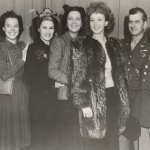
fourjills1 fourjills2 fourjills3 fourjills4


Film Advertisements

[Click image for a larger view!]
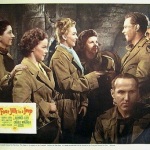
fourjillslobby

fourjillssheetmusic fourjillssoundtrack fourjillswindocard

fourjillscenterfold

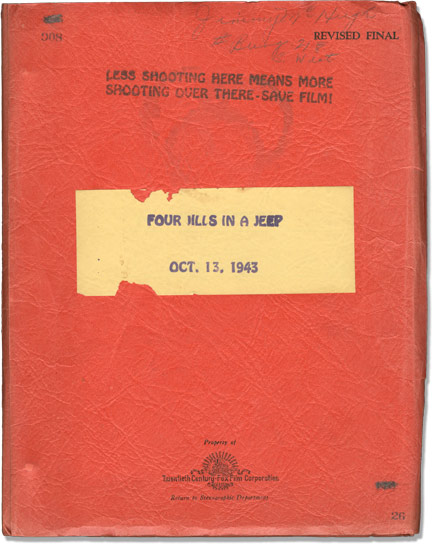
Original script for the film:


fourjillsscript

The Cocoanuts (1929)

Cast:
Groucho Marx as Mr. Hammer
Harpo Marx as Harpo
Chico Marx as Chico
Zeppo Marx as Jamison
Margaret Dumont as Mrs. Potter
Mary Eaton as Polly Potter
Oscar Shaw as Robert ‘Bob’ Adams
Kay Francis as Penelope
Cyril Ring as Harvey Yates
Basil Ruysdael as Detective Hennessey

Directed by Robert Florey & Joseph Santley
Produced by Monta Bell
Written by Morrie Ryskind
Based on the play by George S. Kaufman

Released May 3, 1929
A Paramount Picture.

About the film:
(From the AFI catalog)

The 12 Jan 1929 Motion Picture News announced production was expected to begin on 1 Feb 1929 on Paramount Pictures’ The Cocoanuts, based on the 1925 musical play of the same name by George S. Kaufman and Irving Berlin. The Four Marx Brothers would reprise their stage roles in the “all-talking” screen version, among one of the earliest “talkies” released by Paramount. The picture was made at Paramount’s East Coast Studios in Astoria, Queens, New York City. Irving Berlin composed an original score, and George S. Kaufman reportedly served as the film’s advisor.

On 6 Feb 1929, FD (Film Daily) reported that principal photography had begun. The 2 Mar 1929 Motion Picture News indicated that production would soon be finished, and listed performers from two singing groups who participated in the film: “Louise Bernhardt, Madeleine Southworth, Rita Sebastian and Ann Reichl, and the Miami Serenaders, Smith Blue, Max Sulser, Jack Cronin and Wendell Mayhew.”
The 23 Mar 1929 Exhibitor’s Herald-World noted that actor Oscar Shaw had recently completed The Cocoanuts.

According to the 18 May 1929 Motion Picture News, the world premiere was held at New York City’s Rialto Theatre on 23 May 1929.

Reviews were mixed. The 29 May 1929 Var reported “many laughs” throughout the film, but criticized the performers for talking “too fast” and for talking over their laughs. The 2 Jun 1929 FD declared that the film version did not add upon the stage presentation, but noted several “excellent” dance numbers.

Below: An article from the July 1929 issue of Photoplay discussing challenges costume designers were having with sound films.


Film Images:


Below: An on the set photo published
in the May 1929 issue of Photoplay.


What the Picture Did for Me:

Exhibitor Herald-World‘s long-running column for independent theater owners to tell each other what type of business was made and what the quality of the product was during their showings. Some also wrote the days the film was shown in their theater. 

December 7, 1929:
Four Marx Brothers – October 6. Excellent. Is 100 percent entertainment. The type of picture the public is looking for. Recording perfect. Charles Born, Elks theatre, Prescott, Ariz. – General Patronage

December 28, 1929:
Four Marx Brothers- November 14-15-16. Great stuff! This is one reason why the talkies are a God-send to the small town under 1,000 population. Entertainment of this sort is appreciated and badly needed by the “tank.” Paramount’s courteous treatment makes it a pleasure to do business with them. — Carl Veseth, Palace theatre, Malta, Mont. — General patronage.

January 11, 1930:
Four Marx Brothers – A swell comedy, kept the audience on their toes all through. While it did not draw very well, it was not the fault of the picture. Business not so good right now. – Jack Green, New Genesco theatre, Genesco, Ill. Small town patronage.

Marx Brothers – November 17. Craziest comedy ever made, wonderful drawing power and pleased. If your patrons like to laugh, don’t pass this up. – J.J. Hoffman, Plainview theatre, Plainview, Neb. – General patronage.

Marx Brothers – December 9-10. Good comedy. Some good dancing and beautiful sets. Satisfied customers. Played two days to satisfactory business. Disc recording good. – R.A. Wilson, New theatre, Ark. – General patronage.

April 19, 1930:
Four Marx Brothers— April 4-5.  This one was hot last fall, now it’s barely warm by comparison with what is being shown around us. Lost plenty.  Ten reels. — O.  A.  Fosse, Community theatre, Ridgeway, LA. — General patronage

April 26, 1930:
Four Marx Brothers – March 27-28-29. This is a very good comedy. Is full of wisecracks. In fact, they come so fast you must see the picture at least twice in order to catch them all. Paramount gets you all take in at the gate, however. Not a special. Recording good. Ten reels. – Arvid G. Wiklund, State theatre, New England, N.D. – Small town patronage.

June 7, 1930:
Marx Brothers — This production was not worth the money paid for it and the wisecracks around here were not appreciated. Some people are still asking me what it was all about. Ten reels. — Frank Shepherd, Majestic theatre, Biggar, Sask., Canada. — General patronage.

June 14, 1930:
Special cast – May 18-19-20. The country folk turned out to hear and see this new talker and they put this over alright. This is a crazy show but people seemed to like it, especially men and young folks. That awful-looking Hibernian, Groucho Marx, nearly drove me wild with his monopolizing the show and wisecracking us to death, but the singing, dancing, and tomfoolery of the other Marx boys was just grand.  I would like one of these a month, minus Groucho. End of reels were cut and some silent spots appeared which, considering the price we paid, was a bad pill to swallow. It’s going to be a fight to secure A1 prints. Run this before it gets any older. – Phillip Rand, Rex theatre, Salmon, Idaho. – General patronage.


Film Advertisements:

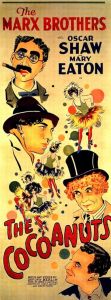
Posters

Lobby Cards

Herald Advertising

The Marriage Playground (1929)

marriageplayground011892Cast:
Mary Brian … Judith Wheater
Fredric March … Martin Boyne
Lilyan Tashman … Joyce Wheater
Huntley Gordon … Cliff Wheater
Kay Francis … Lady Wrench
William Austin … Lord Wrench
Seena Owen … Rose Sellers
Philippe De Lacy … Terry Wheater
Anita Louise … Blanca Wheater
Mitzi Green … Zinnie Wheater
Billy Seay … Bun Wheater
Ruby Parsley … Beatrice Wheater
Donald Smith … Chip Wheater

Directed by Lothar Mendes.
Based on “The Children,” a novel by Edith Wharton.
Screenplay by J. Walter Ruben.
Dialogue by Doris Anderson.
Camera by Victor Milner.

A Paramount Picture.
Released December 13, 1929.

About the film:
After a handful of films for Paramount, it was unclear to the film industry to know what exactly the studio was doing with Kay Francis. Was she being groomed for stardom or supporting player status? The Marriage Playground seemed to convince the world it was the latter.

Two projects that Kay had been announced for after completing Illusion fell through. Those were The Genius, in which Kay was to play a vamp who sinks her teeth into a young musician, and Youth Has Its Fling. Instead, Kay was cast as a vamp named Zinnia La Crosse in the film version of The Children, a novel from Edith Wharton re-titled, The Marriage Playground.

Surprisingly, despite the handsome Fredric March as the leading man and virginal Mary Brian, it was Kay and Lilyan Tashman who stole the show from its players. Hyped as major fashion rivals only a few months earlier when Kay came to Paramount, the studio made sure to give off the vibe that there was “something” between the Francis/Tashman teaming. At the climax of the movie, the two have it out over showing up to a society event in the same outfit.

Later, in 1931, the two would be teamed again, not as rival but this time as best friends, in Girls About Town, directed by George Cukor.

The Marriage Playground was also one of the first movies for Fredric March, a fresh face on the Paramount lot himself but clearly already groomed for leading man status. In The Films of Fredric March, author Lawrence Quirk wrote, “The critics were, for the most part, kind, and March came in for a goodly share of praise…Kay Francis was also along for the ride, though this was before her top-liner days, and her role, while displaying her attractively, was essentially peripheral.”

March followed The Marriage Playground up with Sarah and Son (1930), a Ruth Chatterton mega-hit which mirrored the long-suffering mother roles which Kay later acquired herself at Warner Bros.

Anita Louise, who later became a very popular supporting actor in films such as Marie Antoinette (1938), later worked with Kay in My Bill, playing her ungrateful daughter.

As for Kay Francis, she went onto better films, of course. But Wharton’s novels was revived again for the screen in 1990 shot under the original title and starred Kim Novak, among others.


Vintage Reviews:

Below: From the December 21, 1929 issue of Exhibitor’s Herald-World:


Below: From the March issue of Screenland.

By Mordaunt Hall. Published December 14, 1929 in the New York Times.

Edith Wharton’s novel, “The Children,” has come to the Paramount in audible film form under the title of “The Marriage Playground.” Although it has spasmodic lapses and the youngsters are a trifle too precocious, even for this generation, it is quite an intelligent production with well-woven strands of humor and sympathy, pathos and an appealing romance. The brunt of the acting falls on Frederic March and Mary Brian, who are thoroughly believable in their rôles.

This offering was directed by Lothar Mendes, who would have embellished his scenes considerably had he not photographed all of them within the studio doors. It is far more effective to see the real sunshine, the real sands, with a real breeze fanning a seaside resort, such as the Lido, rather than to gaze upon an obviously artificially lighted patch of sand with a sky that is all too near. Mr. Mendes, however, has done far better by this tale of quarreling parents and their mixed brood than he has with other pictures. He has succeeded in eliciting a diversity of natures from the seven youngsters, the oldest of whom is Judith Wheater, played by Mary Brian. If one thinks that these children are exaggerated types, one may ponder that it may after all be the result of their upbringing and the reckless conduct of their parents. Mr. and Mrs. Wheater have been divorced and re-married to each other. The seven neglected offsprings have different parents, but they all love each other and do not want to be separated.

Judith, with the help of a faithful nurse, Miss Scopy, cares for the six boys, girls and an infant. Mr. and Mrs. Wheater’s second marriage is far from happy and Judith as well as the other youngsters are always terribly afraid that the hectic lives of their parents or step-parents, as the case may be, may lead to their being sent to different homes. As it is, they go from pillar to post on European sands.

A sympathetic soul appears on the horizon in the shape of Martin Boyne, who encounters Judith and her sextet at the Lido. To her gratification she discovers that Mr. Boyne knew her father in Europe. Boyne soon is like a big brother to the six, but Judith, who is getting on for 18, has her own idea about him. Even a 10-year-old girl looks forward to matrimony with somebody and it could not be any one better than Martin, as they call him.

Unfortunately, however, for these youngsters and particularly for Judith, Martin is engaged to marry Rose Sellers, who lives with her philosophic, white-haired aunt. Martin delays going to his fiancée, who happens to be in Switzerland, much to Rose’s annoyance. Rose had been married once before, and one concludes that she is lucky indeed to have inveigled Martin into proposing to her. One also is impelled to think that Martin is not as bright as he seems to be or he would not have fallen in love with Rose.

There are a number of scenes in which pathos and humor are mingled. One of the children is impudent, another is coy; a third, a boy, is getting beyond Judith’s control. In one episode one perceives the youngsters lined up at the side of a bathtub filled with water and two or three of the youngsters are taking their turns at trying to see how long they can keep their heads under water. Victory means a lot to them in this sport. The affection developed by these children for Martin is charming.

Lilyan Tashman is sure enough of herself in the part of Mrs. Wheater, but more often than not she makes the grievous error of reciting rather than talking. Huntly Gordon does well as Mr. Wheater and William Austin delivers some amusement as an English lord. Maude Turner Gordon is splendid as Rose’s elderly aunt. Seena Owen is capital as Martin’s fretting fiancée and Master Philippe de Lacy does intelligent acting as the oldest boy of the heterogeneous flock.

Ruby Keeler Jolson is appearing in the Paramount’s stage attraction, “Ingenues’ Gambol,” which was staged by Boris Petroff.


Film Images:

Below: Rivoli theater in Indianapolis, Indiana in 1930:


Film Advertisements: 

Lobby Cards:

marriageplayss


Posters:

marriagepg


Movie tie-in version of the book:

Magazine Ads:

marriageplaygroundherald


Newspaper Ad:marrigeess

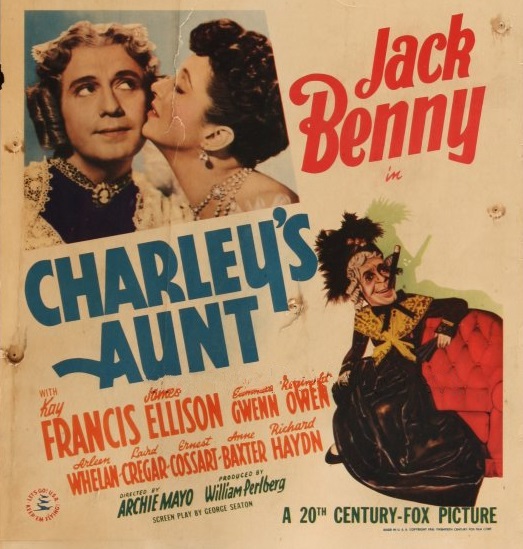
Charley’s Aunt (1941)

charleys0813Cast:
Jack Benny … Babbs Babberley
Kay Francis … Donna Lucia d’Alvadorez
James Ellison … Jack Chesney
Anne Baxter … Amy Spettigue
Edmund Gwenn … Stephen Spettigue
Laird Cregar … Sir Francis Chesney
Reginald Owen … Redcliff
Arleen Whelan … Kitty Verdun
Richard Haydn … Charley Wyckham
Ernest Cossart … Brasset

Produced by William Perlberg.
Directed by Archie Mayo.
Based on the play by Brandon Thomas.
Screenplay by George Seaton.
Music by Alfred Newman.
Set decorated by Thomas Little.
Costumed by Travis Banton.
Editing by Robert Bischoff.

Released August 1, 1941.
A Twentieth Century-Fox film.

Background: After two so-so comedies, Play Girl and The Man Who Lost Himself, Kay’s freelance career needed a new boost. She chose to play the title role in Twentieth Century-Fox’s Charley’s Aunt (1941). But her role was a supporting one, as much of the story revolves around a young man masquerading around as his aunt, believing she is an older, ugly woman, before his young, glamorous aunt makes her entrance towards the end of the story.

The story had been brought to the screen many, many times before this production. One of the more memorable movie versions of this famous play came in 1930 with Kay’s future Trouble in Paradise costar, Charles Ruggles, taking on the starring role.

But it was this version, directed by Kay’s frequent coworker Archie Mayo (who once went as far as to tell Kay she couldn’t act during the filming of Give Me Your Heart) that became the 8th highest grossing movie of 1941, according to Variety.

The film was shot fairly quickly, with production beginning May 12, 1941 and ending June 24. But, considering her small role, Kay wasn’t required to begin work on the film until May 24. She recreated her performance on Jack Benny’s radio show on May 28 to promote the film.

Kay’s career after Charley’s Aunt only rose to the top once more in The Feminine Touch (1941), her last A-role in a quality film. It was downhill into the full-fledged B-movie status after that.

As Lynn Kear and John Rossman pointed out in Kay Francis: A Passionate Life and Career, in truth, much of Kay’s freelance work wasn’t much better than the projects Warners had offered her in the late 30’s.

On a positive note, the film did provide Kay an opportunity to rework with her Paramount costume designer, Travis Banton, who helped make Kay into the clotheshorse she is famous for today.


Review by T.S. in the New York Times, published August 1, 1941.
Consider this a minority report. For though a good deal of the world’s innocence has gone up in smoke since 1892 and the original “Charley’s Aunt,” one never would have known it yesterday at the Roxy, where Jack Benny, in crinolines and cigars, was bucketing through its latest screen incarnation. Not in quite a while has an audience been in more uproarious spirits at a comic shindig. When the Benny physiognomy peered impishly from behind a lacy fan, the audience held its sides, and when in the final scene his wig vanished to leave his masculine coiffure stark naked, there was a roar of laughter that must have shaken the Roxy’s rococo ceiling.

But if Mr. Benny’s ill-fated excursion to the distaff side seemed a hilarious jape to others, we did not find it a more than occasionally chucklesome charade. After an interval of nearly half a century, the merriment of Brandon Thomas’s Oxford comedy of errors seems too tightly calculated. Its comic situations are so obviously plotted and so long forewarned that it never achieves the loose humors of a spontaneous antic. When Mr. Benny is caught with his skirts off, so to speak, the cue for laughter has the dismal inevitability of a grandfather clock sounding out the chimes. And laughter should never be inevitable.

If its humors seem not a little dated, the producers have nevertheless embroidered the skit with foolish detail and dotted it with amusing players. Mr. Benny, as young Lord Babberly who agrees to masquerade as his classmates’ chaperon only to find himself furiously pursued through the halls and box-hedges by several short-winded-gentlemen, has a dryly sardonic delivery that may seem a little worldly-wise for a guileless romp but gives the part an edge it needs. And when he coos “Chase me!” to a bewhiskered suitor, his invitation is in the coyest school of acting.

As the young knaves whose amours started it all, James Ellison and Richard Haydn make a likable pair of exaggerated innocents. Arleen Whelan and Anne Baxter, as the ladies in question, bustle about in twittering feminine apprehension. Laird Cregar’s swashbuckling parent and Edmund Gwenn’s hot-footed old codger are wickedly comic portraits both, and Reginald Owen as a doddering Oxford don turns his role into a hilarious commentary on all guardians of the cloistered life. Only Kay Francis, as the lady from Brazil, seems oddl colorless.

But amid the random gayeties of fussy pedagogues, presumptuously moral guardians and frolicking youths, the escapade of young Babberly still seems strangely mechanical. Although it is breezily played, it has the dubious gayety of an old gentleman cutting a caper. We could almost hear the joints creak—or was it the stop-watch clocking the laughs?


Images from the film:


Film Advertisements:

Lobby Cards:

charleysauntlc1 charleysauntlc2 charleysauntlc3


Reissue Lobby Cards:

charleysauntreissuelobby322


Posters:charleysauntposter3312charleysauntwc32 charleysauntwc33charleysauntpostercharleysauntwindow


Magazine Ads:charleysauntmph1charleysauntmphcharleysauntnews22charleysaunnews

Kay Francis DVDs

On March 23, 2009 Warner Bros. released their Archive Collection. Since then, this beautiful collection has released literally hundreds of movies for the first time ever for home video. With the boom of the internet and social media and Turner Classic Movies (which shows primarily films from the Warner Bros, MGM, and RKO catalogs), Kay Francis and her colleagues have enjoyed a tremendous resurgence. Once forgotten and deemed “non-profitable” she has her fair-share of home-video availability that is only growing thanks to the Warner Bros. Archive collection.It is only fair that Warner Bros. treat her right. I mean, she was their Queen during the Great Depression, and their highest paid star in 1935, ’36,’ ’37, and ’38. They have done an excellent job with her home video releases within the last few years.

The first table contains single available DVDs. The following table contains films of Kay’s available in collections from the Archive.

DVDs that are not from the Archive follow at the bottom of the page. But the focus here is on this fabulous collection. Click here to visit the Archive home page. Click here to visit Kay’s page on their site. The films are also available for purchase on the Turner Classic Movies website. Transactions are strictly between you and the sellers. I do not receive profit from the sales.


 NEW RELEASES AS OF 08/25/2015!
dvdparish dvdangel
 I Found Stella Parish
The White Angel
 dvdconfession  dvdtouch
 Confession
 The Feminine Touch

 forthedefensedvd  raffles-double-feature-dvd_200

For The Defense
(From the Universal
Vault Collection)

Raffles
 streetwomendvd  onewaypassagedvd  housedvd
Street of Women
One Way Passage
The House on 56th Street
 wonderbardvd  britishagentdvd  velvetdvd
Wonder Bar
British Agent
Living on Velvet
 goosedvd  strandeddvd  givemedvd
The Goose and the Gander
Stranded
Give Me Your Heart
 stolendvd  another-dawn-dvd_200  kingofunderworlddvd
Stolen Holiday
Another Dawn
King of the Underworld
 innameonlydvd  playgirldvd  wifewanteddvd
In Name Only
Play Girl
Wife Wanted


 forbiddenhollywood4dvd  mandalaydvdfbh6
Forbidden Hollywood Volume 4 Includes:Jewel Robbery

Man Wanted

Forbidden Hollywood Volume 6Includes:Mandalay

Non-Archive DVDs
 
Click here for the redirect to the TCM page for view/purchase.
 dvdtrouble  dvdwaltonscollection
 Trouble in Paradise
 When the Daltons Rhode
 dvdlittlemen  dvdjills
 Little Men
 Four Jills in a Jeep