Category Archives: Films

The Films of Kay Francis

The Man Who Lost Himself (1941)

manwho0901Cast:
Brian Aherne … John Evans / Malcolm Scott
Kay Francis … Adrienne Scott
Henry Stephenson … Frederick Collins
S.Z. Sakall … Paul
Nils Asther … Peter Ransome
Sig Ruman … Dr. Simms
Dorothy Tree … Mrs. Van Avery
Janet Beecher … Mrs. Milford
Marc Lawrence … Frank DeSoto
Henry Kolker … Mulhausen
Sarah Padden … Maid
Eden Gray … Venetia Scott
Selmer Jackson … Mr. Green
William Gould … Mr. Ryan
Russell Hicks … Mr. Van der Girt
Frederick Burton … Mr. Milford
Margaret Armstrong … Mrs. Van der Girt

Directed by Edward Ludwig.
Produced by Lawrence W. Fox.
Based on the novel by H. De Vere Stacpoole.

Screenplay by Eddie Moran.
Original Music by Hans J. Salter.
Cinematography by Victor Milner.
Film Editing by Milton Carruth.
Art Direction by Jack Otterson.
Set Decoration by Russell A. Gausman.
Gowns by Vera West.
Special Effects by John P. Fulton

Released March 21, 1941.
A Universal Picture.

Background:

In the year The Man Who Lost Himself was made, the year America entered World War II after the bombing of Pearl Harbor on December 7, Kay Francis made four forgettable comedies. This was the only year in her entire Hollywood career where she did not make one dramatic film.

In some ways it’s good. In other ways, it’s not.

Kay started the year off with Play Girl, made for RKO. It was a so-so film, floating between the low A and high B range in production value. After that she went on to this movie, then to a supporting role in Charley’s Aunt and then The Feminine Touch, with Rosalind Russell, Don Ameche, and Van Heflin.

While her talents for light comedy were fine, ably assisted by her charming smile and hearty laugh, it was in the heavy dramatic roles in which she really shined. This was something Warner Brothers picked up on, which is why she suffered on screen for so long before her roles finally began to lighten up a bit, causing a down-turn in her popularity.

Unfortunately, her popularity was still undecided by the movie studios by this time. After her contract at Warner Brothers ended it became clear Hollywood didn’t exactly know what to do with her talent.

By the time The Man Who Lost Himself went into production, she could care less about what the public wanted to see her in. As a freelancer, Kay had her pick of assignments, and picked as many good films and she did bad ones.

This advanced her career yet also damaged it. From now on, when a Kay Francis movie bombed at the box office, there was no guarantee that she would be given another chance to make up for it. So when her independent movies didn’t prove to be so hot, she began working as a leading lady supporting her male costar as actors like George Brent and Ian Hunter had done for her back in her Warners years.

The Man Who Lost Himself is a fine example of this.

Based off of a novel by Henry De Vere Stacpoole, The Man Who Lost Himself had been filmed previously in 1920 starring William Faversham and Hedda Hopper in the roles later taken on by Brian Aherne and Kay Francis. By 1940, after he had completed Gone with the Wind (1939), Leslie Howard picked up this assignment, planning on producing as well as starring in it. The war caused him to abandon the project, it was picked up as a vehicle for Cary Grant and Kay, though when the project landed at Universal Studios Cary was recast with Brian Aherne.

Aherne was a British stage actor who had begun his career at the age of eight. By the time he appeared in The Man Who Lost Himself he had worked with Joan Crawford in I Live My Life (1935), with Constance Bennett in Merrily We Live (1938), and Madeline Carroll in My Son, My Son (1940), a film which was originally conceived as a vehicle for Kay. The year he made The Man Who Lost Himself, he also appeared with Jeanette MacDonald in a Technicolor remake of Smilin’ Through.

He was one of the most popular actors of the time, and Kay’s equal billing to his name in the film credits as well as all advertising materials proves her own popular status as late as 1941, when she was reportedly “washed-up.”

Reviews for The Man Who Lost Himself were largely favorable without being too enthusiastic. Variety found it to be “neatly packaged farce amply fulfilling its aim of light and fluffy entertainment.” Today, it survives as an antique piece, something interesting only to those who have an eye for this kind of subject matter.


Webmaster’s Review:

Malcolm Scott has just escaped from a mental institution. Being a wealthy man, no reason is ever given on why he was in one, though everyone clearly dislikes him. He is in the middle of a divorce with his wife, Adrienne.

In a hotel bar, he runs into John Evans, a man who looks exactly like him though they have no relation whatsoever (of course). He also runs into Adrienne and her attorney, causing Malcolm to get into a heated discussion with the two, leading to his idea which is the concept of this film.

Malcolm gets John drunk and has him sent to his home. When John awakens in the morning, everyone assumes John is Malcolm, giving him the same icy receptions which reveal their huge dislike of the man everyone expect him to be.

One aspect of Malcolm’s life that John would like to get to know better is Adrienne, though she is obviously still resistant of him. She has a new boyfriend, Peter Ransome, and insists that Malcolm will never change. He tries to seduce her, giving her a passionate kiss that leaves her dazed and confused.

Unfortunately, word gets out that John Evans—in reality, it’s Malcolm who has taken John’s place—has been stuck by an automobile and killed. There is speculation to whether it was suicide or someone pushed him.

Meanwhile, Peter asks Adrienne if she is beginning to fall in love with her husband again. She doesn’t quite know, but tells Peter that they mustn’t see each other anymore (obviously, she’s back in love). Adrienne clearly makes up her mind a few minutes later, when she returns to the Scott house, drags John upstairs and begins to undress herself, causing John to up and leave the room immediately (if this was made ten years earlier, they would have slept together).

The family decides that Malcolm needs to be returned to the hospital, and, drugged up, John is placed in a straight jacket and taken away. Shortly after, Adrienne hears that her husband was the one who was killed, and rushes over to John to inform doctors that they have the wrong man.

Everything is cleared up, and John insists that everyone call him by his real name now, Mr. John Evans.

Adrienne slips herself into the straightjacket with John, announcing that “Soon I hope you’ll be able to call me Mrs. John Evans.”

Don’t expect another Strangers in Love (1932) with this film, but it really isn’t that bad of a movie, and certainly has its moments.

First of all, the situation is very ridiculous. These ones always are; the whole “unrelated look-a-like” thing was only done well in a handful of movies, most notably in Lady of the Night (1925) with Norma Shearer. 

What makes this movie good is its cast. Brian Aherne, Kay Francis, and S.Z. Sakall equally share the honors here. Though Aherne has the dual role, Kay and Sakall do keep up with him ably, taking some of the scenes from the highly regarded British stage actor and upstaging him considerably.

For fans of Aherne, this role would most likely be a disappointment. He was so good in Juarez (1939), and it becomes clear that he is one of those talented actors who can’t make stale property come to life (which is the difference between an actor and a star). In his drunk scenes he is over the top, slurring his speech in an exaggerated manner and waving his arms up and down.

But one thing he does have is charm, and it rubs off considerably. One can see why Kay, as Adrienne, is so taken by him.

And while Aherne floats back and forth between lame and not-so-lame, Kay is better than she had been in years. In The Man Who Lost Himself she has come back to her famous onscreen glamour, gowned beautifully by Vera West in furs and evening gowns which are more memorable than the movie itself. She has one of the more attractive 1940s hairstyles, and is jeweled with pearl necklaces and large earrings.

She takes advantage of all of her scenes, being at her best when she reveals her sexual frustration for everyone to see. She makes no effort for subtlety. She’s a woman who knows what she wants..

While this is far from being a Meet John Doe (1941) or Ball of Fire (1943), certainly The Man Who Lost Himself deserves to be seen. Owned by Universal, it has become one of the more obscure titles of Kay and Brian Aherne’s respective careers.


Film Advertisements:
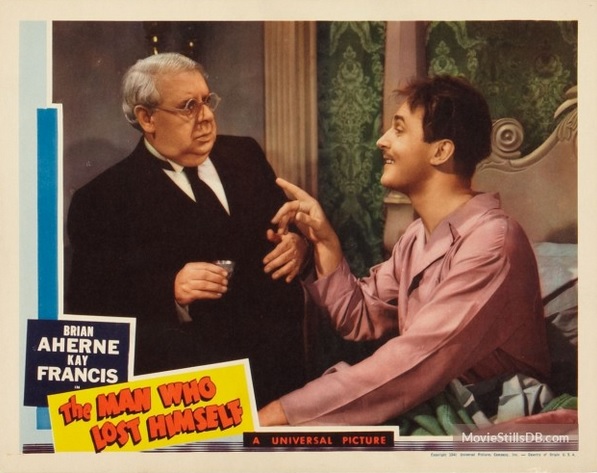
manwholosthimselflc32

Posters:

manwhoinsert09 manwhoposter76themanwholosthimselfposter32manwho23


Theater Slide:

manwhoslide32

Trade Ads:manwholosthimselfherald423the-man-who-lost-himselfmanlostmanlost2

24 Hours (1931)

24hours0818Cast:
Clive Brook … Jim Towner
Kay Francis … Fanny Towner
Miriam Hopkins … Rosie Duggan
Regis Toomey … Tony Bruzzi
George Barbier … Hector Champion
Adrienne Ames … Ruby Wintryingham
Minor Watson … David Melbourne
Charlotte Granville … Sairna Jerrold
Lucille La Verne … Mrs. Dacklehorse
Wade Boteler … Pat Healy
Bob Kortman … Dave the Slapper
Malcolm Waite … Murphy
Thomas E. Jackson … Police Commissioner

Directed by: Marion Gering.
Based on the novel by Louis Broomfield.

Screenplay by Louis Weltzenjorn.
Cinematography by Ernest Haller.
Gowns by Travis Banton.

Released October 2, 1931.
A Paramount Picture.

Background:

During the pre-code Hollywood years, two distinct types of movies were made. The first was the eyebrow-raiser; these were films packed with nothing but sex, drugs, and violence and made solely for profit. The second category was the adult melodrama, of which 24 Hours falls under. These types of movies addressed serious issues of the times and the way society was coping with them.

Louis Bromfield’s 1930 novel, Twenty-Four Hours, struck a chord with readers across the country with its melodramatic plot involving the lives of some very shady and unpleasant characters. Paramount acquired the rights to the novel in April 1931 and used three of its most popular stars, Clive Brook, Kay Francis, and Miriam Hopkins, in the leading roles.

Clive Brook, a veteran matinee idol since the early 1920’s, fitted perfectly into the English debonair character types most associated today with Cary Grant. Brook, however, had established himself as an English actor of the first rate when talking films arrived, and audiences were allowed to listen to him skillfully deliver the early clunky dialogue.

With this he became more than just a face. Paired opposite actresses like Ruth Chatterton in Charming Sinners (1929) and Anybody’s Woman (1930), he was allowed to show himself as an actor, and 24 Hours progressed his strong reviews from critics who praised his “well-toned performances” (Time, October 12, 1931).

He had been paired opposite Kay Francis in Scandal Sheet (1931), which featured Paul Lukas in the lead. So far she had been in Hollywood for about two or three years, and had progressed from her vamp roles into real leads. Some of these leads were slightly stale, and her character in 24 Hours is a prime example of that, but it was good exposure and experience for a starlet who would transform herself into one of the most profitable stars of the 1930s.

Rounding out the top three was a strong-willed newcomer named Miriam Hopkins, who had only appeared in three movies before her work in 24 Hours. Among them was The Smiling Lieutenant (1931), in which she held her own in Ernst Lubitsch’s comedy which also starred Claudette Colbert and Maurice Chevalier. After this one she went on to Dr. Jekyll and Mr. Hyde (1931), and a career that lasted well into the 1960s.

Director Marion Gering’s brief career included I Take this Woman (1931, with Gary Cooper and Carole Lombard), Madame Butterfly (1934, Sylvia Sidney and Cary Grant), and Good Dame (1934, Sidney and Fredric March). 24 Hours was his second work as a film director, and his list of credits only totals to seventeen, only two of which were made after 1937.

The New York Times, Time, and Variety all strongly praised the performances and direction of 24 Hours. One of 700 Paramount productions now owned by Universal, the film has unjustly fallen into the dark side of Hollywood, available only on third or fourth generation DVD/VHS copies.


Webmaster’s Review:

There is a chilling snowstorm in the city this night.

Married couple Jim and Fanny Towner are attending a high-society party which seems to be plagued by a solemn atmosphere. Both know that their marriage is on the rocks, largely because of Jim’s uncontrollable drinking, and insulting attitude towards Fanny, who has been carrying on an affair with David Melbourne.

Actions such as Jim’s leaving the party without Fanny conclude in her mind that Jim doesn’t love her anymore.

Once outside, Jim has a brief conversation with the doorman, who, unknowing that Jim has been carrying on an affair with his sister, says that if his wife’s baby is a girl she will be named Rosie after her.

In a car ride with David, Fanny writes their names with her finger through the fog built up on the windows. She tells David how she thought that she loved him, but, even after all that has happened, she still loves Jim, and always will. She scribbles his name on the window, and gets out and spends the stormy night alone.

A man is shot and killed outside of a speak easy. His lifeless body is dragged inside, where the bloody snow on the ground remains when Jim enters. He has several drinks, becomes aware that there has been a murder, and takes off to Rosie’s where his mistress is the nightclub’s main attraction. She sings “I’m Yours for the Taking,” then has a few drinks with Jim before her husband Tony shows up.

Tony is a loser. He can’t tell the truth, has become victim to the Depression’s wrath, and wants Rosie back in his life because he really has nothing left to cling on to. Rosie asks him for the keys to her apartment back, but he claims he doesn’t have them, and when he gets rough with her, she has a guard throw him out.

Rosie takes Jim back to her place that night. He is in no condition to make it home alone. She puts him to sleep in one room, and locks the door and hides the key, knowing that Tony will be coming around.

When Tony does arrive, he tries to open the door to the bedroom where Jim is, but Rosie insists he is not there. Tony doesn’t listen, and gets pretty physical with her for that key, killing her in the struggle.

Jim gets up that morning and has to break the door in to get out of the room. He finds Rosie dead, and sneaks out of the apartment before he believes anyone sees him. Unfortunately, the doorman from last night (Rosie’s brothers) recognizes Jim while he quickly takes off, and Jim is arrested for murder.

Fanny reads of it in the paper, and rushes to the jail where Jim is being held. There they begin to discuss the situation from last night, and the events leading up to it.

Meanwhile, Tony is gunned down by shady characters, probably people he owed money to. Fingerprints reveal that it was he who killed Rosie, not Jim, and Jim is released, after which he and Fanny agree to reconcile.

This is a great movie for Clive Brook and Miriam Hopkins. They have the better characters, and steal the majority of the picture, though Regis Toomey does get a lot of attention as Tony. While Toomey does play without any sympathy from the audience, his struggle with Hopkins is very realistic, and he comes across as a pathetic wimp throughout all of his scenes with or without her.

Brook, as alcoholic Jim, is nearly as icy cold as the snowstorm outside. No sympathy from him, and he doesn’t try to gain audience favor, either. He plays Jim exactly for what he is: the type of millionaire man who has become so bitter from his money that his sympathetic wife means absolutely nothing to him. His situation, which has stretched him to the point of having an affair with a gaudy nightclub star, is given no Hollywood glamour here.

This isn’t meant to be a scandalous shocker with a lot of overt sexual innuendos and drunkenness. It’s a true tale about the lives of very unhappy people, all affected by the toughness of the times.

Kay Francis and Miriam Hopkins, though they have no scenes together, play off of each other with contradicting characters sharing the same type of heart. Both honestly love Jim, but, as Hopkins tells him, “There’s one that always gets there first.” Their lives are in two completely different directions. Fanny is a society girl living in a beautiful art deco apartment and comfortably adjusted to her husband’s wealth, while Rosie is working class. She hasn’t had it easy, as her brother makes clear, and she’s been used and lied to by almost everyone she has ever trusted.

Fanny knows none of that. The only pain she knows is how Jim can make her feel.

Kay is given a lot of redundant lines about loving Jim anyway, while the image of a dead Miriam Hopkins hanging over the side of the bed is the first image that pops into my mind when I think of this movie.

Directed brilliantly by Marion Gering, 24 Hours has been unfairly relegated to bootlegged DVD copies from third or fourth generation transfers. For 1930’s movie fans, it’s a great example of how well even the simplest of stories could be produced if done with the right budget, people, and direction.

Anyone interested in old movies is sure to find it admirable, especially when viewing on a snowy winter night.


Film Advertisements

Lobby Cards:

aDhaMx2Jln0RlA024hourslobby124hourslobby


Centerfolds:

24hoursherald24hoursherald0242324hoursherald

Storm at Daybreak (1933)

storm3567Cast:

Kay Francis … Irina Radovic
Nils Asther … Capt. Geza Petery
Walter Huston … Mayor Dushan Radovic
Phillips Holmes … Csaholyi
Eugene Pallette … Janos
C. Henry Gordon … Panto Nikitch
Louise Closser Hale … Militza Brooska
Jean Parker … Danitza

Directed by Richard Boleslavsky.
Produced by Lucien Hubbard.
Based on the play “Black-Stemmed Cherries” by Sandor Hunyady.

Adapted by Bertram Millhauser.
Original Music by Dr. William Axt.
Cinematography by George Folsey.
Edited by Margaret Booth.
Costumes by Adrian.
Sound Direction by Douglas Shearer.

Released July 21, 1933.
A Metro Goldwyn Mayer Picture.


Box Office Numbers

Cost of Production: $280,000
Domestic Gross: $302,000
Foreign Gross: $334,000
Total Gross: $636,000
Profit: $121,000

See the Box Office Page for more info.

Background:

Throughout the 1920s and 30s, after the chaos of World War I had calmed down in America, there were a slew of anti-war movies which featured screen giants in complicated plots playing characters whose lives were forever altered by the effects of war.

The message throughout these movies: War is BAD!

Greta Garbo had one of her most potent box office successes in Mata Hari (1931), playing the World War I spy opposite Lionel Barrymore and Latin lover Ramon Novarro (in their first and last screen appearance together). So it was no surprise when Metro Goldwyn Mayer purchased the rights to Sandor Hunyadi’s “Black Stemmed Cherries” with her in mind. Revolving around the life of a woman, her husband, and her lover, who is her husband’s best friend, “Cherries” began with the events leading up to and after the War, taking place within the countryside of Austrian-Hungary.

The exotic location would have been perfect for MGM’s Swedish superstar, but when contractual differences led to her absence from the screen for all of 1933, MGM contacted Warner Brothers for the use of their top female star, Kay Francis, whose striking looks and distant personality fitted nicely into a role which probably would have been to bland for Garbo, if the location itself hadn‘t.

This was the third screen paring of Kay Francis and Walter Huston, who had costarred with Kay in a similar film, The Virtuous Sin (1930), just three years earlier at Paramount.

Directed by Richard Boleslavsky, Storm At Daybreak did little for the reputations for those who participated in its production. Though it’s a nice little film, it has understandably become more forgotten as the years have passed, with little to it to garner attention from the mass audiences. Such a film remains a classic for those seriously passionate about any of the stars featured, or men who worked in the backgrounds to make it.

Webmaster’s Review: 

Storm at Daybreak takes place within the Austrian-Hungarian Empire. It is June 28, 1914, and Archduke Ferdinand has just been assassinated by the Serbians. Young men, as young as twenty years of age, are drafted regardless of their inexperience with the service.

Tensions ride high between the Hungarians and Serbs, which cause some Serbs to desert their homeland to avoid having to fight with the Hungarian Army. Such deserters take refuge in the home of Serbian Irina Radovic, without the knowledge of her husband, Dushan, who is good friends with Captain Geza Petery of the Hungarian Army.

When the soldiers ride up to the Radovic home to look for deserters, Dushan invites Geza and his men in for a good time. Dushan gives his word that there are no men in the house, and asks Geza to spend the night. While Irina is playing a very sensual song over the piano, Geza hears deserters leaving while Dushan insists that he had no knowledge of them in his house until after he had given his word. Geza lets the situation go, his friendship with Dushan is to valuable, but Geza can not escape his feelings for Irina, Dushan’s wife.

On a train, Irina recognizes Geza amongst the wounded, and tells Dushan, who insists on having Geza stay in his home. It is here where the romance between Irina and Geza really takes off, though the two do not get intimate with each other outside of a passionate embrace and kiss.

When Dushan becomes aware of what is going on, he refuses to warn Geza that soldiers—among them a former friend named Panto—are arriving at his home to arrest him on treason. Irina pleads with him to go, and when she gets into a confrontation with Dushan over her love for Geza, she takes off on foot to warn him.

This is made even more dramatic by the dangerous rainstorm and thunder and lightening outside.

Dushan storms into Geza’s, where he finds his former friend and wife together, thinking that there is more to their love than there really is, and starts to strangle Geza. When he becomes aware that nothing really happened between the two, that they are two people who love each other dearly, but love Dushan enough to not have sex behind his back, he decides to save Geza’s life so the two can be happy together.

Sneaky Panto arrives to arrest Geza, but Dushan tells them that Geza has run off with Irina, and that he may go with him to find the two, and charge Geza and eventually execute him. Panto becomes aware of what is going on and the horse carriage over turns from high speed and tumbles down a cliff into the sea.

Dushan and Panto are killed, allowing Geza and Irina to finally be as one.

This is an iffy one. It has fans, but it has many people who can care less about this production. Certainly this isn’t the best example of Kay Francis’ or Walter Huston’s work, but it’s not a bad movie, either.

Kay is photographed rather unattractively, with her hairstyles being some of the worst she every sported in her movie career. The loosely pulled back look doesn’t work for her, and neither does the overly long one, with jet black locks curling down to her waist. Her gowns aren’t really attractive, and there is only one beautiful shot of her, and that one is when she sees Geza on the train.

Now I don’t have much to write about her performance, either. Again, it’s not bad, but it’s certainly not good. Her best scene is when she has the confrontation with Walter Huston over his decision not to warn Geza about Panto. She insists he let her go, and when he doesn’t, she shouts at him, jerks her arms out of his hands, and storms out the door.

That is the first scene with her that pops into my head when I think of this movie.

Walter Huston is exceptional as Dushan. He is brutish, and slightly repulsing. Insane with jealousy, he is at his best in the scenes where he realizes that Geza and Irina love each other. If this would have been a better movie, he might have gotten a little more credit for his performance in this one.

Rounding out the staring cast, Nils Asther becomes, thankfully, more masculine than I can remember seeing him for some time. With his pretty boy days behind him, and his career seriously on the wane, all of his star personality—for which he was so famous for in the silent movies of the 1920s—has disappeared here.

There are three major bonuses to Storm at Daybreak that make it desirable. The first is the realistic feel that director Richard Boleslawski and his crew gave the film in terms of settings and costumes. There is a very real feeling that we are sitting, watching a candid movie reel of people who actually lived through the First World War in the Austrian-Hungarian Empire.

The second is the montage effects of the war. There are some really eye-catching shots, most notable skeletons in uniform while officers shout orders in hostile voices.

The third and final bonus is the shadowy lighting, pre-dating the whole film noir movement by nearly a decade, Storm At Daybreak relies heavily on shadows and give a dramatic mood which is in tuned nicely with the decent performances by able players like Francis, Asther, and, especially Huston.

It’s not the best movie, but it’s not the worst, Certainly Storm at Daybreak deserves a good watching from fans interested in this sort of War-time drama.

Vintage Reviews:

Published in the New York Times, July 22, 1933.

The commonplaces of romance have a familiar look, even in the Balkans, to which the new picture at the Capitol transports its audiences this week. “Storm at Daybreak” deals with the unhappy lot of an ardent Hungarian who finds it equally impossible to live with or without a handsome Serb who happens to be the wife of his best friend. Quartered for a large part of the war in his friend’s home, he heroically declines the wife’s invitation to make her the happiest woman in Serbia, out of deference to his old comrade. Although Richard Boleslavsky has made a good looking production and filled it with the huzzahs and halloos that go with picturesque costumes and romantic warfare, “Storm at Daybreak” is a dull entertainment.

Mischa Auer, looking properly morbid, murders the Austrian archduke and his consort in an effective recreation of the Serajevo assassination early in the film. It is also possible to enjoy the ironical spectacle of the Serbs dashing gallantly to battle against the Germans in comic opera uniforms, riding fretful chargers and taking gay farewells of the peasant lasses. A great many of them return from the front in hospital boxcars, broken and terrified by the slaughter-house methods of warfare employed by their more up-to-date opponents. In these scenes Mr. Boleslavsky reveals a small part of his talent.

But “Storm at Daybreak” is concerned less with the war than with the troubled triangle represented by Nils Asther as the passionate officer, Kay Francis as the young wife, and Walter Huston as the peasant land owner who is the husband. Although they know it is madness and make a conscientious effort to keep out of each other’s way, the lovers are continually thrown together by the hospitable and unsuspecting husband. When the truth comes out, Mr. Huston has the opportunity to express his displeasure in several scenes that somewhat relieve the monotony of a domestic triangle in which the dialogue is as ordinary as possible. Finally, in a burst of magnanimity, he drives off into a night that is filled with the conventional rain and storm and commits suicide by taking his carriage over a gorge, accompanied by his worst enemy.

Mr. Asther has a romantic manner that is pleasantly suave, and Mr. Huston blusters picturesquely as the husband. Although Miss Francis is as attractive as always, she hardly seems suited to the enigmatic and mysterious qualities demanded in the rôle of the wife.

My Bill (1938)

290775214_oCast:

Kay Francis … Mary Colbrook

Bonita Granville … Gwendolyn ‘Gwen’ Colbrook
John Litel … John C. Rudlin, Bank President
Anita Louise … Muriel Colbrook
Bobby Jordan … Reginald ‘Reggie’ Colbrook Jr.
Dickie Moore … William ‘Bill’ Colbrook
Maurice Murphy … Lynn Willard, Muriel’s Fiancé
Elisabeth Risdon … Aunt Caroline Colbrook
Helena Phillips Evans … Mrs. Adelaide ‘Duchess’ Crosby
John Ridgely … Mr. Martin the Florist
Sidney Bracey … Jenner, Aunt Caroline’s Butler
Bernice Pilot … Beulah the Colbrook Maid
Jan Holm … Miss Kelly, Rudlin’s Secretary

Directed by John Farrow.
Produced by Bryan Foy.

Based on the play “Courage” by Tom Barry.
Screenplay by Vincent Sherman and Robertson White.
Gowns by Orry-Kelly.
Cinematography by Sidney Hickox.
Musical Direction by Leo F. Forbstein.
Original Music by Howard Jackson.
Film Editing by Frank Magee.

A First National Picture.
Released July 9, 1938.

Box Office Information:
Cost of Production: $197,000
Domestic Gross: $376,000
Foreign Gross: $183,000
Total Gross: $559,000

See the Box Office Page for more info.


Background:

“If Warner Brothers forced Kay Francis to play a middle-aged mother of four adolescents in My Bill in an effort to discipline her, their plan has boomeranged laughably. The picture, previewed a few nights ago, is a triumph rather than a humiliation for Kay,” Jimmie Fidler, 1938 article for the San Francisco Chronicle

Enthusiastic reviews like Fidler’s kept Kay Francis fans hoping that Warner Brothers would come around and give her career the great big sigh of relief it needed. But his words far stretched the importance of My Bill for Kay Francis. My Bill was hardly a triumph in Kay’s career, but it did have the distinction of being the first B film of her career as a major Hollywood star. Also, it was the success of the film which gave the production executives at Warner Brothers a much deserved slap in the face.

After reigning as the most popular female star at Warner Brothers for much of the 1930’s, Kay Francis’ career hit its peak during the 1936 and 1937 movie seasons. It was at this time she was featured in literally hundreds of publications, voted the sixth most popular star in the entire movie industry by Variety, and receiving the highest weekly salary of any other star/producer at Warner Bros, $5,250. However, it was also at this time when her relationship with the Warner Brothers executives began to dissolve.

Though her films were making good money at the box office, they felt that she was being paid too much. When she began to have differences with the studio over the type of films she should be making, she filed a lawsuit against the studio to end her contract and allow herself to freelance as an artist.

From this came one of the most notorious star/studio wars in the history of the entire movie industry; one which still lingers like a black cloud over the history of the Warner Brothers studios.

At first, Kay’s demands to be released from her contract were ignored by the executives. She was far too popular to let her get away, but, in an interesting twist of sides, somehow the Kay Francis v. Warner Brothers battle ended with her staying on to collect her impressive salary. They became eager to do anything which would humiliate her enough to the point where she’d quit. They lowered her billing, filled her scripts with r’s and l’s (which she couldn’t pronounce), and forced her into what would become some of the worst films of her career.

My Bill was supposed to be one of those films.

Tom Barry’s 1928 play “Courage” opened in New York that same year starring Janet Breecher as a single mother of seven children, at least one of whom may be illegitimate. It was adapted for the screen by Warner Brothers in 1930 with Belle Bennett as the mother in a picture directed by Archie Mayo, who later directed Kay in Give Me Your Heart (1936), among other films.

Bryan Foy, a B movie producer for the Warner Brothers-First National Studios, was unimpressed with the original script, and fired that writer and replaced him with Vincent Sherman. On a Thursday afternoon Sherman was given the assignment, and told to hand in a finished script for My Bill to Foy’s office by Monday morning. Within that three-day period, Sherman managed to rush through the writing to complete his assignment on time, a flaw in the finished picture which stuck out like a sore thumb.

Production began March 31, 1938 and concluded on April 25. John Farrow was set to direct Kay as a forty-six-year-old mother with four children, one of whom was played by actress Anita Louise, who was only ten years younger than Kay, then only thirty-three when the film was produced.

The New York Times dismissed My Bill as “all too pat, too incredible, too unimportant.” But the public did respond to the film, giving it a much more generous reception than it had met with the critics. In fact, My Bill proved to be popular enough to be revived on the radio again on March 3, 1941 when Kay and Warren William starred in a version of the play on Lux Radio Theatre.

Today My Bill holds little importance in the careers of any of the people who worked on it. Kay Francis became most remembered for her top-notch films like I Found Stella Parish (1935) and Confession (1937). Anita Louise is best remembered as a supporting actress in films like Anthony Adverse (1936) and Marie Antoinette (1938), and Bonita Granville is most remembered for her role as Nancy Drew in the recurring series.


Webmaster’s Review:

In Colbrook, Massachusetts, widow Mary Colbrook is raising her four children, Gwen, Muriel, Reginald, and Bill. She is the widow of Reginald Colbrook, who’s father William founded the city years ago. Because of this they are a well known family in town, but rumors and gossip linger around their household about Mary’s faithfulness to her late husband. In the eyes of many, Bill is an illegitimate child Mary had with lover John C. Rudlin, a banker in town. Caroline Colbrook, Reginald’s sister, is especially suspicious of Mary, and has decided that now is the time to do something about the future for Gwen, Muriel, and Reginald.

Unfortunately, Mary wasn’t wise with the money she was left by her late husband. She has squandered most of the family fortune by trying to live a lifestyle she couldn’t afford, and now the creditors and bankers are after their possessions. While Gwen is practicing her piano, Reginald walks in, distraught because the family credit isn’t even reliable enough for him to buy a simple tie. When men come to take the piano away from the house, Gwen, Reginald, and Muriel become suspicious of their own Mother. They insult the way she has managed the family finances, which may seem reasonable at first, but not when one comes to learn of their high demands.

Muriel insists that if she doesn’t get a new dress, she will refuse to go to her fiancé’s party. Reginald demands to know who is going to pay for his college. And Gwen babbles on with meaningless complaints about everything Mary does wrong in her eyes. The only child of Mary’s who appreciates her is Bill, who calls her “Sweetheart.”

Bill hates his siblings. He sees them for the spoiled, arrogant, and rude bunch they really are. His view on life is, if you want a new dress, save up the money and buy it yourself. If you want to go to college, get a job and take night classes. And the less time you leave for complaining, the more time you have for doing. Most importantly, if you see that your mother is in a financial disaster, try to help her out of it, instead of criticizing and belittling her every move.

They don’t see it his way, and pack up their things and move in with their Aunt Caroline, leaving Mary and Bill to fend for themselves.

Meanwhile, Bill has come across an unlikely friend. Playing football, he kicks one right through the window of old Mrs. Crosby, a woman rumored to be a bitter recluse. Bill befriends her after a rocky start, and becomes the only friend she can count on.

Mary is helped out considerably by Rudlin, which raises the eyebrows of Aunt Caroline, confirming the rumors in her mind of Mary’s relationship with him, and the fact that he may indeed be Bill’s real father. When the money runs out entirely, Bill starts a newspaper stand because Mary has trouble finding a job. With nothing left to keep them in Colbrook, Mary decides that it is time for her and Bill to pack up and move to New York City, where the work will be easier to find.

Bill runs over to Mrs. Crosby’s house, finding her in a serious condition. She is dying, and insists that Mary and Bill move in with her. They do so, and stick with her until the very end, and she rewards them by leaving Bill as the sole heir of her rich estate.

Gwen, Muriel, and Reginald have grown tired of Aunt Caroline’s stuck up attitude, and her insults about their own mother. They decide to return to Bill and Mary after Rudlin makes the facts clear to Reginald and Muriel that they need to grow up.

The film ends with Aunt Caroline being thrown out, the family being reunited, and Mary giving the explanation of what happened with Rudlin in front of Caroline and the children. As it turns out, they did love each other, but before Mary married Reginald, who was cruel and demeaning towards her. He accused her of having an affair with Rudlin, producing Bill as a result, but that wasn’t the case. Bill is just as much of a Colbrook as Gwen, Muriel, Reginald, and even Aunt Caroline are.

The children agree that it is time for Mary and Rudlin to finally be together.

This is such an over the top, corny film, but I love it. It’s not brilliant, intelligent, or obviously realistic, but it’s one of those movies that’s so cheesy it’s good. 

Kay is really cheerful in this one. So much so it’s refreshing, and, as Lynn Kear pointed out in her books on Kay, she couldn’t have been happy during the filming of My Bill. So for those who want to belittle Kay’s talent as an actress, turn to this one to see how well she could disguise herself in a role.

Stealing most of the picture, which is odd since he’s last billed under the leading cast, is Dickie Moore.

When one wants to think of the typical, low-budgeted, Hollywood programmer for small town America of the 1930s, no other picture than My Bill should come to mind. It’s quick, cheesy, and to the point. It wastes no time as mindless entertainment and ends almost as quickly as it begins.

One can see why some people really love this movie, and Kay Francis in it.


Film Advertisements:

Lobby Cards:

mybilllobby12mybilllobby13mybilllobby56


Poster:mybillinsert08my-billmybilllobby1


Glass Slide:

Glass Slide
Glass Slide

Guilty Hands (1931)

guiltyhands0828Cast:
Lionel Barrymore … Richard Grant
Kay Francis … Marjorie West
Madge Evans … Barbara ‘Babs’ Grant
William Bakewell … Tommy Osgood
C. Aubrey Smith … Reverend Hastings
Polly Moran … Aunt Maggie
Alan Mowbray … Gordon Rich
Forrester Harvey … Spencer Wilson
Charles Crockett … H.G. Smith
Henry A. Barrows … Harvey Scott

Produced by Hunt Stromberg & Lionel Barrymore.
Directed by W.S. Van Dyke & Lionel Barrymore.

Story and Screenplay by Bayard Veiller.
Cinematography by Merrit B. Gerstad.
Film Editing by Anne Bauchens.
Wardrobe by Rene Hubert.
Recording by Douglas Shearer.
Art Direction by Cedric Gibbons.

A Metro Goldwyn Mayer Picture.
Released August 28, 1931.

Box-office Information:
Cost of Production: $152,000.
Domestic Gross: $452,000.
Foreign Gross: $234,000.
Total Gross: $686,000.
Profit: $282,000.

See the Box Office Page for more info.

Background:

Metro Goldwyn Mayer…the powerhouse of the major three studios of the Golden Age of Hollywood. Kay Francis would complete four films for the company throughout her film career: Passion Flower (1930), Guilty Hands, Storm At Daybreak (1933), and The Feminine Touch (1941). All have a notable aspect to them regarding Kay’s career, but of the four, Guilty Hands was undoubtedly the best.

We can trace the brilliance of Guilty Hands back to two men, Lionel Barrymore, who not only starred in the film but co-directed it with W.S. Van Dyke, and Bayard Veiller, the legendary playwright who wrote the story and screenplay Guilty Hands was based upon.

Barrymore…like all other Barrymores…came to promise via stage success. He had done work in a few silent movies, but it wasn’t until his Madame X (1929), with Ruth Chatterton, where he found a home in Hollywood. Barrymore did not appear in Madame X, his was work was limited to directing only. He had received an Oscar nomination for his work on the film, and subsequently given an extended contract with MGM, which had produced and released Madame X to great success.

Following Madame X, he starred in The Mysterious Island (1929) for MGM, before remaining off the screen for two years, making his triumphant return opposite Norma Shearer in MGM’s A Free Soul (1931). The film earned him an Oscar for Best Actor in a Leading Role, and Barrymore went to work on Guilty Hands right after production on Free Soul wrapped.

Bayard Veiller had been a playwright and director of notable success, most famously with The Trial of Mary Dugan, a crime drama which starred Ann Harding on the New York stage and was brought to the screen with Norma Shearer in the title role. Veiller had worked on the final script for the film version while directing it as well. The Trial of Mary Dugan emerged as one of MGM’s most important films of the early talking years, considerably raising the fame and prestige of Norma Shearer and the studio.

Following Mary Dugan, Veiller brought his Within the Law to the screen via MGM with Joan Crawford in the film version, retitled Paid (1930). It was another hands-down success, allowing the genre of the crime drama to emerge in full bloom.

With Barrymore’s and Veiller’s success in the new genre, MGM decided to pair the two men in an original production and let the creative ideas really flow. With this came Guilty Hands, a film more thoroughly entertaining than Mary Dugan, Madame X, and Paid combined. As where the earlier three films had their slow moments, Guilty Hands would flow smoothly and quickly, with a sixty-some minute pace which rivaled that of even Warner Brothers, who could produce quality entertainment in a shorter running time better than any other studio.

Somehow in the midst of all of this, Barrymore, Veiller, and MGM decided that they needed Kay Francis for the role of Marjorie West. Her casting is still a mystery, but she must have impressed someone at the studio with her manipulative vamp roles at Paramount, for MGM was a studio with a roster of female stars better than any other in Hollywood.

Luckily, Paramount was more than willing to loan Kay out, and in return she got one of the best roles of her pre-Warner Brothers career.

After completing the unmentionable Vice Squad (1931) for Paramount, which featured Kay in yet another thankless second-rate lead, the studio loaned her out to RKO where she could be the star of her next picture, Transgression (1931). Transgression was a glossy soap-opera, but enjoyable and proof that Kay Francis could indeed be a star of her own films. Guilty Hands provided her with a complete turn-around.

Production on the film began June 4, 1931, and was completed on June 22. Originally, it was to be titled Shadows on the Wall, but this was changed prior to the preview of the film. Photoplay considered Guilty Hands “One of the best murder yarns produced, in which Lionel Barrymore gives an excellent and highly polished performance…Kay Francis and Madge Evans also contribute excellent performances.”

The other reviews were also largely favorable, but the film was neglected at the Academy Awards the following year. Still, it has the distinction of being one of the most intriguing films of the early talkie years in Hollywood. Few films of this era remain as watchable to modern audiences as Guilty Hands does.

Webmaster’s Review:

Behind the titles we see decrepit hands…this gives a morbid mood from the beginning.

The film opens on a train. Richard Grant, a district attorney in New York for decades, is now returning home to slow down on his work. He prides himself on being an expert with murder, and states to others that there are some cases where it is justified.

Then there are other cases where it is not. That becomes the question we must answer by the final reel of this movie.

When he reaches his stop, he is greeted by his daughter, Barbara. At Gordon Rich’s home, Richard becomes perplexed with Gordon’s declaration of his intentions to marry Barbara. Richard knows Gordon too well to give his consent, and when Gordon tells him that there is nothing Richard can do to stop him. Richard throws out that he can murder him and get away with it.

Gordon is a man—if one can call him that—of a shady past, filled with the broken hearts of many innocent, young women. One of these girls was only sixteen when she threw herself from a high-rise building over her rejection from Gordon’s life. Richard will not let his daughter become one of those young ladies.

At a dinner to announce his plans to marry Barbara, Gordon upsets Marjorie West considerably. Marjorie is the one Gordon has left all of the money to in his will, and is really the one woman he will ever allow to love him fully, but he will not marry her. They have a questionable relationship, which makes one wonder how such an intelligent girl like Marjorie allow herself to be pushed around by a pig like Gordon.

But, then again, she can have the satisfaction of knowing she is the one woman who will come the closest to winning his heart, even if he will never even consider the idea of a marriage between the two of them. Even when the two meet after the dinner, Gordon tells Marjorie that he pretty much just going to marry Barbara to have her sexually—there is nothing more to their relationship, and he will return to her as he always does.

It is this trait of Gordon’s personality which fuels Richard’s determination to protect his daughter.

Sneaking into Gordon’s room, with the thunder outside to disguise the noise, Richard creeps up upon Gordon and shoots him straight through the heart. He places the gun in Gordon’s hand, and makes his way back to his bungalow. When he his informed that Gordon is dead, he rushes over and automatically declares suicide.

Since he was district attorney in New York for decades, no one dares question him. No one but Marjoie, that is.

Determined by her love for Gordon, Marjorie returns to Richard’s bungalow to figure things out. She discovers that a paper cut out of a facial profile placed on a moving phonograph can easily give the appearance of a shadowy figure walking up and down a room. She discovers that this was Richard’s way of proving that he was “in his room” the entire time. From outside, one would just presume that someone was pacing back and forth, but Marjorie knows better than this nonsense.

Back in Gordon’s room, she and Richard go back and forth over the whole suicide/murder speculation. Richard confesses that, yes, he did kill Gordon, but that she is only going to hang herself if she makes an issue out of this. As “the other woman,” Richard can easily prosecute her as the real killer, enraged by her jealousy of Gordon’s marriage to Barbara.

When the police come, she keeps her mouth shut, and the entire thing is written off as a suicide, but Gordon does manage to get his revenge on Richard. How? Well, you’ll have to watch this one to get the real details. It’s a great thriller, and I don’t want to give too much away.

For such a tiny film, Guilty Hands (1931) is incredible; clearly one of the best murder films Hollywood ever produced. The two distinct characters in the film are Lionel Barrymore’s Richard Grant and Kay Francis’ Marjorie West.

As Grant, Barrymore gives one of his best performances. Fresh off of his success in A Free Soul (1931), the film which garnered him his only Academy Award, he turns in a performance that, in my mind, at least, tops his Stephen Ashe. He is morally corrupt as Grant, suggesting from the beginning that not all murders are at the hands of killers. There are certain circumstances where it is justified, but, unfortunately, the end of Guilty Hands proves that his reason didn’t justify his actions.

He makes one hell of an attempt to prove his innocence, though. Marjorie is only one who questions his decision that Gordon shot himself out of guilt for his shady past.

Speaking of Marjorie, I would like to add that this is Kay Francis at her peak form during her early Hollywood years. She still seems a little green behind the ears, making facial expressions which kind of distract from her over all performance, but she is incredible to watch. Placed in good hands—Barrymore, Madge Evans, C. Aubrey Smith—she is on screen for nearly ten minutes before she scolds her first line, “That child. A mere child!” During that time she is given some interesting close-ups, suggesting there is a highly complex and clever character inside the appearance of this beautiful young woman. The shot of her playing the harp, as well as her reactions to Gordon’s announcing of his plans to marry Barbara, are most significant.

Marjorie West proved to be one of the most intelligent characters Kay Francis ever played onscreen.

Madge Evans does good with her virginal Barbara. She’s a saintly-soul, but not in such a way where she gets on the nerves of the audience. There is only one scene where she comes close to this, and that is when Gordon comes to just give her a simple kiss goodnight. Her reaction to the whole situation is a little ridiculous, but it motivates the plot.

Watch for Barrymore’s reaction where she tells him she had decided not to marry Gordon after the kiss.

There’s no musical score with the exception of the opening and closing credits. Barrymore rarely used music in his films, advancing the melodrama considerably. Barrymore’s Madame X (1929), with Ruth Chatterton, doesn’t even have a score for the opening credits, and no sound of music throughout the entire film. Surprisingly, this does not dull one minute of Guilty Hands at all.

Credric Gibbons’ sets are also of noteworthy importance. The house is beautifully decorated, the ideal setting of a murder mystery as intense as this one is. There are a lot of dramatic decorations which really help set a suspenseful mood. Whether or not this was intentional is beyond me. Metro Goldwyn Mayer did things a little differently than the other studios.

This is a great one. I’d recommend it to anybody just willing to watch a good movie on a stormy, weekend evening.


Mandalay (1934)

mandalay0604Cast:
Kay Francis … Tanya “Spot White” Borisoff
Ricardo Cortez … Tony Evans
Warner Oland … Nick
Lyle Talbot … Dr. Gregory Burton
Ruth Donnelly … Mrs. George Peters
Lucien Littlefield … Mr. George Peters
Reginald Owen … Colonel Thomas Dawson, Police Commissioner
Etienne Girardot … Mr. Abernathie
David Torrence … Captain McAndrews of the Sirohi
Rafaela Ottiano … Madame Lacalles
Halliwell Hobbes … Col. Dawson Ames
Bodil Rosing … Mrs. Kleinschmidt
Herman Bing … Prof. Kleinschmidt

Directed by Michael Curtiz.
Produced by Robert Presnell & Hal B. Wallis.

Based on the story by Paul Hervy Fox.
Screenplay by Austin Parker & Charles Kenyon.
Cinematography by Tony Gaudio.
Film Editing by Thomas Pratt.
Art Direction by Anton Grot.
Costume Design by Orry-Kelly.
Music Direction by Leo F. Forbstein.
Music Composition by Sammy Fain, Irving Kahal, & Heinz Roemheld.

A First National Picture.
Released February 15, 1934.

Box Office Information:
Cost of Production: $294,000
Domestic Gross: $346,000
Forgein Gross: $273,000
Total Gross: $619,000
Profit: $83,462

See the Box Office Page for more info.


Background:

Mandalay was based on a story by Paul Hervy Fox, and involved a young woman who faces the ultimate betrayal from the one man she truly loves. To pay off his debts, Tony Evans sells his fiancé, Tanya Borisoff, into the sex trade by conducting a corrupt deal with the owner of Nick’s Place, one of the most notorious brothels in Rangoon. At the notorious brothel, Tanya is taken advantage of, smacked around, and becomes notorious herself as “Spot-White,” singing the tediously titled “When Tomorrow Comes…” as part of her act.

But Tanya perseveres, freeing herself of her conscious and getting revenge on the only person she assumed she could trust.

Ruth Chatterton was the first choice for the lead in this film, made at the First National studios where Ruth had once reigned supreme. As she turned down stellar film offers such as Mandalay and The House on 56th Street (1933), they subsequently went to Kay, who transformed herself into the biggest star at the Warner Bros.-First National studios with Chatterton’s leftovers. Within a few months of completion on Mandalay, Chatterton was finished with the studio, and returned to New York with the hopes of reviving her stage career.

Interestingly though, Mandalay was not only conceived as a vehicle for Ruth, but also her soon to be ex-husband George Brent. Both walked off the film for different reasons, Brent was in the middle of a contract dispute with the company which caused them to replace him with Ricardo Cortez. No choice could have been better.

Ricardo Cortez and Kay Francis appeared together for the third time together in Mandalay. Previously, they had worked together in Transgression (1931) and The House on 56th Street. After Mandalay finished shooting, the two were paired in Wonder Bar for the fourth in final time. It would be wise to note that the irresistibly sleazy “Latin Lover” (in reality he was Austrian) was murdered in all four of their films together, but his death wasn’t limited to his work with Kay alone, either. He was murdered in quite a good percentage of his films. Figure that one out.

Production began October 17, 1933 and concluded a month later. Of course the censors had a fit with Michael Curtiz’s finished film. But it was condemned before the cameras even finished rolling, appearing on a list of films complied by the Catholic Legion of Decency, which forbid the Catholics to spend their spare dimes on watching Kay parade a revealing collection of gowns in a notorious bordello in Rangoon, murdering her former lover and getting away with it in the end.

Luckily, all the Catholic fuss didn’t hurt Mandalay’s financial earnings, or Kay’s career. In fact, she benefited greatly off of the production, earning rave reviews and a salary increase the following year and proving that there’s nothing wrong with a little bit of sin once in a while.


Webmaster’s Review:

Mandalay opens and takes place not in Mandalay, but mostly in Rangoon and on a steamship to Mandalay. In the opening scene, establishing location in Rangoon, we see Tony Evans discussing a financial deal with Nick, the owner of the most notorious and popular brothel in Rangoon. Tony agrees to stop by Nick’s place that night, and returns to his yacht where his beautiful girlfriend Tanya Borisoff has been relaxing in the sun all day.

Tony tells her to get ready, put on her white dress with the most “lovely” flowers wrapped around her shoulders. As she gets undressed and approaches the tub, she catches Tony playfully watching and runs over to him where the two embrace and kiss.

As Tanya and Tony enter Nick’s place, Tanya is in awe of the openness of the atmosphere, asking Tony “all these girls, Tony, what are they?”

“Just like café girls anywhere.”

“You mean?”

“Yes, my dear. That’s exactly what I mean.”

When Tanya follows Nick and Tony upstairs while they discuss their financial dilemma, she sits at a piano and begins to beautifully sing “When Tomorrow Comes…” Nick walks in to tell her that Tony has traded her into the sex trade, and she is now property of Nick’s. She struggles to resist, and her smacks her out of rage to keep her in line.

Depressed, Tanya doesn’t eat. She is given priceless information by an older, wiser countess, who instructs Tanya to stop making a fool of herself. Starving herself isn’t going to free her, but taking advantage of the men who come to the brothel will. The Countess instructs her to use men, take them for everything they have and use it against them.

Now equipped with the Countess’ tips on how to survive, Tanya makes a spectacular entrance into the brothel wearing a gold-sequined gown topped with an overly exaggerated feathered scarf. We see a montage of her smoking, drinking, dancing, and accepting jewelry from generous suitors.

Eventually, Tanya becomes the most notorious woman in Rangoon, prompting the police to execute plans to deport her back to Russia. She blackmails the officer, who has once come to Nick’s place himself for a little entertainment from Tanya, now known as “Spot White,” into giving her a huge amount of money to get herself financially stable and on her own two feet.

She runs away from Nick’s place and boards a steamship to Mandalay. There she meets an alcoholic doctor on his way to the same location, only going further inland to help fight an epidemic of black fever. It’s a suicide mission; as soon as he helps the village recover, he will likely die of the disease himself, but he insists that he must go, and that Tanya would never understand.

Onboard that steamship, Tanya runs into Tony, who goes out of his way to get her alone where he tries to make love to her. She fights him off, but the creep still doesn’t get it. He insists that they can go somewhere and open up their own brothel and make Tanya the headlining attraction. She refuses, and poisons him by slipping something into his drink.

“I loved you, Tony,” she tells him. “I loved you more than life. And what did you make of me? Spot White. I couldn’t go back to that. I couldn’t! Forgive me.”

He reaches out for her throat, but then throws himself overboard.

The next day, the ship arrives in Mandalay, and Tanya and the doctor head on for the black fever epidemic, knowing that they will die as a result.

I can’t stress how beautiful Kay appears in this film. From the establishing shot of her on Tony’s yacht, to the final walk into Mandalay, she is gorgeous. Her beautiful, tanned dark skin is contrasted by white gowns, and her hair is more grown out, with those jet black locks of curls flowing down to her shoulders. Rangoon was the perfect location for her exotic good looks, and she appears more exotic in this film than any of the others she ever made.

Her performance as Tanya is capable. It’s one of her best films, though Tanya’s circumstance is a little bit drastic. This is a well disguised attempt from First National Pictures to make Kay look like she’s acting when in reality she’s just doing what she does best: wearing stunning clothes and suffer in melodramatic situations.

For me, the most memorable aspect of this movie is Tanya’s entrance into Nick’s Place, walking down the stairs wearing that flashy gown. That, along with her entrance to a party in Stolen Holiday (1937) for me are the best she ever made. They don’t film stuff like that anymore.

Ricardo Cortez has another role as a sleazy creep with nothing on his mind but financial gain. Also good is Lyle Talbot as the alcoholic doctor. I like him here much better than I did in Mary Stevens, M.D. In Mandalay he is given a big task, and performs it admirably.

Mandalay was released with a huge success, despite being banned by the Catholic Legion of Decency. The direction by Michael Curtiz is brilliant, and probably would be a great example to show people who have never seen a movie made before 1950 a good example of how great the films from the early 1930s could be.


Vintage Reviews:

Kay Francis is a girl of doubtful past, present and future who eventually casts her lot with an outcast doctor in what an extra reel may have developed as possible reformation for both.

Picture trips along at a nice pace and except for one spot, toward the end, invites no adverse reaction. This is in connection with the faked suicide of Ricardo Cortez, a gun-runner who leaves an empty poison bottle and an open window in his ship’s cabin as evidence of his act.

The audience is let in on the phony suicide, whereas it would have been more effective to spring the surprise and the explanation on the audience the same as on people in the cast, notably Francis.

Much of the action [from a story by Paul Hervey Fox] occurs on a boat bound from Rangoon for Mandalay. Earlier sequences are in the former seaport, where the heroine has been forced into a life of doubtful purity when her gun-runner boyfriend takes a run-out powder. This portion of the story isn’t as convincing as it might be. Manner in which Warner Oland browbeats her into working for his joint is anything but convincing, either.
Published in Variety, 1934.

The screen of the Strand may be as near as most of us will ever get to Rangoon; if it is, “Mandalay” will make an adequate vicarious substitute. In the new film they have set the sultry picturesqueness of the East down on the screen so neatly that a New Yorker is tempted to throw his overcoat and earmuffs away, and cut a bee-line through the opium smoke to Nick’s. Now if a spectator is willing to estimate “Mandalay” by its power to convince him he is no stranger to the sarong and the rickshaw, “Mandalay” is a good deal better than adequate. But what if the story of Tanya, and of Tony, who loved her, and of Nick, who desired her, begins to sound like old stuff in the second reel and becomes tedious by the fourth?

Kay Francis is Tanya in the story. Ricardo Cortez is Tony and Warner Oland is Nick. Tanya has been living with Tony, a munitions smuggler, who is forced to turn his girl over to Nick, the big chief, when he gets in a jam. As hostess in Nick’s dive, Tanya sings a song called “When Tomorrow Comes” in a sultry contralto, and indicates, by many a narrowed eyelid that men are a total loss so far as she is concerned. Now, having saved her presents and jewelry, she says good bye to Rangoon and takes a boat for Mandalay, falling in love on the way with a clean-cut American physician who is bound for the black fever country. Meanwhile Tony reappears. He is wanted by the police. Apologizing profusely, Tanya puts poison in his whisky to clear the way for a new start in life.

A fundamental flaw with the film is that Ricardo Cortez generates so much sympathy as the villain that his demise removes the one character for whom the audience feels anything like affection. Warner Oland makes a usual sort of joss house menace, Miss Francis is highly decorative, and Lyle Talbot plays the young physician pleasantly.
Published February 15, 1934 in the New York Times.


Lobby Cards:

528754_1020_A528752_1020_A528753_1020_Amandalay-LC


mandalayherald2mandalayherald1


Posters:mandalayposter3123mandalayposter0406


German Poster:mandalaypostergerman


Spanish magazine ad:mandalayherald


Glass Slide:

mandalayslide343

Secrets of an Actress (1938)

Cast:
Kay Francis … Fay Carter

George Brent … Richard ‘Dick’ Orr
Ian Hunter … Peter ‘Pete’ Snowden
Gloria Dickson … Mrs. Carla Orr
Isabel Jeans … Miss Marian Plantagenet
Penny Singleton … Miss Reid, Orr’s Secretary
Dennie Moore … Miss Blackstone, Snowden’s Secretary
Selmer Jackson … Mr. Thompson
Herbert Rawlinson … Mr. Harrison
Emmett Vogan … Joe Spencer, Fay’s Agent (as Emmet Vogan)
James B. Carson … W.P. ‘Bill’ Carstairs, Theatrical Manager

Directed by William Keighley.
Produced by David Lewis.

Based on the story “Lovely Lady” by Milton Krims.
Original Music by Heinz Roemheld.
Cinematography by Sidney Hickox.
Film Editing by Owen Marks.
Art Direction by Anton Grot.
Costume Design by Orry-Kelly.

A First National Picture.
Released October 8, 1938.

Box Office Information:
Cost of Production: $345,000
Domestic Gross: $273,000
Foreign Gross: $115,000
Total Gross: $388,000

See the Box Office Page for more info.

Background:

Secrets of an Actress…a rather intriguing title with a mystique to it which sounds like we’re in for some typical Kay Francis entertainment. As the reels progress, however, we just realize we’re in for Kay Francis. There’s little entertainment in this dud.

Kay Francis’ battle with Warner Brothers was in full-bloom during the production on this one, and their attempts to sabotage her career are evident in the lack of drama, story, and production value. Filming began February 17, 1938 and ended around mid-March.

For unknown reasons, Secrets of an Actress was initially shelved after it completed production at the First National studios. Then under the title of Lovely Lady—taken from Milton Krims’ Lovely Lady, the screenplay which inspired the film—it sat on the shelves until the release of Kay’s next B movie for the studio, My Bill (1938). Suddenly, someone decided to dust of the prints, change the title, and Secrets of an Actress was released for theatrical exhibition on October 8, 1938.

Reviews for Secrets of an Actress were moderate; decent but not too enthusiastic. The New York Times noted that the only shocking thing about the picture was that the predictable plot was still being used by the major studios. The Motion Picture Herald, however, wrote that “If Vitagraph wants to kill off Kay Francis, they are doing a swell job of it.”

Today, there is only one major detail to the film which makes it notable in the Kay Francis history books for a very special reason. This was Kay Francis’ final film with frequent costar George Brent. A sad finale to one of the great teams of the 1930s, years later he named Kay among the most glamorous women to ever appear on the screen (as did many of her costars). Ian Hunter had only one more film with Kay under his belt after this one, Comet Over Broadway (1938).

As with nearly all of the characters she portrayed on screen, however, Kay Francis did perceiver. Her long-awaited comeback would be seen the following year in one of the classiest soap-operas ever made, In Name Only (1939).


Webmaster’s Review:

Fay Carter has reached a fork in the road of her acting career. She’s tired of theatrical touring. “There’s no road anymore,” she insists to her agent. “What used to be the road is now a double feature movie, a newsreel, a travelogue—and try to get in on bank night! No.” She gives him an ultimatum “Either I’m going to see my name in lights in New York or quit the profession entirely.”

It’s Broadway or nothing.

Fay gets a decent audition for a good part in a good play, but the producers back out because the financial backers want someone whose a sure box office star. They’re not risking money on an unknown actress to star in a big production and risk the chance of having it flop. The producers, who really see Fay as the lead part in the play, break the news to her by saying that the higher-ups think she’s “too sophisticated to play a milk maid.”

Out with roommate Marian, Fay finds herself again babysitting the other, who has gone on another drinking binge. Marian swings her right arm and hits Peter Snowden, an architect. He helps Fay take her back to their apartment, and between Marian drunkenly falling over both of them, they become acquainted in the back of the car. She tells him that she is an actress, the daughter of Henry Carter, famous for playing Hamlet on the stage for years. As it turns out, of course, Peter and Fay both appeared in one of Henry’s productions together, and Fay goes on about her new ideas for a play she’s written.

Luckily for her, Peter is interested in producing it. He asks his business partner, Dick Orr, to help him with the sets. At lunch, Dick and Fay go back and forth over what chances the production actually has to succeed. After they get nowhere, Fay, Marian, and Peter get Dick to change his mind and chance it.

“Springboard,” starring Fay Carter, opens in New York with Fay as the headlining attraction. It’s a success. “I wanted to show you your city,” Dick tells Fay during an intimate moment the two share on a balcony. “You took possession of it tonight when the curtain rang down on the last act.” They kiss.

Later, Peter unknowingly tells Fay that Dick is married to a world-class bitch named Carla, leaving Fay slightly bitter towards Dick. He sees Carla for a divorce, but she refuses to grant him one. Thinking that there’s no future with Dick, Fay agrees to marry Peter, although she is not in love with him. During a car ride home from a party, he comes to realize that the entire thing is a mistake. So, being played by Ian Hunter, Peter has to come up with a way to get Carla out of the picture for Fay and Dick.

Having drinks with Carla, Peter lies to her, saying he is going to fire Dick, which means Dick will be without a cent. Because of this, Carla agrees to divorce him. Fay tracks Dick down. He is onboard a parting ship for Norway, and she spells out “Carla” on one suitcase so he can read it from the deck, writing “Divorce” on another so he can put the two together.

It clicks in, and he jumps down and embraces Fay.

If My Bill didn’t make it clear to audiences that Kay Francis was old news on the Warner Brothers lot, Secrets of an Actress confirmed it. The plot is so empty, so unimportant, a canvas so blank it makes one wonder why they even stretched it out into the tiny duration it already has. They could have pieced this claptrap together in fifteen minutes and made it maybe slightly more entertaining.

For Kay Francis fans, you need only watch this one for her beautiful hairstyles and gowns. This appears to be the only extravagant part of the movie. And though she’s a little thicker in this one than her previous films, she’s still stunningly beautiful. Kay always looked good with longer hair, and in this one she appears in full advantage of her best features. Aside from her hairstyles, her gowns and hats are elaborately designed, though at times they are a little too over the top for an unknown actress running low on cash to be wearing.

This is one of the few movies in which you’ll see Kay Francis deny a cigarette. I could be wrong, but I don’t remember her having one in the entire film.

Notice how many times the script calls for her to say Dick’s name. In some scenes, she says it more suggestively than others. “Who is the woman with Dick?” Aside from all the R’s she’s given to mispronounce, it becomes clear the studio had the writers trying to make her into a perverted joke for audiences.

This is a good one for fans of Ian Hunter. It’s one of his best romantic leads, and in terms of his pictures with Kay Francis, he is given more time to be with her onscreen. Aside from Stella Parish, White Angel, and Stolen Holiday, their other films having them loving for only so many minutes of the entire print. Watch him when he realizes that Fay doesn’t love him. He’s at his best in these moments, and the final shot of him in the car at the end of the picture at least indicates that he’ll be moving on, perhaps to a woman who will love him for him, and not just as a business partner.

It would have been nice to see Rosalind Russell play the role of Marian. Isabel Jeans gets annoying, and Gloria Dickson is too predictable as Mrs. Dick Orr. Though she’s a convincing bitch, her hair is dyed platinum blonde, she wears a lot of makeup, and is gowned in strange clothing. It’s enough to make one almost tired of these types of characters standing in the way of Kay’s happiness in her movies.

As usual. George Brent play George Brent. And for those of you who recognize the actress who plays Peter’s secretary, she’s Dennie Moore, the manicurist in The Women (1939) who tells Norma Shearer the bit of gossip of “this Crystal Allan girl who’s hooked Mr. Haines.”


 Lobby Cards:

secretslobby1secretslobbysecretsofanactresslobby0211 secretsofanactresslobby0212


Posters:secretsofanactressposter1029


Glass Slide:

I Loved a Woman (1933)

iloved080812Cast:
Edward G. Robinson … John Mansfield Hayden
Kay Francis … Laura McDonald
Genevieve Tobin … Martha Lane Hayden
Robert Barrat … Charles Lane (Credits), Phineas D. Lane (in Film)
Murray Kinnell … Davenport
Robert McWade … Larkin
J. Farrell MacDonald … Shuster
Henry Kolker … Mr. Sanborn
George Blackwood … Henry
Walter Walker … Oliver
Henry O’Neill … Mr. Farrell
E.J. Ratcliffe … Theodore Roosevelt
William V. Mong … Bowen

Directed by Alfred E. Green.
From the novel by David Karsner.

Cinematography by James Van Trees.
Film Editing by Herbert Levy.
Art Direction by Robert M. Haas.
Costume Design by Earl Luick.
Hairstyles by Olga Collings.
Makeup by John Wallace and Perc Westmore.
Production Management by Robert Ross.
Assistant Direction by Frank Shaw.
Set Direction by C. Chapman.
Props by Pat Patterson.
Sound Direction by Francis J. Scheid.
Musical Direction by Leo F. Forbstein.


Released September 23, 1933.
A First National Picture.

Box Office Information:
Cost of Production: $338,000
Domestic Gross: $381,000
Foreign Gross: $168,000
Total Gross: $549,000

See the Box Office Page for more info.

Background:

I Loved a Woman (1933) ranks down among the least memorable of Kay Francis’ films. It’s a decent movie, but it’s more of a star vehicle for Edward G. Robinson. Kay is just has some nice scenes as Robinson’s leading lady.

The film was based on David Karsner’s book about a determined businessman, loosely based on the life of Samuel Insull. However, many point out the similarities to the life of William Randolph Hearst, largely because I Loved a Woman has many similarities to the cinematic masterpiece, Citizen Kane (1941). Edward G. Robinson plays a character much like Orson Welles’ Charles Foster Kane, and Kay Francis as Laura MacDonald, a beautiful but not too talented opera singer, seems to predate the Susan Alexander mold. However, these characters are more neutral, and Kay isn’t a shrieking alcoholic bimbo with no respect for her lover or herself.

Robinson didn’t like the script, and made his objections loud and clear. But he did insist on having Kay as his leading lady, much to her disapproval. She wanted nothing to do with I Loved a Woman, and was not surprised when the 5’5” Robinson tried to cut the 5’7” Kay down to his size take after take. In many of their scenes together, Robinson was forced to stand on a box and have Kay lean into him. Years later, Kay still maintained that her best scenes had been cut from the final print. The film was a complete dud.

On top of losing her best scenes on the cutting room floor, being harassed by a temperamental talent, and working on something she wanted nothing to do with, Kay’s singing was badly dubbed by Rose Dirman. [Warner Bros.never made any effort to even find a singing voice which pleasantly resembled Kay’s, even though she was a long-term contract star.]

Released September 21, 1933, I Loved a Woman was written off by critics as unmentionable. As the authors of The Complete Kay Francis Career Record wrote, “[the film] makes you wonder what they—the studio, crew, actors, etc.—were thinking.”

But decades later, Edward G. Robinson wrote that the film seemed better than he had remembered it. “Let me give a small bow to Kay Francis,” he wrote. “Despite her lisp, despite her background as a model, despite her inexperience in the theater, she had that indefinable presence that somehow enabled her to be convincing as well as beautiful.”


Webmaster’s Review:

Though John Hayden is an art lover first, his father had spent his life building the most prominent meat packing company in the entire United States. So when his father dies, John is forced to take over where his father left off, even marrying Martha Lane, whose father, Charles Lane, has built the second greatest meat packing company in the US.

Unfortunately, John knows little about business, and the company slips from first to sixth within the matter of only a few years under John’s watch. He is forced to borrow money from his father-in-law, while his marriage suffers considerably at the same time.

In his office one day, a young woman named Laura MacDonald arrives. She was sent from the Metropolitan Opera House, where she had studied, and asks John is he will sponsor her. An ambitious young woman, she has mapped out every single detail, and has John in awe of her before she even sings her first song. Going back to her place, his emotions overcome him as she sings “Home on the Range,” a tune that his father used to play to him when he was a child.

They come to a mutual agreement to remain friends before lovers, and Laura takes off to Paris to study more before she makes her debut. But before she goes, she tells John to think less of her, and more on turning the luck of his business around. He’s got the resources to really make a success of himself, she tells him, and he takes her advice seriously.

When the Spanish-American War begins, John gets a $50,000,000 dollar deal with the services to supply the meat for the soldiers. Unfortunately, his cheaply produced product causes “more soldiers to die from poisoned meat than Spanish bullets.” He can care less about the situation, having made his money and enough to pay his father back every cent he borrowed from him.

Confronted by Theodore Roosevelt at a party, John arrogantly dismisses the future president’s threats to tear down his corrupt business, and is even more cocky when McKinley wins the election, not seeing Roosevelt as a threat even in the Vice Presidency.

Meanwhile Laura returns to the United States, where she and John carry on their affair, though she insists that it never go beyond a “friendship.”

McKinley is assassinated, and one of Roosevelt’s first actions is to tear down the corruption of the meat industry. John is tried for manslaughter because of his ill-manufactured goods, but acquitted. Later, he discovers that Laura has been unfaithful to him all along. In reality, she has used him merely to get to the top. While she had respect for him as a friend, she never really loved him, and it’s John anger over this dilemma which causes his ruthless drive to soar higher than he ever has before.

Archduke Ferdinand is assassinated. World War I begins. John signs numerous deals with countries to supply meat products to their soldiers, going crazy on over sizing his business to meat the demands. The war ends, however, and John is left with an overstock of product, and crumbles faster than he had ever built himself up. Every bank turns him down for loans. Ruined, he goes back to Martha to see if she will go to her father for money.

Martha, who has known all about John’s corruption and affair with Laura, is glad to see him finally collapse from his own selfishness. She decides to finally leave him, and the next morning John is indicted, but slips away to Athens to escape.

It is there, ten years later, when Laura MacDonald returns to see him. At first he cannot remember her, but it all comes back when he hears her sing “Home on the Range.” As she gets nearer to John, who has aged considerably, he is unable to recognize the once dark brunette beauty who stole his heart. He claims he doesn’t know her before he announces how tired he is, before leaning back and probably dying.

While a little long, this movie does have production values. The sets are beautiful, and there is a realistic feel of the 1890s, completed with Kay and Genevieve Tobin looking radiant in the period wardrobe. Both women really steal the spotlight in every scene they’re in.

Though she becomes spitefully vindictive by the end, there is a lot of sympathy for Tobin’s wronged wife throughout the movie. And she sticks by her husband, pretending that she has no idea what it going on when she knows perfectly well what a snake he really is. Watch her from the beginning to end. As she first learns of John’s shady deals, she carries on in a solemn manner; very quiet and long-faced. But by the end, especially that final scene in the bedroom, she has a nasty little smirk on her face because she knows he is about to get exactly what’s coming to him.

Now Kay does good with her character’s ruthless ambition to become a celebrated opera star, even if her singing is horribly dubbed with a voice that comes nowhere near to her own. Her hair here is also beautiful, which is worthy of mention only because Warner Bros. seemed to be having a hard time finding a right style for her in these years. Though she is beautiful throughout the movie, she seems a little too modern–too art deco–to be placed in Gay ‘90s surroundings. 

In her first scene, the one where she meets John in his office to discuss his sponsoring her, her dialogue is filled with R after R, and it gets a little difficult to follow her as she mispronounces word after word. Slightly embarrassing for her, it’s cute to watch for the audience.

Edward G. Robinson is all over the place. His performance is about as smooth and consistent as the Rocky Mountains. He bursts out with theatrical reactions in one scene, but is completely mannered down and appropriate in another. It’s a difficult part for any actor to play, and considering how talented he was, a fault can be put either on the director or screenwriters. I’d blame the screenwriters.

Filled with bizarre circumstances, and a classic cowboy song being played over and over again in the country’s second most hectic city, I Loved a Woman is far from being the best movie ever made. It’s one that doesn’t need to be seen more than once or twice, but it’s worth a look because of its cast of characters, and because of its strong influence over Orson Welles’ Citizen Kane.


Vintage Reviews:

Edward G. Robinson’s latest picture, “I Loved a Woman,” which owes its origin to a book by David Karsner, is a worthy offering, even though it is open to the accusation of being anti-climactic. It is concerned with the crimes of Chicago meat-packers both during the Spanish-American and the World Wars and in it Mr. Robinson has an excellent opportunity for a definite characterization, of which, it need hardly be said, this efficient actor takes full advantage.

It has the further distinction of having been expertly directed by Alfred E. Green, who reveals his perspicacity in his selection of the supporting cast. These players include Kay Francis, who portrays a somewhat heartless opera singer named Laura McDonald, and Genevieve Tobin, who appears as Martha Lane, the girl who becomes the wife of John Hayden (Mr. Robinson).

The story opens in Athens, Greece, where Hayden is picking up art treasures, and it closes with Hayden in the same capital, to which he flees to escape the American authorities. It is a case of an individual with artistic inclinations having a business career thrust upon him. It is, perhaps, in revenge for this that he becomes a conscienceless man of affairs, one who does not hesitate to sell “embalmed beef” to the United States Government for the troops in Cuba during the Spanish-American War and later does virtually the same thing during the World War.

When he first takes his late father’s place as the head of a packing concern which the Haydens have run for three generations, he is a gentle soul, whose sympathetic nature is revealed when he surprises his colleagues by trying to raise money to improve living conditions of the stockyard toilers. Martha inspires him to do this good work, but after she is married to him she seems to be mainly interested in society life.

Hayden’s ambition to rise to the top and his change in business methods is due chiefly to Laura, who comes to him with a letter of introduction from a New York impressario and asks him to finance her operatic studies in Europe for two years. She is confident she will be able to repay the loan, being, as she says, as sure of success as she is of death.

The packer goes to her apartment to hear her sing and after she has sung several operatic arias. Hayden, somewhat demurely, asks her if she knows “Home, Home on the Range.” Miss Francis delivers this song with fine effect and the refrain is heard at various stages of the film.

After a few flashes of fighting in the Spanish-American War, Theodore Roosevelt, impersonated by E. J. Ratcliffe, appears and he does not hesitate to denounce Hayden for sending bad beef to the soldiers. Hayden, through contributing to campaign funds, claims credit for having shelved Roosevelt as Vice President, but after the news of McKinley’s assassination, the packers tremble and in course of time Hayden is indicted and tried, but he is acquitted.

One would imagine that this experience was enough, but he becomes more and more grasping in his business deals and, when the World War Armistice is signed, he finds he had overestimated the duration of the war in the matter of contracts and is in a sorry dilemma.

The story hangs together exceedingly well until Hayden’s acquittal for his dealings with the government during the Spanish-American War, but thereafter the incidents are somewhat incredible.

Mr. Robinson’s portrayal rivals his splendid impersonation in “Silver Dollar.” Miss Francis is excellent as the opera singer and Miss Tobin gives one of her best performance as Martha.
Published September 22, 1933 in the New York Times.


Cynara (1932)

cynara321Cast:

Ronald Colman … Jim Warlock
Kay Francis … Clemency Warlock
Phyllis Barry … Doris Emily Lea
Henry Stephenson … John Tring
Viva Tattersall … Milly Miles
Florine McKinney … Garla
Clarissa Selwynne … Onslow
Paul Porcasi … Joseph, Maitre D’
George Kirby … Mr. Boots
Donald Stuart … Henry
Wilson Benge … Merton, Jim’s Valet
Halliwell Hobbes … Coroner at Inquest

Directed by King Vidor.
Produced by Samuel Goldwyn.

Screenplay by Frances Marion.
Original Music by Alfred Newman.
Cinematography by Ray June.
Film Editing by Hugh Bennett.

A Samuel Goldwyn Production.
A United Artists Release.
Released December 24, 1932.

Background:

After working successfully opposite Ronald Colman in Samuel Goldwyn’s production of Raffles (1930), Kay Francis was loaned out from Warner Brothers to United Artists for Goldwyn’s follow-up picture with the Colman/Francis teaming, Cynara (1932), one of the more interesting melodramas of the early 1930s.

Many authors have found parallels between Cynara and the Adrian Lyne’s classic, Fatal Attraction (1987), starring Michael Douglas, Glenn Close, and Anne Archer. In both, happily married men have extramarital affairs with women of mental instability. Cynara is modern in this fashion, but King Vidor’s direction of R. Gore-Brown’s “An Imperfect Lover” is different in tone and overall presentation of the subject matter at hand.

As mentioned, Cynara was based on Brown’s “An Imperfect Lover,” which had been turned into a London stage play by Brown and H.M. Harwood, and brought to the screen by Arthur Hornblow Jr., Myrna Loy’s future husband whom Kay later had an affair with herself. With a screenplay by Frances Marion, and a final production cost of $697,958, one would think that Cynara would rank a little higher up in popularity than it does. Yet, while some love this slow-moving melodrama, others can’t stand it.

Though Kay Francis is second-billed, she is seriously limited in her camera time. This is more of a showcase for Ronald Colman and Phyllis Barry, who made her film debut in Cynara. Having an uncanny resemblance to Kay, Barry’s career continued until the late 1940s, and most of her film work was in minor roles in small movies. It is perhaps her resemblance to Kay which limited her career in Hollywood. Knock-offs of big stars never quite turn out to achieve as much as the originals, but it is unfortunate since Barry shows us a great gift in her dramatic abilities as an actress. In styles and talent she varies between Kay and Ann Dvorak.

Slow-moving or not, Cynara was of major importance in the careers of both Ronald Colman and, in a way, Kay Francis. 1932 was Kay’s year to shine, perhaps the greatest she ever worked through. In that special year alone, she successfully switched studios, appeared in four of the most popular films of the year, and established herself as a star of major importance. She was no longer just an ordinary player in featured roles. Now Kay Francis had become one of the most watched and talked about stars in the entire movie industry, and her importance was represented in high box office grosses which were now topping that of Warner Brothers’ former female supreme, Ruth Chatterton.

But in her openly talked-about opinions, though, Kay Francis could honestly care less.


cynara19320815


Webmaster’s Review:

The setting is Naples. Jim Warlock was a successful barrister whose career has been ruined following an affair with a tragic young woman while his wife was away on a holiday in Venice. He tells Clemency, his wife, that he has no other choice but to leave the country. He’s now a ruined man. She asks him exactly what happened between him and this young girl, and we’re taken to a flashback some months before.

Clemency is planning to leave Naples for Venice because her younger sister, Garla, has had some romantic mishaps. Clemency and Jim have an ideal marriage, one built on honesty, loyalty to one another, and trust. Jim doesn’t want her to leave, but she insists that she must, that her younger sister needs to get away from Naples, but not without supervision to find the same sort of trouble in another location.

That night, after Clemency and Garla have left, Jim goes out to dinner with John Tring, a sinister old man who has a reputation for being a womanizer in his past. At dinner, he tells Jim that “no woman is respectable unless she’s dead,” and then he takes Jim to the next table to sit next to two young woman, Doris Lea and Milly Miles, who live and work together.

Following dinner, the four go to see a movie, Charlie Chaplin’s A Dog’s Life, and when Jim takes Doris home, she gives him her full name, number, and where she works. On the drive home, John jokes with Jim about having a relationship with Doris while Clemency is away, though he dismisses this with the gesture of tearing up the paper Doris wrote her contact information on, and then throwing it out the window.

Jim takes the offer of judging a swim competition, one which Doris is in, and wins first place for thereafter. When she collects her prize, she falls and sprains her ankle, and Jim picks her up and takes her back to her apartment where the two sit beside the fire and become more acquainted.

Weeks pass, and Jim and Doris become seriously involved with each other, so much so that her distraction from her work has caused her boss to dismiss her services. The two take a holiday together, and come to the conclusion that they must get used to seeing less and less of each other because Clemency will be returning home in a few days. Though Doris agrees, she is just telling Jim what he wants to hear, and when Clemency does return, Doris even goes as far as to call on him at his house, where he urgently meets with her in person to tell her to back off.

He caves due to her heartbreaking sincerity over her love for him, and agrees to see her again.

In his office, he writes a lengthy letter to Doris, telling her that he has changed his mind, and that their relationship must end at once. When he gets home, Milly arrives to tell him off, that he has cause Doris to loose her job, that she has no where to go, and that Jim won’t even help to pick her pieces up and place them back together again. He agrees to write her off with a check—pay her off to stay away from him, but it’s too late. A policeman arrives at the door to say that Doris has committed suicide by poison, and that she was found with the letter from Jim at her side.

A trial follows, with Clemency learning of the entire affair. While on the stand, Jim, a true gentlemen, doesn’t answer if Doris had been involved with other married men. The truth is she had, and when the scene goes back to Naples Clemency asks Jim if there were. He tells her the truth, and then tells her goodbye.

Right after Jim leaves, John shows up and guilts Clemency into tracking Jim down. He tells her that, first of all, the whole thing was Doris’ fault, and then tells her that Jim might take his own life, and that it would be Clemency’s fault in a way.

She arrives at the dock, where she and Jim embrace one another, then wave goodbye to John from the ship.

Forget Henry Stephenson. Forget Viva Tattersall. Forget Florine McKinney. Hell, even forget about Kay Francis. This one is all about Ronald Colman and Phyllis Barry, both of whom are excellent in this one. The relationship between their characters is the center of this movie, and the entire production revolves around their involvement with one another.

Being a veteran performer, Ronald Colman averages well. He really doesn’t have a best scene, though the final one with him and Phyllis Barry on the bench is quite touching. He does, however, garner audience sympathy before, during, and after his adulterous affair. While not exactly going out for it, he plays Jim Warlock as a man who is just lonely. A man who doesn’t want his wife to leave, and takes an interest to a young girl who has a striking resemblance to her (Kay Francis and Phyllis Barry look almost identical). Their affair is completely innocent as a whole without being childish.

There is a lot more to their relationship than sex. That’s what makes Cynara different then the other films of the time.

Phyllis Barry, who made her film debut in this one, comes across as mature of an actress who had been working in films for five or six years. She’s exceptional here, and doesn’t give Doris a dim-witted mindset. She’s an emotional young girl, with no family, who turns to anything who can give her the love she has been looking for since she was a girl.

That’s the starter conversation when she and Jim are first introduced at the restaurant; that she has no one but Milly in her life.

Henry Stephenson, always the wiser-older man, here gives advice that would make any feminist track him down with a pair of scissors and seal his goodies in a pickle jar. He has no respect for women here, so don’t be expecting him to be as kind and generous as he is in Give Me Your Heart (1936) or Marie Antoinette (1938).

It is, however, an example of his “versatility.”

Limited in camera time, though not totally overshadowed by a stellar cast and story, is Kay Francis as Clemency. She doesn’t have much to do but wear some nice costumes and make strange facial gestures. But catch a glimpse of her face when the police officer arrives at the Warlock residence when the movie is ending. She’s got one noticeably scowling look on her face. It’s a look that stays embedded in one’s mind.

Though it runs a bit longer than it needs to, the film has beautiful production values and stunning outdoor scenes. It probably would be a little more interesting had they trimmed some minutes off of it, but it’s not a bad film at all, and unlike the other precode movies of its time, perhaps one of the more mature films of the era.

Cynara deals with scandalous actions, but it doesn’t intend to “shock” or “stifle” audiences. The film just intends to show mature content for adult audiences ready to see more than flashy sets and ridiculous circumstances.


Film Advertisements: 

Original Lobby Card:

cynaralobby0810cynaralobby1cynaralobby2


Original Herald: 

cynaraheraldcynarak


Theater Slide:cynaraslide234


Foreign Program:

cynarafrench


Re-release Lobby Card:

cynaralobbycard1018


Re-release Poster:cynara1postercynaralobbycard32323

Street of Women (1932)

streetofwomen09282Cast:
Kay Francis … Natalie Upton
Roland Young … Linkhorne ‘Link’ Gibson
Alan Dinehart … Lawrence ‘Larry’ Baldwin
Gloria Stuart … Doris ‘Dodo’ Baldwin
Marjorie Gateson … Lois Baldwin
Allen Vincent … Clarke Upton
Adrienne Dore … Frances
Louise Beavers … Mattie, Natalie’s maid

Directed by Archie Mayo.
Produced by Hal B. Wallis.

Original Music by W. Franke Harling & Matty Malneck.
Cinematography by Ernest Haller.
Film Editing by James Gibbon.
Art Direction by Anton Grot.

Released May 26, 1932.
A Warner Bros. Picture.

Box Office Information:
Cost of Production: $195,000
Domestic Gross: $250,000
Foreign Gross: $89,000
Total Gross: $339,000

See the Box Office Page for more info.

Background

Street of Women (1932) provided Kay Francis her second consecutive starring vehicle for her new studio, Warner Bros.

The plot is that of a typical Kay Francis melodrama. She loves a rich, older man, whose daughter is in love with Kay’s younger brother. Francis is not only beautifully gowned in this tearjerker, but her character is another working, professional woman. This time, the owner of her own dress shop.

Alan Dinehart plays the lover, Allen Vincent plays the younger brother, and, in her film debut, Gloria Stuart is the daughter. Which relationship has to end for these victims to find stability? That is the question asked by Street of Women, answered in the final reel after many tears from its female lead.

Kay had sparkled in Man Wanted (1932), her first film for Warner Bros. after completing three years of employment at Paramount. Now an established star at a new studio, Kay Francis was hyped up with the typical studio-generated publicity. But Street of Women was a decent turnout from a studio which tended to overlook the strength of a story for sharp costumed characters placed in elaborate surroundings.

The film was based on the 1931 novel of the same name by Polan Banks, which was adapted to the screen by Charles Kenyon. Directed by Archie Mayo, Kay was placed in the guiding hands of genius Hal B, Wallis, perhaps the greatest producer at Warner Brothers at the time. Designer Earl Luick created some beautiful clothes for Kay to wear as the owner of a fashion boutique in the center of Manhattan. This film can be pointed to as the one which cemented Kay’s influence in the fashion world off the screen.

Still, some were not impressed…

Running only 59 minutes, Movie Mirror noted that “Kay Francis, since she went to Warners, has been working hard and fast, turning out pictures rapidly. The chief trouble is they look like it. Her first Warner film wasn‘t any wow. Neither is this.”

Reviewed favorable by critics or not, the film helped firmly establish Francis as a star in her own right.


Webmaster’s Review:

The people of New York are frantic over the construction of the Baldwin Building, soon to be the world’s tallest structure. Perhaps the most ambitious project man has ever undertaken, behind that powerful man, Larry Baldwin, is of course a woman.

Natalie Upton owns a dress salon in Manhattan. She has been involved with Larry Baldwin for some time now, though she is not the typical selfish, younger mistress. She actually loves Larry for who he is, unlike his wife, Lois, who is with him only for social clout.

While Larry has paved some of the way for Natalie’s success, make no mistake, her eye for fashion is what made her salon a sensation. And it is the money she has gathered from her own creations which have paid for her brother Clarke’s tuition for the Paris School of Architecture.

When Natalie hears that Clarke is coming home, she tells Larry that they can no longer see each other. She tearfully tells him that Clarke is still very young, and wouldn’t understand the situation. “We’ve had our happiness,” she tells Larry, who agrees to her request.

Larry’s daughter Doris is having her debutante party, and Clarke is invited. Him and Doris have known each other for sometime now, and, since he is coming home, begin to take their relationship a few steps further. Neither Larry nor Natalie knew of the relationship between Clarke and Doris, and, in Natalie’s mind, this is even more of a reason for them to give each other up.

In the mean time, Lois has become suspicious of Larry’s affair. Already having denied permission for a divorce, she walks into Natalie’s shop and demands to see her. Without once telling Natalie she knows about the affair, Lois makes sure Natalie knows her name and unofficially insults Natalie’s taste of style.

At Natalie’s apartment, Larry stops by to see her. As the two discuss their predicament, Clarke walks in, overhearing everything. “Well, who do I owe thanks to my Paris education,” he asks, “the lady who gave her services or the gentlemen who paid for them?” When Natalie tries to explain, he jerks his head to Larry and tells him that he will repay every cent. Natalie tries to plead with Clarke, telling him that the money came from her salon, but he wont have none of it.

Clarke packs his things and abandons everyone, including Doris.

The two run into each other sometime later at a party. Doris is too emotionally wrecked to talk to him, and heads out. Clarke takes off after her, and they hop in Doris car, getting into a terrible accident discussing their relationship and breakup.

The two decide to marry, and Clarke also reconciles with Natalie.

As for Lois, well, she has agreed to a divorce, and heads to Reno to get it. Larry and Natalie are reunited in front of the Baldwin building, where they embrace.

This is one of my all-time favorite Kay Francis movies. Street of Women represents everything she was so famous for.. She is a working woman, wears great clothes, is photographed beautifully, and of course she suffers relentlessly until the final reel. Everything in here is in place for her screen persona, and not one detail needs to be changed about this picture.

While not an artistic triumph like Give Me Your Heart (1936) or Confession (1937), this Warner Brothers film gives Kay some great moments to prove herself as an actress. In her first scenes with Alan Dinehart, she’s flirty and seductive, making us believe that a woman as beautiful as she is can really be in love with a man lacking in handsome appeal like Dinehart.

Their roles and performances play off of one another nicely.

Natalie has a motherly attitude towards Clarke that is touching. While he can not be too much younger than her, one can obviously tell she is of major influence in his life. Kay and Allen Vincent have a special chemistry between them that allows us to know that, whatever their situation is with their parents is, they always have each other, and are going to be their for each other no matter what choices the other one makes.

Roland Young has the wise character role in which he provides guidance for all of the character’s situations. Unfortunately, he is not as important in the film’s plot as he is in Give Me Your Heart

Street of Women was Gloria Stuart’s film debut. It shows in some scenes.

Fast-paced and ending just as soon as it unfolds, Street of Women is great for an introduction to Kay Francis movies. It’s one of the many brief movies she made in these years which kept the audiences going back for more.


Vintage Reviews:
Love and the construction of a tall building are discussed in “Street of Women,” a verbose triangle affair which is now occupying the screen of the Warners’ Strand. It has several cleverly composed scenes and praiseworthy acting, particularly by Roland Young and Marjorie Gateson, who interpret the rôles of the more or less unfortunate beings in the story. Miss Gateson appears as Lois, whose husband, Larry Baldwin, does not conceal the fact he would welcome the idea of being sued for a divorce. As for Mr. Young, he portrays in his usual facile fashion, Link Gibson, who is so enamored of Natalie Upton that he proposes marriage to her at least once a day. His hopes of success in this direction are, however, blighted, for Natalie happens to be in love with Baldwin, who reciprocates her affection.

There is also to be considered the love existing between Larry and his daughter, Doris, and Natalie’s devotion to her brother Clarke. Matters are further complicated by a romance between Doris and Clarke. Hence the idle thoughts of the young man in Spring are not neglected. But it does seem a pity that Link Gibson has to be left out in the cold, for he is far more sympathetic than Larry, who is seen in the person of Allan Dinehart.

Larry, who is supposed to be responsible for building Gotham’s highest skyscraper, in a radio talk gives credit to a woman for the inspiration. His wife is congratulated, but Larry really refers to Natalie.

At the psychological moment in this tale there is the inevitable contretemps. Clarke is indignant when he hears that his sister is partial to Larry and off he goes to South America, believing that Larry had footed the bills for his education abroad. He returns, however, as all juveniles do in motion pictures, and, as might be surmised, he next encounters Doris at a dance. He follows her to her car and insists on riding with her and there is a crash, when, one sees by the speedometer, they are traveling at seventy miles an hour. Both are injured, but it is this accident that causes Lois to be a little less flint-hearted, for she announces that she is going to Nevada.

Allan Dinehart does fairly well considering the writing of his part. Kay Francis is attractive and pleasing as Natalie, and Gloria Stuart is satisfactory as Doris.

Other pictorial subjects on the same program are S. S. Van Dine’s “Side Show Murder” and Bobby Jones’s golf lesson on “The Spoon.”
Published in the New York Times, May 30, 1932.


 Film Advertisements

Lobby Cards:

streetlobbystretofwomenlobbycard


Glass Slide:

streetslide