All posts by M.O.

Encyclopedia Page Q

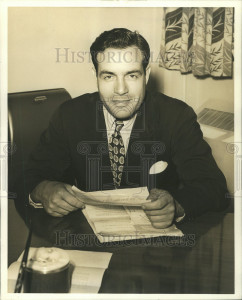
Quirk, Lawrence J. Long-time Hollywood writer/critic who said of 1933’s House on 56th Street, “[the film] contains Kay Francis’ finest performance, in the type of role that made her a household name in the 1930s.”

Quirk wrote books about many Hollywood stars, including Norma Shearer and Joan Crawford.

Wikipedia page.


A Kay Francis Encyclopedia…

A ♦ B ♦ C ♦ D ♦ E ♦ F ♦ G ♦ H ♦ I J ♦ K ♦ L M ♦ N ♦ O ♦ P ♦ Q ♦ R ♦ S ♦ T ♦ U ♦ V ♦ W ♦ X-Y-Z

Encyclopedia Page P

Eugene Pallette ♦ Paramount Pictures ♦ Paramount on Parade ♦ James Robert Parish ♦ Louella Parsons ♦ Passion Flower ♦ Anthony Perkins ♦ Walter Pidgeon ♦ Zasu Pitts ♦ Play Girl ♦ Dick Powell ♦ William Powell ♦ Otto Preminger ♦ The Production Code ♦ The Prudential Family Playhouse

Pallette, Eugene. Character actor, best remembered for his comedy skills, who worked with Kay in 1931’s Girls About Town and 1940’s It’s a Date. Pallette also appeared in 1930’s Paramount on Parade.

Wikipedia page.


paramountlogoParamount Pictures. The first studio which employed Kay from 1929 through January 1932. When Kay first signed with the studio, she was working at the Paramount Astoria Studios in Queens, New York. After completing her first two movies there, they brought her out to Hollywood. At first, surprisingly, Kay didn’t want to go. When she did arrive the publicity department declared, “Her striking brunette beauty, her ability to wear clothes as well as her mellow voice won her a contract with a ticket to Hollywood” (PL).

A big blow occurred in January 1931 when Kay, William Powell, and Ruth Chatterton jumped ship by signing with Warner Bros. “They were stolen from under my nose,” producer Jesse L. Lasky recalled (RC). Columnist Hubbard Keavy wrote, “The loss of Powell and Miss Francis didn’t bother Paramount officials much, but the expected loss of Chatterton, the money maker, caused them some dismay.”

Paramount filed a lawsuit against Warner Bros., but a mutual decision was reached upon when Kay would be loaned out to Paramount for one more movie, Trouble in Paradise (1932).

In retrospect, it’s clear to see Paramount had no real plans to develop Kay into a sensational star. She later echoed this when she switched to Warner Bros., “I feel I owe [Warner Bros.] a great deal. After all, they made a star out of me. When I was with Paramount I was only playing featured roles. That feeling of gratitude is one reason I haven’t complained more over some of the roles given to me.”

Official website.


paramountonparadeposter4Paramount on Parade. Paramount, 1930. All-star revue which is the only time Kay Francis appeared in color on the movie screen.

Paramount on Parade page.


Parish, James Robert. Long-time Hollywood author. Co-wrote the first retrospect article on Kay Francis in a February 1964 Films in Review issue. He later wrote further about Kay in Hollywood Beauties and The Great Hollywood Love Teams. In the latter, he detailed the Kay Francis-George Brent film made for Warner Bros.

In a foreword for Lynn Kear and John Rossman’s The Complete Kay Francis Career Record in 2008, Parish wrote, “In recent years, 1930s Hollywood movie queen Kay Francis has enjoyed a terrific renaissance—thanks to repeated showcasings of her feature films on cable’s Turner Classic Movies, to the release of DVDs of several of her pictures, and to new books such as this excellent volume covering in great detail the life and career of this glamorous, enigmatic cinema star.”

Some additional information RE Parish and his work on KF from him directly (lifted from a personal email from Parish to me, dated February 3, 2015):

“In The Great Movie Series (A. S. Barnes, 1971)- my first solo book as an author–I dedicated the book to Kay and there is a large photo of her on the dedication page

“In my book Hollywood Divas (Contemporary Books, 2003–the company was taken over by McGraw-Hill) one of the 70 female stars given a mini-chapter in the volume is Kay Francis.”

Official website.


Parsons, Louella. Hollywood columnist who had a very good relationship with Kay Francis. Kay, who was always leery of the press because of her desire for privacy, spoke openly to Parsons and Dick Mook. Hedda Hopper, not so much.

Wikipedia page.


passionflowertraded1021

Passion Flower. MGM, 1930. Directed by William C. de Mille. Based on the novel by Kathleen Norris. Kay, in her first top-billed film, plays the sexy cousin of Kay Johnson, and is out to steal Johnson’s onscreen husband played by Charles Bickford.

Passion Flower page.


perkinsaPerkins, Anthony. (April 4, 1932 – September 12, 1992) Famous actor of the stage and screen who worked with Kay in a brief run of Theatre. See the Books Page for an excerpt on their collaboration.

Wikipedia page.


itsadateeeeeeePidgeon, Walter. Played opposite Kay and Deanna Durbin in 1940’s It’s a Date.

Wikipedia page.


Pitts, Zasu. Famous character actress who worked with Kay in 1930’s Passion Flower.

Wikipedia page. Silents are Golden page.


Lobby Card
Lobby Card

Play Girl. RKO, 1941. Directed by Frank Woodruff. Kay plays an aging gold-digger out to teach a young Mildred Coles the “tricks of the trade.” Nigel Bruce and Margaret Hamilton also star.

Play Girl page.


Powell, Dick. Major film star at Warner Bros. during Kay’s years there. He appeared in 1934’s Wonder Bar.

Wikipedia page.


jewel08081Powell, William. (July 29, 1892 – March 5, 1984) Before his legendary partnership with Myrna Loy, Powell was actually most noted for his onscreen romances with Kay Francis. Their films included Behind the Make-Up, Street of Chance, For the Defense, Ladies’ Man, Jewel Robbery, and One-Way Passage. They also both are in Paramount on Parade, though they have no scenes together.

On February 1, 1950 Kay helped Powell celebrate his 60th birthday at the 21 Club. But according to Bette Davis, Powell was a bit gossipy over Kay’s sexuality. According to Bette, Powell “went around telling anyone who would listen that she must be a good actress, because she played convincing love scenes with men. What I heard, elsewhere, was that Miss Francis had girlfriends, but only in between husbands” (PL). [My personal note: I don’t really believe it was Powell who was the gossip, I attribute that to Davis. No other source mentions Powell’s opinions of Kay in that way.]

In 1933 Powell was originally slated to play opposite Kay in The Keyhole, while she was slated to play opposite him in The Key. Unfortunately, the two never worked together after One Way Passage, which many point to as their finest film together, and one of the best either actor ever made.

Wikipedia page. NY Times obituary.


Preminger, Otto. Austrian filmmaker who Kay had a passionate affair with in the mid-1940s. The two met in September, 1942 at a pool party Kay was throwing. When the affair first began, Kay noted of his poor love-making skills. Within two weeks, she was raving about him in her personal diary. (Perhaps he was intimidated by KF.) The affair when on through the end of 1944, when Kay began sleeping with Don King, a handsome pilot she met on a USO Tour.

Wikipedia page.


Production Code, The. Enforced in July 1934 as a way of controlling the content being placed into films. It has been written by many this led to the demise of the careers of many film stars, some of which have included Kay’s name on the list of actors and actresses effected by it. In truth, Kay’s popularity was indeed continuing to rise, and it’s likely the poor stories and relationship with Warner Bros. led to her career decline.


Prudential Family Playhouse. Broadcast on CBS, Kay had a live appearance on this show in November 7, 1950 in “Call It a Day,” which was based on a Warner Bros. film released in 1937. See the Television Page for further information.

Wikipedia page.


A Kay Francis Encyclopedia…

A ♦ B ♦ C ♦ D ♦ E ♦ F ♦ G ♦ H ♦ I J ♦ K ♦ L M ♦ N ♦ O ♦ P ♦ Q ♦ R ♦ S ♦ T ♦ U ♦ V ♦ W ♦ X-Y-Z

Encyclopedia Page O

Jack Oakie  Merle Oberon  Pat O’Brien  Scott O’Brien  Una O’Connor  George O’Hanlon  Oklahoma City  Warner Oland  One Hour of Romance  One Way Passage  Nance O’Neil  Orry-Kelly  Ossining  Reginald Owen


letsgoyenOakie, Jack. (November 12, 1903 – January 23, 1978) Popular larger-than-life comedian back in the 1930s and ‘40s. He and Jeannette MacDonald were the oddly paired leads in 1930’s Let’s Go Native (which featured Kay in a small role) and he had a leading part opposite Kay and George Bancroft in the lackluster 1940’s Little Men. In Native, Kay has one of her rare on-screen songs (which she actually sang) “I’ve Got a Yen for You”, which she sings to Oakie.

Wikipedia page.


Oberon, Merle. Popular leading lady during Kay’s Hollywood years, and one of her social pals. The two were probably introduced via Norma Shearer, who was especially close to Oberon. From her first year in Hollywood, Kay had become close with Irving Thalberg and Shearer. When he died, Kay continued her friendship with Shearer, who, at that time, became especially close to Oberon.

Oberon also appeared in a less-than-successful version of One Way Passage retitled ‘Till We Meet Again.

Wikipedia page.


With Pat O'Brien
With Pat O’Brien

O’Brien, Pat. (November 11, 1899 – October 15, 1983) One of Warner Bros.’ most popular male stars of the 1930s and ‘40s. He worked with Kay in 1938’s Women Are Like That. O’Brien later said of Kay, “One of the most glamorous leading ladies I played opposite was Kay Francis. Not only was she a big dark beautiful creature, but she was endowed with a wonderful sense of humor. I saw Kay a few years ago when I was playing in Falmouth, Massachusetts. She and Eloise [his wife] and I dined together and I reminded her of how completely uninhibited she was” (CR).

Wikipedia page.


O’Brien, Scott. Hollywood biographer who wrote Kay Francis: I Can’t Wait to be Forgotten.

Official website.


O’Connor, Una. Famous Irish character actress perhaps best remembered for 1931’ Invisible Man, who starred Kay’s future costar in Stolen Holiday, Claude Rains. O’Connor worked with Kay in 1933’s Mary Stevens, M.D. and 1942’s Always in My Heart.

Wikipedia page.


O’Hanlon, George. Supporting actor who appeared in 1939’s Women in the Wind, Kay’s last film for Warner Bros.


Oklahoma City, Oklahoma. Kay’s city of birth. As her family frequently traveled, they did not stay here for long (see the Chronology for further info).

Government Webpage.


Oland, Warner. Swedish-American character actor who played the owner of the Rangoon brothel where Kay is sold to in 1934’s Mandalay.


One Hour of Romance. The original title of Confession and the title of the sing Kay sings in the sleazy cabaret with the memorable spoken line, “You held me near you, close to your heart. I still can hear you say ‘we never will part.'”


onewaypassage34355One Way Passage. Warner Bros., 1932. Directed by Tay Garnett. The last, and best, film William Powell and Kay Francis appeared in as a screen team. Passage was one of the most successful films Kay would ever made, and the only one she personally owned a print of that she screened for friends and lovers. The film contained what Kay herself considered some of her most beautiful photography, “And even that was more of a matter of lighting than of my face. It was beautiful because Bob Kurle, the cameraman, took so much time and trouble shifting his camera fifty different ways, experimenting with the lighting and shadow. When I saw that, I felt the one pang of pleasure I’ve ever experienced when I’ve looked at myself on the screen.”

The film was reissued in 1937 and Kay and William Powell also appeared on a radio performance of the story on March 6, 1939. The film was remade a year later with Merle Oberon and George Brent as ‘Till We Meet Again, but was less memorable for critics and audiences. That version was directed by Edmund Goulding, who Kay had a brief affair with in the 1920s.

One Way Passage page.


O’Neil, Nance. Stage actress, rumored lesbian lover of accused ax-murderess Lizzie Borden. She had the part of Kay’s jealous sister-in-law in 1931’s Transgression.

Wikipedia page. Aftermath Crime Library info.


Going over designs with Orry-Kelly

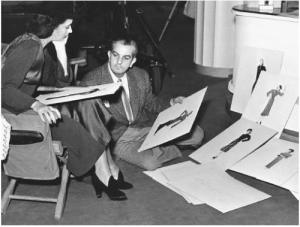
Orry-Kelly. (December 31, 1897 – February 27, 1964) Suggested as a costume designer for Warner Bros. by Cary Grant. Orry-Kelly was told he’d be hired if—and only if—Ruth Chatterton and Kay approved of his designs. With the exception of 1932 (he arrived at the studio mid-way through the year), he designed all of Kay’s clothes for Warner Bros. and even some for her personal collection. He later remembered Kay as “the essence of good taste” (PL).

Years later, costume designer Dorothy Jeakins remembered the influence of the Kay Francis-Orry-Kelly team, “Kay Francis had an innate sense of style. Tall, dark, and willowy, she showcased some of the top designers in movie history. Her association with Orry-Kelly gave Hollywood and the world true glamour.”

Orry-Kelly believed Kay’s best features were her back and shoulders. Many of her gowns were designed to showcase them.

Wikipedia page. Write-up in the Sidney Morning Herald.


Ossining, New York. Kay lived and went to school in this area between 1919 and 1921.


Owen, Reginald. British character actor who played the policeman who informs Kay she’s up to no good in Mandalay and he also had a part in 1941’s Charley’s Aunt.


A Kay Francis Encyclopedia…

A ♦ B ♦ C ♦ D ♦ E ♦ F ♦ G ♦ H ♦ I J ♦ K ♦ L M ♦ N ♦ O ♦ P ♦ Q ♦ R ♦ S ♦ T ♦ U ♦ V ♦ W ♦ X-Y-Z

Encyclopedia Page N

Nancy Goes to Rio  Alla Nazimova  Pola Negri 
The Next Corner  Florence Nightingale  Kathleen Norris 
A Notorious Affair

Nancy Goes to Rio. A less successful 1949 MGM remake of It’s a Date.


Nazimova, Alla. Famous actress of the European and New York stage who originated the Polish play by Maria Morozowicz-Szcepkowska which was adapted for the American screen as Dr. Monica, which starred Kay in the title role.

Wikipedia info.


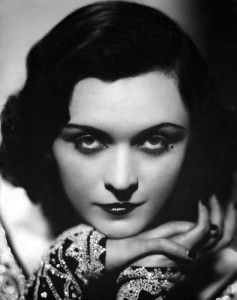
negripNegri, Pola. European silent screen vamp who was Kay’s personal favorite movie star as a child. “She held me enthralled. I thought she must be the most marvelous person in the world. When I met Pola not long ago, I was so awed that I could scarcely speak” (PL). Kay met Pola on May 8, 1931 at a party hosted by Bebe Daniels.

The Willi Forst production, Mazurka (1935; a German film), had been a sensation in Europe. According to Negi, it was expected to be her big America film comeback. UNTIL Warner Bros. bought up all the distribution rights and withheld it from American theaters to remake it as Confession (1937), Kay’s last great film. Negri remained furious, possibly for the rest of her life.

Pola Negri Appreciation Site. 


Next Corner, The. Play by Kate Jordon which was brought to the screen as Transgression.


Nightingale, Florence. English historical legend who was a prolific nurse of her time. The White Angel was a biopic of her life story.

Wikipedia page. Florence Nightingale Museum.


Norris, Kathleen. Author of the novel which Passion Flower was based.

notorious0508Notorious Affair, A. First National Pictures, 1930. Directed by Lloyd Bacon. Based on the play Fame by Audrey Carter and Waverly Carter. Kay’s most comfortable performance in front of the camera until that point, and her best vamp role. She plays a conniving, sexually charged Russian Countess who seduces a troubled musician played by Basil Rathbone. While Billie Dove stars as his ingénue wife, this is Kay’s movie.

A Notorious Affair page.


A Kay Francis Encyclopedia…

A ♦ B ♦ C ♦ D ♦ E ♦ F ♦ G ♦ H ♦ I J ♦ K ♦ L M ♦ N ♦ O ♦ P ♦ Q ♦ R ♦ S ♦ T ♦ U ♦ V ♦ W ♦ X-Y-Z

Encyclopedia Page M

Jeanette MacDonald ♦ Kenneth MacKenna ♦ Aline MacMohan ♦ Man Wanted ♦ The Man Who Lost Himself ♦ Mandalay ♦ David Manners ♦ Fredric March ♦ The Marriage Playground ♦ Herbert Marshall ♦ The Marx Brothers ♦ Mary Stevens M.D. ♦ W. Somerset Maugham ♦ Joe May ♦ Mitzi Mayfair ♦ Archie Mayo ♦ McCalls ♦ Joel McCrea ♦ Frank McHugh ♦ Memory of Love ♦ Lothar Mendes ♦ Una Merkel ♦ Gertrude Michael ♦ Patsy Ruth Miller ♦ Mirror, Mirror ♦ Mistress of Fashion ♦ Monogram Pictures ♦ Dickie Moore ♦ Jean Muir ♦ My Bill ♦ Odette Myrtil

macdonaldjMacDonald, Jeannette. (June 18, 1903 – January 14, 1965) Musical sensation best remembered for her onscreen romance with Nelson Eddy in their MGM films. Before this, she was a contract player at Paramount when Kay worked there as well. MacDonald appeared most notably opposite Kay’s future French boy-toy Maurice Chevalier. MacDonald also had an affair with him.

In 1930, when Kay was still doing unimportant roles at Paramount, she had a small role in the film Let’s Go Native, an odd pairing of Jeanette with…Jack Oakie!

Wikipedia page. MacDonald/Nelson Eddy site.

Legendary Jeanette Macdonald.


mackennakMacKenna, Ken. (August 19, 1899 – January 15, 1962) Kay’s third and last husband. (Rumors persist to this day that she married Erik Barnekow in 1939. This isn’t true.) The two were married from January 17, 1931 until February 21, 1934. The relationship began when they met on the set of 1930’s Virtuous Sin. MacKenna, who shared Kay’s passion for good sex, seemed to be her ideal mate at first. Both were considered to be one of the more famous Hollywood couples. Unfortunately, Kay’s career began to overshadow his, and drinking from both took its toll on the relationship. More than once their verbal disagreements became physical.

Unlike her divorce from William Gaston, whom she remained friends with for decades after their divorce, Kay kept no communication with MacKenna following their marriage failure.

Wikipedia page.


MacMahon, Aline. Character actress who played “Barrel House Betty” in 1932’s One Way Passage.
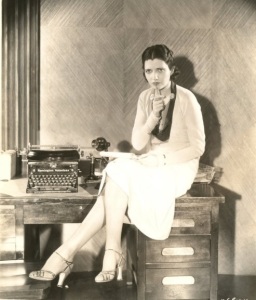


manwanted11142Man Wanted. Warner Bros., 1932. Directed by William Dieterle. Based on the story “A Dangerous Brunette” by Robert Lord. Kay’s first film for Warner Bros.

Man Wanted page.


themanwholosthimselfMan Who Lost Himself, The. Universal, 1941. Directed by Edward Ludwig. Based on the novel by H. De Vere Stactpoole. Brian Aherne has a dual role while Kay plays his glamorous leading lady. The film also features S.Z. Sakall and Henry Stephenson.


The Man Who Lost Himself page.


mandalay0604Mandalay. Warner Bros., 1934. Directed by Michael Curtiz. A Ruth Chatterton reject that became one of Kay’s biggest successes. Kay plays a young woman sold to a Rangoon brothel by her sleazy lover, played by Ricardo Cortez. Shirley Temple claimed to have a bit part in the film, though her scenes don’t seem to have survived. “Mandalay was a steamy, sensual tropical yarn,” Temple remembered, “but my fleeting part was as a homey prop, held for an instant in someone’s arms” (CR).

Mandalay page.


Manners, David. Kay’s handsome leading man in her first film for Warner Bros., Man Wanted. According to Manners, he and Kay did not see eye-to-eye, as he liked to joke around on the set.

David Manners homepage.


marchfMarch, Fredric. (August 31, 1897 – April 14, 1975) Perhaps one of the greatest actors of the Golden Age of Hollywood. Before he became associated with character parts, he was a handsome leading man opposite glamour girls like Kay. The two worked together in 1929’s Marriage Playground and 1932’s Strangers in Love. In the latter he had a dual role.

March was slated to appear in Confession with Kay, but he became unavailable and the part went to Basil Rathbone. Kay socialized frequently with March and his wife, actress Florence Eldridge. Kay did NOT like Eldridge. At all.

Wikipedia page.
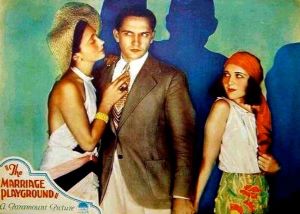


marriageplayssMarriage Playground, The. Paramount, 1929. Directed by Lothar Mendes. Kay has a small role as a vamp in this film with Lilyan Tashman, Fredric March, and Mary Brian. Anita Louise has a small part in this film, too.


The Marriage Playground page.


Marshall, Herbert. Kay’s leading man in 1932’s Trouble in Paradise.


Marx Brothers, The. Kay appeared in one movie with them, 1929’s The Cocoanuts.


Mary-Stevens-LCMary Stevens, M.D. Warner Bros., 1933. Directed by Lloyd Bacon. Kay plays the title role in one of her best films. The film also features Glenda Farrell, Lyle Talbot, and Una O’Connor.


Mary Stevens, M.D. page.


Maugham, Somerset W. Legendary writer who’s “Caesar’s Wife” became Kay’s 1937 film, Another Dawn. Kay later appeared on the stage in his Theatre.

The Literature Network page.


May, Joe. Director of 1937’s Confession. May was so impressed by the 1935 version of the story, Mazurka (with Pola Negri), he drove the cast and crew mad by trying to get an exact remake of the film. He apparently used a stopwatch to time their scenes, screened the film on the set, and even went as far as to tell Kay, in front of cast and crew, she couldn’t act. He never worked again for Warner Bros. after the film’s production completed.

Wikipedia page.


Mayfair, Mitzi. Professional dancer and actress of the stage and screen. Accompanied Kay, Carole Landis & Martha Raye on several USO tours which were later sort-of reproduced into 1944’s Four Jills in a Jeep. Mayfair also had a small role in Paramount on Parade.


Mayo, Archie. Directed two of Kay’s best films: 1932’s Street of Women and 1936’s Give Me Your Heart. Later, after her Warner Bros. days, he directed her again in 1941’s Charley’s Aunt. Though he was one of her best directors, they did not get along. Mayo went as far as to tell Kay she couldn’t act.

Wikipedia page.


McCalls. Kay modeled for the January 1927 cover.


girlsabouttown (1)McCrea, Joel. (November 5, 1905 – October 20, 1990) One of the most natural actors from the Golden Age of Hollywood and husband of actress Frances Dee. McCrea appeared as Kay’s true love in 1931’s Girls About Town. Dr. Monica was actually initially conceived as a vehicle for McCrea and Barbara Stanwyck until Kay and Warren William were cast.

Wikipedia page.


McHugh, Frank. Popular comedian in Warner Bros. films. Appeared as the humorously drunk criminal in 1932’s One Way Passage and revived his role in the 1940 remake ‘Till We Meet Again. He also worked with Kay in 1933’s The House on 56th Street and, that same year, appeared in the film version of Elmer the Great, a stage production Kay had appeared in in 1927 opposite Walter Huston.

Wikipedia page.


Memory of Love. The novel by Bessie Breuer which was filmed in 1939 as In Name Only with Kay, Carole Lombard & Cary Grant.


Mendes, Lothar. One of Kay’s most frequent directors during her Paramount contract. Born in Germany, he seemed to have disappeared professionally after WWII. His films with Kay were 1929’s Dangerous Curves, Illusion & The Marriage Playground, 1930’s Paramount on Parade, 1931’s Ladies’ Man, and 1932’s Strangers in Love. Considering he filmed Kay opposite such names as Clara Bow, Fredric March, William Powell, and Carole Lombard, Mendes really deserves a lot of credit for helping evolve Kay’s technique for screen acting.

Wikipedia page.


Merkel, Una. Gifted comedic actress who plays the jealous girlfriend of David Manners in Man Wanted, Kay’s first film for Warner Bros.


michaelgMichael, Gertrude. Supporting actress whose career was slightly damaged by her heavy drinking. She played envious, jealous, scheming women especially well. Good examples of this are opposite Mae West in I’m No Angel (1933) and Kay in Allotment Wives (1945). She also sings the song “Sweet Marijuana” in the Pre-Code cult favorite, Murder at the Vanities.


Wikipedia page.


Miller, Patsy Ruth. Writer of Windy Hill, which was directed by Ruth Chatterton and Kay’s comeback to the stage after a 17-year absence. Miller said, “Kay preferred the sure thing of the road to uncertainty of a New York opening. We finally had to close due to Kay’s contract with Monogram Studios, who had a picture ready for her, and threatened a breach of contract suit if she didn’t return. That effectively closed our show, as the producer wouldn’t hear of putting anyone else in Kay’s part. To my regret, Windy Hill never did get to New York. By the time Kay was free again the producer had died, his estate was involved in a legal battle, and I got tired of the whole thing and went back to California, which was probably stupid of me. But it had been a great experience and I had come to love Kay” (PL).


Mirror, Mirror. Kay hoped that this play would take her back to Broadway. It didn’t. See the Stage Page for further info.


Mistress of Fashion. The original title of Stolen Holiday.


monogrampMonogram Pictures. One of the most notorious of the “Poverty Row Studios” in Hollywood. The pictures produced were usually cheap, vulgar entertainment simply made for a fast profit. Monogram didn’t have a “roster of stars” per say, but there were several actors who worked there early in their careers (John Wayne) or who ended up there after their careers hit the skids (Kay Francis).

Kay completed her final three movies for Monogram: Divorce, Allotment Wives, and Wife Wanted. It’s still unknown exactly why she chose to work for such a place, and still widely debated among critics. To those who really know Kay Francis, it’s most likely the producing aspect that made Kay accept the offer. The co-produced each of the films with a man named Jeffery Bernerd. (Rumors persist to this day that Kay, a notorious frugal, kept the budget so low she made sandwiches at home for the cast and crew.)

In regards to the quality of the films, they’re actually not all that bad. An argument can be made that the films are so bad, they’re actually pretty good. The same cannot be said of some of Kay’s other films made for the major studios.

Recommended reading: Ted Okuda’s The Monogram Checklist.

Wikipedia page.


Moore, Dickie. Famous child actor who played in two Kay Francis movies: 1930’s Passion Flower and 1938’s My Bill.


Muir, Jean. Warner Bros. supporting actress who played Kay’s best friend in Dr. Monica who becomes pregnant with her husband’s illegitimate baby.


mybilllobby13

My Bill. Warner Bros., 1938. Directed by John Farrow. Produced by Brian Foy. Based on the play Courage by Tom Barry. Kay’s first “B film” for Warner Bros. following her contract dispute. The story had been filmed by Belle Bennett under the play’s original title in 1930, and was directed by Archie Mayo, one of Kay’s best directors (though they hated each other). Everyone was shocked when Kay chose to make the film instead of walking out on her contract, and they were even more shocked when the film became a hit with audiences.


My Bill page.


Myrtil, Odette. One of Kay’s actress friends who designed her costumes for Divorce and Allotment Wives.


A Kay Francis Encyclopedia…

A ♦ B ♦ C ♦ D ♦ E ♦ F ♦ G ♦ H ♦ I J ♦ K ♦ L M ♦ N ♦ O ♦ P ♦ Q ♦ R ♦ S ♦ T ♦ U ♦ V ♦ W ♦ X-Y-Z

Encyclopedia Page L

Ladies’ Man ♦ The Lady with Red Hair ♦ Carole Landis ♦
Fritz Lang ♦ The Last of Mrs. Cheyney ♦ Last Will and Testament 
Charles Laughton ♦ Anderson Lawler ♦ Let Us Be Gay ♦
Let’s Go Native ♦ Margaret Lindsay ♦
Lindsay Morrison Stock Company ♦ Little Men 
Living on Velvet ♦ Carole Lombard ♦ Robert Lord ♦
Anita Louise ♦ Myrna Loy ♦ Ernst Lubitsch ♦ Paul Lukas 
Lux Radio Theatre

ladiesmanlobby3Ladies’ Man. Paramount, 1931. Directed by Lothar Mendes. The film was another reunion for William Powell and Kay Francis. The film also featured Powell’s then-wife, Carole Lombard, who became one of Kay’s closest friends during the production of the film. Despite the off-screen relationships between the three, it’s Kay’s character who is Powell’s true love in the film. Not Lombard. Of the production, Powell said, “I’m offering a direct challenge to the movie public, playing this part…I’m throwing down the gauntlet. How can they receive me in such a naïve part? I’m not a ladies’ man. I haven’t the physical characteristics for one thing. Not handsome. Someone like Valentino should have played this part. Not Bill Powell” (WP).

Ladies’ Man page.


Lady with Red Hair, The. A Warner Bros. film originally brought to the lot when Kay was still employed (1938) and she was a top contender for the role with Bette Davis. Neither made the film based on Kay’s friend Leslie Carter. Instead it went to Miriam Hopkins.

Wikipedia page.


Landis, Carole. Young Hollywood starlet who traveled with Kay, Mitzi Mayfair and Martha Raye during the WWII USO tours to entertain troops. Landis’ book paralleled Four Jill in a Jeep (1944). When she committed suicide, Kay, surprisingly, made no mention of it in her diary.

Wikipedia page. Fan site.


Lang, Fritz. Famous German-Austrian filmmaker Kay had a short but passionate affair with in July 1940.

Wikipedia page.


Last of Mrs. Cheyney, The. This famous play by Federick Lonsdale Kay revived in the late 1940s on the stage. The play was filmed three times: in 1929 with Norma Shearer, in 1937 with Joan Crawford, and in 1951 with a faded Greer Garson. When Kay brought it back to life in the late 1940s most couldn’t understand why she bothered. View the Stage Page for more info.


Last Will and Testament (of Kay’s). 

Kay’s will was seven pages in length and left bequests to twelve individuals. Some of the bequests included:

Arnold Weissberger (Kay’s attorney), who received a drawing by Kenneth MacKenna’s father, Leo Mielziner, Sr. as well as two drawings by MacKenna’s brother Jo.
Priscilla Brandt who received Kay’s copy of Picasso’s Guitar Player.
Stephie Wiman who received Kay’s emeralds.
Helen Morgan who received $2,000, two pieces of sculpture, and Kay’s then-dog Chic.
The Museum of the City of New York received her collection of career records (film stills, clippings) and her diary.
Jetti and Lou Ames received pieces of furniture.
The Seeing Eye of Morristown, NJ famously received the bulk of her estate.

Kay’s will was made public in the New York Times later in 1968.


Laughton, Charles. Famous British stage actor. When Kay was making 1942’s Between Us Girls, Laughton was working with Kay’s It’s a Date (1940) costar Deanna Durbin in It Started with Eve. Apparently his behavior left Kay feeling uneasy. “Kay was in the middle of a scene when the lights on the set suddenly went out, and guns began to go off. Kay, who hated guns, was horrified and grabbed [director Henry] Koster’s arms saying, ‘Somebody’s shooting.’…Charles came down the stairs in a long nightgown and nightcap he had worn in It Started with Eve singing ‘Happy Birthday, Dear Henry!’…Koster, who had completely forgotten his own birthday, was astounded, while Kay Francis ran off the set in tears” (BF).

Official site. Wikipedia page.


Lawler, Anderson (Andy). Kay’s jerky husband in 1931’s Girls About Town. He became one of Kay’s closet friends, having a bit part in Confession (1937).

Later, Lawler made up the story that a drunken Kay showed up at his door naked saying “I am not a star. I am a woman. And I wanted to get fucked!” This probably never happened, as Kay knew Andy was gay and most likely made up the story to protect his sexuality.


Let Us Be Gay. A Rachel Crowthers play from the late 1920s Kay revived on the stage many times in the late 1940s. See the Stage Page for more info.


letsgonativeLet’s Go Native. Paramount, 1930. Directed by Leo McCarey. Stars Jeanette MacDonald and Jack Oakie. Kay only has a bit part in perhaps her most bizarre film of her entire Paramount career. The film was probably one of the major reasons Kay jumped studios to Warner Bros. a few months later when she signed her contract in January 1931 (her employment began there a year later in January 1932).

Let’s Go Native page.


houseon56pics0914Lindsay, Margaret. Despite being only 5 years younger than Kay, she played Kay’s daughter in 1933’s The House on 56th Street (the character Kay plays ages 30 years on film). In the beginning of 1941, Lindsay was involved in a big scandal she was photographed at a lesbian orgy. Warner Bros. was blackmailed as a result. While the scandal never made the mainstream news, Kay made note of it in her diary of “Margaret Lindsay” and “trouble” on January 4.

Wikipedia page.


Lindsay Morison Stock Company. After Kay’s mother, Katherine Clinton, left her father, Joe Gibbs. She toured with this company on the stage. Around 1909.


Title Lobby Card
Title Lobby Card

Little Men. RKO, 1940. Directed by Norman Z. McLeod. Based on the novel by Louisa May Alcott. Kay stars as Alcott’s legendary “Jo” in one of her poorer freelance films.


Little Men page.


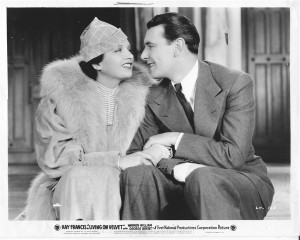
livingLiving on Velvet. Warner Bros., 1935. Directed by Frank Borzage. The property was supposedly hand-picked for Kay to make by Jack Warner. It was her second film with George Brent and also her second (and last) film with Warren William. In the script there’s reference to Global Warming at a party in the beginning of the film and there’s a brief scene between Kay and George Brent where Kay (in the only time onscreen) acknowledges her speech impediment.

Living on Velvet page.


innameonlyLombard, Carole. (October 6, 1908 – January 16, 1942) One of Kay’s closest—and most loyal—Hollywood friends. The two met on the set of 1931’s Ladies’ Man and remained friends up until Lombard’s tragic death in an airplane crash. Lombard’s accident was made mention of in Kay’s diary, which is notable because some of Kay’s friends whose lives were cut short (Lilyan Tashman, Carole Landis) did not get a mention in her personal writings.

When Kay was dismissed from Warner Bros. following her contract dispute, and her career was in big trouble, it was Lombard who got Kay the job in 1939’s In Name Only, which helped revive interest in Kay Francis and gave her one of her best roles.

Carole & Co. LiveJournal. Wikipedia page.


Lord, Robert. Writer and producer at Warner Bros. during Kay’s years at the studio. He worked on many of her films.

Wikipedia page.


Louise, Anita. Supporting starlet who appeared with Kay in three films: 1929’s Marriage Playground, 1937’s First Lady & 1938’s My Bill.

Wikipedia page.


loymLoy, Myrna. (August 2, 1905 – December 14, 1993) When Kay was voted the 6th most popular actress in films by Variety in 1937, Loy was voted the MOST famous. And, at the time, indeed she was. Loy and Kay’s careers mirrored each other’s in the way both started by playing dark, scheming, vamp roles before transitioning into more sympathetic screen characters. Both have William Powell as their most frequent leading man. Both were top contenders for The Rains Came (1939), which Loy successfully won. On top of all of this, Loy and Kay were friends, working with each other during their WWII volunteer work. On the Books Page, read a detailed account of their work together written by Loy herself.

This sites’ Myrna Loy page.

Center of Performing Arts. Wikipedia info.


Lubitsch, Ernst. Famous Hollywood producer-director who worked on 1930’s Paramount on Parade and 1932’s Trouble in Paradise with Kay.

Fan site.


ifoundstellaparish3464Lukas, Paul. Hungarian actor who worked with Kay in several films: 1929’s Illusion (he made sexual advances to her on the set which she coldly rejected), 1930’s Behind the Make-Up, 1931’s Vice Squad & 1935’s mega-hit I Found Stella Parish.


Wikipedia page.


Lux Radio Theatre. Kay had many appearances on this radio show. See the Radio Page for further information.


A Kay Francis Encyclopedia…

A ♦ B ♦ C ♦ D ♦ E ♦ F ♦ G ♦ H ♦ I J ♦ K ♦ L M ♦ N ♦ O ♦ P ♦ Q ♦ R ♦ S ♦ T ♦ U ♦ V ♦ W ♦ X-Y-Z

Encyclopedia Page K

George S. Kaufman ♦ Lynn Kear ♦ The Ken Murray Show ♦ Merna Kennedy ♦ The Key ♦ The Keyhole ♦ Guy Kibbee ♦ Don King ♦ King of the Underworld ♦ Patric Knowles ♦ Otto Kruger

Kaufman, George S. Kay appeared in two film version of Kaufman plays, 1929’s The Cocoanuts (which Kaufman co-wrote with Irving Berlin) and 1937’s First Lady (the box office bomb which ended Kay’s top-liner days).

Wikipedia page. Official Website.


Kear, Lynn. Author who co-wrote Kay Francis: A Passionate Life and Career with John Rossman in 2006 and The Complete Kay Francis Career Record again with Rossman in 2008.

Official site.


Ken Murray Show, The. One of Kay’s television appearances in 1952. See the Television Page for further information.


Kennedy, Merna. Comedic actress who appeared with Kay in 1934’s Wonder Bar.


Key, The. A 1933 Warner Bros. film originally planned to reunite Kay with William Powell. Powell made the film, but without Kay.

Wikipedia page.


keyhole232Keyhole, The. Warner Bros., 1933. Directed by Michael Curtiz. Kay’s first appearance onscreen with George Brent. The film was originally supposed to reunite Kay with William Powell.


The Keyhole page.


Kibbee, Guy. Famous character actor who appeared with Kay in 1934’s Wonder Bar.


kingdonpioletKing, Don. When Kay left for a USO tour for Canada and Alaska on February 18, 1944, King was one of their piolets. Kay began an affair with him. Fellow traveler Marsha Hunt later wrote, “…we trusted Don to deliver us safely, and so he did, despite a few rather dicey occasions. He was also handsome and a fine companion” (PL).

The affair went on through the beginning of 1945, and Kay brought in her 40th birthday with him on January 13. Considering his job, Don couldn’t have much contact with Kay. By March she had had it, and the relationship shortly cooled after.


kingofunderworld456King of the Underworld. Warner Bros., 1939. Directed by Lewis Seiler. Based on the serialized novel by W.R. Burnett. This was the only time that Kay appeared opposite Humphrey Bogart on the screen. The two had known each other for years, and Bogart had even dined with Kay in her New York apartment on November 23, 1928. The film was a remake of Dr. Socrates, and Kay played the role originated by Paul Muni in the 1935 Warner Bros. film. Of the project, Kay just blatantly told an interviewer “I’m going to be Paul Muni in skirts” (PL).

King of the Underworld page.


Knowles, Patric. British actor who play’s Kay’s baby-daddy in 1936’s Give Me Your Heart. He is perhaps best known for 1938’s Robin Hood.

Wikipedia page. LA Times Obituary.


Kruger, Otto. Character actor who played Kay’s right-hand-man in 1945’s crime drama Allotment Wives.

Wikipedia page. Hitchcock Zone page.


A Kay Francis Encyclopedia…

A ♦ B ♦ C ♦ D ♦ E ♦ F ♦ G ♦ H ♦ I J ♦ K ♦ L ♦ M ♦ N ♦ O ♦ P ♦ Q ♦ R ♦ S ♦ T ♦ U ♦ V ♦ W ♦ X-Y-Z

Encyclopedia Page J

Sybil Jason ♦ Stuart Jerome ♦ Jewel Robbery ♦ Kay Johnson

Jcomet6ason, Sybil. Signed by Warner Bros. in 1935 as an answer to the success of the Shirley Temple films at 20th Century Fox. Jason actually got her career going doing impersonations of Kay’s then-boy-toy Maurice Chevalier. Michael Curtiz directed her film debut in Little Big Shot (1935), and after she was cast in the more ambitious I Found Stella Parish, which starred Kay. Unfortunately, her career never picked up and by the time she was cast opposite Kay in 1938’s Comet Over Broadway, she had no future projects lined up. She later said, “I hadn’t been assigned to do a film for three months, and that wasn’t a good sign. Kay Francis helped me. She said she wouldn’t do Comet Over Broadway unless I played her daughter. She was kind” (BF).

Jason ended her career with two small roles in Shirley Temple films, 1939’s Little Princess and 1940’s Blue Bird (the latter which was the box office bomb that ended Temple’s own movie stardom). The two women remained life-long friends, and Jason continued to speak highly of Kay until her own death.

Jason also wrote a message for readers of Scott O’Brien’s KF bio, I Can’t Wait to Be Forgotten.

Wikipedia page. NY Times Obituary.


Jerome, Stuart. Employee at Warner Bros. during Kay’s contract dispute with the studio in 1938. He recalled her problems with management vividly in his gossipy autobiography, Those Crazy, Wonderful Years.


Lobby Card
Lobby Card

Jewel Robbery. Warner Bros., 1932. Directed by William Dieterle. William Powell and Kay star in this film which is as close to Lubitsch as any other studio ever got without using Ernst Lubitsch. Apparently, Darryl F. Zanuck had quite some problems with the direction of the film, feeling it too sophisticated. In a studio memo to Lucien Hubbard on March 26, 1932, he wrote, “Keep your eye very close on the rushes of Dieterle…as he has a habit of shooting his most important scenes with the camera moving or sweeping around or going back and forth, and you miss the important point of it all.” (WP)

In his words to Dieterle, he contrasted his own words, “the rushed continue to be very excellent and I like the manner in which you are continuing to put movement and action in all of the scenes… Keep this up: this is very fine.” (WP)

Jewel Robbery page.


passionflower1028Johnson, Kay. Appeared opposite Kay Francis in 1930’s Passion Flower. The two had a brief fling the year before and Johnson told Kay she’s always love her (PL). Johnson later married director John Cromwell, having his children (one is actor James Cromwell).

[My personal note: Johnson, an excellent actress, had good roles in 1930’s Madame Satan (directed by Cecil B. DeMille during his stint at MGM) and 1932’s Thirtween Women. The latter is a personal favorite of mine in which Irene Dunne & Myrna Loy also star.]

Wikipedia page.


A Kay Francis Encyclopedia…

A ♦ B ♦ C ♦ D ♦ E ♦ F ♦ G ♦ H ♦ I J ♦ K ♦ L ♦ M ♦ N ♦ O ♦ P ♦ Q ♦ R ♦ S ♦ T ♦ U ♦ V ♦ W ♦ X-Y-Z

Encyclopedia Page I

I Found Stella Parish ♦ I Loved a Woman ♦ Illusion ♦ In Name Only 
It’s A Date

Poster
Poster

I Found Stella Parish. Warner Bros., 1935. Directed by Mervyn LeRoy. Based on the story “The Judas Tree” by John Monk Saunders. The film stars Kay with Paul Lukas (who she worked with at Paramount), and was her first film with Ian Hunter & Sybil Jason. After three moderately successful films that year, Parish became a blockbuster success for Kay, and one of her most successful films (see the Box Office Page). Kay’s boss, Hal B. Wallis, admitted there was a story shortage on the Warners lot at the time, as one writer wrote after an interview with him, “He says they are acquiring plays, one by one, suitable for her, so that they will have a list to choose from. A few days ago I Found Stella Parish, the dramatic story of an actress, by John Monk Saunders, was purchased with Kay in mind” (PL).

When the film became one of Warner Bros.’ biggest hits of the year, Jack Warner offered Kay a new contract even though her old one hadn’t expired yet (BF). This was the contract that paid her $5,250 a week, and the one she would file a lawsuit to get out of two years later. (See the Salaries entry for further info.)

I Found Stella Parish page.


ilovedawomanI Loved a Woman. Warner Bros., 1933. Directed by Alfred E. Green. Based on the book by Davis Karsner. The film is really a star vehicle for Edward G. Robinson. Kay’s unusual casting in this film (a small role) seems to verify the claims by Glenda Farrell about how Warner Bros. rotated their actors between leading and supporting parts. The film also stars Genevieve Tobin, who didn’t like Kay.

Of the film, Edward G. Robinson later wrote in his book, “I saw it the other night on channel 52 (webmaster’s note: um, before cable???), and I was astonished to find it pretty good. Let me give a small bow to Kay Francis. Despite her lisp, her background as a model, despite her inexperience in the theater, she had that indefinable presence that somehow enabled her to be convincing as well as beautiful” (CR).

I Loved a Woman page.


illusion2Illusion. Paramount, 1929. Directed by Lothar Mendes. Based on the play by Arthur Cheyney Train. Starring Charles “Buddy” Rogers and Nancy Carroll, Kay had a minor role in this partially lost film. Only a brief segment survives at UCLA, though the soundtrack exists.

Illusion page.


innameonly10281In Name Only. RKO, 1939. Directed by John Cromwell. Based on the novel Memory of Love by Bessie Breuer. The film stars Carole Lombard, Cary Grant, and Kay. The film is memorable for showcasing Kay’s name (despite third billing) in equal size to Lombard’s and Grant’s this late in her career. Aside from this, In Name Only is one of her best performances in, arguably, her last great film. Kay later said of her work in it, “When I played the heavy in In Name Only, my friends told me I was crazy. I said I had to be seen in some other type of part than the mush I had been playing.”

In Name Only page.


itsadate23It’s a Date. Universal, 1940. Directed by William A. Seiter. The film stars Deanna Durbin, Kay, and Walter Pidgeon. Columnist Ruth Waterbury wrote after the film’s release, “Give her a hand…Kay Francis beat Hollywood at its own game when she played to the hilt her role in It’s a Date…a year ago she was taking a terrible beating…she did that most difficult of all things when the breaks are going against you…she remained a lady” (BF).

Photoplay wrote of Kay’s appearance in It’s a Date & In Name Only, “Memo to Kay Francis: This is what is called a comeback deluxe…and we mean it.”

It’s a Date page.


A Kay Francis Encyclopedia…

A ♦ B ♦ C ♦ D ♦ E ♦ F ♦ G ♦ H ♦ I J ♦ K ♦ L ♦ M ♦ N ♦ O ♦ P ♦ Q ♦ R ♦ S ♦ T ♦ U ♦ V ♦ W ♦ X-Y-Z

Encyclopedia Page H

William Haines ♦ Edith Head ♦ Katharine Hepburn ♦ Hollywood Canteen ♦ Bob Hope ♦ Miriam Hopkins ♦ Hedda Hopper ♦ Arthur Hornblow ♦ House of Westmore ♦ The House on 56th Street ♦ Leslie Howard ♦ Jobyna Howland ♦ Ian Hunter ♦ George Hurrell
Ruth Hussey ♦ Walter Huston

Haines, William. MGM contract star who was one of Kay’s closest Hollywood friends. Haines, a gay leading man, was in a long term relationship with boyfriend Jimmie Shields. In June 1936 there was a gay sex scandal about Shields, and Haines, Shields, and Andy Lawler were attacked as a result. Kay received a phone call about the incident from Perc Westmore on June 4.

William Haines Designs. Wikipedia page.


Head, Edith. Costume designer at Paramount who Kay probably had a one-night stand with on January 22, 1932. On the following day, she wrote in her diary, “Swell time, but got very drunk. T.B. (probably Tallulah Bankhead) called me a lesbian. E.H. (probably Head) and I were very next to getting queer! Damn fool!”

Fan site. Wikipedia page.


Hepburn, Katharine. According to Darwin Porter, Kay was one of the lesbians Hepburn, who Porter also argued was a lesbian, socialized with. See the Books Page for further “information”.

In a more realistic connection to Kay Francis, Katharine Hepburn was one of the names (which also included Kay’s) on the notorious 1938 “Box Office Poison” list.

Wikipedia page.


Hollywood Canteen. Kay was one of the many stars who volunteered here during WWII. Kay didn’t make it into the 1944 Warner Bros. film of the same name, but she was the star of that year’s Four Jills in a Jeep at Twentieth Century-Fox instead.

Canteen History.


hopebHope, Bob. Legendary comedian who remembered Kay’s WWII efforts fondly. “What a looker! A great star! A great dame! They called her ‘ravishing Kay Francis.’ Nowadays, people forget what a trouper Kay was. She did a lot for the USO and gave her time to many patriotic causes. She was a real class act” (PL).


Official website.


troublewithkayHopkins, Miriam. (October 18, 1902 – October 9, 1972) Blonde actress most remembered for her thick Southern accent. She appeared with Kay in 1931’s 24 Hours and 1932’s Trouble in Paradise. Kay was a bit “miffed” when Hopkins’ name was billed above hers on the latter. Kay and Hopkins were social friends, and were announced as the original stars of The Sisters (1938), which went to Bette Davis. When Miriam was too ill to do Comet Over Broadway, Kay was slated for the role. Hopkins also starred in The Lady with Red Hair, a biopic about Kay’s friend Mrs. Leslie Carter. Kay was an original choice for that part, too.

Wikipedia page.


Hopper, Hedda. Hollywood gossip columnist Kay couldn’t stand. She bluntly stated in her diary “Hedda here. What a bitch” (PL).


Hornblow, Arthur. Myrna Loy’s husband at the time he and Kay had an affair. Despite Myrna Loy writing very fondly of Kay in her book, she seems to not have known about Kay’s relationship with him. This might have been because Loy described Hornblow as cruel and controlling, and possibly because the only reason the affair is known about today is because of Kay’s diary entries about it.


House of Westmore. Opened by Kay and a roster of female stars to help Perc Westmore, make-up man at Warner Bros.


houseon56thstreetposter0914House on 56th Street, The. Warner Bros., 1933. Directed by Robert Florey. Stars Kay, Ricardo Cortez, Gene Raymond, and Margaret Lindsay. The film was a major success for Kay, and a project turned down by Ruth Chatterton.

The House on 56 Street page.


Howard, Leslie. (April 3, 1893 – June 1, 1943) Kay’s costar in 1934’s British Agent. The two had a brief affair during filming.

Wikipedia page.


virtuoussin2014Howland, Jobyna.  (March 31, 1880 — June 7, 1936) Played the owner of the brothel where Kay seduced Walter Huston in The Virtuous Sin (1930). Howland, over 6 feet tall, was one of the few women who towered over Kay Francis on the screen.

Howland’s career was most prominent on the stage. Her other film work included A Lady’s Morals (1930; which starred Kay’s friend Grace Moore) and The Story of Temple Drake (1933, which starred Kay’s pal & costar Miriam Hopkins).

Wikipedia page.


ifoundstella1002Hunter, Ian. (June 13, 1900 – September 22, 1975) Tied with William Powell as Kay’s most frequent leading man (7 total!). Their films include 1935’s I Found Stella Parish, 1936’s White Angel, 1937’s Stolen Holiday, Another Dawn & Confession, 1938’s Secrets of an Actress & Comet Over Broadway. In the original end of Another Dawn, Flynn was supposed to die so Hunter could get Kay at the end of the film. The audience didn’t like that so it was switched so Hunter died and Flynn got Kay.

No word on his opinions of Kay, or hers of him, but she probably had more chemistry with Hunter than any other leading man.

Wikipedia page.


passionkayHurrell, George. Photographer who worked most famously with the MGM stars in the 1930s. Hurrell’s photos of Kay Francis for Passion Flower (1930)—in which she wore gowns by Adrian—were better than the actual film itself, and gave moviegoers a preview of the serious glamour Kay could portray in the proper setting.

Hurrell did move to Warner Bros. in the late 30s & early 40s but Kay was on her way out. Their best collaboration, however, remains the stills for Passion Flower.

More notable stars photographed by Hurrell include Norma Shearer, Joan Crawford & Jean Harlow. There was also his disastrous shoot with Garbo.

For more information on Hurrell, I strongly suggest Hurrell’s Hollywood Portraits by Mark A. Vieira.


Hussey, Ruth. Kay replaced Hussey in the stage run of State of the Union to much merriment and publicity.

IBDB info.


gentlemenofthepressHuston, Walter. Appeared with Kay in 4 films, including her screen debut in 1929’s Gentlemen of the Press. They were close friends, and appeared in 1930’s Virtuous Sin, 1933’s Storm At Daybreak, and 1942’s Always in My Heart. The last one was made at Warner Bros. where Huston had just signed a contract. He requested Kay for his leading lady, and they had to hire her at her asking price. This was the only time she would work at the studio again since leaving there on terrible terms in September 1938.


Wikipedia page.


A Kay Francis Encyclopedia…

A ♦ B ♦ C ♦ D ♦ E ♦ F ♦ G ♦ H ♦ I J ♦ K ♦ L ♦ M ♦ N ♦ O ♦ P ♦ Q ♦ R ♦ S ♦ T ♦ U ♦ V ♦ W ♦ X-Y-Z