All posts by M.O.

Encyclopedia Page G

Clark Gable ♦ Greta Garbo ♦ Bill Gaston ♦ Gentlemen of the Press ♦ Katharine Edwina Gibbs ♦ Katherine Clinton-GibbsJoe Gibbs ♦ Girls About Town ♦ Give Me Your Heart ♦ The Golden Arrow Samuel Goldwyn Gone With the Wind ♦ Goodbye My Fancy ♦ The Goose and the Gander ♦ Edmund Goulding ♦ Cary Grant ♦ D.W. Griffith ♦ Sidney Guilaroff Guilty Hands

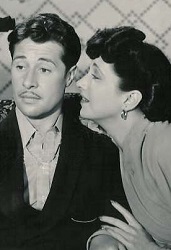
Gable with wife Carole Lombard, who was one of Kay's closest friends.
Gable with wife Carole Lombard, who was one of Kay’s closest friends.

Gable, Clark. Husband of Kay’s close friend Carole Lombard. Kay, Carole, and Gable enjoyed spending time away from Hollywood together with whoever happened to be Kay’s lover at the time. When Lombard died, Kay attended the funeral but lost touch with Gable after.

Wikipedia page. Classic Movie Favorites page.


garbog

Garbo, Greta. Kay’s alluring but distant mystique was often compared to that of Garbo’s and also Marlene Dietrich. According to Kay, Garbo was her favorite movie star. “I am quite sure if I should ever meet Greta Garbo I would be speechless with admiration and unable to utter a syllable. I adore her as much as any fan and I don’t suppose I shall ever be able to look upon her as just another human being who eats and sleeps and works just as all the stars in pictures do.” (PL)

Kay DID eventually meet Garbo in April 1942 at a dinner party held by Basil and Ouida Rathbone.

Storm at Daybreak was a Greta Garbo reject.

Check out these two excellent fan-sites: Garbo Forever Garbo Types.


ggastonbillGaston, Bill (11/12/1896-08/30/70). Kay’s second husband. The two were married on November 19, 1925. The marriage was doomed from the beginning, as that same night Kay noted in her diary, “Married to BG, my God!” Gaston lived and worked in the Boston area, and was Assistant District Attorney of Suffolk County in Massachusetts when he married Kay. Their marriage was a secret that few knew of, most likely because of his family’s well-known background and Kay’s sketchy past.

According to a friend, Gaston was “a very good-looking bastard” (PL). When Kay started working for Stuart Walker in 1926, she started sleeping around with fellow costars, while Gaston was doing the same with women from the Boston area. They divorced on September 1, 1927.

The two remained friendly after. When Kay hit it big, he asked her to marry him again at least once and at least as late as 1934. She declined.

(Note: In BF O’Brien states that Gaston died on August 30, while in PL Kear & Rossman state he died on August 15.)

Photos of Gaston
(Click for a larger view.)


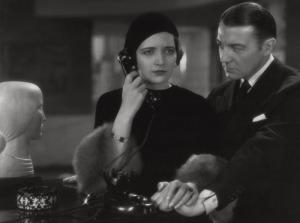
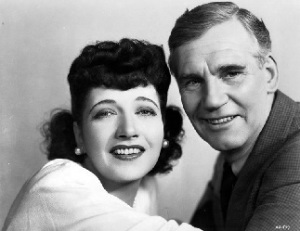
gentlemen0812Gentlemen of the Press. Paramount, 1929. Produced by Monta Bell. Directed by Millard Webb. Stars Walter Huston and, in her film debut, Kay Francis (she’s credited as Katherine Francis on film). Based on the play by Ward Morehouse. The original title was News. The film was surprisingly based off of Arthur James Pegler, a coworker of Morehouse in the mid-1920s on the Tribune staff.

According to one writer, “Kay was the thirteenth girl tested for the screen role in Gentlemen of the Press after twelve blondes had been tried out” (PL). Despite the Morehouse story where they discovered Kay at Tony’s, Kay herself insisted it was boyfriend John Meehan who got her the job. On December 11, 1928 he gave her a tour of the Paramount Astoria Studio in Queens, and set up a screen test for her on December 13.

Of her test for the film, Kay said, “I had a bad cold and when they told me to come to the studio they said they wouldn’t have to test my voice. But when I got there they decided to test it anyway. Walter [Huston] told me about it in the commissary. I ran up to the dressing room and gargled for an hour. Then I are a box of throat lozenges and stepped in front of the camera. It sounded very bad to me, but when the studio people saw it they said it was fine. They hadn’t heard a low voice like mine before, they said. I never told anyone about the cold.”

Gentlemen of the Press page.


Gibbs, Katharine Edwina. Kay’s birth name.


Gibbs, Katherine Clinton. Kay’s mother (see the Clinton, Katherine entry).


Gibbs, Joseph. Kay’s father. A hotel manager who disappeared quickly from Kay and her mother’s lives quickly after Kay was born. The family moved around extensively before they moved to Salt Lake City, Utah, which is where Katherine probably left Joe around 1906. There was some communication between them until around 1907/1908 when Kay saw him for the last time in New York.

On January 20, 1919 he died in St. Louis. Kay never heard of the news, and lives the rest of her life not knowing whatever happened to her father. He was survived by his new wife, Minnie, and their two daughters, four-year-old Virginia and five-year-old Helen, Kay’s half-sisters. The Homer Masonic Lodge pays for his $15 funeral and burial.

Though he had virtually no impact in her childhood, Kay’s first memory was of him. “When I see a red sweater I remember running down a road to a white gate and hanging on the gate waiting for my father on Sunday mornings. We were living in Montecito, in California, and he used to ride to town for the paper and then I would put on my red sweater and run out to meet him. That was the first thing I remember about myself. I wasn’t quite four-years-old and we were living on a little ranch and there were a lot of orange trees. I used to sit under the trees and reach up and pick the fruit and sit there eating it. We had a big dog and father had brought home a cat for me. The cat and I used to ride all around the yard on the dog’s back” (PL).


girlsabouttown1021Girls about Town. Paramount, 1931. Directed by George Cukor. Based on a story by Zoe Atkins. The film stars Kay, Lilyan Tashman, and Joel McCrea. Kay and Tashman play gold-diggers, but Kay gives it all up for love with McCrea.


Girls About Town page.


giveme098Give Me Your Heart. Warner Bros, 1936. Directed by Archie Mayo. Based on the play “Sweet Aloes” by Jay Mallory. Kay has one of her greatest roles as a mother forced to give up her son to the married man (played by Patric Knowles) she conceived it with and his invalid wife (played by Frieda Inescort). George Brent and Roland Young also star in this emotional film which became one of Kay’s most financially successful movies (see the box office page for figures).

Give Me Your Heart page.


Golden Arrow, The. This 1936 box office bomb was originally offered to Kay, who refused to do it. It was given to Bette Davis as a result.


kaysamgoldwyn0914Goldwyn, Samuel. This legendary producer cast Kay in two of his best films: 1930’s Raffles and 1932’s Cynara. Goldwyn also wanted to cast Kay (who also wanted to participate) in Dodsworth, but Warner Bros. refused to loan her out and the part went to Mary Astor. Kay and Goldwyn frequently socialized, too.


IMDB info.


Gone with the Wind. Kay was one of the many actresses considered for the part.  She met with David O. Selznick on August 26, 1936 to discuss her casting, and he gave her a copy of the book to read, which she finished doing 3 days later. On August 30 she met with George Cukor who told her he could “see” her as Scarlett. Kay noted of all of this in her diary (PL), but after the August 30 meeting with Cukor, she never mentioned it again. It’s most likely because Selznick became focused on casting Norma Shearer (yes, Shearer, not Bette Davis or Katharine Hepburn) for the part before finally settling for Vivien Leigh.

It’s most likely the reason Cukor could “see” her as Scarlett (as did Selznick) was because both worked with Kay at Paramount when she was playing her manipulative, deceiving, sexy vamp roles. So it does sort-of make sense. (Sort-of…)


Goodbye, My Fancy. Kay has a brief run on the stage in this weak comedy which was made into a terrible movie with Joan Crawford in 1951. See the Stage Career page for further info.


Goose-and-the-GanderGoose and the Gander, The. Warner Bros, 1935. Directed by Alfred E. Green. Stars Kay with George Brent and Genevieve Tobin. Kay plays a woman out to expose her ex-husband’s new bride’s cheating. Considered by many to be one of the best comedies Kay ever made.


The Goose and the Gander page.


Goulding, Edmund. Famous director who Kay had a wild affair with in 1928 which was on-again/off-again and basically just for sex. About Goulding’s strong sexual drive, one writer said, “if there was anything he hadn’t tried, it was because it hadn’t occurred to him” (PL).

On April 23, 1928 Kay indicated in her diary the two had performed some unnamed sex act for the first time. They remained friends for years when the sex ended.


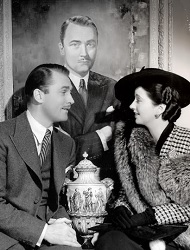
innameonly0808Grant, Cary. (January 18, 1904 – November 29, 1986) Kay’s costar in 1939’s In Name Only. The two became friends during production and remained friends for years after. Actually, Kay spent Thanksgiving 1941 with Grant and his wife. (Note: a year after Kay worked with Grant, she worked with his rumored gay lover, Randolph Scott, in 1940’s When the Daltons Rhode.)

Ultimate Cary Grant pages.


Griffith, D.W. On February 12, 1926 Kay made a screen test for Griffith, her first appearance before a camera. The test was done at the Famous Players studio in Astoria. Nothing came of it.

Wikipedia page.


Working on the wigs for Marie Antoinette, a 1938 Norma Shearer film.

Guilaroff, Sidney. Discovered by Joan Crawford and brought to Hollywood by her to style hair for MGM. He worked with Kay in 1941’s Feminine Touch. Of Kay, Guilaroff Said, “I loved Kay Francis. One of the great movie-going pleasures in the 1930s was Kay. She was exotic, poised, dark, and lovely. I did her hairstyle in a film with my good friend Roz Russell…Kay was a joy to work with. She possessed incredible eyes that were very expressive. She wore hats and turbans with such style and grace. She was very elegant on and off the screen.”

Wikipedia info.


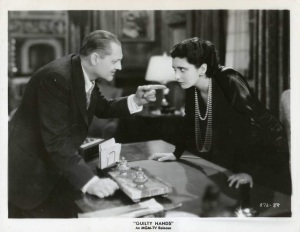
guilty-hands-LCGuilty Hands. MGM, 1931. Directed by Lionel Barrymore and W.S. Van Dyke. Also starring Barrymore, Kay has one of her best early parts in this murder mystery where Barrymore is trying to accuse her of a murder in a mansion on a stormy night he committed himself. The plot is almost a very early version of Clue.

Guilty Hands page.


A Kay Francis Encyclopedia…

A ♦ B ♦ C ♦ D ♦ E ♦ F ♦ G ♦ H ♦ I J ♦ K ♦ L ♦ M ♦ N ♦ O ♦ P ♦ Q ♦ R ♦ S ♦ T ♦ U ♦ V ♦ W ♦ X-Y-Z

Encyclopedia Page F


Douglas Fairbanks, J.R. ♦ The False Madonna ♦ Glenda Farrell  Alice Faye ♦ Charles K. Feldman ♦ The Feminine Touch ♦ Films in Review ♦ First Lady ♦ Errol Flynn  For the Defense ♦ Willi Forst  ♦ 42 Street ♦ Four Jills in a Jeep ♦ Frances Langford – Don Ameche Show ♦ James Dwight Francis
Elmer Fryer

fairbanksjrFairbanks, Douglas Jr. (December 9, 1909 – May 7, 2000) Along with his then-wife, Joan Crawford, Fairbanks and Kay were social pals in the early 1930s. Fairbanks remembered Kay fondly in his autobiography, saying, “I never had the privilege of working with Miss Francis in a film. I knew Kay and Kenneth socially in the early ‘30s. Kay was lovely and very popular. She brightened many social occasions with her sparkling charm and wit. I don’t think she ever warmed up to Hollywood. I think of her as a true bon vivant.”

Fairbanks said his favorite movie of Kay’s was 1934’s British Agent.

Kay’s diary made a few more mentions of social interactions with Fairbanks, who divorced Crawford in 1933. She only made one more note in her diary of interaction with Crawford. When Ginger Rodgers held a roller-skating party on March 6, 1937 Kay noted of how dull the party was, spending the time talking with Crawford and her then-husband Franchot Tone.

Wikipedia page.


falsemadonna0808False Madonna, The. Paramount, 1931. Directed by Stuart Walker, the same Stuart Walker who Kay toured with in 1926 on the stage. Kay is miscast as an unwilling woman among corrupt individuals. The film was released in England as The False Idol. This was her last film under contract to Paramount.

The False Madonna page.


farrellincolorFarrell, Glenda. Very humorous character actress at Warner Bros. who appeared with Kay in 1933’s The Keyhole & Mary Stevens, M.D. She later used Kay’s star power at Warner Bros. to explain how the studio rotated the stars between leading, featured, and bit parts. “So you weren’t Kay Francis,” she claimed, “You were still well-paid and you didn’t get a star complex.”

Wikipedia page.


Faye, Alice. This blonde beauty has a cameo appearance in 1944’s Four Jills in a Jeep.


feldmanthebestFeldman, Charles K. (April 26, 1904 – May 25, 1968) Famous Hollywood producer who Kay had slept with, noting in her diary on May 1, 1940, “Slept with him and he may be the best of them all! Christ, I am a slut.” (That’s “the best” on a long, long list of men..)


Wikipedia page.


Poster
Poster

Feminine Touch, The. MGM, 1941. Directed by Major W.S. Van Dyke. Produced by Joseph L. Mankiewicz. The film stars Rosalind Russell, Don Ameche, Kay, and Van Heflin. The film contains the famous scene where Kay and Russell get into a physical brawl.


The Feminine Touch page.


Films in Review. This small industry magazine contained a piece on Kay in their 1964 issue written by James Robert Parish & Gene Ringgold. The article, “Kay Francis’ Complete Career”, was the first major article written about Kay’s career in retrospect.


firstladyad

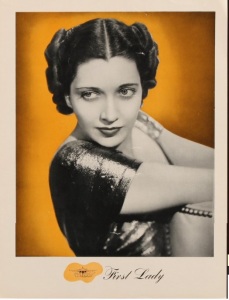
First Lady. Warner Bros, 1937. Directed by Stanley Logan. Based on the play by George S. Kaufman. Originally purchased for Norma Shearer to make on loan-out from MGM. The film stars Kay with Preston Foster, Verree Teasdale, and Victory Jory. About two women in competition to become the Nation’s First Lady, the film was the box office failure which led to Kay’s demise as the top female star at the studio.

Of the failure of the film, Kay later said, “The fans expect sincerity from me, a certain warmth and ‘sympatica.’ And if they don’t get it they howl. They didn’t like me in First Lady worth a cent. They told me so, by the hundreds.” (PL)

First Lady page.


With Errol Flynn
With Errol Flynn

Flynn, Errol. Kay’s handsome costar in 1937’s Another Dawn. When the film became one of Warner Bros.’ most profitable of the year, plans were made to reteam them in The Sisters (1938, which was made with Bette Davis) and All Rights Reserved (which was apparently never made). Of his good-looks, Kay said, “He’s grand. That boy hasn’t one camera angle that isn’t perfect. It’s quite appalling!” (BF)


for-the-defenseFor the Defense. Paramount, 1930. Directed by John Cromwell. The third paring of Kay and William Powell. In a letter dated February 3, 1931 (a year after the release of the film), David O. Selznick wrote to Paramount executive B.P. Schulberg that he “suggested and planned and supervised” both For the Defense and Street of Chance for Powell and Kay. Selznick stood by his claims that it was he who made both Kay Francis and William Powell popular named for 1930s moviegoers before both went to different studios.

For the Defense page.


Forst, Willi. German director who’s Mazurka, with Pola Negri, was the film which inspired 1937’s Confession, a take-for-take remake of the Forst film.


42nd Street. Kay was originally supposed to star in this now-legendary musical for Warner Bros. Unfortunately, she was in the middle of renegotiating her contract and was unable to complete it. The role went to Bebe Daniels.


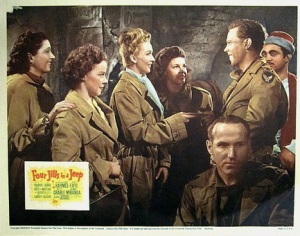
fourjillslobbyFour Jills in a Jeep. Twentieth Century-Fox, 1944. Wartime studio musical which featured actors making a cameo appearance as themselves. Based on the real-life experiences of Kay, Martha Raye, Carole Landis, and Mitzi Mayfair.

Four Jills in a Jeep page.


Frances Langford-Don Ameche Show. One of Kay’s rare television appearances. See the Television Page for further info.


Francis, James Dwight. Kay’s first husband, and the first man she began a sexual affair with (before they were married). The two were married on December 4, 1922 (when Kay was 17, he was 25) and divorce was granted on March 26, 1925. It’s still unclear how the two met, though it may have been through Julia Cutting (party organizer), who Kay was working for at the time she met him.


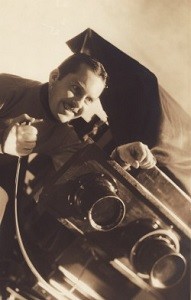
fryereFryer, Elmer. As head of the publicity stills department for Warner Bros., Fryer held an enormous importance in the image of Kay Francis for moviegoers. Fryer was born in Springfield, Missouri on January 21, 1898 and began his career in photography in 1924.

When Warner Bros. and First National Studios merged in 1929, Fryer replaced Fred Archer as the head of the stills department. Fryer remained at Warner Bros. until 1941 and died, aged only 46, on March 3, 1944.

More info on Fryer.


A Kay Francis Encyclopedia…

A ♦ B ♦ C ♦ D ♦ E ♦ F ♦ G ♦ H ♦ I J ♦ K ♦ L ♦ M ♦ N ♦ O ♦ P ♦ Q ♦ R ♦ S ♦ T ♦ U ♦ V ♦ W ♦ X-Y-Z

Encyclopedia Page E

Edwina ♦ George Eells ♦ Elmer the Great ♦ Empress Josephine

Edwina. Kay’s middle name. This originated from her mom’s brother, Edwin.


Eells, George. Hollywood author. In terms of Kay Francis, he’s most famous for his 1976 Ginger, Loretta & Irene who? The book provided one of the first text retrospect pieces on Kay. Eells was able to interview people who she worked with and knew, but, unfortunately, painted her as a drunken, bitter recluse in her later years. While it may be partially true Kay had a bitter attitude towards her film career (why would she be as stubborn as to refuse to discuss it?), she was not a bitter person, as her friends from her later years have stated.

NY Times Obituary


Elmer the Great. A play Kay appeared in with Walter Huston, who helped secure her with her film debut in Gentlemen of the Press (1929)—the rest is history! See the Stage Career page for further information.


Empress Josephine. This was one of the projects announced for Kay in the 1933/1934 film season. The project never materialized.

Wikipedia page for the real-life Josephine.

A Kay Francis Encyclopedia…

A ♦ B ♦ C ♦ D ♦ E ♦ F ♦ G ♦ H ♦ I J ♦ K ♦ L ♦ M ♦ N ♦ O ♦ P ♦ Q ♦ R ♦ S ♦ T ♦ U ♦ V ♦ W ♦ X-Y-Z

Encyclopedia Page D

Dangerous Curves ♦ Dark Victory ♦ Delmer Daves ♦ Marion Davies ♦ Bette Davis ♦ Dolores Del Rio ♦ William Dieterle ♦ Divorce ♦ Dr. Monica ♦ Dr. Socrates ♦ Dodsworth ♦ Billie Dove ♦ Deanna Durbin  Otto Dyar

dangerouscurves1028Dangerous Curves. Paramount, 1929. Directed by Lothar Mendes. Based on a story by Lester Cohen. The film is really notable today for being Clara Bow’s second sound film, though both a silent and sound version was produced for theaters not equipped for sound. Third-billed, Kay plays the vamp who seduces Clara’s boyfriend played by Richard Arlen in this circus drama. This was the first movie Kay made in Hollywood. Her previous two films, 1929’s Gentlemen of the Press & The Cocoanuts, were filmed at Paramount’s Astoria Studio in Queens.

Dangerous Curves page.


darkvDark Victory. The property was originally brought to MGM for Greta Garbo in 1935 to make for producer David O. Selznick. When Garbo chose Anna Karenina instead, the project never materialized. Two years later the property was brought to Warner Bros. for Kay. “I think you would have a good Kay Francis picture in a reasonably short time and one that would not cost a fortune to make. Moreover, Kay herself is, I understand, very much in favor of it” (PL). That note was written to producer Hal Wallis, Kay’s boss at Warner Bros.

Barbara Stanwyck also expressed interest in making the film, but it was finally given to Bette Davis, who received an Oscar nomination for the film which she considered her personal best.

Wikipedia page.


On the set of 1935's Stranded. From left: Daves, Kay, George Brent, Frank Borzage & player.
On the set of 1935’s Stranded. From left: Daves, Kay, George Brent, Frank Borzage & player.

Daves, Delmer. (July 24, 1904 – August 17, 1977) A screenwriter for Warner Bros. Kay and Daves had a long-running affair after her one with Maurice Chevalier hit the skids. Her relationship with Delmer went on for about 2 years, ending in the fall of 1937 when she wrote in her diary, “I am sick of his superiority” on September 20, 1937.

Of their breakup, Daves later said, “…so I went to Europe alone, and suggested that she find a new love while I was gone” (PL). Kay Francis being Kay Francis, she most certainly did. By Christmas of that year she was with Baron Erik Barnekow.

Daves only worked on one movie with Kay, 1935’s Stranded. Odd, considering it’s one of her weaker films and Daves had decent credits to his name, including 1936’s Petrified Forest and 1939’s Love Affair (which was made at RKO).

Wikipedia page.


Davies, Marion. Wonderful film actress whose lover, William Randolph Hearst, had a production company, Cosmopolitan Productions, which produced Give Me Your Heart (1936), one of Kay’s best roles (the film was still released through Warner Bros.).

Wikipedia page.


Kay Francis, (Harry Warner?), and Bette Davis.

Davis, Bette. Both Davis and Kay made their first films for Warner Bros. in 1932. Kay starred in Man Wanted, while Bette had a small role in The Man Who Played God. As the decade went on, Kay was further and further eclipsed by Davis, especially in 1937 & 1938. Davis’ position at the studio was one of the major factors that had the higher-ups at Warner Bros. convinced it was time to push Kay out after her fall 1937 lawsuit with the company. As Davis was paid a fraction of what Kay was, but her films were earning more and more money, the trouble they had with Kay Francis seemed pointless to put up with.

When Davis learned about Kay’s mistreatment from Warner Bros., she was surprisingly defensive of Kay. Actually, until the very end of her life she remained supportive of Kay Francis. In her later years she was quoted as having said of it all, “Out of the blue, it was announced she would complete her contract by starring in B pictures! It was simply unprecedented and no reason was ever given. A huge embarrassment for such a star—she had many, many fans… Jack Warner was despicable to Miss Francis. I felt awfully sorry for her and it certainly scared every actress in town.” (BF)

Davis and Kay remained sort-of close after Kay left Warner Bros. Actually, they had such a good relationship that Davis was enticed to watch one of Kay’s performances on the stage in Theatre on August 18, 1952. After that performance, the two actresses talked about their past careers with the studio. When Davis asked why Kay didn’t fight back, she famously said “I didn’t give a shit. I wanted the money.”

It should be noted by readers about the lack of tension or feuding between Kay & Bette Davis. Considering that they both were constantly pinned against one-another for roles at Warner Bros., they never spoke badly about the other. It’s a true piece of evidence that both ladies knew their real problems were with the management, not each other.

Wikipedia page. Official site.


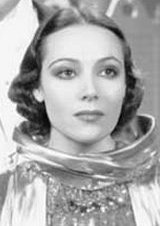
delriodDel Rio, Dolores. (August 3, 1905 in Durango, Mexico – April 11, 1983 in Newport Beach, California) Actress who worked with Kay in 1934’s Wonder Bar. Kay was very annoyed that her star power was used to lure viewers into the film, but that her role was cut down to showcase Del Rio’s. Kay did have the satisfaction of a bit of payback when she lost out on the part of Madame DuBarry that same year to Del Rio. It became the flop which partially drove her out of Hollywood.

Wikipedia page.


dieterlewDieterle, William. (July 15, 1893 – December 9, 1972) One of Kay’s best directors. His work with Kay included 1932’s Man Wanted & Jewel Robbery, 1934’s Doctor Monica, 1936’s White Angel, and 1937’s Another Dawn. Dieterle may be most famous for his biopics, which not only included White Angel, but also The Story of Louis Pasteur (1935) and The Life of Emile Zola (1937).

Wikipedia page.


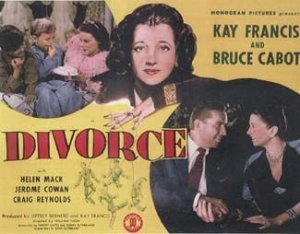
divorcelobby.jpgDivorce. Monogram, 1945. Directed by William Nigh. Produced by Jeffery Bernerd & Kay Francis. Kay’s first film for Monogram Pictures. The film is notable for being so bad, it’s good, and that it was a return for Kay to the seductive, manipulative vamp roles she played in her early years at Paramount.

Divorce page.


With Jean Muir. The film was criticized for its abortion references.

Dr. Monica. Warner Bros, 1934. Directed by William Dieterle. Costarring Warren William, the film marked the second time Kay played a doctor on the screen. Monica is also memorable as being Kay’s last Pre-Code movie, and she certainly went out with a bang! The censors had a fit with the suggested abortion references.

Dr. Monica page.


Doctor Socrates. This 1935 film was remade by Kay and Humphrey Bogart as King of the Underworld (1939). Kay played the part originated by Paul Muni. She wrote in her diary, “I’m going to be Paul Muni in skirts” (PL).


Dodsworth. Kay was considered for a part in this film which eventually went to Mary Astor. Apparently, Warner Bros. refused to loan her to Samuel Goldwyn for what they felt was very much a supporting role to Walter Huston and Ruth Chatterton, both of whom Kay was a more valuable box office player than. Kay, not caring about box office, was furious. This played a factor in her lawsuit with Warner Bros.


notoriousaffairkayanddoveDove, Billie. The real star of 1930’s Notorious Affair, which costarred Kay and Basil Rathbone. Dove plays the ingénue who loves Rathbone, who has an affair with sexy-vamp Kay.

Wikipedia page.


itsadate7

Durbin, Deanna. Star of 1940’s It’s a Date. Kay played her mother in the film.

Hollywood was a bit confused at the time as to why Kay would choose to have appeared in the film. Considering that the Durbin pictures were some of the most popular in the entire country at the time, it was a wise decision and good exposure for Kay following her Warner Bros. troubles.

Wikipedia page. NY Times obituary.


Dyar, Otto. Born on July 25, 1892, Dyar began working at the Paramount studios where he photographed their top stars such as Clara Bow, Louise Brooks, Gloria Swanson, Gary Cooper, William Powell, Kay, and others.

Dyar left Paramount and worked for other studios, crafting the outdoor shoot which was an innovation of the time. He died at 96 years old on December 26, 1988 in Honolulu.

Perhaps the most creative photographs of Kay were shot by Dyar during her Paramount years (1929-1931). See the below example for the artsy, creative side of Kay from Dyar versus the polished, glam Kay photography by Elmer Fryer at Warner Bros.


A Kay Francis Encyclopedia…

A ♦ B ♦ C ♦ D ♦ E ♦ F ♦ G ♦ H ♦ I J ♦ K ♦ L ♦ M ♦ N ♦ O ♦ P ♦ Q ♦ R ♦ S ♦ T ♦ U ♦ V ♦ W ♦ X-Y-Z

Encyclopedia Page C

Bruce Cabot ♦ James Cagney ♦ Carlotta ♦ Nancy Carroll ♦ Mrs. Leslie Carter ♦ Cathedral School of St. Mary ♦ Celebrity Time ♦ Charley’s Aunt ♦ Ruth Chatterton ♦ Maurice Chevalier ♦ Chevrolet Tele-Theatre ♦ Cleopatra ♦ Katherine Clinton ♦ The Cocoanuts ♦ Claudette Colbert ♦ Ronald Colman ♦ Comet Over Broadway ♦ Confession ♦ Gary Cooper ♦ Ricardo Cortez ♦ Cosmopolitan Productions ♦ Joan Crawford ♦ Crime ♦ John Cromwell ♦ George Cukor ♦ Michael Curtiz ♦ Cynara

Cabot, Bruce. Kay’s leading man in 1945’s Divorce, made for Monogram.


cagneyjCagney, James.  (July 17, 1899 – March 30, 1986) Major star at Warner Bros. during Kay’s employment with the studio. Though the two never appeared on film together, he was one of Kay’s favorite movie stars to watch. The two socialized in the 1930s and Cagney was one of the people who stuck-up for Kay during her mistreatment by Warner Bros. in 1938 following her lawsuit with them the previous year.

Wikipedia page.


Carlotta. The title of the project with eventually became known as Juarez (1939). Kay asked to be considered for the female lead in the project, but was replaced by Bette Davis instead.


Carroll, Nancy. One of the most popular stars at Paramount in the late 1920s and early 30s when Kay was a contract star in featured roles. Kay had a featured role in Illusion (1929), which starred Carroll and Buddy Rodgers in this now partially lost film.

Wikipedia page.


Carter, Mrs. Leslie. Very famous stage actress who Kay knew in the 1920s. In the spring of 1938, when Warner Bros. was in the pre-production stages for a biopic about her life, Kay and Bette Davis were considered for the leads. Neither actress ended up with the part. The role was assigned to Miriam Hopkins, who starred as Carter in 1940’s The Lady with Red Hair.


Cathedral School of St. Mary. Kay attended this private school in Garden City, Long Island in 1920-1921. No records of Kay’s attendance could be found (PL).


Celebrity Time. Kay appeared on this TV series. See the TV Page for more info.


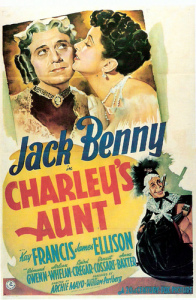
charleysauntposterCharley’s Aunt. Twentieth Century-Fox, 1941. Directed by Archie Mayo. Based on the play of the same name by Brandon Thomas. Jack Benny starred in the film though Kay played the title role. Anne Baxter also had a small role in the film.

Becoming the 8th highest grossing film of the year (BF), Kay and Jack Benny recreated their roles on his radio show that same year to promote the film.


Charley’s Aunt page.


chattertonrChatterton, Ruth. (December 24, 1892 – November 24, 1961) One of the most inspirational women of the first half of the 20th Century, Chatterton began her remarkable career on the New York stage, eventually making her way to Broadway. She began her contract with Paramount in the late 1920s and stayed at the studio until 1932, when she moved to Warner Bros. with Kay and William Powell.

Though Paramount executives later stated that losing Powell and Kay wasn’t a major blow, losing Chatterton DID have an impact on the studio’s plans for her career (RC). Unfortunately, Chatterton’s association with Warner Bros. began to decline almost immediately upon her arrival. When she was paid 8,000 per week, the studio became immediately concerned when her films were not the big hits they expected to be.

Initially, Chatterton had the first pick of every script on the lot. Some of Kay’s earliest roles for Warner Bros. (1933’s The House on 56th Street and 1934’s Mandalay & Dr. Monica) were Chatterton rejects. When Kay starred in 1935’s The Goose and the Gander, she played opposite two of Chatterton’s ex-husbands: George Brent and Ralph Forbes.

When Samuel Goldwyn began casting for his production of Dodsworth, he wanted Kay to play opposite Walter Huston and Chatterton in a role which eventually went to Mary Astor. Later, when Kay was preparing her comeback to the stage in 1945’s Windy Hill, Chatterton directed the entire project.

Wikipedia page.


chevaliermChevalier, Maurice. (September 12, 1888 – January 1, 1972) Legendary French performer who Kay had a long-term affair with throughout the first half of the 1930s, with their affair becoming most serious around 1934, following her divorce from husband Kenneth MacKenna. The two appeared in Paramount on Parade (1930), though they had no scenes together.

Their affair was an intense one, filled with passionate love making and explosive fights. On March 11, 1934 she indicated in her diary, “Had merciless afternoon with Maurice–four times in 2 hours.” On May 19, during one of their arguments, she told him he was selfish. Two days later they had made up. Their affair ended around the beginning of 1935 when she began seeing Delmer Daves.

Wikipedia page.


Chevrolet Tele-Theatre. On September 19, 1949 Kay was scheduled to appear on this program but backed out. Kay remained afraid of TV, and resisted appearing on it for some time.


Cleopatra. When Kay was asked by Screenland to pose as a famous historical character, Kay chose Cleopatra. The photographs were published in the June 1930 issue.

See the Portraits page for the 1930 photographs of Kay in costume.


katherineclinton1Clinton, Katherine. Kay’s mother. Clinton was a stage actress before Kay was born, and continued her career after Kay’s father, Joe Gibbs, disappeared from their lives. The relationship between the two was close, but definitely had its limitation.

Her mother did not visit Kay on the set or attend the few parties Kay held, but she famously kept detailed scrapbooks with a large amount of clippings regarding Kay’s career which are now held at the Wesleyan University in Connecticut.

When Kay’s mother passed away, she left her daughter the following letter:

“My Precious Babe, I want you to know what a wonderful daughter you have been but really darling I never thought I’d live on so long to be a burden to a very smiling child. I have loved you always more than anyone in this world—but you know that. I wish I could have left more as you have given so much but a very great many things have unexpectedly had to be done and I have tried to keep the place in good condition for you to dispose of as you see fit. I have no debts and the only bills will be the monthly ones. I wish I could have been more of help to my one ewe lamb but just remember me a loving and devoted Mother.”

Considering Kay played so many single mothers in her movies, it can be assumed that she perfected how to play those parts by her experience with her own mom, a single mother herself.

IBDB info.


cocoanuts0914Cocoanuts, The. Paramount, 1929. Kay appeared in this film with the Marx Brothers which also featured Margaret Dumont. Kay was paid $450/week and began the film immediately after completing Gentlemen of the Press. Filming was done at the Paramount Astoria Studio in Queens, and after Kay was brought out to their Hollywood location to begin featured roles in more important films.

The Cocoanuts page.


colbertcColbert, Claudette. Worked at Paramount when Kay was also employed with the studio. The two never appeared in a film together, and Colbert was one of the very few Paramount stars to not appear in Paramount on Parade (1930).

Colbert and Kay were two of the actresses who helped open makeup man Perc Westmore’s House of Westmore, and were also listed by Variety as two of the 10 most popular female movie stars in 1937. Colbert was also one of the women Kay named on her personal list of best dressed women in movies around the same time.

The two are most notoriously linked over the project Tovarich (1937), which starred Colbert and Charles Boyer. Upon conditions of Kay’s contract renewal with Warner Bros. in 1935, SHE was supposed to make the film. Apparently, Kay believed the film was the perfect project to bring her back to the sophisticated comedies she made in the early 1930s at Paramount (Trouble in Paradise). After the part was assigned to Colbert, Kay filed a lawsuit against Warner Bros., which began the end to her stardom in Hollywood.

Inevitable rumors of a feud between the actresses came up. Kay denied them. “The stories about Claudette and myself being enemies is silly,” Kay said. “We are the best of friends. As you know, she’s one of the nicest persons out here” (BF).

Of her work in Tovarich, Colbert told author Lawrence Quirk, “I’ve done better, and I have certainly done worse, a lot worse” (BF).

Wikipedia page.


raffles214Colman, Ronald. (February 9, 1891 – May 19, 1958) English actor, Kay’s leading man in 1930’s Raffles & 1932’s Cynara. The first became one of the biggest hits of the year (BF). Both were produced by Samuel Goldwyn through United Artists.

Kay and Colman enjoyed a brief fling, and rumors circulated they would marry (PL). Colman did give Kay good advice for film acting that she used for the rest of her film career (PL).

Wikipedia page.


comet091334Comet Over Broadway. Warner Bros., 1938. Directed by Busby Berkeley. Based on a story by Faith Baldwin. The property was originally conceived as a follow-up to Jezebel (1938) for Bette Davis (!). Davis, offended to even be considered for such a project, said of the whole thing: “This was the first nothing script I was given since my court battle in England. It was heartbreaking to me. After winning an Academy Award…I was asked again to appear in junk…nor could I afford, career wise, to make films such as Comet Over Broadway.”

Davis held out for four months before beginning work on The Sisters, a project which was originally purchased for Kay.

The film has become a favorite for many fans, falling into the “so bad, it’s good” category. The project did provide child actress Sybil Jason with her first assignment in four months. “That wasn’t a good sign,” Jason remembered (BF). Supposedly (according to Jason), Kay refused to make the movie if Jason didn’t play her daughter (BF).

Comet Over Broadway page.


confessionposter45

Confession. Warner Bros., 1937. Directed by Joe May. Based on the screenplay Mazurka by Hans Rameau. Considered by most to be the final great film Kay Francis ever appeared in for Warner Bros. This was the last project that Kay received over Bette Davis, who was a considered actress for the starring part. After Confession, the only roles which would tie the two actresses together would be ones which Davis rejected or that were given to Davis over Kay.

The film was a take-for-take remake of a 1935 German film titled Mazurka, which starred Kay’s childhood movie favorite, Pola Negri. Negri was furious when Warner Bros. purchased up all of the American distribution rights to the film in order to prevent the public from seeing the Negri one, luring them to watch Kay’s (CR).

confession08221Film historian Allan Ellenberger said of the film, “Despite being a major actress of the 1930s, Kay Francis is mostly forgotten today, except for film buffs. This is regrettable, considering the immeasurable talent this striking beauty communicated on the screen. Who could forget Francis as Vera in Confession, arguably one of her greatest screen performances, who as a woman of means is seduced and ruined by Basil Rathbone. After losing her husband and daughter, she becomes a fallen woman and is forced to entertain in sleazy cafes to earn a meager living. The poignancy and naturalness of her performance shows the range in emotion she was capable of, confirming her place in film history with such greats as Stanwyck, Hepburn, and Davis” (PL).

The set was supposedly a very tense one. Kay walked off the set at least once following an argument with May. Producers at the studio complained that May wanted Confession to be a take-for-take remake of Mazurka, aggravating cast and crew by running the film frequently on the set and even using a stopwatch to time the actor’s scenes.

Jane Bryan, who played Kay’s daughter in the film, remembered it as “ridiculous” (CR).

May never worked again for Warner Bros.

Confession page.


coopergCooper, Gary. (May 7, 1901 – May 13, 1961) American film icon who Kay enjoyed a brief affair with during her contract years at Paramount. After that the two remained close social pals. Kay was announced as a costar in City Streets (1931), a film which starred Cooper and Sylvia Sidney. Unfortunately she lost the part to Wynne Gibson.

Wikipedia page.


mandalay092614Cortez, Ricardo. (September 19, 1900 – April 28, 1977)  Austrian actor given a Spanish name to capitalize on the “Latin Lover” phase in the 1920s when he started making Hollywood pictures. Cortez worked with Kay in several films: Transgression (1931), The House on 56th Street (1933), Wonder Bar and Mandalay (both 1934). Often cast as the sleaze, he was killed off in his films by many of his leading ladies.

After the introduction of the Production Code in July 1934, he worked only in films for a brief while before venturing successfully into financing.

Wikipedia page.


Cosmopolitan Productions. Producing corporation set up by William Randolph Hearst to finance his lover Marion Davies’ often unsuccessful films. 1936’s Give Me Your Heart was produced through the company (though the film was released by Warner Bros.).


crawfordjCrawford, Joan. One of Kay’s social pals in the early 1930s. Crawford’s then-husband, Douglas Fairbanks, Jr., later spoke very highly of Kay in his later years.

In her autobiography, The Million Dollar Mermaid, Esther Williams recalled a rather bizarre situation featuring a past-her-prime Crawford RE the latter’s work at MGM in Torch Song (1953):

That was Joan Crawford at her best—when she wanted something.

Once she’d made her grand departure, I got myself together to go home, but as I was leaving I heard some noises coming from Stage 4. It sounded like yelling, so I walked over to take a look. Stage 4 was where they did all the show business pictures, because it was set up like a theater. The house was dark; no one was in the audience. There was nothing on but the work light in the center of the stage; in the far corner a janitor was sweeping up. Downstage under the middle of the proscenium arch was Joan, still in her bird outfit, talking to empty seats.

I stood there and listened in the darkness as she cried out, “Why have you left me? Why don’t you come to my movies? What did I do? What did I say? Don’t turn your back on me!” Joan had been a star since the 1920s, with an Oscar and a fine body of work behind her, but here she was, almost fifty, reduced to begging an imaginary audience not to forget her. Tears were streaming down her face; streaking her copper makeup. Suddenly she looked old and pathetic. I slipped away without her noticing.

What a sad, sad lady, I thought as I got into my car…Seeing Joan like that was a shot across the bow for me. “Get out when you’re still on top,” I told myself. “There’s life after Hollywood.”

The Best of Everything.


Crime. One of Kay’s major stage appearances in the 1920s. See the page for her Stage Career for further info.


Cromwell, John. Married to Kay’s friend (and sometime lover) Kay Johnson. Cromwell was one of Kay’s (Francis, not Johnson) best directors. His worked with Kay included 1930’s Street of Chance & For the Defense, 1931’s Scandal Sheet & Vice Squad, and 1939’s In Name Only, which was a major comeback for Kay Francis after leaving Warner Bros. on terrible terms.

Cromwell’s son with Johnson is James Cromwell, famous actor and activist.

Wikipedia page.


Cukor, George. Directed Kay in 1930’s Virtuous Sin and the much better 1931’s Girls About Town. Cukor later told an interviewer that he found the first one dated, and hoped it would disappear (CR). Regarding the latter, Cukor joked that, because of the characters Francis & costar Lilyan Tashman play, it should have been titled The Virtuous Sinners.

Wikipedia info.


Curtiz (striped shirt) directing Kay & Alison Skipworth in Stolen Holiday, 1937.

Curtiz, Michael. One of the most important directors at Warner Bros. in the 1930s and 40s, and one of Kay’s most important directors, working on several of her most important films: 1933’s The Keyhole, 1934’s Mandalay & British Agent, and 1937’s Stolen Holiday. The latter was the beginning of a long partnership between director Curtiz and actor Claude Rains.

Wikipedia page.


cynara3214Cynara. Produced by Samuel Goldwyn through United Artists, 1932. Directed by King Vidor. Kay’s last film with Ronald Colman. Along with Trouble in Paradise & One Way Passage, Cynara was on the critics’ “must see” list for 1932 (BF).

Cynara page.

A Kay Francis Encyclopedia…

A ♦ B ♦ C ♦ D ♦ E ♦ F ♦ G ♦ H ♦ I J ♦ K ♦ L ♦ M ♦ N ♦ O ♦ P ♦ Q ♦ R ♦ S ♦ T ♦ U ♦ V ♦ W ♦ X-Y-Z

Encyclopedia Page B

Irving Bacon ♦ Lloyd Bacon ♦ George Bancroft ♦ Tallulah Bankhead ♦ Travis Banton ♦ Erik Barnekow ♦ Richard Barr ♦ Phillis Barry ♦ Diana Barrymore ♦ Lionel Barrymore ♦ Richard Barthelmess Charles Baskerville ♦ Anne Baxter ♦ Beat the Clock ♦ Louise Beavers ♦ Behind the Make-Up ♦ Monta Bell ♦ Ralph Bellamy ♦ Constance Bennett ♦ Jack Benny ♦ Busby Berkeley ♦ Jeffery Bernerd ♦ Betty Crocker Show ♦ Between Us Girls ♦ Charles Bickford ♦ Bitterness ♦ Black Chiffon ♦ Joan Blondell ♦ Humphrey Bogart ♦ Veda Ann Borg Clara Bow ♦ Charles Boyer ♦ George Brent ♦ Mary Brian ♦ British Agent ♦ Louis Bromfield ♦ Clive Brook ♦ Nigel Bruce ♦ Jane Bryan ♦ Carol Burnett

Bacon, Irving. Character actor who worked with Kay in Street of Chance (1930), The Vice Squad & Scandal Sheet (both 1931), The Keyhole (1933) and Between Us Girls (1942).


Bacon, Lloyd. Director of 1933’s Mary Stevens, M.D., which starred Kay in the title role.


scandalsheetkay43Bancroft, George. Legendary character actor who appeared with Kay in 1930’s Paramount on Parade, 1931’s Scandal Sheet, and 1940’s When the Daltons Rode & Little Men.


Wikipedia page.


bankheadtBankhead, Tallulah. Notorious actress of stage and screen who was originally considered for the role of “Julia Ashton” in Another Dawn, which eventually went to Kay.

The two supposedly enjoyed a “fling” during Kay’s contract years at Paramount (PL) and socialized frequently with other very sexually-charged Hollywood superstars. On January 23, 1932, at a party hosted by Kay’s former lover Eddie Goulding, Kay wrote in her diary, “Swell time, but got very drunk. T.B. called me a lesbian. E.H. and I were very close to getting queer! Damn fool!”

As Lynn Kear and John Rossman pointed out, “T.B.” was probably Bankhead, while “E.H.” was most likely Edith Head, who was working under costume designer Travis Banton at the time.

Wikipedia page. IMDB info.


bantontBanton, Travis. Costume designer at Paramount when Kay arrived to Hollywood in 1929. She worked with Banton primarily during her contract years at the studio (’29-’32). Considering the most famous female star at Paramount were short with inconsistent weight (Clara Bow and Nancy Carroll), Banton liked that Kay was tall and her figure remaining fairly consistently shaped.

Banton said of Kay, “Miss Francis is the epitome of feminine allure, and her dark beauty calls for fashions that are extreme and chicly daring” (PL). Banton was brought out to Hollywood by Paramount, but lost his position there in the late 1930s due to his heavy drinking.

Edith Head took over his position.

After Kay left Paramount, she worked with Banton only two more times: for 1932’s Trouble in Paradise and 1941’s Charley’s Aunt.

Wikipedia page. IMDB info.


With Erik Barnekow in 1939

Barnekow, Erik. (March 10, 1897—October 25, 1942). In the fall of 1937, Kay was introduced to Barnekow at a party at Countess di Frasso’s. Tall with light hair and clear eyes, the relationship started with frequent lovemaking, and Kay noted of his ideal abilities in her diary. As 1938 went on, Kay’s career began to nosedive, she brushed off care about it in the press because she insisted she was going to marry Barnekow. Privately, the relationship was troubled from the beginning. Kay had loaned him money on several occasions, and their fights were extremely volatile.

Rumors began to spread almost immediately that he was a Nazi spy. In the beginning of their relationship, his name was unknown to the press. He was merely referred to as the “boyfriend of Miss Francis.” The FBI went to considerable trouble to track down his true identity to keep tabs on him (PL).

Barnekow claimed that he was the heir to a castle and country estates in Pomerania. He had a son, Erik, in 1926 with his first wife, Ingeborg Wendroth. The couple divorced before Erik was one, and he never met his father. Brita, Barnekow’s sister, filled young Erik in on the gaps about his father.

Barnekow disappeared to Europe right after the beginning of World War II. Kay never saw nor heard from him again. When he committed suicide on October 25, 1942, she never learned of it. She died never knowing what became of him.


Barr, Richard. Producer who had a long, long career in Hollywood. Social pal of Kay’s in the late 1940s.

Wikipedia page.


Barry, Phillis. Appeared in Cynara as the tragic young woman who commits suicide when Ronald Colman’s character ends the affair when his wife (Kay) comes home.


barrymoredBarrymore, Diana. 1942’s Between Us Girls was a big Universal publicity campaign to make a huge star out of Barrymore, who was a brat during filming (CR). As a result, her career didn’t pick up.

During filming of Between us, her father, legendary John Barrymore, died.

IMDB info.


guiltyhands0808Barrymore, Lionel. Co-directed and starred in 1931’s Guilty Hands, a murder mystery which was one of Kay’s better films from her early years.

Barrymore enjoyed a long career, winning an Oscar the same year as Guilty Hands for his performance as Norma Shearer’s alcoholic father in A Free Soul.


Barthelmess, Richard. Was one of the few notable actors at First National Studios when Warner Bros. took over the lot in a financial merger in 1930. Barthelmess and his wife, Jessica, were very good friends of Kay’s throughout her entire Hollywood career, frequently spending New Years with the couple.


Baskerville, Charles. Editor for The New Yorker, remembered fondly of Kay’s entrance into the New York City circle in 1922. The two remained good friends, and sometimes lovers. Of Kay, Baskerville said, “She was an extraordinary person. That summer she had no wardrobe but took a paisley—gray, black and white—Persian shawl and had it made into an evening wrap. Whenever we were going to any swell place, she would put the paisley wrap over her gown, and she was a knockout. She carried herself beautifully; her hair was cut as short as mine, and she wore no jewelry, only lipstick. No eye shadow or anything; she didn’t need it. People were stampeded by this creature. They thought she was a maharani on the loose.”

New York Times Obituary.


Baxter, Anne. Early in her career Baxter had a small role in Charley’s Aunt.

Wikipedia page. IMDB info.


Beat the Clock. Game show on which Kay appeared. (See Television page.)


Beavers, Louise. African American character actress who played a maid in 3 movies with Kay: 1931’s Girls About Town, 1932’s Street of Women & 1934’s Dr. Monica.

IMDB info.


behind08172Behind the Make-up. Paramount, 1930. Directed by Robert Milton & Dorothy Arzner. Based on Mildred Cram’s “The Feeder.” Starring Hal Skelly, the film was the first teaming of William Powell and Kay Francis. Though Kay only has a minor role (about 7 minutes on film, not even appearing until almost 37 minutes into the 65 minute movie), her role is an important one since she drives Powell to suicide. The film is a better showcase for Fay Wray, though her part is a bit unappealing.

The film is notable largely for its use of shadows and darkness to enhance the dreariness of the entire story.

Powell biographer Roger Bryant wrote of the film, “[Powell’s] first release of 1930 was a now-forgotten film that deserves rediscovery…Many of the early sequences are brilliantly photographed by Charles Lang in near darkness. Lang paints a chiaroscuro of grays and blacks, drawing heavily on the European influences that had been so recently prominent in Hollywood and at Paramount in Particular.”

Behind the Make-Up page.


Bell, Monta. Film producer most famous for his silent works and association with Norma Shearer at Metro Goldwyn Mayer. Was the producer for 1929’s Gentlemen of the Press, which was Kay’s first appearance on film.


Bellamy, Ralph. Appeared with Kay in State of the Union. See the Stage Page for further info.

IBDB info.


bennettcBennett, Constance. Pal of Kay’s in the late 1920’s and early 30’s. The two were hyped up as fashion rivals according to Paramount publicity (PL). When Kay announced her own “best dressed” list in the Los Angeles Evening Herald Express in April 1936, she listed Bennett as one of them. The others included Claudette Colbert, Marlene Dietrich, Carole Lombard, and Myrna Loy.

To avoid problems with her friends, Kay asked to have them listed in alphabetical order.

Wikipedia page. IMDB info.


charleysauntBenny, Jack. Extremely popular comedian in the early 1940s. Kay appeared opposite Benny in Charley’s Aunt (1941), and also on his popular radio show to help promote the film.

Wikipedia page. IMDB info.


Berkeley, Busby. Legendary director of the enormously popular musicals from Warner Bros. in the early 1930s. Famous for his geometric camera tricks with dancers, Berkeley directed 42nd Street (1932), which was initially supposed to star Kay in the role which eventually went to Ruby Keeler. Kay lost the part due to contract negotiations with Warner Bros.

Berkeley later worked on the designs for Wonder Bar (1934), and worked as a director for Comet Over Broadway (1938).

Wikipedia page.


Bernerd, Jeffery. Monogram producer who worked with Kay on all three of her films for the studio: 1945’s Divorce & Allotment Wives and 1946’s Wife Wanted, which turned out to be Kay’s final film.

Kay co-produced all three of her Monogram films with Bernerd, which some have claimed was the idea which initially brought Kay to the poverty-row studio. In a letter dated July 25, 1944 Kay wrote, “I’ve decided to produce pictures” (PL).

IMDB info.


Betty Crocker Show. Kay appeared on a 1953 episode of this TV series. See the Television Page for more info.


betweenus1009Between Us Girls. Universal, 1942. Produced & directed by Henry Koster. Based on Le Fruit Vert (The Green Fruit in English) by Regis Gignous & Jacques Thery. The property was designed to make a big star out of Diana Barrymore. Unfortunately, Barrymore’s personal problems interfered with the film’s production and, eventually, her chances at ever achieving stardom (PL).

John Boles and Kay were billed below the lesser-known Barrymore and Robert Cummings in the advertising materials and actual film.

Between Us Girls has the distinction of being Kay’s last legitimate film before her final three movies at Monogram. Her next feature after Between Us, was the wartime canteen musical Four Jills in a Jeep (1944), which had Kay appearing as herself.

Between Us Girls page.


passion0817Bickford, Charles. Kay’s costar in 1930’s Passion Flower. Aggravated because producer Irving Thalberg refused to loan Bickford to RKO for Cimarron (the part went to Richard Dix, who received an Academy Award nomination for his performance in the Best Picture winner), he later said of the film, “Of all the bad pictures I have made, and there were many, Passion Flower takes the cake. As I had warned Thalberg, it had exactly nothing to commend it and turned out to be the big daddy of all stinkeroos. It was but one of the Thalberg productions you never heard about” (CR).

Wikipedia page.


Bitterness (of Kay’s). The 1976 George Eells book, Ginger, Loretta, and Irene Who?, has widely been sourced as the piece of writing to identify Kay Francis as having become a bitter recluse following her falling out with Warner Bros. In truth, Kay was identified with being bitter over her Hollywood troubles long before the book was even published; even long before she even passed away.

In the February 1964 issue of Films in Review, an article by James Robert Parish and Gene Ringgold concluded with the following statement, “Since [leaving Hollywood] Kay Francis has divided her time between her New York City apartment and her home on Cape Cod near Falmouth, where she is associated with a summer resort. She grants no interviews, refuses to be photographed, and rarely discusses her stage and screen career. When she does so it is clear she believes she was mistreated in Hollywood.”

When that article was published, Kay was still very much alive (and had sparing communication with Parish, though she refused to discuss her past with him).

In her later years Kay was very close with Lou and Jetti Ames. Lou, who was interested in Hollywood, tried (and failed) to get her to discuss her career. “I always tried to get her to talk about Hollywood because I’m a movie buff,” he told author Scott O’Brien. “She was probably bitter about leaving all of that behind her. I think she showed her attitude by not talking about it.”

Jetti, Lou’s wife, told O’Brien, “By the same token, she didn’t go around with it ‘hanging out.’ She chose not to talk about it. When you talk about her being bitter, it’s important to mention that she didn’t go around stewing about it. Because she didn’t.”

Very rarely, when Kay did reference her troubles in Hollywood, Jetti Ames claimed that Kay referred to it simply as “her big struggle.”

Bob French, a long-time fan who met Kay in 1966 or 1967, mentioned that he also had tried to get Kay to discuss her career. She refused, saying that it was long ago and all so “rotten.”

It appears as though Kay took the “The Chapter is Closed” attitude about her career. Gavin Lambert wrote in his Norma Shearer biography, Norma Shearer: A Life, that Shearer used that saying to discuss with friends why she turned down several comeback offers following her 1942 retirement.

…“The Chapter is Closed.”


Black Chiffon. A play Kay starred in during her later stage career. See the Stage Page for more info.


blondellj
James Cagney, Kay, Maurice Chevalier, and Blondell in 1934.

Blondell, Joan. Actress who hit her peak in the early 1930s at Warner Bros. at the same time Kay was employed at the studio. Blondell’s career on film stretched a bit farther than Kay’s, as she later went into character parts in her later movies.

On April 16, 1935, Blondell was one of the actresses (which included Kay, Marlene Dietrich, Carole Lombard, Anita Louise, Clara Bow, Myrna Loy and Claudette Colbert) who helped open House of Westmore, which was owned (and partially financed by Kay) for Warner Bros. makeup man Perc Westmore.

Wikipedia page. IMDB info.


kingoftheunderworld33Bogart, Humphrey. Kay’s costar in 1939’s King of the Underworld. Bogart began his film career with small parts at Warner Bros., later progressing to larger parts in more prestigious productions. When Bogart worked with Kay, he was not a top-notch star. As Kay was given what the New York Times called “a poor second billing”, Bogart was displeased that he was used by Warner Bros. to attack Kay’s stardom, which was already on the decline (BF).

In the 1920s, he and Kay had known each other socially in New York. During the 1940s, Bogart reached the peak of his career at Warner Bros., playing most famously opposite his wife Lauren Bacall.

Official Website. Wikipedia page.


Borg, Veda Ann. Had a small, unspoken part of Xenia in 1937’s Confession and also appeared in Wife Wanted, Kay’s last film.

IMDB info.


borzagefBorzage, Frank. One of the more popular directors from Kay’s Hollywood years. He directed her in Living on Velvet & Stranded.


IMDB info. Wikipedia page.


dangerouscurveskayclaraBow, Clara. Hollywood’s “It Girl” in the 1920s until sound films came in at the end of the decade. Kay actually had one of her most important vamp roles in Dangerous Curves, Bow’s second sound film. Kay later remembered Bow for her kindness during the film’s production.

Wikipedia page. The Clara Bow page.


Boyer, Charles. The male lead in 1937’s Tovarich, which Kay was desperate to make.


Breen, Joseph. In charge of production code enforcement after July 1934 which had a huge impact on many of the screen’s biggest stars, including Kay. Films were heavily censored thereafter.


giveme091423Brent, George. One of Kay’s most frequent leading men. The two appeared in six films together, beginning with 1933’s The Keyhole and ending with 1938’s Secrets of an Actress. Brent had turned down the role which eventually went to Pat O’Brien in Women Are Like That (1938), and he also did star in 1939’s The Rains Came, which was a film Kay was a consideration for in a part which eventually went to Myrna Loy.

The last time Kay worked with Brent was on a 1943 radio production “The Lady is Willing.” Around the same time, Brent was asked to identify the most glamorous women in film; Kay made his list.

At Warner Bros., Brent played opposite nearly all of the top female stars besides Kay, including Barbara Stanwyck and Bette Davis. He was loaned out to MGM to appear opposite Greta Garbo in The Painted Veil (1934).

Married to Ruth Chatterton briefly in the early 1930s, when Kay worked with Brent in The Goose and the Gander (1935), she was also worked opposite Chatterton’s OTHER ex-husband, actor Ralph Forbes.

Wikipedia page. IMDB info.


Brian, Mary. Star at Paramount in the 1920s who was the lead in Marriage Playground, which featured Fredric March, Kay, and Lilyan Tashman.


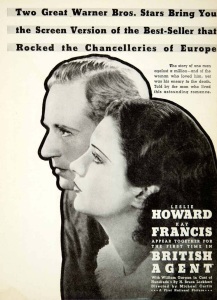
britishadBritish Agent. Warner Bros., 1934. Directed by Michael Curtiz. Based on the popular autobiography by R.H. Bruce Lockart. Aside from a small role in that same year’s Wonder Bar, British Agent was Kay’s post prestigious production for Warner Bros. until that point. Costarring Leslie Howard, the film was based on the real-life problems faced by R.H. Lockhart during the Bolshevik Revolution in Russia in 1917.

During production Kay suffered a mysterious injury to her wrist, which was most likely a suicide attempt. She later made up a story she cut her wrist on glass on a window, trying to her into her own home after she locked herself out (PL).

British Agent page.


Louis Bromfield. Author of The Rains Came, which was adapted into a 1939 film of the same name that Kay was considered for a leading role. The part went to Myrna Loy.

Wikipedia page.


withclivebrookBrook, Clive. One of Paramount’s most distinguished leading men. He was Kay’s romantic interest in two 1931 films: Scandal Sheet and 24 Hours. One of his best roles was opposite Marlene Dietrich in Shanghai Express (1932).

Wikipedia page. IMDB info.


Bruce, Nigel. Famous English character actor who appeared with Kay in The White Angel and Playgirl.


Bryan, Jane. Plays Kay’s daughter in Confession. When Kay was originally announced to appear in The Sisters, Bryan was also listed in the cast which also included Miriam Hopkins. When the film version came out, Bryan found herself with Bette Davis & Anita Louise.


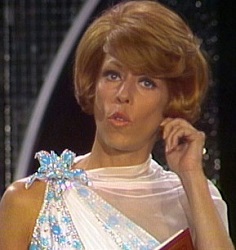
burnettcBurnett, Carol. On a September 28, 1974 broadcast of this comedienne’s famous show, The Carol Burnett Show, she parodied One Way Passage with a sketch titled “One Way Ticket.”

Wikipedia page.


A Kay Francis Encyclopedia…

A ♦ B ♦ C ♦ D ♦ E ♦ F ♦ G ♦ H ♦ I J ♦ K ♦ L ♦ M ♦ N ♦ O ♦ P ♦ Q ♦ R ♦ S ♦ T ♦ U ♦ V ♦ W ♦ X-Y-Z

Encyclopedia Page A

Adrian ♦ The Adventerous ♦ The Affairs of Monica ♦ Brian Aherne ♦ Louisa May Alcott ♦ Katharine Alexander ♦ All Rights Reserved ♦ Dennis Allen ♦ Allotment Wives ♦ Always in My Heart ♦ Amateur Anne ♦ Don Ameche ♦ Angel of Mercy ♦ Another Dawn ♦ Anyone Can Win ♦ Eve Arden ♦ Richard Arlen ♦ Jean Arthur ♦ Dorothy Arzner ♦ Joel Ashley ♦ Nils Asther ♦ Mary Astor ♦ Athena ♦ William Austin

adrianAdrian. (3/3/03 – 9/14/59) Famed MGM designer who most notably worked with Norma Shearer, Garbo, Joan Crawford, and the other MGM contract stars from the late 1920’s up until 1941. Adrian designed costumes for Kay for three movies: Passion Flower, Storm at Daybreak, and The Feminine Touch. The latter was one of the final projects he would ever work on.

IMDB Info. Wikipedia page.

For more images & info, please view this Facebook page.


Adventurous, The. Alice D.G. Miller story upon which The Keyhole (1933) was based.


Affairs of Monica, The. Original title to 1934’s Dr. Monica.


ahernebAherne, Brian. (5/2/02 – 2/10/86) British actor who worked with Kay in The Man Who Lost Himself (1941).


alcottlmAlcott, Louisa May. After the massive success of the film adaptation of Alcott’s Little Women for RKO in 1933, the studio produced a film adaptation of Alcott’s Little Men in 1940 with Kay taking on the role as Jo.

Wikipedia page.


Alexander, Katharine. Famous character actress who appeared with Kay in 1939’s In Name Only (playing Carole Lombard’s sister) and 1941’s Play Girl.

IMDB Info. Wikipedia page.


All Rights Reserved. Originally conceived as a reteaming of Kay and Errol Flynn after the massive success of Another Dawn.


Allen, Dennis. Kay’s boyfriend in the early 1950s who not only appeared with her on the stage, but also attended a showing of Trouble in Paradise with Kay on August 26, 1953 at the Museum of Modern Art.

Allen worked with Kay in her early 1950’s stage production of Somerset Maugham’s Theatre.


allotmentwAllotment Wives. Monogram, 1945. Running time: 80 minutes. Directed by William Nigh. Produced by Jeffery Bernard and Kay Francis. Based on a story by Sidney Sutherland. Kay stars in this great film noir as a woman in charge of a massive scam for young girls to marry servicemen for their ODB stipends from the government.

This was the only time Kay was murdered onscreen. Critic Mick LaSalle said of the film, “It’s surprising that Francis didn’t become one of the top noir women. She’s as tough as Crawford and as cool as Stanwyck, with an ironic fatalism that’s more like Robert Mitchum than any femme fatale” (CR).

Allotment Wives page.


alwaysimhAlways in My Heart. Warner Bros., 1942. Running Time: 92 minutes. Kay’s only return to Warner Bros. playing the wife of Walter Huston, who has everyone in her life convinced she’s a widow when in reality Huston has been serving time in prison. The film was an attempt to make a big star out of Gloria Warren. Unfortunately, that fell through.

Though only grossing a meager amount in the US & Canada, the film was a major hit in foreign markets (see the Box Office page for figures). As a result, the film was one of the studio’s highest grossing movies of 1942, and even had Warner Bros. considering another contract for Kay at the studio.

Of her big return to Warners, Kay stated, “I buried the hatchet over here on my way out, and if you want me to work for you again, here I am” (BF). Unfortunately, other factors prevented Kay from returning to Warner Bros. as a contract star. She would never work for the studio again.

Always in My Heart page.


Amateur Anne. Comedy by Bayard Veiller and G.M. Fair. Kay appeared in a 1927 stage production of the play.

See the Stage Career page for more info.


amechedAmeche, Don. Popular actor who worked opposite Kay in 1941’s The Feminine Touch. Ten years later, Kay would appear on his television show, The Frances Langford-Don Ameche Show.

IMDB Info. Wikipedia page.


Angel of Mercy. The original title of Kay’s 1936 Florence Nightingale biopic, The White Angel.


With Ian Hunter
With Ian Hunter

Another Dawn. Warner Bros., 1937. Running time: 73 minutes. Directed by William Dieterle, based on W. Somerset Maugham’s “Caesar’s Wife.” Kay, teamed for the only time with Errol Flynn, is top-billed in this desert action-adventure film which also stars Ian Hunter. The plot involves a love triangle Between Francis with Flynn and Hunter.

The project was originally offered to Bette Davis. When she temporarily left Warner Bros. in 1936 during her contract dispute, Tallulah Bankhead was tested before Jack Warner handed it over to Kay.

Another Dawn was one of the top 10 highest grossing films of the year for Warner Bros. See the Box Office page for more info.

Another Dawn page.


Anyone Can Win. Kay appeared on this game show’s last broadcast on September 1, 1953.

See the Television page for further info.


Arden, Eve. Comedic actress who worked with Kay in Women in the Wind (1939), which turned out to be Kay’s last film as a Warner Bros. contract star.

Arden detailed her worked in the film and with Kay in her autobiography, Three Faces of Eve.

IMDB Info. Wikipedia page.


arlenrArlen, Richard. Contract star at Paramount around the same time Kay was employed with the studio. He appeared in her first Hollywood film, Dangerous Curves (1929), and also appeared in Paramount on Parade (1930).

IMDB Info. Wikipedia page.


arthurjArthur, Jean. Played small roles at Paramount while Kay was beginning her career also. The two worked together in Street of Chance (1930), and Arthur also appeared in Paramount on Parade.

IMDB Info. Wikipedia page.


Arzner, Dorothy. Famed pioneer female director who co-directed Kay in two 1930 movies, Behind the Make-Up and Paramount on Parade.

IMDB Info. Wikipedia page.


Ashley, Joel. Boyfriend of Kay’s in the late 1940s and early 1950s who appeared with Kay on the stage in The Last of Mrs. Cheyney, Favorite Stranger, Let Us Be Gay, Goodbye, My Fancy, The Web and the Rock and Mirror, Mirror.


asthernAsther, Nil. Swedish film star who worked with Kay in 1933’s Storm at Daybreak and had a minor role opposite her in 1941’s The Man Who Lost Himself.

IMDB Info. Wikipedia page.


astormAstor, Mary. Famous actress and social pal of Kay’s during her Hollywood career. The role Astor played in Dodsworth (1936) was originally offered to Kay. When Warner Bros. refused to loan Kay out for what they believed was a supporting role, Astor got the part, fueling Kay’s anger against Warners.

IMDB Info. Wikipedia page.


Athena. Designer of Kay’s wardrobe for her final movie, 1946’s Wife Wanted.


Austin, William. Character actor who played opposite Kay in Illusion, The Marriage Playground, Paramount on Parade, Let’s Go Native, The Goose and the Gander, and Charley’s Aunt.

Wikipedia page.

A Kay Francis Encyclopedia…

A ♦ B ♦ C ♦ D ♦ E ♦ F ♦ G ♦ H ♦ I J ♦ K ♦ L ♦ M ♦ N ♦ O ♦ P ♦ Q ♦ R ♦ S ♦ T ♦ U ♦ V ♦ W ♦ X-Y-Z

House That Shadows Built (1931)

1932paramountjubileeA Paramount Picture.
Released in July, 1931.
Frequently shown as a double feature with The Magnificent Lie, a Ruth Chatterton film released on July 25, 1931 (RC).

Background/Review:

Celebrating its 20th Anniversary, Paramount released a short, 55 minute feature highlighting the studios past, present, and future accomplishments. Today, considering how unavailable the films from Paramount are, it’s a rare find. I was fortunate enough to see a copy online for free which had decent quality. The first actual shot in the film is a barn, a barn which supposedly still existed in 1931 because the film shows footage of it. In this barn is where the origins of Paramount Studios began, a showcase of its humble beginnings.

The film goes begins to show clips from the very, very early films. Footage is shown of stars like Mary Pickford, Douglas Fairbanks, Pola Negri, Gloria Swanson, Rudolph Valentino, Lon Chaney, and others. There’s excellent shots from many of their most memorable silent films, some of which I believe are now lost so House That Shadows Built contains the very brief segments of footage which is all that exists today.

In regard to Kay Francis, she is spotlighted as they show her picture when announcing their roster of great stars. Her name is shown on a marquee for two of her upcoming Paramount films: 1931’s 24 Hours & Girls About Town. This is basically it.

If you’re a fan who REALLY knows the Paramount film stars, you’ll be excited over the brief, dramatic footage of Ruth Chatterton in Stepdaughters of War, which was never completed. According to the film’s director, Dorothy Arzner, “There was a wonderful script called Stepdaughters of War. I’d worked on it for months with Chatterton, but she signed with Warners and it had to be called off. Warners offered her everything an actress could desire. Much later, we tried planning it with Dietrich. It was a big anti-war picture” (RC).

So the footage of Chatterton in here from Stepdaughters is the only known footage of the film known to survive. This is part of what makes House That Shadows Built unique.

Of course in the upcoming films section there are several listed productions that were never made, or were made at a much later date with a completely different cast. This includes: An Entirely Different Woman (Marlene Dietrich), Uncertain Woman (Claudette Colbert), The Round-Up (produced by Paramount 10 year later), A Farwell to Arms (Helen Hayes ended up in the released film, not Eleanor Boardman as advertised here), The Man With Red Hair, The Lives of Bengal Lancer (not made until 1935).

In regards to Kay Francis, viewing this film really puts it into perspective how unimportant she really was on the Paramount lot. She was popular with audiences, of course, but she doesn’t get the attention and hype here as some of the other female stars received. This may be in part because House that Shadows Built was released after Kay had signed with Warner Bros., and Paramount wasn’t too happy about losing her, despite the fact they had no real plans for her career to begin with.

Sources: (RC) Ruth Chatterton: Actress, Aviator, Author by Scott O’Brien, BearManor Media, 2013.

Screenshots from the film (the last two images are from Stepdaughters of War):

December 5, 2014

itsadate7December 5, 2014

It’s all about It’s a Date tonight!

I’m such a horrible webmaster sometimes! I was putting off watching this movie again because I knew the next time I watched it I would HAVE to get a review of it together for the site. Well, it’s most likely I haven’t seen this one since 2009, when I was preparing this website for it’s January 2010 launch.

After watching it this evening, I enjoyed it tremendously. I’ve been rewatching a lot of Kay’s movies lately, but this one really impressed me. I knew it was one of Kay’s better freelance works, but, again, I wasn’t watching it because I knew I would have to review it and I finally have.

Besides the review, I added six photos to a gallery. I added six lobby cards, and I added a bunch of cool advertising items for both domestic and foreign releases.

Enjoy,

Michael!

December 4, 2014

Film Poster
Film Poster

December 4, 2014

OK So I’ve been fixing a bunch of stuff on the site. So again, please be patient. I completely updated the Biography and sourced all the information that needed sourcing to make it a little more credible.

Under Photos, I added a page for Kay Francis Artwork. (Big thanks to Scott O’Brien.)

For the films:

Added two foreign posters for Another Dawn (1937)
Added a photo to Confession (1937)
Added a movie poster for Secrets of An Actress (1938)
Added a poster and two photos for Women Are Like That (1938)
Added a photo and lobby card for In Name Only (1939)

I watched Women Are Like That and Comet Over Broadway a week ago. I found the first disappointing but I found the latter so bad it was hysterically good!

Michael